Licensed Practical Nurse Resume Examples: free ATS score
LPN Nursing Resumes: Write One That Proves Your Scope and Speed
By Mustafa Tarabya, founder of CVBooster · Published · Updated
LPN and LVN resumes with practical nursing examples for new graduates and skilled nursing: objectives, job bullets, license block and LVN resume skills.
Sample resumes for a licensed practical nurse
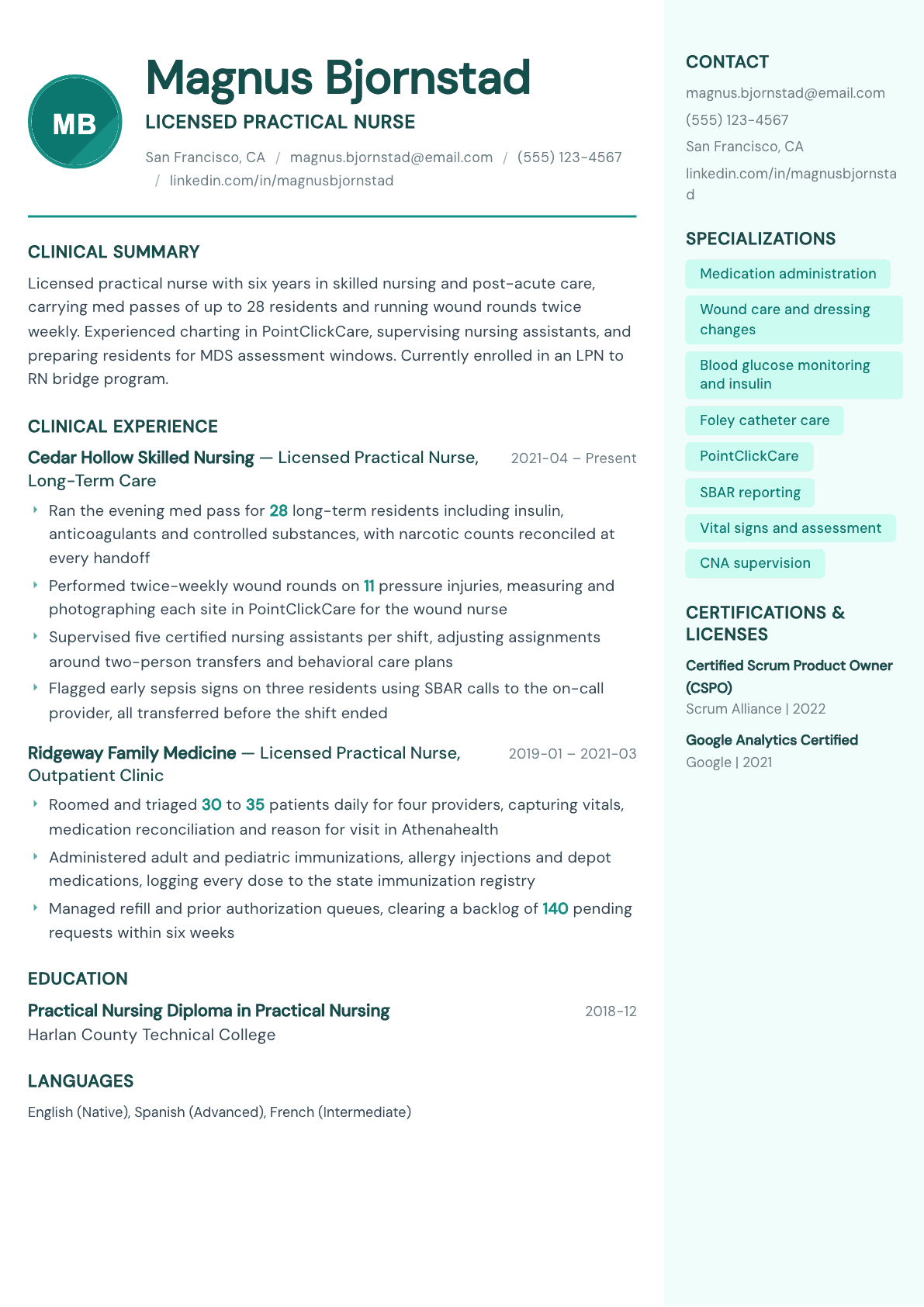
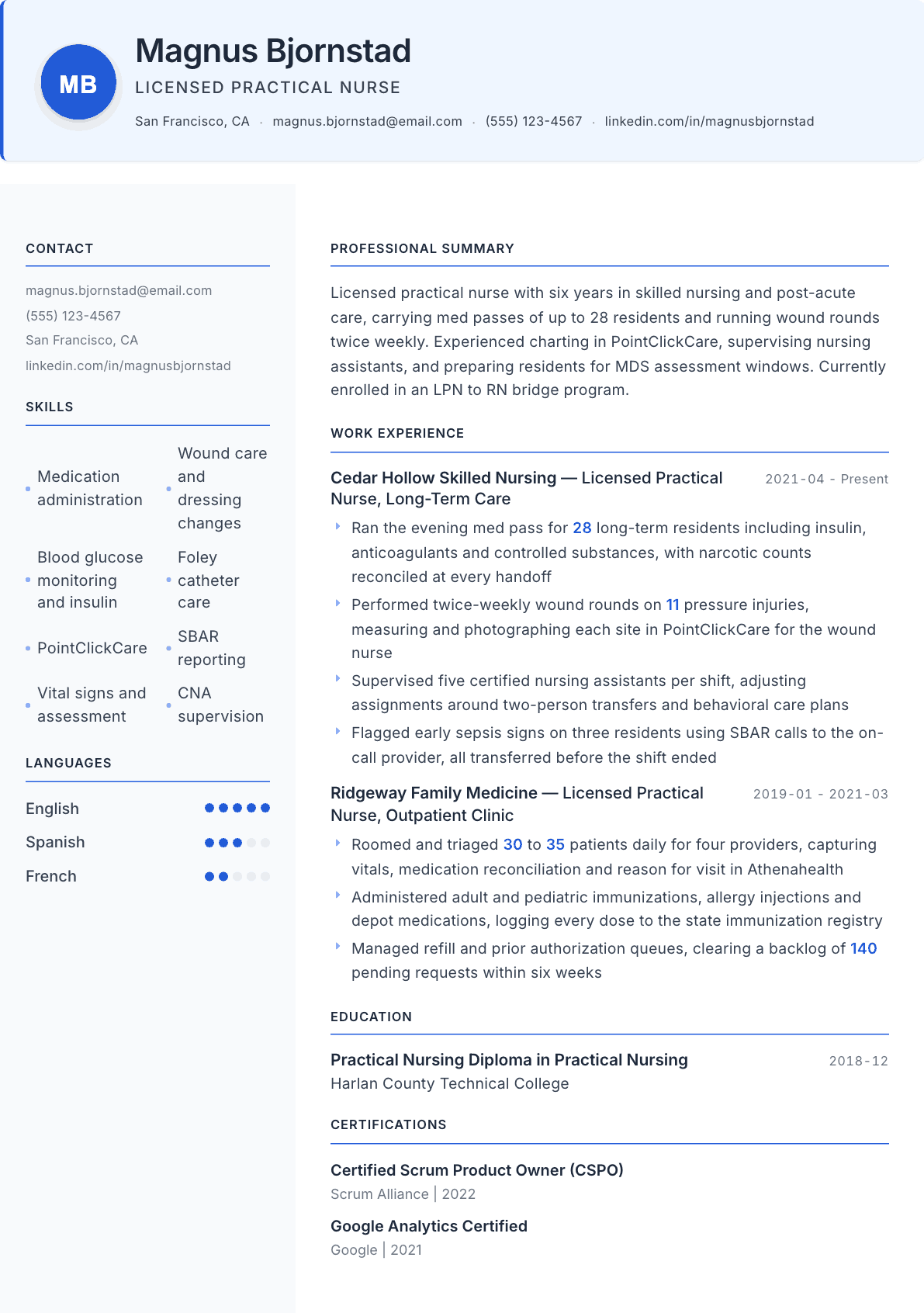
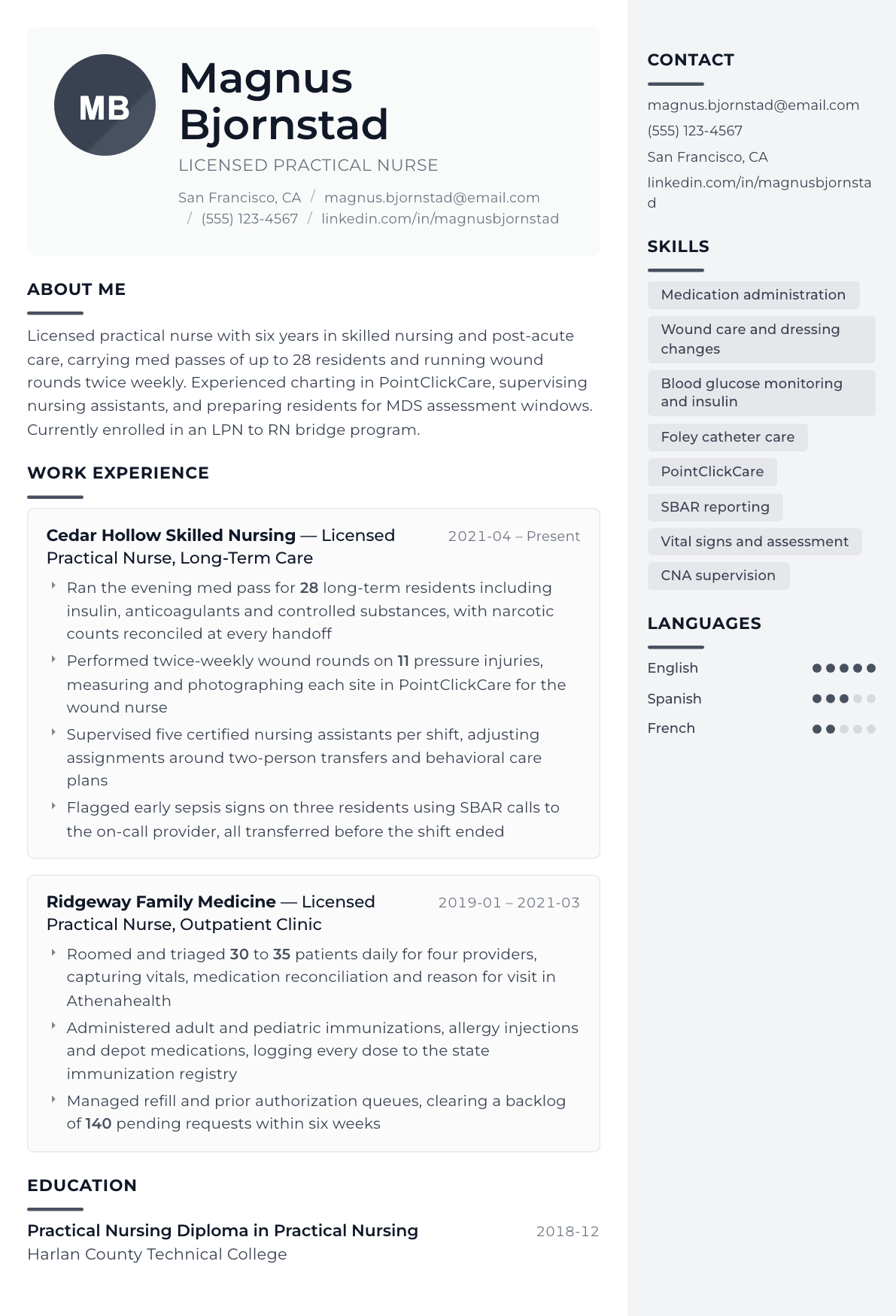
The same licensed practical nurse content laid out in three CVBooster templates, so you can see what the finished document looks like before you write a word.
Example Licensed Practical Nurse summary
Licensed practical nurse with six years across skilled nursing and outpatient primary care. Comfortable carrying a 28-resident med pass, running wound rounds, and supervising a five-aide team on evenings. Certified in IV therapy and wound care, fluent in PointClickCare charting, and known for calling early on residents who are turning. Seeking a subacute rehab unit with a strong preceptor structure.
Skills to list on a Licensed Practical Nurse resume
- Medication administration
- Wound care
- Insulin and blood glucose monitoring
- Foley catheter insertion and care
- Tracheostomy care
- Enteral feeding
- Vital signs monitoring
- IV therapy
- Specimen collection
- PointClickCare
- MatrixCare
- SBAR communication
- Resident care planning
- Infection control
- CNA supervision
- Narcotic counts and documentation
What actually gets this resume read
- Name your state license and whether you hold IV therapy certification, because scope of practice for LPNs changes at every state line.
- Give the resident or patient count you carried on a med pass; a manager reads that number before she reads anything else.
- List the charting system by name, whether it is PointClickCare, Epic, Cerner or MatrixCare, since facilities screen for it directly.
- Show supervision of nursing assistants if you have it, with the number of aides and the shift you led.
- Separate long-term care, rehab, clinic and correctional experience clearly, because those settings hire on very different rhythms.
- If you are in an LPN to RN bridge program, put the expected completion date in the education section rather than hiding it.
How to write a licensed practical nurse resume
A licensed practical nurse (LPN) resume is judged on scope before anything else. The director of nursing reading it wants to know which state licensed you, whether that state lets you start IVs, hang piggybacks or push certain medications, and how many residents you have carried on a single med pass. Two LPNs with identical years of experience can be qualified for completely different work depending on the state line they trained behind.
The second thing the reader checks is setting. Skilled nursing, subacute rehab, assisted living, a family practice clinic, home health, dialysis and corrections all hire LPNs, and the day looks nothing alike across those settings. A resume that says only "provided nursing care to patients" forces the reader to guess, and busy hiring managers do not guess, they move to the next file.
This guide covers the licensed practical nurse resume objective with five written examples, the header, the license block, the experience section, the skills list and the questions LPNs ask when they sit down to write, with example summaries for a new graduate, a mid-career nurse and someone with charge and supervisory duty.
Licensed practical nurse resume objective, LPN summaries and duty bullets
A practical nurse resume needs an objective only when the reader cannot guess what you want: a new graduate, a move between settings, a step up from aide work, or a return to nursing. Otherwise use a summary. A good licensed practical nurse resume objective is two lines with three parts: the license and its state, the setting and shift you want, and the one thing you bring that shortens your orientation. Seeking a challenging position contains none of the three. These five LPN objectives for a resume each name the license, the setting and what you bring.
New graduate objective: Newly licensed practical nurse with a long term care clinical rotation, seeking a day shift LPN role on a skilled nursing unit where I can grow my med pass speed and wound care skills under a strong charge nurse.
Changing settings objective: LPN with four years in skilled nursing, seeking a clinic role in family practice where my injections, vitals and patient teaching experience carry straight across.
Returning to nursing objective: Licensed practical nurse returning after time at home, with an active license and a completed refresher course, seeking part time work in assisted living.
Aide to nurse objective: Licensed practical nurse, newly licensed in Ohio after three years as a certified nursing assistant on the same rehab unit, seeking an evening LPN position where I already know the residents, the charting system and the routines.
IV certified objective: Licensed practical nurse with Florida licensure and IV therapy certification, seeking a subacute or infusion role where IV starts, line care and antibiotic administration are part of the daily assignment.
LPN nursing resumes change with the setting more than with the years. A skilled nursing summary leads with the resident count and the med pass, a clinic summary leads with injections and patient teaching, and a home health summary leads with independent visits and documentation.
Skilled nursing summary: LPN on a thirty bed rehab and long term care unit, running the med pass and treatments for half the hall on day shift and directing three nursing assistants.
Clinic summary: LPN in a busy pediatric practice, rooming patients, giving vaccines and teaching parents about follow up care between provider visits.
Home health summary: LPN making five to six home visits a day for wound care, medication setup and vital signs, charting each visit at the point of care and reporting changes to the RN case manager.
For the licensed practical nurse job description on a resume, start from what the role covers and add the numbers that are yours. The bullets below are one long term care LPN entry, written the way a director of nursing reads it.
- Complete the med pass for 24 residents on a skilled nursing unit within the scheduled window, including insulin and crushed medications.
- Perform wound care, dressing changes and tube feedings to the treatment orders, and document each in the electronic record.
- Take vital signs and assessments, and report changes in condition to the RN supervisor and the physician by phone.
- Direct four certified nursing assistants on the unit, assigning residents and checking that care is charted.
- Admit new residents, reconcile their medications and update care plans with the interdisciplinary team.
Header and license block: state, number, expiration, IV certification
Put your credential after your name the way a facility writes it, so "Danielle Okafor, LPN". Directly under the contact line, give a licenses block: the state that issued the license, the license number if you are comfortable listing it, the expiration month, and whether you hold IV therapy certification. In several states an LPN may not initiate IV therapy without that separate certification, so its presence or absence changes which jobs you are eligible for.
In California and Texas the license is called licensed vocational nurse, so a resume for LVN roles uses the LVN title from the header down. Written out: Jordan Ellery, LVN, California license with number and expiration, IV therapy and blood withdrawal certified. List licensed practical nurse once in the summary too, because postings and tracking systems use the two titles interchangeably.
- Name and credential, city and state, phone, email.
- Licenses: state, expiration, IV therapy certification if held.
- Sections in order: summary, licenses and certifications, experience, education, skills.
- New graduates place education above experience and add clinical rotation sites.
Summary: setting, resident load, and one thing you carry alone
Three lines is enough. Name the setting, the years, the size of the assignment you handle, and one duty that is genuinely yours: the treatment cart, the wound rounds, the admission paperwork, the insulin sliding scales, the narcotic count. A licensed practical nurse who says she runs a 28-resident evening med pass and supervises five aides has told the reader more in one sentence than a paragraph of adjectives would.
Experience: the census, the cart, the aides you direct
Every job needs the facility type, the census or panel size, and the shift. "Evening shift, 60-bed long-term care unit, 28-resident med pass" is a line a director of nursing understands instantly. Follow it with three to five bullets that describe the work only your setting produces.
In long-term care that means the med pass volume, the treatment cart, wound measurement and photography, controlled substance counts, MDS assessment support, and the number of certified nursing assistants you direct. In a clinic it means patients roomed per day, immunizations given, triage protocols, refill and prior authorization queues, and the electronic record. In home health it means visits per day, driving radius, OASIS documentation support and skilled visit notes.
LPN and LVN resume skills: the keyword section that gets you screened in
List clinical skills first: medication administration, insulin and blood glucose monitoring, wound care and dressing changes, Foley catheter care, tracheostomy care, enteral feeding, specimen collection, and IV therapy if certified. Then name the charting system exactly as the facility would: PointClickCare, MatrixCare, Epic, Cerner, Athenahealth. Long-term care recruiters filter on those product names because a nurse who already knows the system needs a shorter orientation.
Leave soft skills out of the list and prove them in the bullets instead. "Compassionate" in a skills column is a claim. A bullet about calling a provider at three in the morning on a resident who was quietly turning is evidence.
LVN resume skills are the same clinical list under a different license title, mirrored to the posting: clinic postings ask for rooming, injections, immunizations, EKGs, point of care testing and prior authorizations, while skilled nursing postings ask for med passes, treatments and admissions. In California, IV therapy and blood withdrawal are a separate certification, so list it on its own line only if you hold it. Below is a skills block written out for an invented LVN moving from skilled nursing into a clinic.
- Clinical: medication administration for 24 residents per med pass, insulin and blood glucose monitoring, wound care and dressing changes, intramuscular and subcutaneous injections, immunizations, EKG, specimen collection.
- Credentials: LVN, California, active; IV therapy and blood withdrawal certified; BLS.
- Systems: PointClickCare, Epic, e-prescribing refill queues.
- Scope proof, placed in the experience bullets rather than the list: directed 3 nursing assistants per shift, took report and called providers with SBAR updates.
Practical nursing resume: program, clinicals, bridge and credentials
Give the practical nursing program, the school and the completion date. If you are partway through an LPN to RN bridge, put the program, the school and the expected completion month in the education section. Facilities that pay tuition want to see it, and hiding it only creates an awkward conversation later.
A practical nursing resume written straight out of school has no nursing job to lean on, so the program does the work. Put the license block first, with NCLEX-PN passed or the scheduled test month, then an education entry that lists each clinical rotation with the setting, the hours and what you did there. Earlier jobs as a nursing assistant, a medication aide or in a hospital kitchen go below that, each with one line on the patient contact or pace it gave you.
Certifications belong in their own block near the top rather than buried at the bottom. Wound care, IV therapy, dementia practitioner training and gerontology coursework all make a licensed practical nurse more employable in post-acute settings, which is where most LPN hiring happens.
- Clinical rotation line: Long-term care rotation, 90 hours, assigned four residents per shift, passed oral medications under instructor supervision and completed dressing changes.
- Preceptorship line: Final preceptorship on a rehabilitation unit, 120 hours, carried a partial assignment with my preceptor and charted in the facility electronic record.
- Earlier job line: Nursing assistant for two years in an assisted living community, vitals, transfers and meal support for up to 18 residents on evenings.
Licensed Practical Nurse resume summary examples
New graduate
Newly licensed practical nurse with clinical rotations across long-term care, medical-surgical and a rehabilitation unit, including a 120-hour preceptorship on a 60-bed skilled nursing floor. Trained in med pass, wound dressing changes and glucometer use, charted in PointClickCare, and seeking a post-acute role with structured orientation.
Six years in
Licensed practical nurse with six years in skilled nursing and outpatient primary care. Runs a 28-resident evening med pass, owns twice-weekly wound rounds on 11 pressure injuries, and directs five nursing assistants per shift. IV therapy certified, fluent in PointClickCare, and currently enrolled in an RN bridge program.
Charge LPN
Charge licensed practical nurse with eleven years in post-acute care, the last four running the evening shift on a 90-bed building: assignments, admissions, narcotic reconciliation and family calls. Certified in wound care and IV therapy, trained twelve new nurses on the treatment cart, and supports the MDS coordinator through assessment windows.
Work experience bullets: before and after
Before: Passed medications to residents on the unit.
After: Ran the evening med pass for 28 long-term residents including insulin, anticoagulants and controlled substances, with narcotic counts reconciled at every handoff.
The resident count and the drug classes tell a director exactly how heavy your cart is, which "passed medications" never does.
Before: Provided wound care as needed.
After: Performed twice-weekly wound rounds on 11 pressure injuries, measuring and photographing each site in PointClickCare for the wound nurse to review.
Frequency, wound count and the documentation path turn a routine phrase into a repeatable process you owned.
Before: Worked with nursing assistants.
After: Directed five certified nursing assistants per shift, adjusting assignments around two-person transfers, behavior care plans and meal supervision needs.
Naming the number of aides and what you adjusted for shows supervision rather than proximity.
Before: Noticed changes in resident condition and told the nurse.
After: Identified early sepsis signs in three residents through vital sign trending and mental status change, and escalated by SBAR to the on-call provider before the end of shift.
The specific finding and the escalation method demonstrate the clinical judgment a facility is actually buying.
Before: Helped with clinic paperwork and phone calls.
After: Managed refill and prior authorization queues for four providers, clearing a backlog of 140 pending requests within six weeks and holding same-week turnaround afterward.
A volume and a result convert administrative filler into a measurable contribution.
Hard skills
- Medication administration
- Insulin and blood glucose monitoring
- Wound care and dressing changes
- Foley catheter care
- Tracheostomy care
- Enteral and gastrostomy feeding
- IV therapy
- Specimen collection
- Vital signs and focused assessment
- PointClickCare and MatrixCare charting
- Controlled substance counts
- Resident care plan documentation
Soft skills
- Directing nursing assistants
- SBAR escalation
- Family updates
- Time management on a heavy cart
- De-escalation with confused residents
- Handoff accuracy
Certifications worth listing
- Basic Life Support (BLS) (American Heart Association)
- IV Therapy Certification (State board of nursing)
- Wound Care Certified (WCC) (National Alliance of Wound Care and Ostomy)
- Certified Dementia Practitioner (CDP) (National Council of Certified Dementia Practitioners)
- Certified Registered Nurse Infusion (CRNI) (Infusion Nurses Certification Corporation)
Mistakes that cost licensed practical nurse candidates the interview
- Leaving the licensing state and IV certification off the page, which makes scope of practice impossible for the reader to judge.
- Writing "provided quality resident care" instead of the med pass size, the treatment cart and the aides you directed.
- Using the same resume for a skilled nursing job and a family practice clinic, when those readers want opposite evidence.
- Omitting the charting system, when many post-acute recruiters screen on PointClickCare or MatrixCare experience by name.
- Burying an in-progress RN bridge program at the bottom, or leaving it off entirely out of fear it signals you will leave.
- Listing every in-service you ever attended, which pushes the license block and the real clinical work onto a second page.
Licensed Practical Nurse resume questions
Should I write LPN or LVN on my resume, and do LVN resume skills differ?
Use the title your license carries, then mention the other once in the summary or skills line. Texas and California license vocational nurses, most other states license practical nurses, and recruiters search both acronyms. The skills are the same clinical list: medication administration, glucose monitoring, wound care, injections and your charting system, plus any IV certification your state requires.
What should LPN nursing resumes include?
A license block with state, number and expiration, a summary or objective naming the setting, then experience with your resident or patient load, the med pass, treatments, the aides you direct and the systems you chart in. Use an objective only if you are new, changing settings or returning to nursing.
How do I write a practical nursing resume as a new graduate?
Lead with the license block and NCLEX-PN status, then your practical nursing program with each clinical rotation, its hours and the tasks you performed. Add earlier care jobs below with patient numbers. The license number itself is optional, but the issuing state and expiration month are not.
How do I write a resume for an LVN job?
Use LVN in the title line and license block, because California and Texas license under that name and their postings search for it. Then follow the same order as any practical nursing resume: license with state, number and expiration, IV certification, a summary naming setting and patient load, experience bullets with med pass size and treatments, and a skills section built from the posting. If you directed aides without a charge title, say how many and on which shift.
What if my experience is mostly assisted living rather than skilled nursing?
Lead with the transferable clinical volume: med passes, treatment carts, glucose monitoring, wound checks, and how many residents you covered alone at night. Then name any subacute or rehab clinical hours, agency shifts or float experience that shows higher acuity.