Personal Care Assistant Resume Examples: free ATS score
Craft a Personal Care Assistant Resume That Gets Called
By Mustafa Tarabya, founder of CVBooster · Published · Updated
Personal care assistant resume example with shift detail, client support tasks, agency keywords and a section by section guide to writing it well.
Sample resumes for a personal care assistant
The same personal care assistant content laid out in three CVBooster templates, so you can see what the finished document looks like before you write a word.
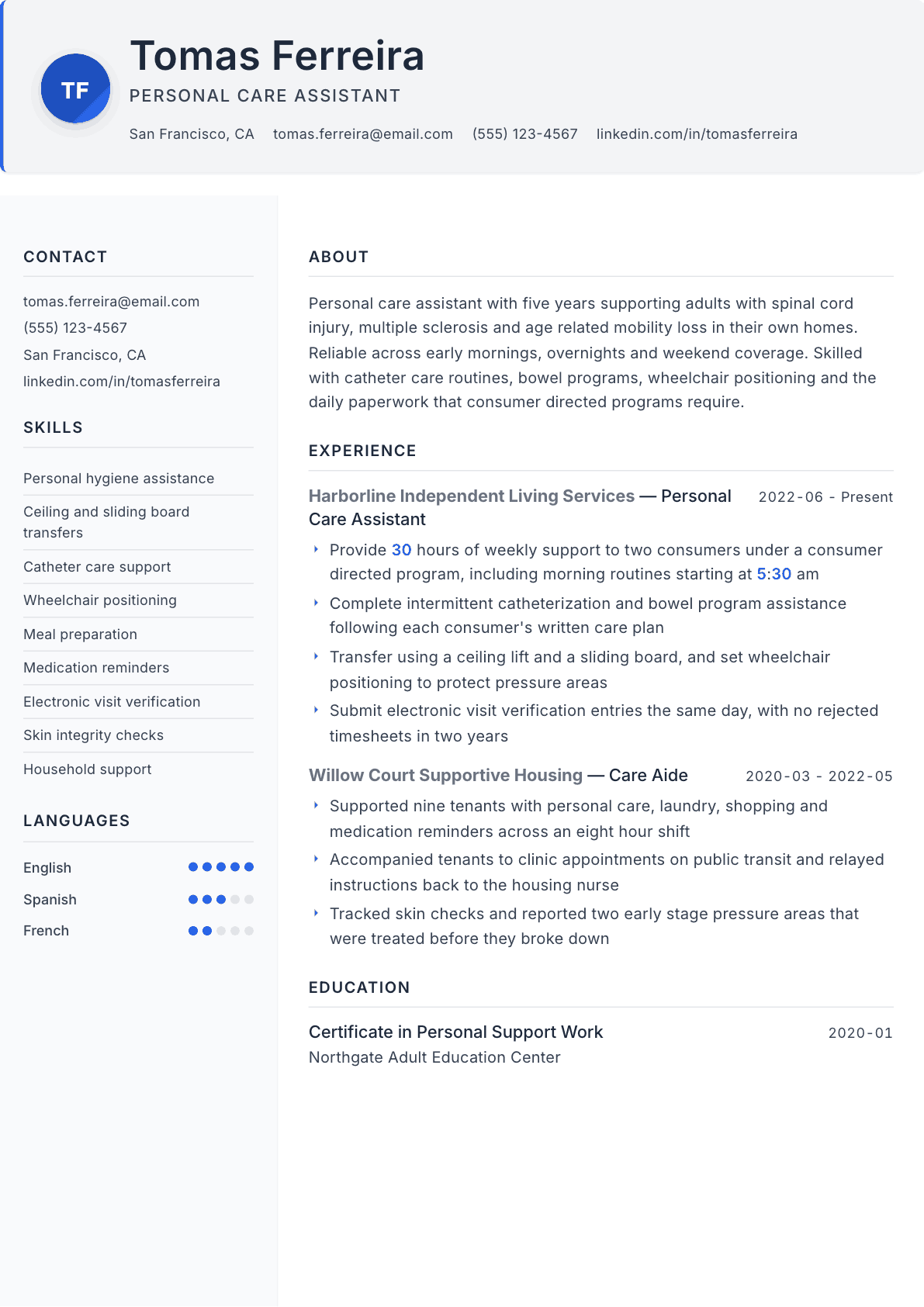
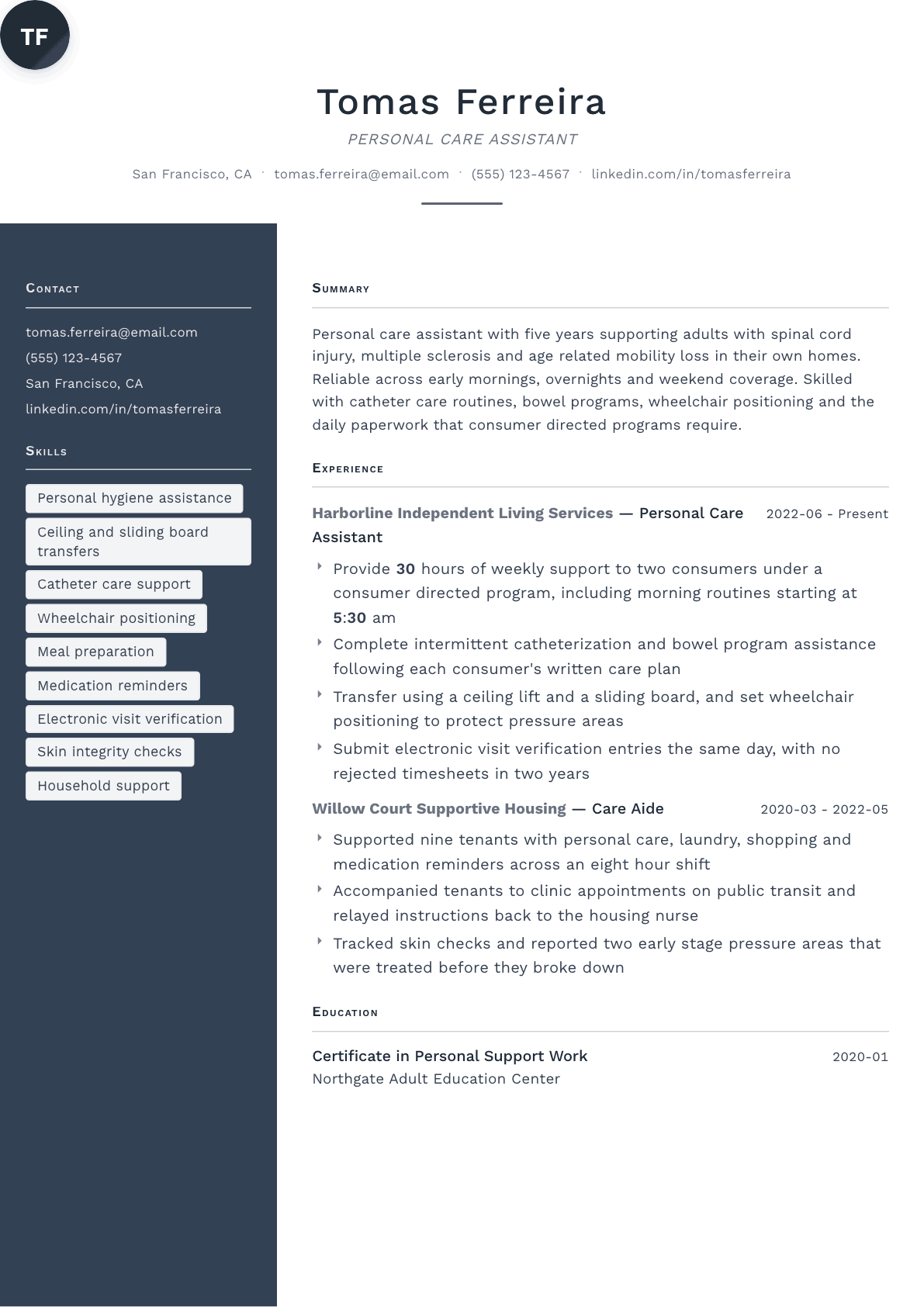
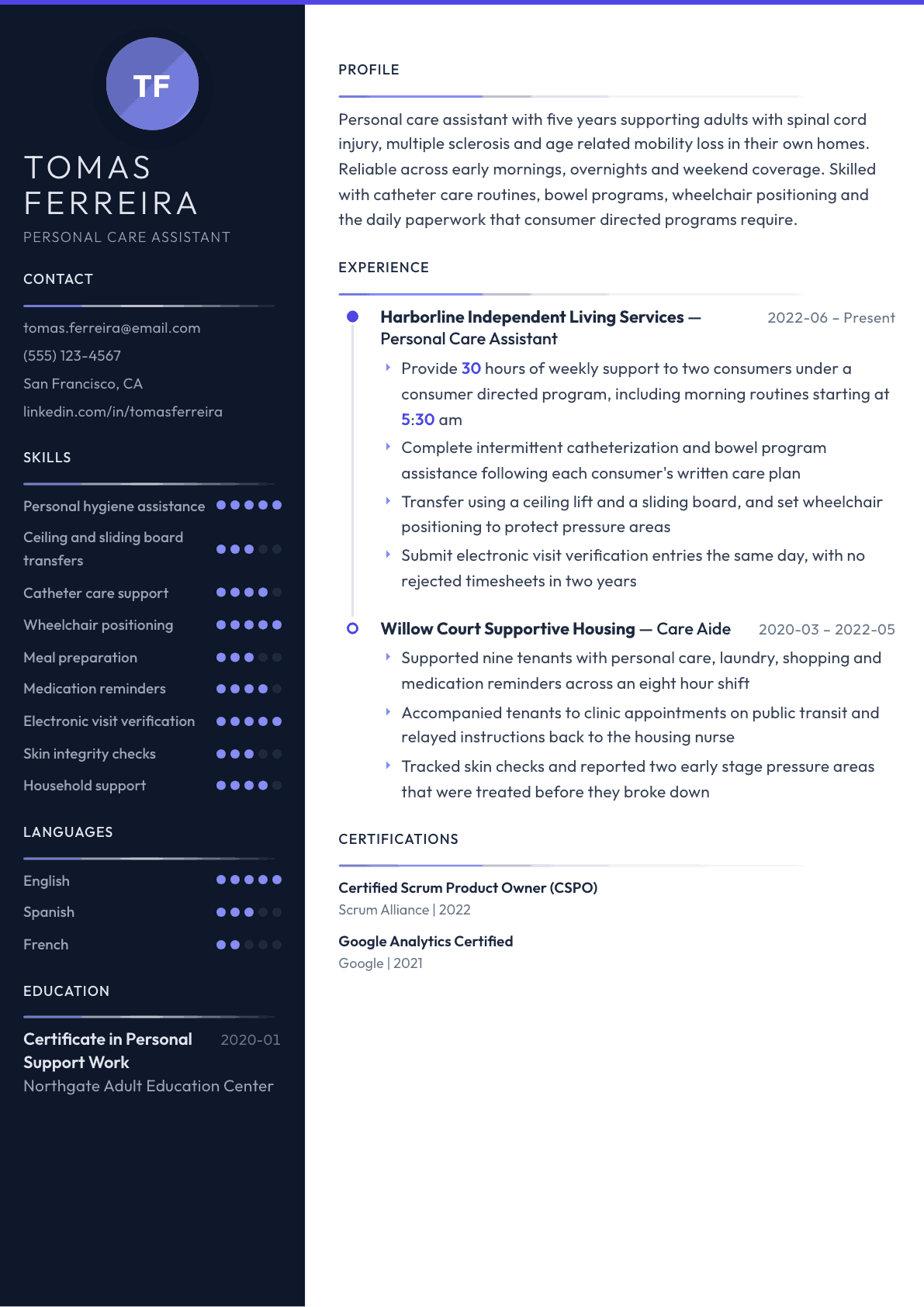
Example Personal Care Assistant summary
Personal care assistant with five years of one to one support for adults with physical disabilities in home and supportive housing settings. Confident with mechanical lift and sliding board transfers, catheter routines and pressure area prevention. Available for early mornings, overnights and weekends, with a clean record on visit verification and a habit of reporting small changes before they become medical problems.
Skills to list on a Personal Care Assistant resume
- Activities of daily living support
- Mechanical lift transfers
- Catheter and bowel program assistance
- Wheelchair and positioning support
- Personal hygiene and grooming
- Meal preparation and feeding support
- Medication reminders
- Range of motion exercises
- Skin integrity monitoring
- Light housekeeping and laundry
- Community and appointment escort
- Electronic visit verification
- Care plan documentation
What actually gets this resume read
- Open with the populations you support, because agencies match assistants to disability type before anything else.
- Give your real availability in a line near the top: overnights, split shifts, weekends and how far you travel.
- List the equipment you use by name, from ceiling lifts and transfer boards to shower chairs and manual wheelchairs.
- Show that you follow a written care plan exactly, since consumer directed programs audit that behavior.
- Name the visit verification or scheduling system you have used, because clean timesheets matter to every agency payroll.
- Keep client details anonymous, describing the support rather than names, ages or addresses of the people you serve.
How to write a personal care assistant resume
Personal care assistant hiring is a matching problem, not a ranking problem. The coordinator reading your file has a specific consumer with a specific routine, a specific lift, a specific start time and a specific personality. She is not looking for the best applicant in the pile. She is looking for the one whose skills and schedule fit the person she has to cover.
That changes how the resume should be built. Instead of generic care language, it needs the disability populations you have supported, the equipment you have used, the procedures you assist with, and your genuine availability down to the hour. A file that reads as a menu of what you can be assigned to gets called. A file that reads as a personality description does not.
Below is the structure that home care agencies, independent living centers and consumer directed programs expect, with example summaries at three stages, before and after bullets from real support work, and the questions personal care assistants ask when they update the file.
Format: one page, availability block, no decoration
A single page in reverse chronological order, plain headings, no columns. Under your contact line add an availability block: the days and hours you can work, whether you take overnights or split shifts, whether you drive and how far you travel, and whether you can cover on short notice. Coordinators build schedules from this, so it belongs above your work history.
Follow it with a short populations line naming the disability groups you have supported: spinal cord injury, cerebral palsy, multiple sclerosis, muscular dystrophy, traumatic brain injury, age related mobility loss. Those words drive the match more than anything else on the page.
- Header: name, city, phone, email, availability, driving and vehicle status.
- Sections: summary, populations supported, certifications and clearances, support experience, skills, training, languages.
- First time applicants lead with training hours and any volunteer or family support work, dated honestly.
Summary: population, level of support, hours carried
Three lines that answer who, how much, and when. Name the populations, the number of consumers you supported at once, the weekly hours you carried, and the level of physical support required. A consumer who needs full assistance for transfers, hygiene and feeding is a different assignment from one who needs cueing and household help, and the coordinator has to know which you are used to.
If you have worked under a consumer directed or self directed program where the consumer is your employer, say so. That model requires taking direction precisely from the person you support, and agencies treat prior experience with it as a real qualification.
Experience: routines, procedures, equipment, timing
Each entry needs the program or employer, the setting, how many consumers, and the shift pattern with start times. Early morning routines that begin before six and overnight repositioning schedules are hard shifts to fill, and saying you have covered them puts you at the front of the list.
Write bullets around the actual routine. Personal hygiene and dressing with the level of assistance. Procedures you assist with under a written plan: intermittent catheterization, bowel programs, ostomy care, ventilator or cough assist support, tube feeding, suctioning. Equipment by name: ceiling track lift, portable lift, sliding board, standing frame, power and manual wheelchairs, shower commode chair. Household and community support including cooking, cleaning, shopping, appointment escort and transit.
Include a bullet on following the written care plan exactly. Consumer directed programs are audited, and an assistant who works from the plan rather than from habit is what a coordinator is quietly checking for.
Certifications, clearances and payroll reliability
Group your certificate, CPR and first aid with the issuing organization, tuberculosis screening, background clearance and driver license into one block near the top. Add any state registry number if your program uses one. These are hard requirements, and putting them in one place saves a round of verification email.
Then add a line most applicants never think to include: your record with visit verification and timesheets. Programs are paid on those records. An assistant whose entries are submitted on time and rarely rejected is genuinely easier to employ, and saying so plainly is not boasting, it is useful information.
Skills, languages and the keywords the software matches
Postings in this field repeat a narrow vocabulary: activities of daily living, instrumental activities of daily living, transfers, personal hygiene, meal preparation, medication reminders, mobility assistance, care plan, and the name of the visit verification system. Mirror those exact phrases once in the skills list and once inside a bullet where the work is shown.
Finish with languages spoken and read, and any communication methods you have used with nonverbal consumers, such as a letter board, a speech generating device or a personal sign system. Communication access is often the difference between a placement that lasts and one that ends in a week.
Personal Care Assistant resume summary examples
New to personal care
Personal care assistant with 60 hours of completed training in transfers, personal hygiene and infection control, plus eighteen months supporting a family member with multiple sclerosis through daily routines and appointments. CPR certified, driving with own vehicle, available for early mornings and weekends.
Three years in home support
Personal care assistant supporting two consumers with spinal cord injury for a combined 32 hours a week, including 5:30 am start routines, intermittent catheterization assistance and ceiling lift transfers. Works from each written care plan, submits verification entries the same day, and covers holiday shifts on request.
Seven years and training peers
Senior personal care assistant with seven years across consumer directed programs and supportive housing, covering ventilator dependent, bariatric and complex bowel program cases. Trains new assistants on safe lift technique and plan fidelity, and has held two placements past three years each with no service interruptions.
Work experience bullets: before and after
Before: Assisted consumers with personal care.
After: Supported two consumers with full assistance for bathing, dressing, oral care and toileting across morning and evening routines totaling 32 hours a week.
The number of consumers, the level of assistance and the weekly hours turn a duty into a schedulable fact.
Before: Helped with transfers.
After: Performed transfers using a ceiling track lift and a sliding board, positioned the consumer in a power wheelchair with pressure relief tilts every two hours, and completed nightly repositioning per the plan.
Equipment names and the repositioning schedule show competence a coordinator can rely on without retraining.
Before: Assisted with medical routines.
After: Assisted with intermittent catheterization and a scheduled bowel program exactly as written in the care plan, using clean technique and logging each step for the supervising nurse.
Naming the procedures and the plan fidelity is what separates a personal care assistant from a companion.
Before: Kept track of my hours.
After: Submitted electronic visit verification entries at the end of every shift for two years with no rejected timesheets, and flagged schedule conflicts to the coordinator before they affected coverage.
Payroll reliability is a hiring criterion in this field, so state it with a record attached.
Before: Communicated with the consumer.
After: Communicated with a nonverbal consumer using a letter board and an eye gaze device, and learned his personal signals for pain, temperature and repositioning within the first two weeks.
Showing the communication method proves you can build a working routine with someone who cannot direct you verbally.
Hard skills
- Activities of daily living assistance
- Ceiling and portable lift transfers
- Sliding board and pivot transfers
- Intermittent catheterization assistance
- Bowel program support
- Ostomy and skin care support
- Wheelchair positioning and pressure relief
- Range of motion exercises
- Meal preparation and feeding assistance
- Medication reminders
- Electronic visit verification systems
- Care plan documentation
Soft skills
- Taking direction from the consumer
- Punctuality on early shifts
- Discretion in someone else's home
- Patience through slow routines
- Clear escalation to the supervising nurse
- Consistency over long placements
Certifications worth listing
- CPR and First Aid (American Red Cross)
- Basic Life Support (BLS) (American Heart Association)
- Certified Nursing Assistant (CNA) (State nurse aide registry)
- Home Health Aide Certification (State health department registry)
- Personal Care Aide Training (State approved training provider)
Mistakes that cost personal care assistant candidates the interview
- Omitting the availability block, which makes the coordinator guess whether you can take the shift she needs covered.
- Describing support in general terms without naming the lift, the wheelchair or the procedure you actually assisted with.
- Leaving out the disability populations you know, which is the single strongest matching signal in this field.
- Presenting yourself as a companion when the posting is for hands on physical support, or the reverse.
- Skipping the certification and clearance block, so an agency cannot start onboarding without chasing paperwork.
- Overstating scope by claiming clinical procedures you are not permitted to perform, which ends the process at reference check.
Personal Care Assistant resume questions
What is the difference between a personal care assistant and a home health aide?
A personal care assistant focuses on daily living support and follows the consumer or a written plan, often in self directed programs. A home health aide usually works under nurse supervision in a certified agency and may carry additional clinical tasks. Requirements differ by state.
Should I list the hours I am available on my resume?
Yes, near the top. Coordinators fill specific shifts, so knowing you can start at half past five in the morning or cover Sunday overnights moves you ahead of applicants whose availability has to be discovered through a phone call.
How do I write about a consumer without breaking confidentiality?
Describe the support, never the person. Write the diagnosis category, the equipment and the routine, and leave out names, ages, addresses and family details. That keeps the resume professional and gives the reader everything useful.
Do I need to be certified to work as a personal care assistant?
It depends on the program and state. Many consumer directed programs require only a background check and short orientation, while agency and Medicaid funded positions often require an approved training certificate. List every training you have finished, certified or not.
How do I show reliability if my placements were short?
Give the reason for each ending, such as a consumer moving into a facility or a program funding change, and highlight attendance instead. Consistent coverage of hard shifts and a clean verification record read as reliability even without long tenure.