Plant Operator Resume Examples: the lines they read
Build a Plant Operator Resume Around the Equipment You Run
By Mustafa Tarabya, founder of CVBooster · Published · Updated
Plant operator resume example, keyword list and writing guide covering boilers, turbines, SCADA rounds, shift logs and outage work.
Sample resumes for a plant operator
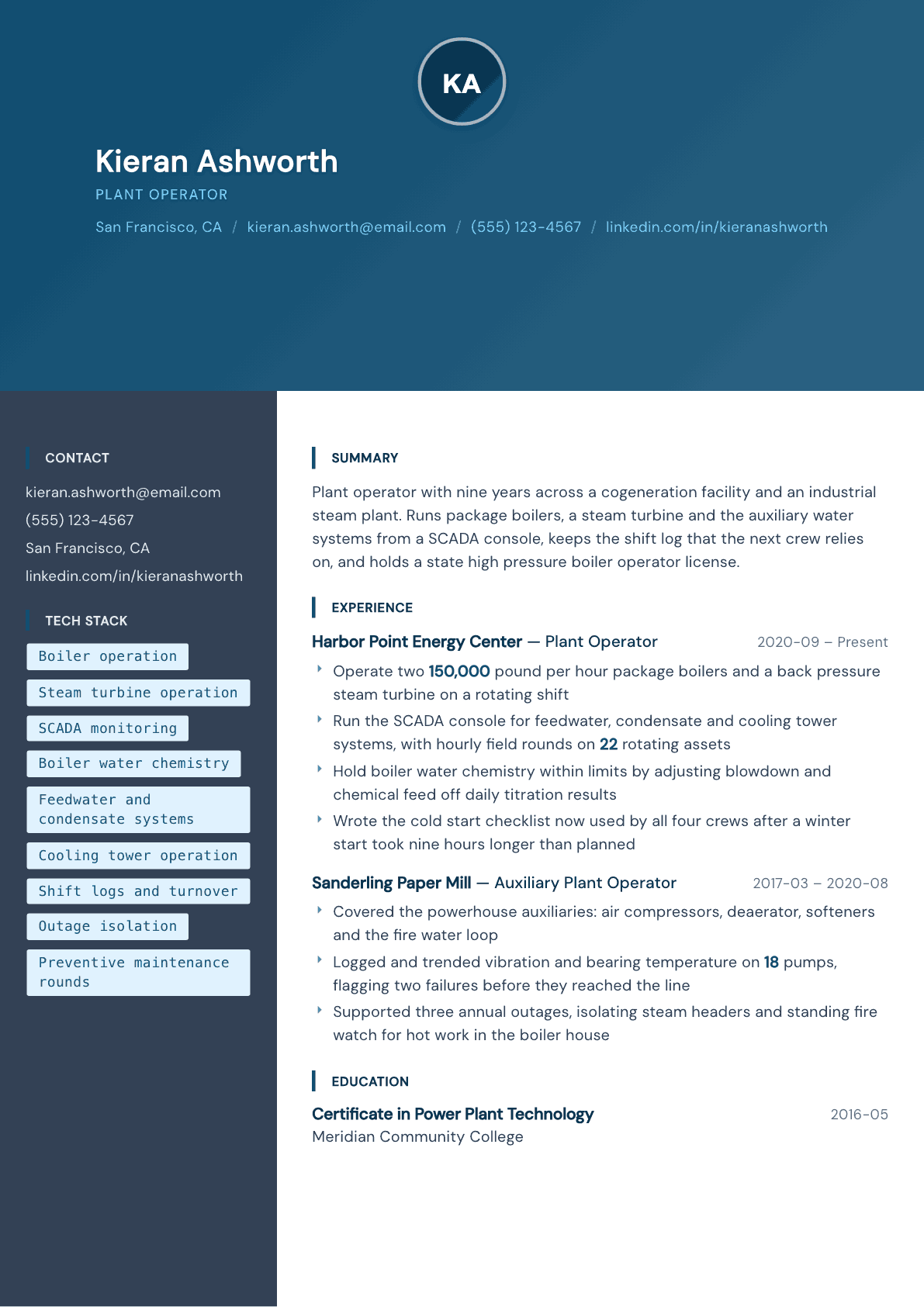
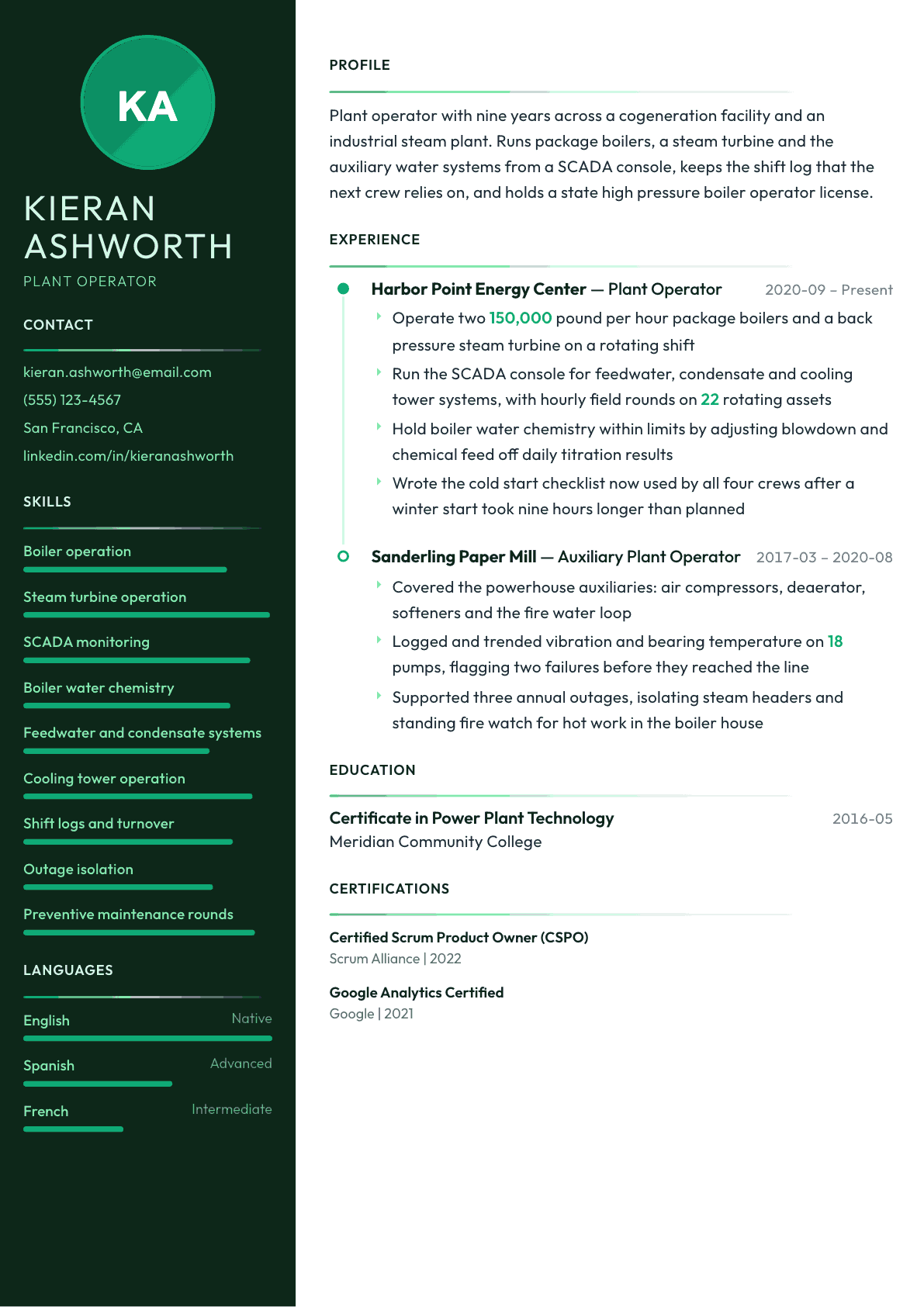
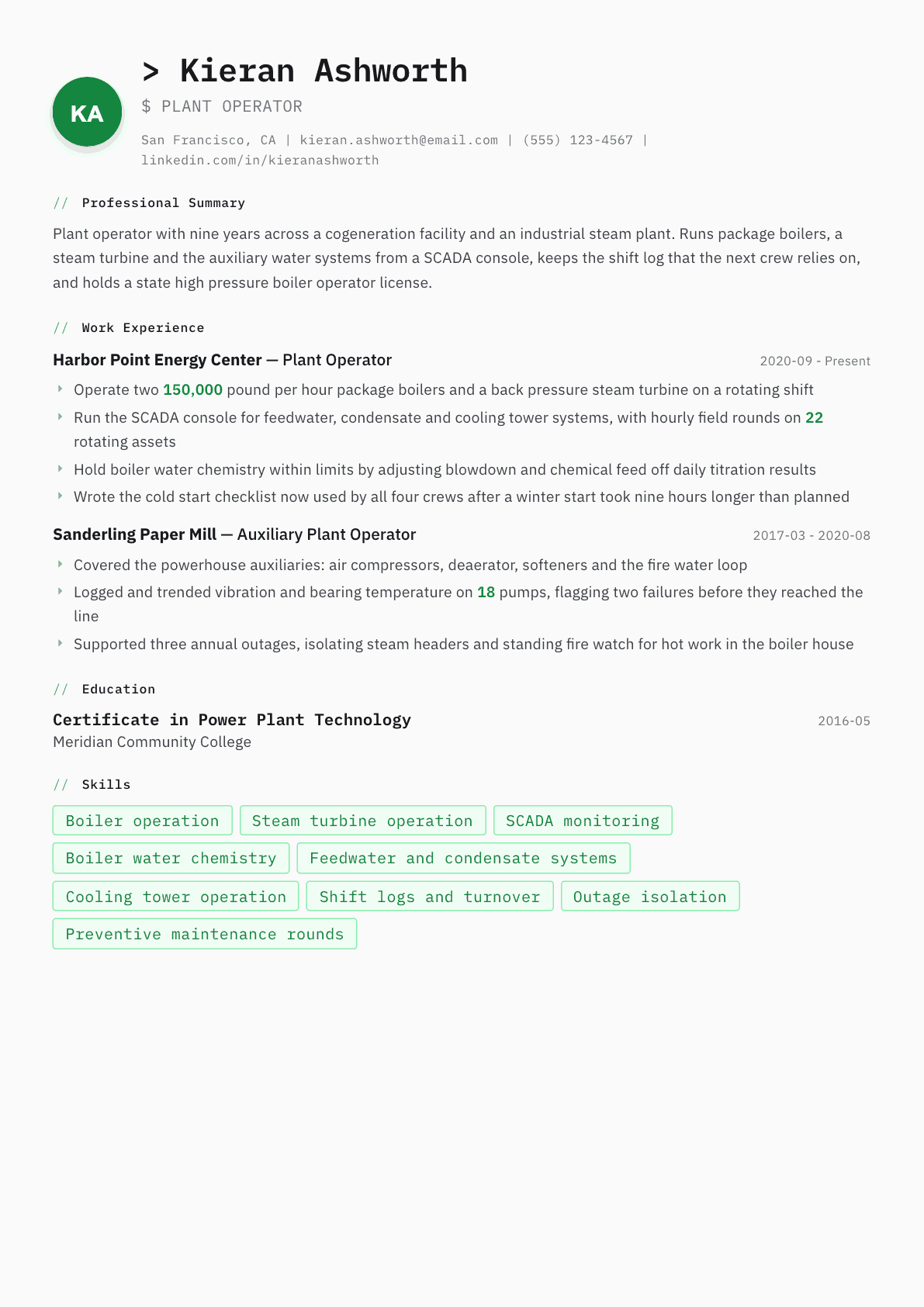
The same plant operator content laid out in three CVBooster templates, so you can see what the finished document looks like before you write a word.
Example Plant Operator summary
Plant operator with nine years across a cogeneration center and a mill powerhouse, licensed for high pressure boilers. Runs package boilers, a back pressure turbine and the full water side from a SCADA console, controls boiler chemistry off daily titrations, and has isolated steam headers for three annual outages. Wrote the cold start checklist the site now trains on, and is looking for a lead operator seat on a larger unit.
Skills to list on a Plant Operator resume
- Package and watertube boilers
- Steam turbine startup
- SCADA and HMI monitoring
- Water chemistry and blowdown control
- Deaerator and feedwater pumps
- Cooling tower and condenser operation
- Air compressor systems
- Chiller operation
- Valve lineups and isolation
- Shift turnover documentation
- Preventive maintenance rounds
- Vibration and temperature trending
- Emergency shutdown procedures
- Fire watch and hot work support
- Outage planning support
What actually gets this resume read
- State the plant type first, because a cogeneration operator and a water plant operator answer to different regulators.
- Give boiler capacity, turbine size or throughput so a hiring supervisor can size your experience in one line.
- Name your operator license, the issuing state and the class, then keep the renewal date next to it.
- Describe the shift pattern you have worked, since twelve hour rotating nights weeds out more candidates than skill does.
- Include one cold start or emergency shutdown you ran, with what you saw and the order you did things in.
- Mention outage work explicitly, because plants recruit for outages months before the outage begins.
How to write a plant operator resume
Plant operator is one of those titles that means five different jobs depending on the site. At a cogeneration facility it means boilers and a turbine. At a paper mill it means the powerhouse auxiliaries. At a manufacturing site it can mean the compressed air, chilled water and steam that everything else depends on. The first job of your resume is to say which one you are.
The reader is normally a shift supervisor or a chief engineer who has to staff a rotating roster and keep an insurance inspector happy. He looks for equipment names and capacities, an operator license if the jurisdiction requires one, and evidence that you can be trusted alone on nights. Adjectives do none of that work.
What follows is the structure that gets a plant operator resume read: how to open, how to describe equipment at a scale a supervisor recognizes, how to write about outages, and how to answer the questions that come up when operators move between plant types.
Format: plant type, capacity and license in the first block
Reverse chronological, one page for most operators. Plant hiring runs on verifiable facts, so the top of the page belongs to the plant type you have run, the headline capacity of the equipment, and any operator or engineer license with the state and class attached.
Keep a separate equipment block. A supervisor reading quickly wants to see boilers, turbines, chillers, compressors and pumps listed with their type and size, not scattered through prose. Where a jurisdiction sets license classes by pressure or horsepower, put those numbers next to the equipment so the match is obvious.
- Headline block for an operator: plant type, boiler or turbine capacity, control platform and license class with the issuing state.
- Order down the page: summary, equipment operated, plant experience, licenses and safety training, then technical schooling.
- Each employer entry names the facility type, what it supplies, the shift pattern and the crew size on nights.
- Keep an outage line for each site: the year, the equipment opened and what you isolated or returned to service.
Summary: the equipment, the license, the shift
Three lines is enough. Say what kind of plant, how long, what the largest equipment you have operated is, and what license you hold. Then add the thing that separates you from an operator with the same years, which is usually a start you have run alone or a system you rebuilt the procedure for.
Be honest about shift availability inside the summary if you are open to rotating nights. Plants filter hard on this, and an operator who volunteers it early tends to get a call before one who leaves it to the interview.
Experience: capacity, rounds and the fault you found first
Every job opens with a one line description of the facility: what it makes or supplies, the equipment set, the number of operators on shift and whether the plant runs continuously. That single line saves a supervisor from guessing at your scale.
Then write bullets that carry equipment capacity and operating decisions. Boiler output in pounds of steam an hour, turbine rating, chiller tonnage, compressor capacity and tank volumes all belong here. So does the water chemistry work, because a plant that has lost a boiler tube to poor chemistry treats that section as the real test of an operator.
The most persuasive bullet you can write is a failure you saw before it became an outage. Bearing temperature creeping, vibration rising, a pump losing suction, a conductivity spike after a condenser leak: name the reading, the action and the outcome.
- Facility line first, then three to five bullets per job.
- Include one bullet on water chemistry with the tests you run and the control you adjust.
- Include one bullet on a start, a trip recovery or an emergency shutdown you handled.
- Include one bullet on outage work with the equipment opened and the isolation you performed.
Logs, rounds and the paperwork an inspector reads
Shift logs are not clerical work in a plant, they are the record an insurance inspector and the next crew both depend on. If your logs were used to trend equipment condition, or if you rebuilt a round sheet so it caught something the old one missed, that is worth a bullet.
Say which computerized maintenance system you raise work orders in and how you prioritize them. An operator who writes a clear work order with the reading attached saves a mechanic a diagnostic trip, and a maintenance manager reading your resume knows exactly what that is worth.
Skills and keywords that survive the first filter
The vocabulary in plant operator postings is stable: boiler, turbine, chiller, compressor, deaerator, feedwater, condensate, cooling tower, SCADA, HMI, valve lineup, blowdown, lockout tagout, hot work, permit, rounds and turnover. Match the posting word for word once in your skills list and once inside a bullet.
List the licenses and cards separately from the skills. Boiler operator or stationary engineer license, refrigeration operating credentials, forklift and aerial lift authorization and first aid all belong in a block with the issuing body and the class. That block is what a compliance officer copies into the site file on your first day.
Plant Operator resume summary examples
New to the control room
Power plant technology graduate with a third class boiler operator license and 18 months as an auxiliary operator on compressors, softeners and the fire water loop. Trained in valve lineups, hazardous energy control and confined space entry. Ready for a full plant operator seat on rotating shifts.
Six years in
Plant operator with six years on package boilers and a back pressure turbine at an industrial steam plant, holding a second class state license. Runs cold starts alone, controls boiler chemistry from daily titrations, and has supported three annual outages including steam header isolation and hot work fire watch.
Lead operator
Lead plant operator with fourteen years across cogeneration and mill powerhouses, first class licensed, responsible for a four person crew on nights. Owns the cold start and trip recovery procedures, trends rotating equipment from round sheets, and has taken two boilers through internal inspection with no repeat findings.
Work experience bullets: before and after
Before: Operated boilers and other plant equipment.
After: Operated two package boilers rated at 150K pounds of steam an hour with a back pressure turbine, running the whole set from a SCADA console on a rotating shift.
Capacity plus equipment set plus control platform is exactly what a chief engineer screens on.
Before: Checked equipment during rounds.
After: Trended bearing temperature and vibration on 18 pumps through hourly rounds and flagged a failing boiler feed pump three weeks before it would have tripped the plant.
A round becomes evidence when it names the parameter, the asset count and the failure it caught.
Before: Handled water treatment for the boilers.
After: Held boiler water conductivity and alkalinity inside limits by adjusting continuous blowdown and chemical feed from daily titration results, with no tube failures across four years.
It names the tests, the control you move and the outcome an inspector cares about.
Before: Assisted with the yearly shutdown.
After: Isolated and tagged the main steam header for the annual outage, stood fire watch on boiler house hot work, and returned the plant to service on a written start sequence in under seven hours.
Outage scope with an isolation, a safety role and a return to service time reads as real accountability.
Before: Wrote up problems for maintenance.
After: Rewrote the cold start checklist after a winter start ran nine hours long, and trained all four crews on the revised sequence.
It turns a complaint into a fix you owned and rolled out to other shifts.
Hard skills
- Package and watertube boiler operation
- Steam turbine startup and loading
- SCADA and HMI console work
- Boiler water chemistry and blowdown control
- Deaerator and feedwater pump operation
- Cooling tower and condenser operation
- Air compressor and dryer systems
- Chiller and refrigeration plant operation
- Valve lineups and system isolation
- Hazardous energy control
- Shift log and turnover records
- Vibration and temperature trending
- Emergency shutdown and trip recovery
- Outage isolation and return to service
Soft skills
- Working alone on night shift without drift
- Clear handover to the incoming crew
- Staying calm through a trip
- Writing a work order a mechanic can act on
- Coaching an auxiliary operator through a start
Certifications worth listing
- Certified Power Engineer (National Institute for Uniform Licensing of Power Engineers)
- OSHA 30-Hour General Industry Outreach Training (Occupational Safety and Health Administration)
- Universal EPA Section 608 Technician Certification (United States Environmental Protection Agency)
Mistakes that cost plant operator candidates the interview
- Using the bare title "plant operator" with no facility type, so the reader cannot tell steam from water from gas.
- Leaving equipment capacities off the page, which makes a small plant and a large one look identical.
- Burying the operator license instead of putting the class and issuing state where a compliance officer sees it.
- Treating water chemistry as a background task rather than the control loop it actually is.
- Writing "assisted with outages" with no isolation, no equipment and no return to service detail.
- Omitting the shift pattern you can work, which is the constraint that ends most plant applications.
Plant Operator resume questions
Do I need a boiler operator license to apply?
It depends on the jurisdiction and the pressure of the equipment. Many states and cities require a class of license above a set boiler size, and some plants will hire you unlicensed on the condition you sit the exam within a year. Say which class you hold or are studying for.
How do I move from an industrial plant to a power plant?
Lead with the equipment that transfers: boilers, turbines, feedwater, cooling and compressed air behave alike whatever the plant makes. Then be explicit about what you have not run, such as a generator on the grid, because a chief engineer respects that more than a vague claim of coverage.
Should I include maintenance work on an operator resume?
Yes, if you performed it. Packing changes, filter swaps, valve repacking and basic instrument checks make you cheaper to staff on a small crew. Keep it clearly separate from operating duties so the reader can see which side of the line each task sat on.
What matters more, years or equipment size?
Equipment size and independence, usually. A supervisor cares whether you have held the plant alone on nights and what capacity you were responsible for. Ten years as a second operator who never ran a start is a weaker case than four years of independent coverage.
How should I present military engine room experience?
Translate every rating and system into civilian equipment names, then give the plant size in familiar units. Watchstanding, casualty control and preventive maintenance all map directly onto shift operation, and hiring supervisors value that background once they can read it.
Related resume examples
- Power Plant Operator Resume example
- Boiler Technician Resume example
- Plant Manager Resume example
- Process Operator Resume example
- Industrial Maintenance Technician Resume example
- Refinery Operator Resume example