Refinery Operator Resume Examples: the lines they read
A Refinery Operator Resume That Names Your Units
By Mustafa Tarabya, founder of CVBooster · Published · Updated
Refinery operator resume example with crude unit, hydrotreater and DCS keywords, plus a guide to proving turnaround and process safety work.
Sample resumes for a refinery operator
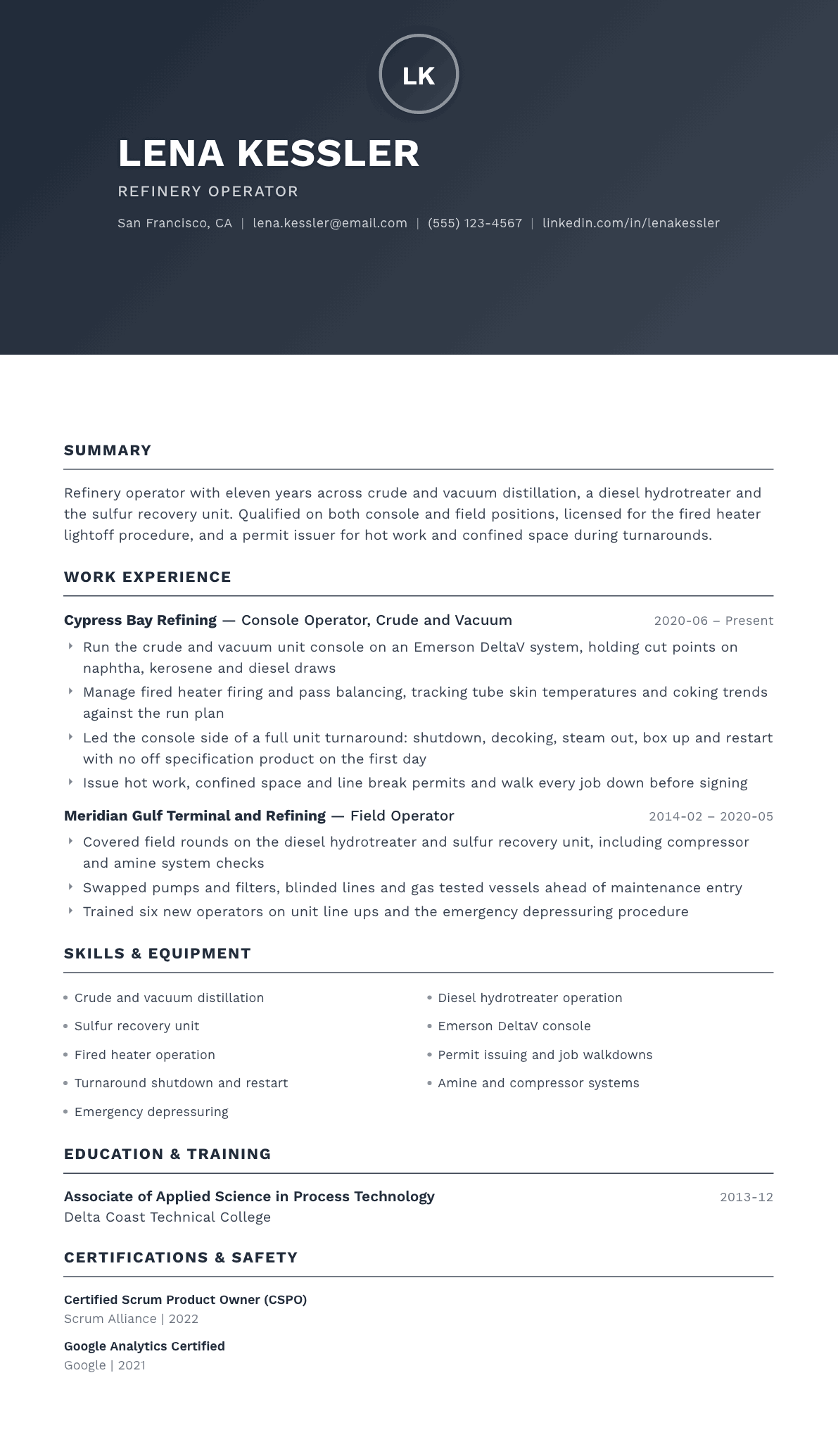
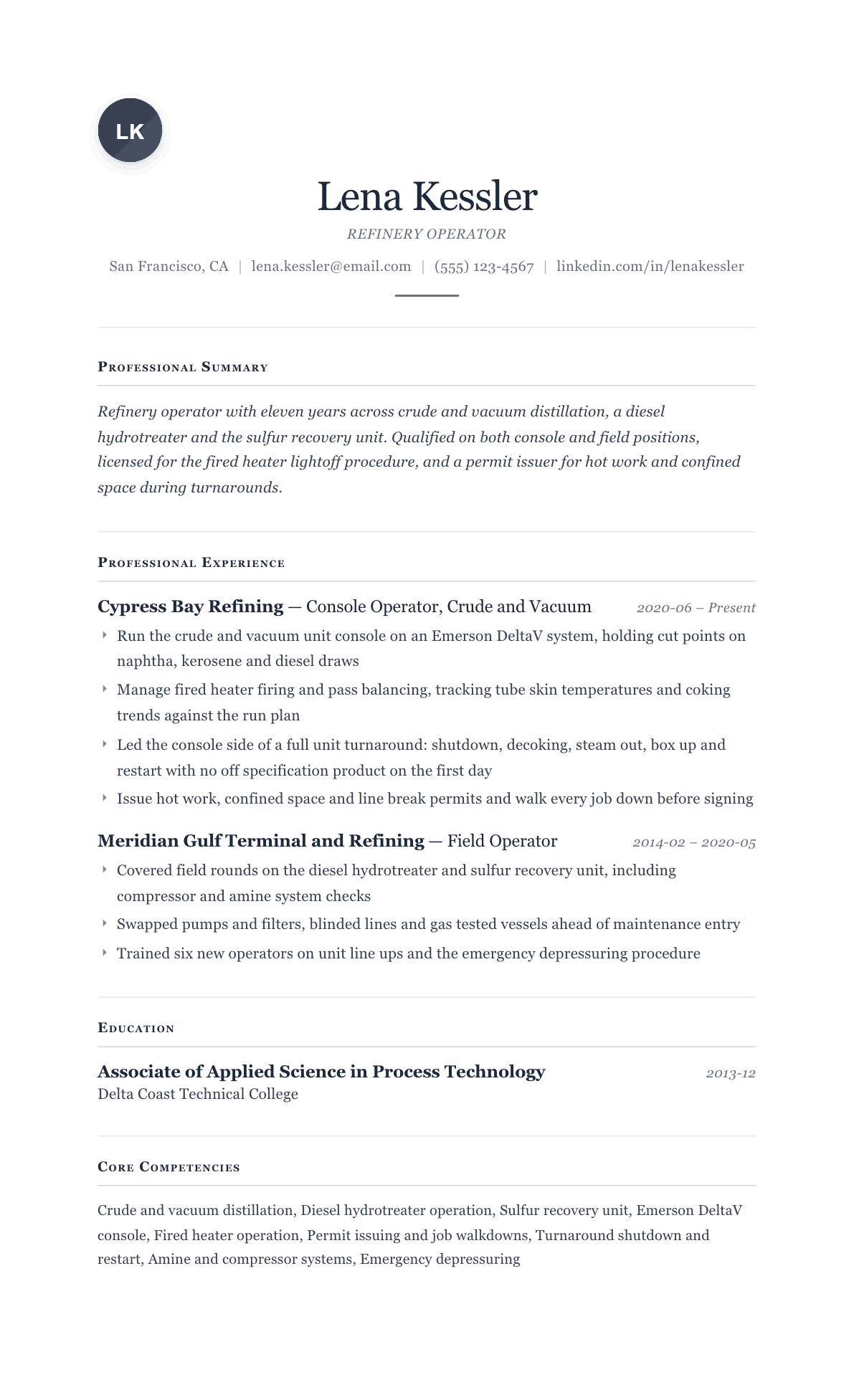
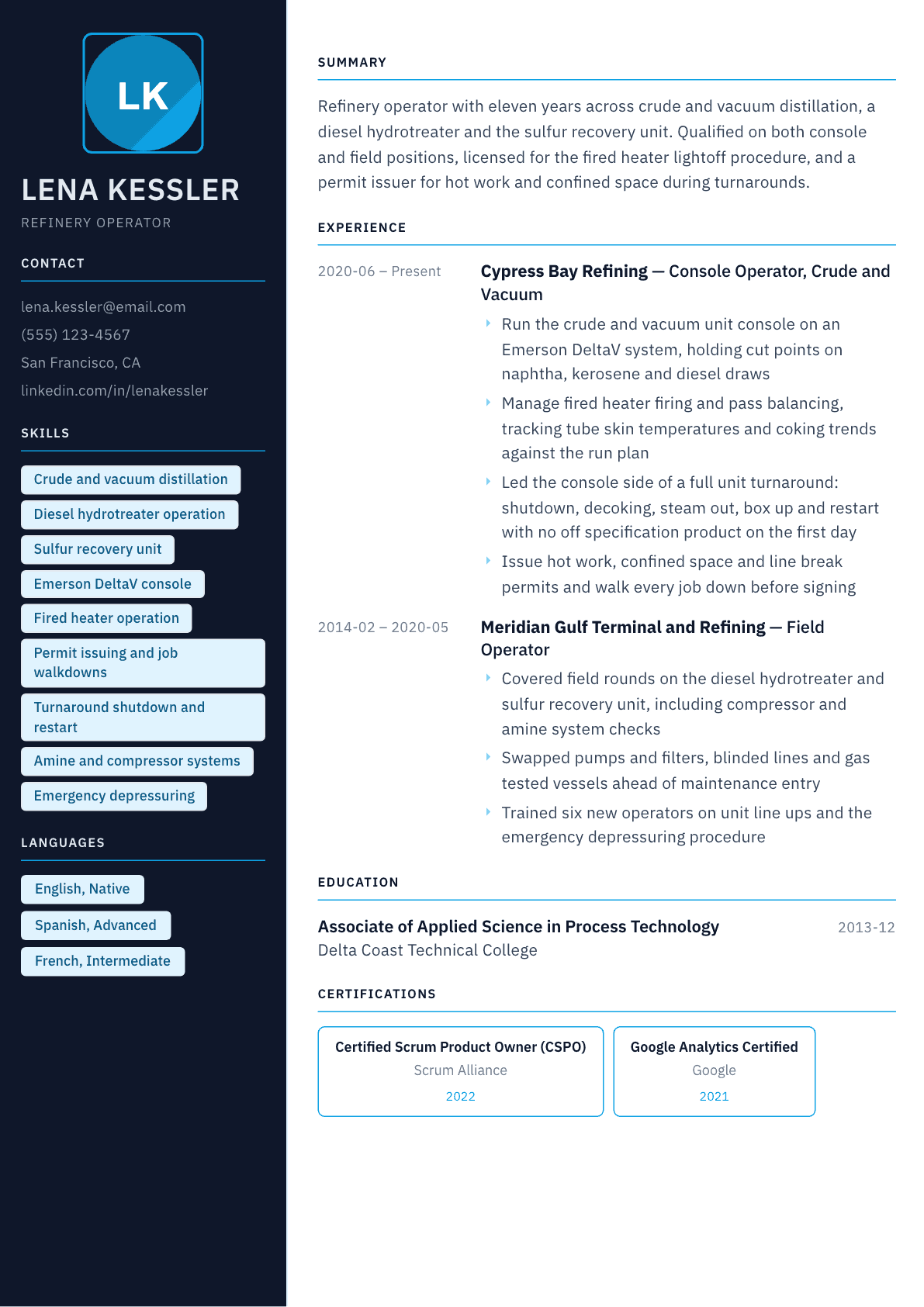
The same refinery operator content laid out in three CVBooster templates, so you can see what the finished document looks like before you write a word.
Example Refinery Operator summary
Refinery operator with eleven years across crude and vacuum distillation, a diesel hydrotreater and sulfur recovery, qualified on both console and field positions. Runs an Emerson DeltaV console, holds product cut points through crude slate changes, and manages fired heater firing against tube skin and coking trends. Led the console side of a full unit turnaround from shutdown through restart, and issues hot work, line break and confined space permits.
Skills to list on a Refinery Operator resume
- Crude and vacuum distillation
- Hydrotreating and hydrocracking units
- Catalytic reforming
- Fluid catalytic cracking support
- Sulfur recovery and amine treating
- Fired heater operation and lightoff
- Console operation on a DCS
- Advanced process control monitoring
- Field rounds and equipment checks
- Pump, compressor and exchanger swaps
- Permit to work issuing
- Turnaround shutdown and startup
- Emergency depressuring and flaring
- Process safety management elements
- Shift turnover documentation
- Operator training and qualification
What actually gets this resume read
- Name every unit you are qualified on, because a refinery hires against a specific board and a specific unit.
- Say whether you are a console operator, a field operator, or qualified on both positions.
- List the control system and any advanced control applications you run alongside it.
- Show turnaround work in detail: shutdown, decoking, box up, restart, and what you owned in each phase.
- Put permitting on the page, including hot work, line break and confined space, plus who signs behind you.
- Give your process safety training and any emergency response role you hold, such as fire brigade or rescue.
How to write a refinery operator resume
Refinery hiring runs on unit qualification. A refinery operator is not a general job title, it is a person signed off on a named position on a named unit, and the operations superintendent reading your resume is checking whether your qualifications overlap with the vacancy he has. Crude and vacuum, hydrotreating, reforming, cat cracking, alkylation, sulfur recovery, coking, utilities and the tank farm are separate worlds with separate boards.
The second thing he checks is whether you have been through the hard parts. A full turnaround with a shutdown, a decoke, a box up and a restart. A unit trip handled without an incident. A fired heater lightoff done to procedure. Anyone can describe steady state operation. What tells a superintendent about an operator is what happened when the unit was not steady.
This guide covers how to lay out unit qualifications so they can be matched to a vacancy, how to write console and field experience separately, how to present turnaround and process safety work, and how to make a page that survives a refinery's screening process before it ever reaches a human.
Format: a qualification matrix, then units, then employers
Two pages is normal here and nobody objects, because unit qualifications take room. Open with a qualification block that reads almost like a table: unit, position, console or field, and when you were last signed off. Anyone screening for a crude console vacancy will find you in seconds if you write it that way, and will miss you if it is buried in prose.
Next, describe the units themselves rather than your daily duties. Crude and vacuum with the charge rate range and the crude slates you have run. Hydrotreater with the feed and the treating severity. Sulfur recovery with the trains and the tail gas unit. Superintendents read those details as proof you were actually responsible rather than present.
- Contact line: name, phone, email, city, plus whether you hold a current TWIC and can pass a fitness for duty screen.
- Qualification block: every unit and position you are signed off on, with the sign off dates.
- Control system line: the DCS by vendor, plus any advanced process control you monitor and when you take it off.
- Experience: refinery, units covered, crude or feed slate, and what you owned on each shift.
- Safety block: process safety training, permit authority, emergency response team role and rescue training.
Console work: cut points, heaters and holding the plan
A console operator is running an economic plan, not just a safe unit. Write about it that way. Holding cut points on naphtha, kerosene and diesel draws through a crude slate change. Managing fired heater firing and pass balance, watching tube skin temperatures and coking trends against the run length the planners assumed. Keeping a hydrotreater at the severity that meets the sulfur target without wasting hydrogen or shortening a catalyst run.
Say what you do with advanced process control: when you run it, what you watch, and under what conditions you take it off and hand control back to the board. That single detail tells a superintendent whether you understand your tools or merely trust them.
Alarms and interlocks belong here too. Describe how you handle an alarm flood, how you prioritize during an upset, and any experience with alarm rationalization work. Refineries have spent years on that problem and an operator who can talk about it sensibly stands out immediately.
Field work: rounds, swaps and making the unit safe for maintenance
Field operators keep the unit physically honest. List the equipment you cover and what you actually do: pump and filter swaps, strainer cleaning, exchanger isolation, compressor and amine system checks, sampling with the right technique for the stream, blinding lines, gas testing vessels and steaming out ahead of entry.
Give the catches. A bearing you heard before the vibration monitor did, a seal weeping that you got onto a planned repair instead of a rate cut, a relief valve chattering that you reported before it lifted. Two or three of those on a page do more than a paragraph of self description.
Emergency response is often the field operator's second job. Say whether you are on the fire brigade, whether you are hazmat or rescue trained, what your role is in a unit emergency, and how often you drill. Refineries staff those teams from operations and it matters in hiring.
- Equipment types you cover on rounds and the checks you make on each.
- Isolation work: blinding, draining, purging, steaming and gas testing before entry.
- Sampling with the technique the stream requires and how the sample reaches the lab.
- Specific catches on rounds and what they saved the unit.
- Emergency response role, training held and drill frequency.
Turnarounds and unit events: the strongest section you have
Turnaround work is the most valuable thing on a refinery operator resume, so give it space. Describe the phases you owned: rate reduction and feed out, shutdown sequence, depressuring and flaring, steam out and nitrogen purge, decoking, blinding and handover to maintenance, then the reverse path through box up, tightness testing, purge, heater lightoff and the sequenced restart.
Say what the outcome was in operational terms. Restarting without off specification product on the first day, meeting the on stream date, or catching an error during box up before it became a leak on startup. Those results are what a superintendent uses to decide whether you would be useful on his next one.
Handle unplanned events with the same discipline: what tripped, what you did, and what the outcome was. Keep it factual and short. An operator who can describe a trip clearly and without blame reads as someone worth putting on a console.
Permits, training and how refineries screen
Permitting authority is a real distinction in refinery hiring. Say whether you issue hot work, line break and confined space permits, whether you walk the job down before signing, and whether you act as entry supervisor or gas tester. Add your lockout tagout role and any authorization level you hold.
Refineries screen resumes on hard vocabulary before a person sees them. Use the terms plainly and where they belong: crude unit, vacuum tower, hydrotreater, reformer, cat cracker, alkylation, sulfur recovery, amine treating, flare, relief system, cut point, tube skin, catalyst run length, on stream factor, turnaround, blind list, permit to work, process safety management, operator qualification. Name your process technology degree or your operator training program too, and any prior military or maritime engineering background, which refineries recruit from deliberately.
Refinery Operator resume summary examples
Trainee operator
Process technology graduate now in a refinery operator training program, working outside positions on a hydrotreater under a qualified operator. Makes rounds, takes samples, performs pump swaps and filter changes, and has completed confined space, lockout tagout and hydrogen sulfide awareness training.
Console qualified
Refinery operator with eleven years across crude and vacuum distillation, a diesel hydrotreater and sulfur recovery, qualified on both console and field positions. Runs an Emerson DeltaV console, holds cut points through crude slate changes, and manages fired heater firing against tube skin and coking trends.
Shift supervisor
Operations shift supervisor with twenty years, running a crew of fourteen across three units and holding permit authority for the area. Leads turnaround shutdown and restart from the shift side, qualifies new operators against the training matrix, and serves as incident commander until the emergency organization stands up.
Work experience bullets: before and after
Before: Operated refinery process units.
After: Ran the crude and vacuum unit console on an Emerson DeltaV system, holding cut points on naphtha, kerosene and diesel draws across changing crude slates and charge rates.
Naming the unit, the control system and the products makes the experience matchable to a specific vacancy.
Before: Monitored fired heaters.
After: Managed fired heater firing and pass balancing, tracking tube skin temperatures and coking trends against the run plan and adjusting excess oxygen to keep efficiency without risking the tubes.
The specific variables show heater knowledge, which is one of the highest risk areas an operator controls.
Before: Participated in a plant turnaround.
After: Led the console side of a full unit turnaround through shutdown, decoking, steam out, box up and restart, finishing with no off specification product on the first day back on feed.
Phases owned plus a measurable restart outcome make the turnaround claim concrete and checkable.
Before: Issued work permits.
After: Issued hot work, confined space and line break permits and walked every job down with the crew before signing, including gas testing and verifying isolation at the blind list.
The walkdown, gas testing and isolation verification describe real permit authority rather than a signature.
Before: Trained new operators.
After: Trained six new operators on unit line ups and the emergency depressuring procedure, signing them off against the qualification matrix only after a walked demonstration.
A count, the specific procedures and a demonstration standard show training with accountability behind it.
Hard skills
- Crude and vacuum distillation operation
- Hydrotreating and hydrocracking units
- Catalytic reforming
- Fluid catalytic cracking support
- Sulfur recovery and amine treating
- Fired heater operation and lightoff
- Console operation on a distributed control system
- Advanced process control monitoring
- Field rounds and equipment condition checks
- Pump, compressor and exchanger isolation and swaps
- Blinding, purging, steaming and gas testing
- Permit to work issuing and job walkdowns
- Turnaround shutdown, box up and restart
- Emergency depressuring and flare management
- Process safety management participation
Soft skills
- Prioritizing during an alarm flood without freezing
- Giving a turnover that leaves nothing for the next crew to discover
- Working alongside contractors without losing control of the unit
- Saying no to a rate push when the heater will not take it
- Staying disciplined on the twelfth hour of a night shift
Certifications worth listing
- Transportation Worker Identification Credential (Transportation Security Administration)
- HAZWOPER 40-Hour (OSHA Training Institute)
- OSHA 30-Hour General Industry (OSHA Training Institute)
- Certified Production Technician (Manufacturing Skill Standards Council)
Mistakes that cost refinery operator candidates the interview
- Writing refinery operator without listing the units and positions you are qualified on, which is how every vacancy is defined.
- Leaving out whether you are console qualified, field qualified or both, forcing a superintendent to guess.
- Skipping turnaround work, which is the clearest evidence of competence outside routine operation.
- Describing permits as a duty rather than saying whether you issue them and walk the job down first.
- Omitting the crude or feed slate and the charge rates, which hide the scale you actually operated at.
- Burying emergency response team membership at the bottom when refineries staff those teams from operations and value it highly.
Refinery Operator resume questions
How do I present unit qualifications that have lapsed?
List them with the dates and mark them as lapsed rather than dropping them. Requalification on a unit you have run before is far quicker than training from nothing, and a superintendent can factor that into his plan if you are straightforward about the status.
Does experience at a chemical plant transfer to a refinery?
A large part does, particularly distillation, fired equipment, compressors, permitting and process safety discipline. Emphasize those and be honest about the units you have not run, because refineries expect a training period and prefer candidates who scope it accurately.
How important is turnaround experience for a refinery job?
It is one of the strongest signals on the page. Shutdown and restart demand judgment that steady operation never tests, so describe the phases you owned and what happened at the end. An operator with two solid turnarounds often outranks one with more total years.
Should I include military or maritime engineering experience?
Yes, and translate it into process terms: boilers, turbines, pumps, valves, fuel systems, watchstanding, logs and casualty response. Refineries recruit steadily from those backgrounds because the discipline transfers, but the resume has to make the connection explicit.
What if I have only worked one unit my whole career?
Go deep on it instead of apologizing. Detail the operating windows, the upsets you handled, the turnarounds you worked and the procedures you helped revise. Depth on one unit reads as expertise, and most operators are hired against one specific board anyway.
Related resume examples
- Chemical Plant Operator Resume example
- Plant Operator Resume example
- Process Operator Resume example
- Power Plant Operator Resume example
- Production Operator Resume example
- Assembly Line Worker Resume example