Process Operator Resume Examples: the lines they read
Write a Process Operator Resume That Names Your Unit
By Mustafa Tarabya, founder of CVBooster · Published · Updated
Process operator resume example, keyword list and writing guide covering DCS panels, batch records, unit turnarounds and permit to work.
Sample resumes for a process operator
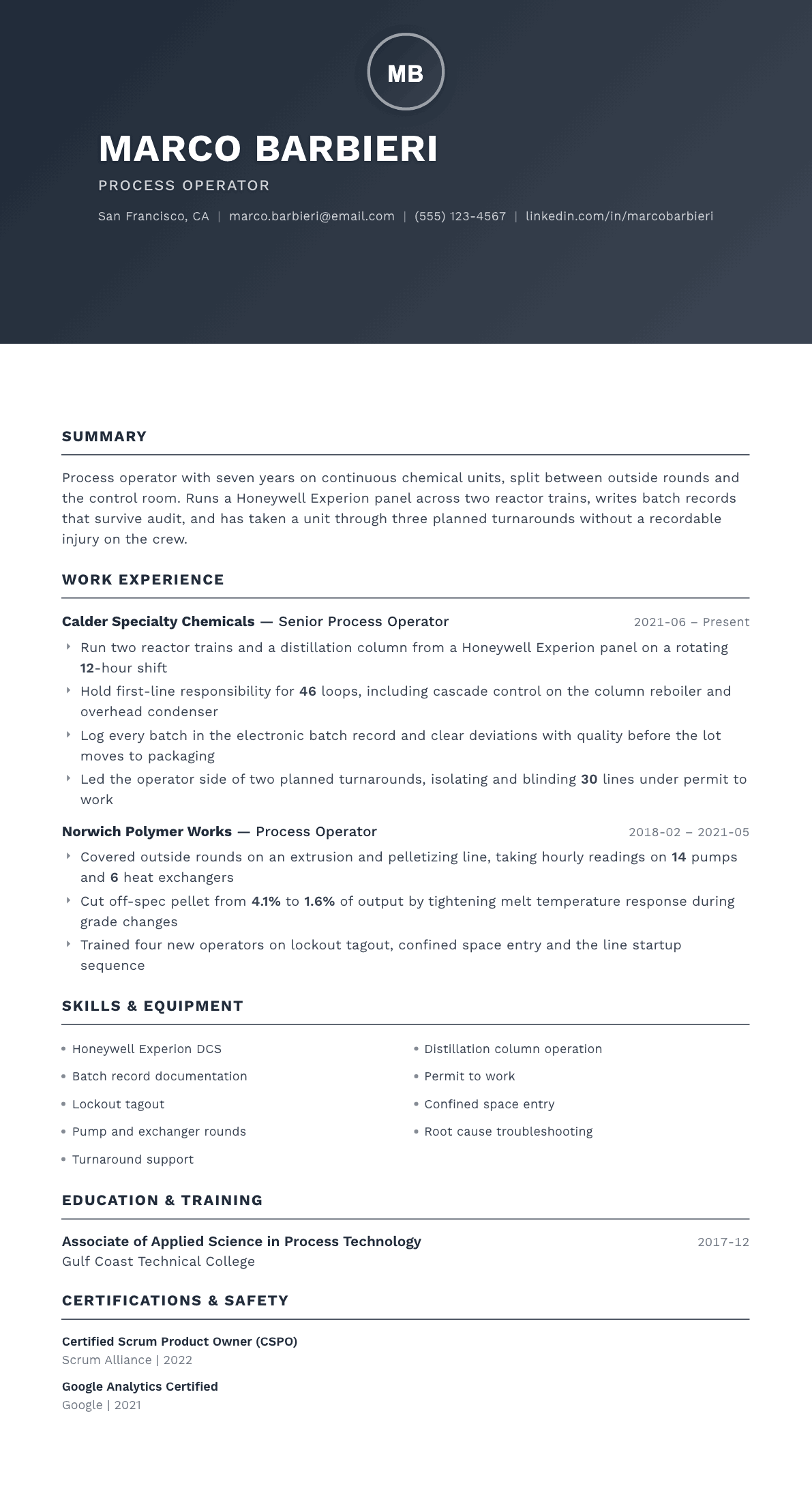
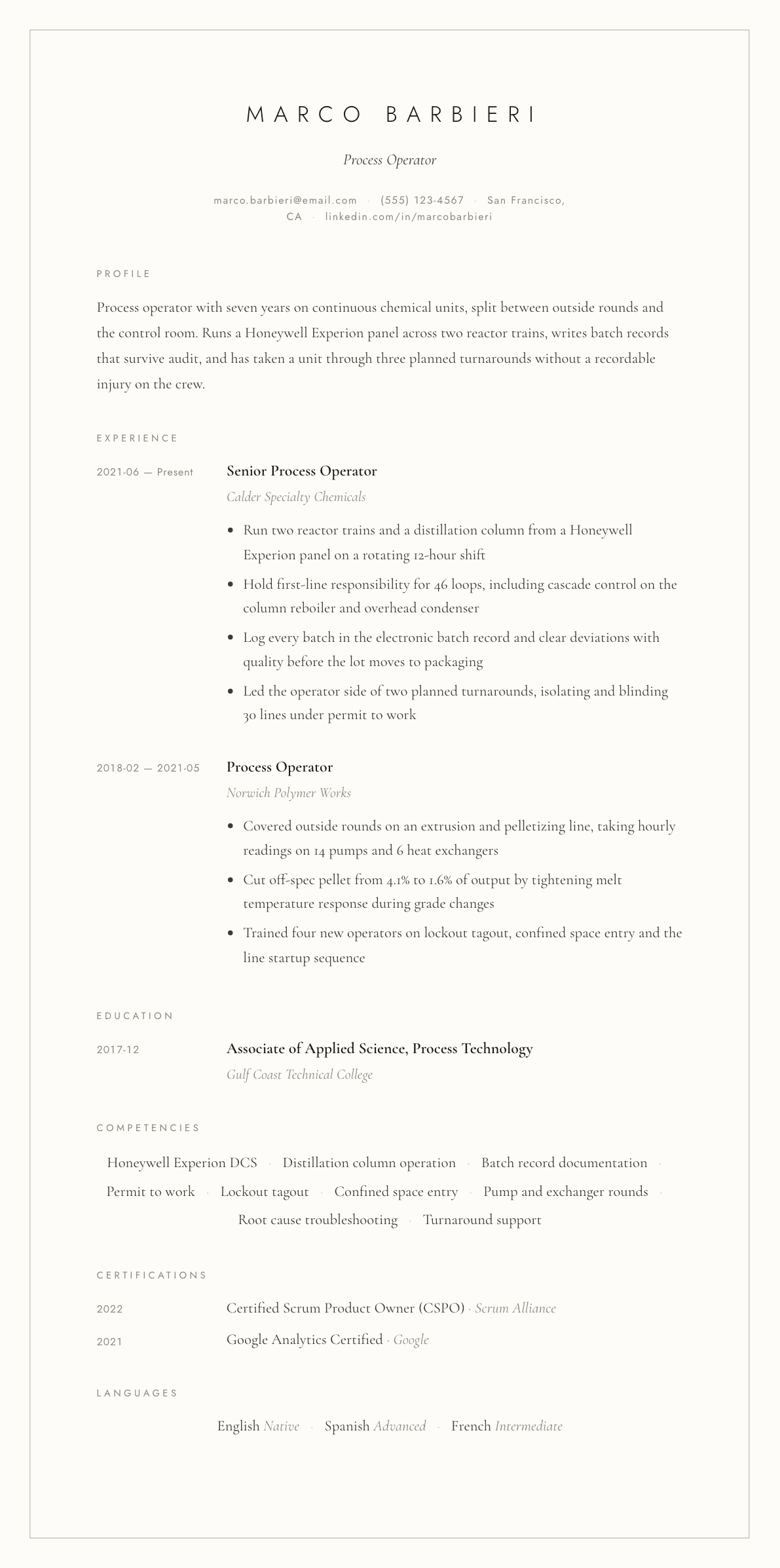
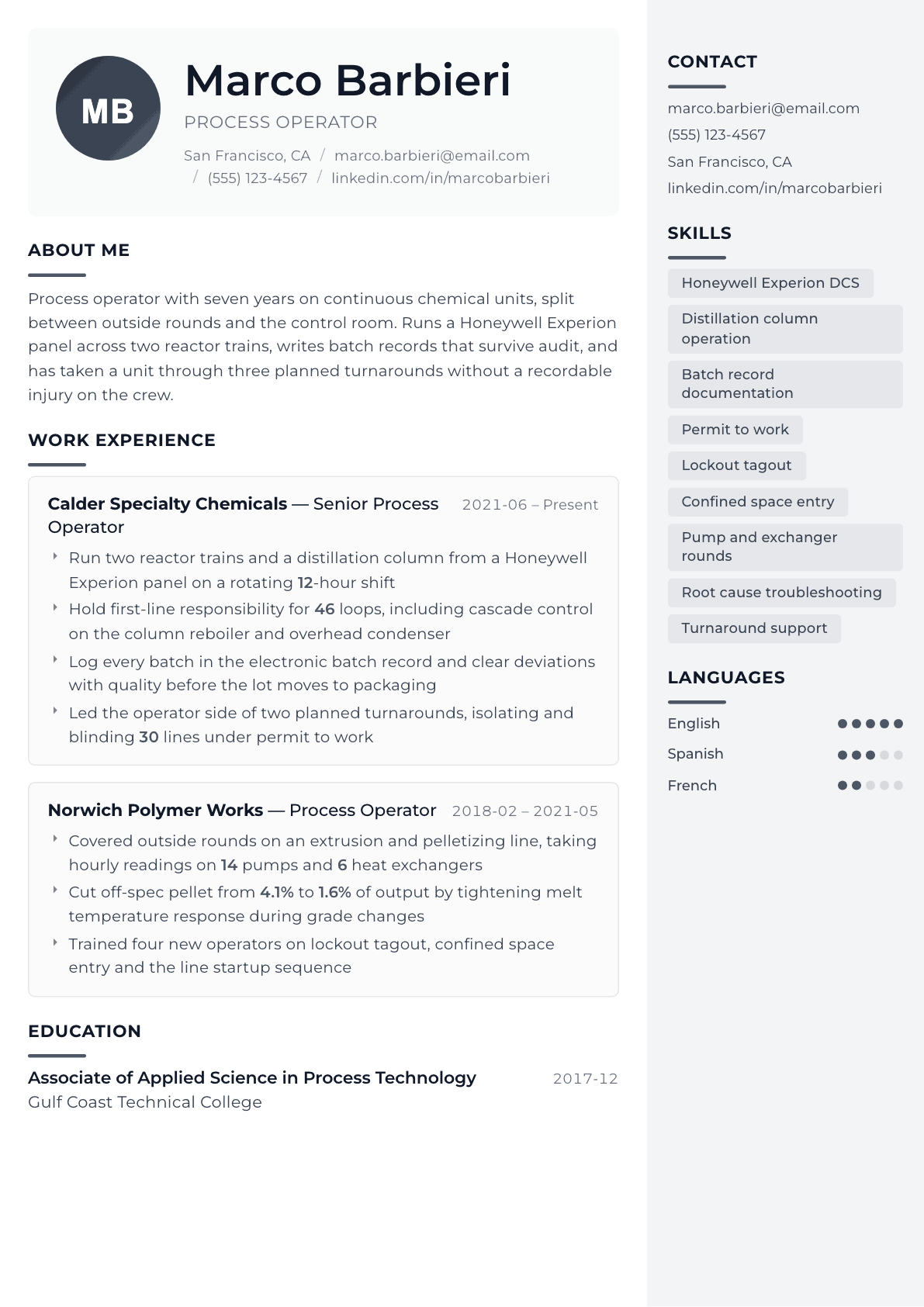
The same process operator content laid out in three CVBooster templates, so you can see what the finished document looks like before you write a word.
Example Process Operator summary
Process operator with seven years on continuous chemical units, comfortable on both the panel and the outside rounds. Runs reactor trains and a distillation column from a Honeywell Experion console, writes batch records that pass audit without a rework loop, and has isolated lines under permit to work through three planned turnarounds. Certified in confined space entry and looking for a senior operator seat on a larger unit.
Skills to list on a Process Operator resume
- Distributed control systems
- Panel board operation
- Outside operator rounds
- Distillation and separation
- Reactor charging and quench
- Pump, compressor and exchanger checks
- Batch record and deviation logging
- Permit to work systems
- Lockout tagout isolation
- Confined space entry
- Line breaking and blinding
- Startup and shutdown sequences
- Process troubleshooting
- Sampling and field testing
- Turnaround and outage support
What actually gets this resume read
- Name the control system you run, because a plant on Honeywell will not assume you can walk onto its panel.
- Say what your unit actually makes and at what rate, since a reactor operator and a packaging operator are different hires.
- List every safety permit system you have worked under, including confined space, hot work and line breaking.
- Put the loop count, tank count or line count on the page so a supervisor can judge the scale you have held.
- Show at least one deviation or upset you diagnosed, with the reading that gave it away and what you changed.
- Add your turnaround history, since plants staff outages from people who have done one before.
How to write a process operator resume
The person reading a process operator resume is usually a shift supervisor or a unit superintendent who needs a seat filled on a crew that is already short. He is not scoring your prose. He is asking three questions: can you hold a panel on my kind of unit, will you pass the safety expectations without being watched, and how long before you are signed off to work alone.
That is why vague resumes stall here more than anywhere else in manufacturing. A line that says "operated production equipment in a safe and efficient manner" tells a superintendent nothing about whether you have run a distillation column, charged a reactor, or only pressed start on a filling machine. The resumes that move name the unit, the control system, the products and the permits.
This guide covers what to put in each section of a process operator resume, with summary examples for a technician fresh out of a process technology program, an operator with a few units under him, and a senior operator who trains the crew. It ends with the questions operators ask when they move between industries.
Format: unit type up front, safety credentials where a supervisor can find them
Reverse chronological, one page for under a decade and two pages once you have carried several units through turnarounds. The top third should establish the industry, the unit and the control system before the reader has scrolled, because that is the filter every superintendent applies first.
Group your safety training in its own block rather than sprinkling it through job bullets. Confined space entry, hot work, line breaking, respiratory fit testing and hazardous energy control are the items a site checks against its own program, and they are easier to verify when they sit together with the year you last refreshed each one.
- Line one under your name: the industry, the unit family and the control system, such as continuous specialty chemicals on a Honeywell panel.
- Order on the page for an operator: summary, plant and unit experience, control systems, safety training, then education and process technology coursework.
- Every employer line carries the plant type, what it produces and whether you sat inside on the board or outside on rounds.
- Keep a short block for turnarounds and outages with the year, the unit and what you personally isolated or commissioned.
Summary: three lines that place you on a specific unit
The summary is where you tell a superintendent what he is buying. Name the process family, the years you have run it, the control platform, and whether you are board qualified or outside only. Add one differentiator, usually the hardest thing you have done alone: a cold start, an emergency shutdown, or a commissioning.
Avoid the phrase "safety conscious team player". Every operator writes it and it survives no scrutiny. If safety is the thing you want to lead with, lead with something checkable instead, such as the number of turnarounds you have worked under permit or the incident free stretch your crew held.
Experience: unit, scale, and the upset you caught
Give each job a one line orientation before the bullets: the plant, the product, the unit and the crew structure. A reader who knows the industry can then read your bullets against a mental picture of your board rather than guessing at it.
Then write bullets that carry the scale and the decision. Scale means loop count, tank count, throughput, number of trains, or the size of the column. Decision means what you changed and what you were watching when you changed it. The strongest bullet an operator can write is an upset caught early: the reading that moved, what you suspected, what you adjusted, and what it saved.
Sequences matter too. Startups, shutdowns, grade changes and product transitions are the parts of the job where an inexperienced operator costs money, so say how many you have run and whether you wrote or revised the procedure.
- One orientation line per job: plant type, product, unit, shift pattern and crew size.
- Three to five bullets covering board work, field rounds, sequences, documentation and troubleshooting.
- At least one bullet on a deviation you diagnosed, naming the instrument reading that gave it away.
- One bullet on turnaround work: what you isolated, blinded, tested or recommissioned under permit.
Control systems, documentation and the audit trail
Name your distributed control system by vendor and version family, and name the historian and the maintenance system you raise work orders in. Sites weigh this heavily because retraining an operator onto an unfamiliar console eats weeks of a supervisor's attention.
Documentation deserves its own bullets in regulated plants. If you write electronic batch records, log deviations, complete cleaning verification or sign off on production records, say so, because a plant under a quality system will not take an operator who treats paperwork as an afterthought. Describe the standard you write to rather than claiming attention to detail.
Skills and keywords the screening pass looks for
Operator postings recycle a narrow vocabulary: DCS, PLC, HMI, batch record, permit to work, lockout tagout, confined space, line breaking, process safety management, startup, shutdown, turnaround, sampling and troubleshooting. Use the exact words the posting uses, once in your skills block and once in a bullet where the work is visible.
Add the physical and shift realities plainly. Rotating twelve hour shifts, on call coverage, working at height, respirator use and hot work in summer are all things a supervisor would rather learn from your resume than from your resignation. An operator who states them reads as someone who has done the job, not read about it.
Process Operator resume summary examples
Fresh from a process technology program
Process technology graduate with 720 program hours including a plant simulator lab on distillation and reactor control. Completed confined space, hazardous energy and respiratory training, plus a summer helper role on an outside rounds crew. Seeking a first operator seat on a continuous chemical unit.
Five years in
Process operator with five years on continuous chemical units, board qualified on a Honeywell panel covering a reactor train and a stripping column. Runs startups and grade changes without supervision, writes batch records that clear quality first pass, and has worked two planned turnarounds under permit to work.
Senior operator and crew trainer
Senior process operator with twelve years across polymer and specialty chemical plants, board qualified on two control platforms. Owns the unit startup procedure, trains new operators to sign off, and led the operator scope of a full turnaround covering 30 line isolations. Certified in process safety management practice and confined space rescue support.
Work experience bullets: before and after
Before: Operated production equipment safely and efficiently.
After: Ran two reactor trains and a stripping column from a Honeywell Experion board across 46 control loops on a rotating 12-hour shift.
The unit, the platform and the loop count let a superintendent judge whether you can hold his board.
Before: Monitored gauges and reported problems to the supervisor.
After: Caught a fouling exchanger from a 9 degree rise in column overhead temperature and pulled the unit to a controlled rate cut before the relief valve lifted.
It shows the reading you watched, the diagnosis you made and the consequence you avoided.
Before: Filled out paperwork for each production batch.
After: Wrote electronic batch records for 220 lots a year with a first pass approval rate above 98%, closing deviations with quality before release.
A documentation volume with an approval rate is checkable where "filled out paperwork" is not.
Before: Helped during plant shutdowns.
After: Led the operator scope of a planned turnaround: isolated, drained and blinded 30 lines under permit to work, then recommissioned the unit on a written start sequence.
Turnaround scope with a line count and permit language is the fastest proof of unit competence.
Before: Trained new employees on the job.
After: Trained four operators to board sign off on the reactor unit, cutting the average time from hire to independent shift coverage by about six weeks.
A training outcome measured in time to sign off means more to a supervisor than the fact that you helped.
Hard skills
- Distributed control system operation
- Panel board and field rounds
- Distillation and separation control
- Reactor charging and quench
- Pump, compressor and exchanger monitoring
- Startup and shutdown sequences
- Grade change and product transition
- Electronic batch records and deviations
- Permit to work and hazardous energy control
- Confined space entry
- Line breaking and blinding
- Process sampling and field analysis
- Alarm response and rate cuts
- Turnaround isolation and recommissioning
Soft skills
- Clean shift turnover under time pressure
- Radio discipline during an upset
- Judgment about when to stop a unit
- Teaching a sequence to a new operator
- Holding a procedure when production pushes back
Certifications worth listing
- OSHA 30-Hour General Industry Outreach Training (Occupational Safety and Health Administration)
- HAZWOPER 40-Hour (OSHA-authorized training provider)
- Certified Maintenance and Reliability Technician (CMRT) (Society for Maintenance and Reliability Professionals)
Mistakes that cost process operator candidates the interview
- Writing "operated machinery" without naming the unit, the product or the control platform behind it.
- Leaving the control system off the page, which forces a supervisor to assume you would need retraining.
- Listing safety training as a claim about attitude instead of a dated block a site can verify.
- Skipping turnaround and outage history, which is the work sites recruit hardest for.
- Describing troubleshooting in general terms with no instrument reading and no corrective action behind it.
- Hiding whether you are board qualified or outside only, since that single fact decides which vacancy you fit.
Process Operator resume questions
How long should a process operator resume be?
One page under about ten years, two pages once you have run several different units and worked multiple turnarounds. Depth beats breadth here, so a second page is only worth it if the extra unit experience is genuinely different from the first page.
Do I need a process technology degree to get hired?
Many plants prefer an associate degree in process technology, but military nuclear or engineering room service, refinery helper experience and internal promotion from maintenance are all common routes. If you lack the degree, put the equivalent training hours and any simulator work in its place.
How do I move from one industry to another as an operator?
Translate your unit operations rather than your job title. Pumps, exchangers, columns, reactors and dryers behave the same across food, pharmaceutical and chemical plants, so lead with those and with your control platform, then acknowledge the regulatory framework you would be learning.
Should I list every safety training class I have taken?
List the ones a site verifies before letting you work: hazardous energy control, confined space, hot work, line breaking, respiratory protection and fall protection. Refresher classes with no expiry attached add clutter, so keep those in a single line rather than one per row.
What should an entry level operator put in the experience section?
Simulator hours by unit type, any plant helper or contractor work, and the specific equipment you touched during a co-op. Warehouse or maintenance work at a process plant counts too, because it proves you know how a site behaves and what a permit means in practice.
Related resume examples
- Chemical Plant Operator Resume example
- Refinery Operator Resume example
- Production Supervisor Resume example
- Manufacturing Engineer Resume example
- Plant Operator Resume example
- Water Treatment Operator Resume example