Wastewater Treatment Operator Resume Examples: free score
A Wastewater Treatment Operator Resume Built on Your License Grade
By Mustafa Tarabya, founder of CVBooster · Published · Updated
Wastewater treatment operator resume example, keywords and writing guide covering license grades, permit limits, lab work and SCADA rounds.
Sample resumes for a wastewater treatment operator
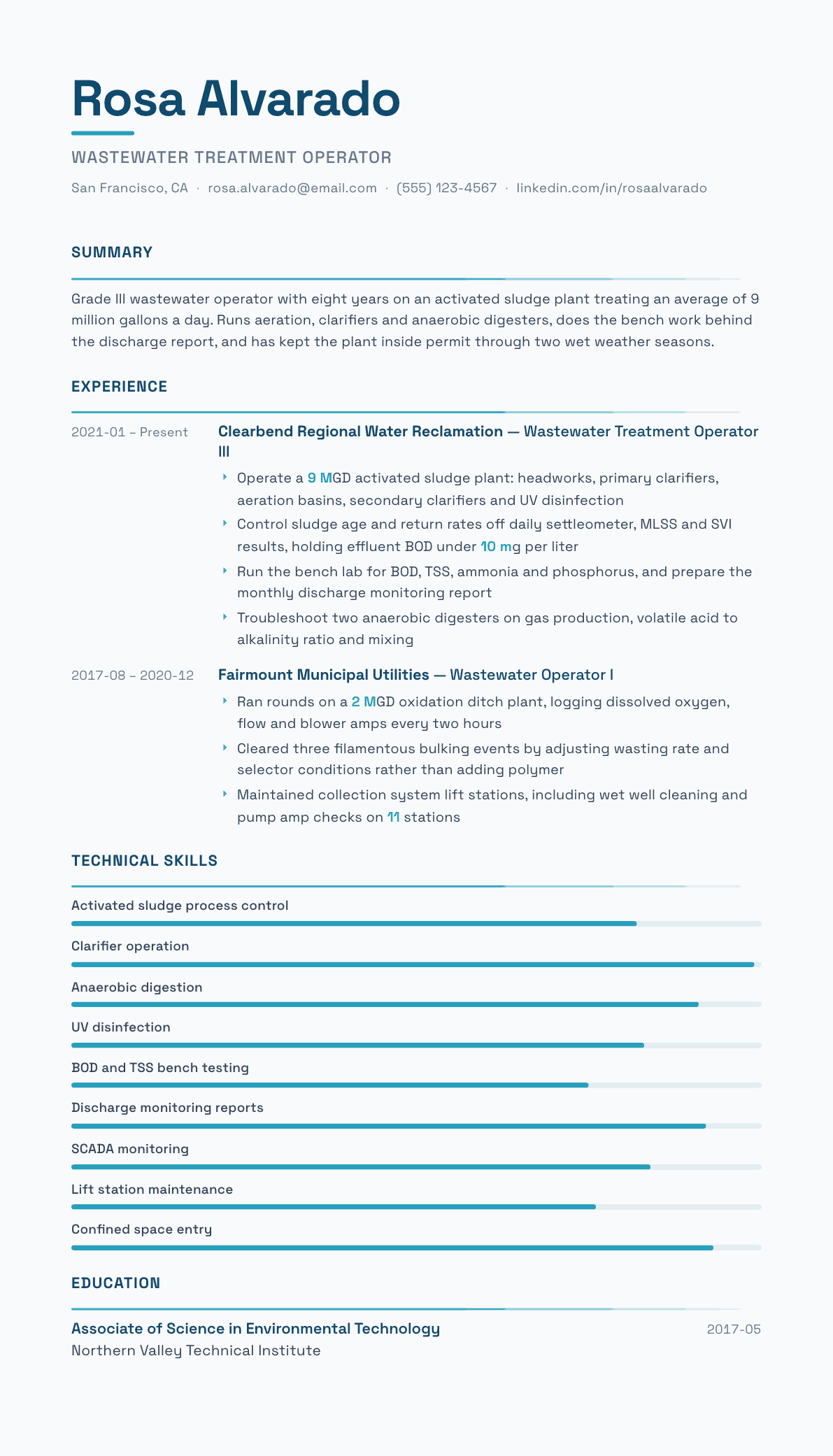
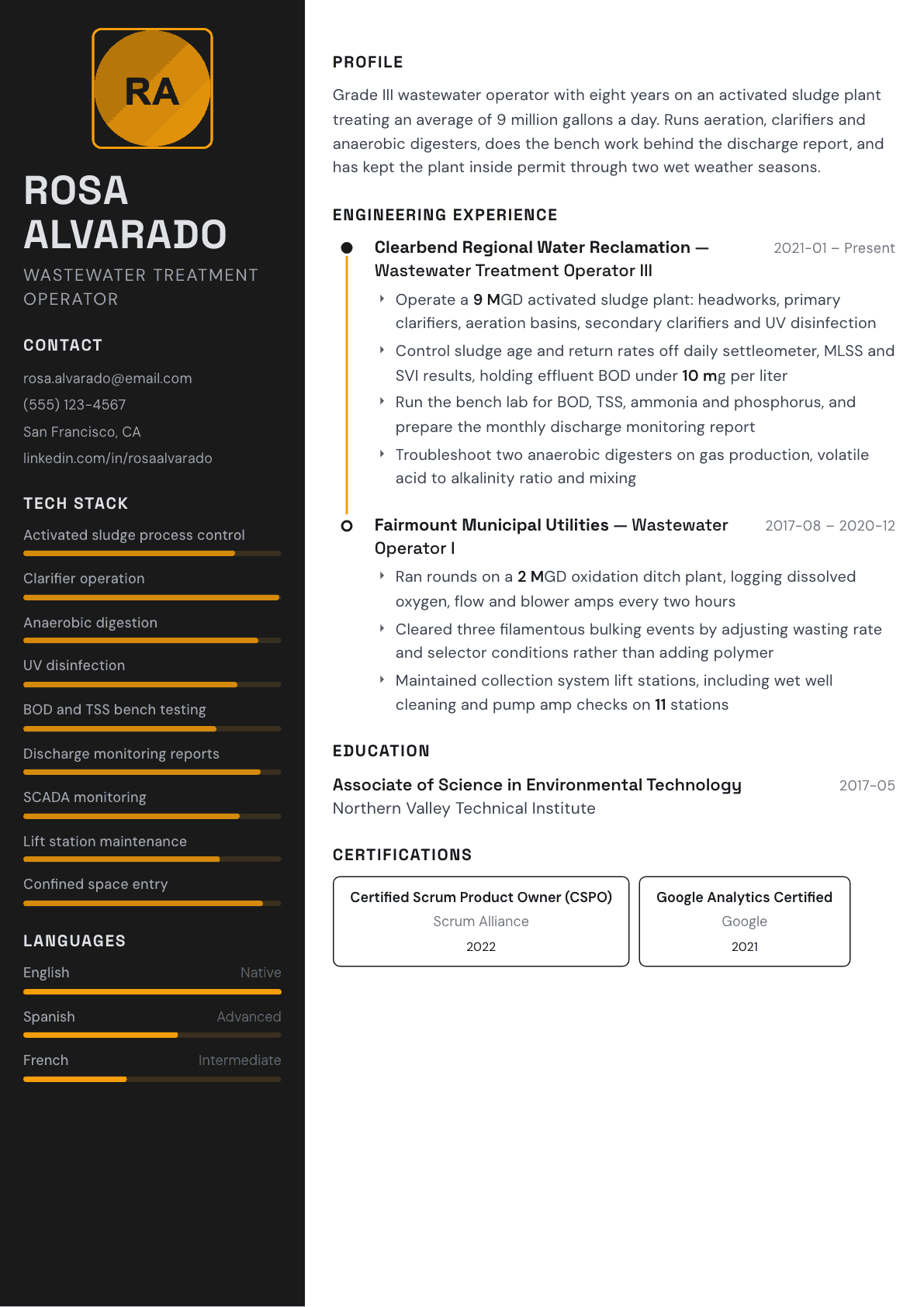
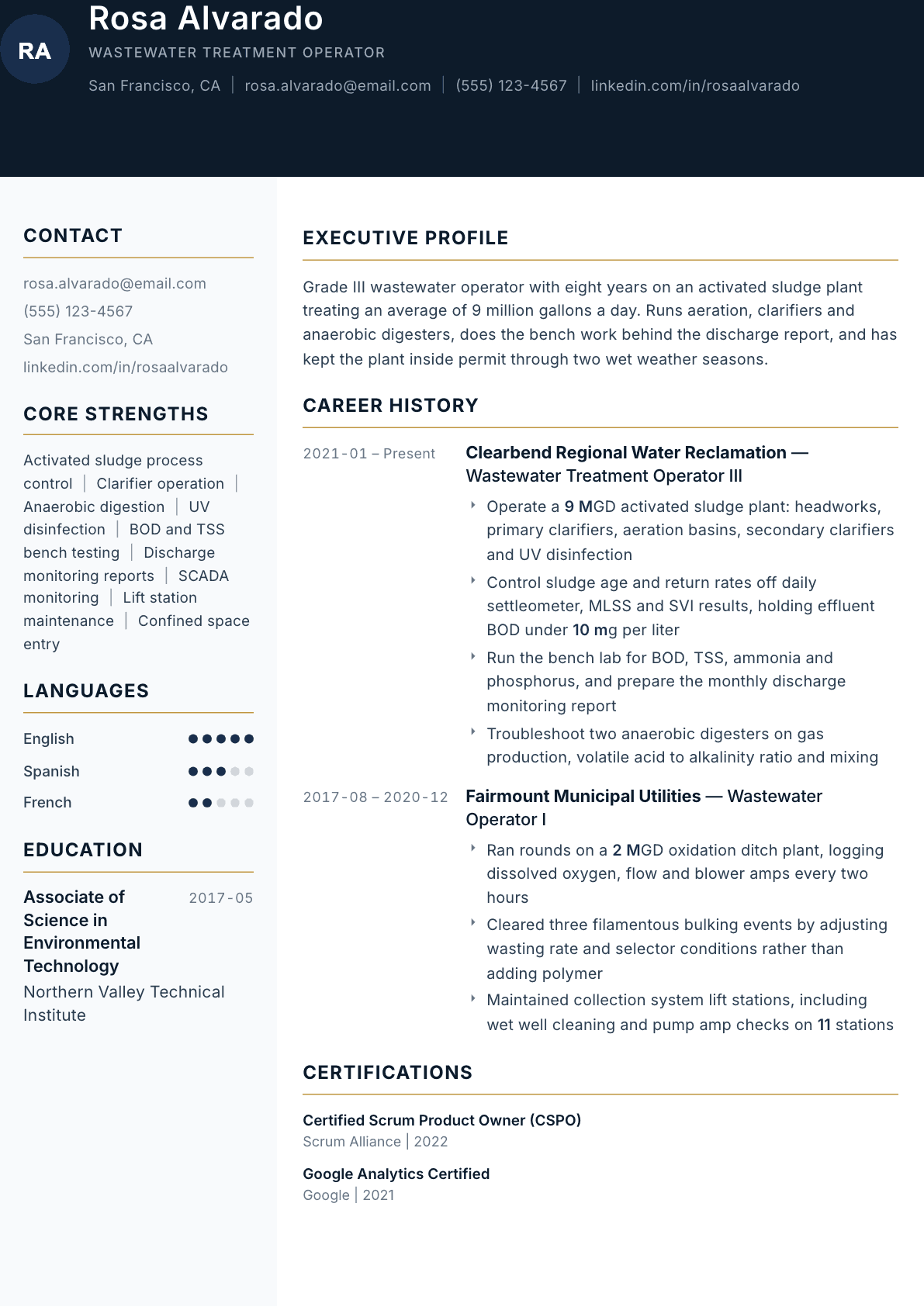
The same wastewater treatment operator content laid out in three CVBooster templates, so you can see what the finished document looks like before you write a word.
Example Wastewater Treatment Operator summary
Grade III wastewater treatment operator with eight years on activated sludge plants, currently running a 9 MGD facility from headworks to UV. Controls sludge age off daily settleometer and MLSS results, runs the bench lab behind the monthly discharge report, and has cleared filamentous bulking without leaning on polymer. Holds confined space and collection system credentials and is ready for a chief operator track.
Skills to list on a Wastewater Treatment Operator resume
- Activated sludge control
- Sludge age and wasting rates
- Settleometer and SVI testing
- Primary and secondary clarifiers
- Anaerobic digester operation
- Belt press and dewatering
- UV and chlorine disinfection
- Nutrient removal
- Discharge monitoring reporting
- Bench laboratory analysis
- SCADA and telemetry
- Lift station operation
- Blower and pump maintenance
- Confined space entry
- Sampling and chain of custody
What actually gets this resume read
- Put your operator license grade and the issuing state in the top third, because it screens the application before a human does.
- State the plant flow in million gallons a day and the treatment train, from headworks through disinfection.
- Name the process control tests you run yourself: settleometer, MLSS, SVI, ammonia, phosphorus and residual chlorine.
- Say whether you prepare or only feed the discharge monitoring report, since regulators hold the signer responsible.
- Describe one process upset you corrected, naming the indicator you watched and the rate you changed.
- List collection system work separately if you hold that license, because many utilities hire for both.
How to write a wastewater treatment operator resume
Hiring a wastewater treatment operator is a regulated act. The utility has a discharge permit with numbers in it, a staffing requirement tied to license grades, and a state inspector who will ask who was in responsible charge on the day something went out of limits. Your resume is read against that reality, not against a general idea of competence.
So the first thing a superintendent looks for is your license: the grade, the state that issued it, and whether it covers treatment, collection or both. The second is the plant you have run, described in flow and process train. The third is whether you do the bench work and the reporting yourself or whether someone else has always covered it.
This guide takes those three questions and turns them into a page. It covers layout, the summary, how to write process control experience that reads as real, the numbers worth including, and the questions operators ask when they move between plant sizes or between municipal and industrial work.
Format: license grade first, then the process train
Reverse chronological, one page for most operators and two only when you hold several license classes across states. Put the license grade and issuing state in the header area next to your name, because many utilities screen applications against a required grade before a person ever reads the page.
Immediately under the summary, describe the plants you have run as process trains rather than as employers. A reader who sees headworks, primary clarifiers, aeration, secondary clarifiers, filtration and disinfection can picture your plant in one pass. A reader who sees "municipal treatment facility" cannot.
- Header line for a wastewater operator: license grade, issuing state, expiry month, and whether it covers collection systems too.
- Page order: summary, license and credentials, plants operated with flow and process train, experience bullets, lab and reporting work, then schooling.
- Each plant entry gives design flow, average daily flow, treatment type and whether the site is staffed around the clock.
- Keep a short line for the industrial or pretreatment loading you handle, since a plant with a heavy industrial contributor is a different job.
Summary: grade, flow, process and the report you sign
Three lines. Lead with grade and years, then the plant flow and process, then what you personally own. Ownership is the differentiator: whether you set wasting rates, whether you run the bench lab, and whether you assemble or sign the monthly discharge report.
If you have held responsible charge, say so plainly and name the period. Utilities treat responsible charge as a different level of trust from operating a shift, and it is the fastest way to be considered for a chief operator opening.
Experience: process control decisions, not a duty list
The weakest wastewater resumes are duty lists: monitored equipment, collected samples, performed maintenance. Every operator does those. What separates candidates is process control, which means the decisions you make about sludge age, wasting, return rates, aeration, chemical dose and how you use test results to make them.
Write those decisions with the indicator attached. A settleometer result that told you the sludge was bulking, an SVI trend that moved you to change the wasting rate, an ammonia rise that led you to add a blower, a low food to organism ratio that explained pin floc. This is the material a superintendent uses to decide whether you are an operator or a button pusher.
Digesters, dewatering and biosolids handling deserve their own bullets where you run them. Volatile acid to alkalinity ratio, gas production, polymer dose and cake solids are all things a plant with a struggling digester will search for by name.
- One bullet on process control: the test you read, the rate you changed, the effluent result you held.
- One bullet on an upset you corrected, whether bulking, foaming, a toxic load or a wet weather event.
- One bullet on solids: digester operation, dewatering equipment, polymer dose and cake dryness.
- One bullet on maintenance you perform yourself, from blowers and mixers to pumps and diffuser cleaning.
Lab work, sampling and regulatory reporting
Say which tests you run at the bench and which go to a contract laboratory. Operators who run their own biochemical oxygen demand, solids, ammonia, phosphorus and residual analyses are cheaper to staff and faster to react, and utilities know it.
Reporting is the other half. Name the reports you build, describe the sampling program behind them, including composite samplers, chain of custody and holding times, and state whether you sign the discharge report or prepare it for the superintendent. If you have been through a state inspection or a permit renewal, that experience belongs on the page.
Skills, safety and the keywords a utility screens on
Job postings for this role reuse a compact set of terms: activated sludge, MLSS, SVI, wasting rate, return activated sludge, nitrification, denitrification, anaerobic digestion, belt press, UV disinfection, SCADA, lift station and discharge permit. Use the posting language once in your skills list and once in a bullet where the work is shown.
Safety in a wastewater plant is specific. Confined space entry into wet wells and digesters, hydrogen sulfide monitoring, chlorine handling, hazardous energy control and bloodborne pathogen awareness all belong in a credentials block with dates. A superintendent checks these before a candidate is allowed near a hatch.
Wastewater Treatment Operator resume summary examples
Grade I, first plant
Grade I wastewater operator with an environmental technology associate degree and 14 months on a small oxidation ditch plant. Runs dissolved oxygen and solids testing, logs SCADA rounds every two hours, and maintains six lift stations. Studying for the Grade II exam and seeking a larger activated sludge plant.
Grade III, eight years
Grade III wastewater treatment operator with eight years on activated sludge plants, currently on a 9 MGD facility from headworks through UV. Sets wasting rates from daily settleometer and MLSS results, runs the bench lab, and prepares the monthly discharge report for the superintendent to sign.
Chief operator track
Grade IV operator with sixteen years across municipal and industrial wastewater, holding responsible charge on a 20 MGD nutrient removal plant. Directs a crew of nine, owns the permit compliance package and the pretreatment program, and has carried the plant through two state inspections without a violation.
Work experience bullets: before and after
Before: Monitored the treatment process and collected samples.
After: Controlled sludge age on a 9 MGD activated sludge plant from daily settleometer, MLSS and SVI results, holding effluent biochemical oxygen demand under 10 milligrams per liter all year.
It names the tests, the control variable and the permit number the utility is actually judged on.
Before: Dealt with problems in the aeration basins.
After: Cleared three filamentous bulking events by adjusting wasting rate and selector conditions rather than dosing polymer, cutting chemical spend for the year.
The diagnosis and the choice not to reach for chemicals shows process judgment, not just reaction.
Before: Responsible for lab testing.
After: Ran the bench lab for biochemical oxygen demand, total suspended solids, ammonia and phosphorus, and assembled the monthly discharge monitoring report with no state corrections in four years.
A clean regulatory record attached to the tests you personally run is the strongest proof available.
Before: Worked on the digesters.
After: Stabilized two anaerobic digesters by trending the volatile acid to alkalinity ratio and mixing time, bringing gas production back to a level that covered building heat again.
Digester work with an indicator and a recovered outcome separates you from operators who only take readings.
Before: Handled wet weather flows when it rained.
After: Managed peak wet weather flow above twice average by staging equalization, adjusting return rates and protecting clarifier blanket depth, with no bypass across two storm seasons.
Wet weather performance is the scenario a superintendent worries about, so answering it directly carries weight.
Hard skills
- Activated sludge process control
- Sludge age and wasting calculations
- Settleometer, MLSS and SVI testing
- Nitrification and denitrification control
- Primary and secondary clarifier operation
- Anaerobic digester operation
- Belt press and centrifuge dewatering
- UV and chlorine disinfection
- Biochemical oxygen demand and solids analysis
- Discharge monitoring reporting
- Composite sampling and chain of custody
- SCADA and telemetry monitoring
- Lift station and collection system work
- Blower, mixer and pump maintenance
Soft skills
- Explaining a permit exceedance without hiding it
- Steady decision making during a storm event
- Handing over a process trend, not just a reading
- Training a new operator on why a rate changes
- Working with regulators as colleagues rather than opponents
Certifications worth listing
- Wastewater Treatment Operator Certification (Association of Boards of Certification)
- Collection System Operator Certification (Association of Boards of Certification)
- OSHA 10-Hour General Industry Outreach Training (Occupational Safety and Health Administration)
Mistakes that cost wastewater treatment operator candidates the interview
- Leaving the license grade and issuing state out of the header, which stalls the application at the first screen.
- Describing the plant as a facility instead of a process train with a design flow and an average daily flow.
- Writing duty lists about monitoring and sampling with no process control decision anywhere on the page.
- Hiding whether you run the bench lab yourself, which is one of the biggest cost differences between two operators.
- Omitting wet weather and upset experience, the two situations a superintendent most wants covered.
- Forgetting collection system and lift station work, which many small utilities need in the same person.
Wastewater Treatment Operator resume questions
How important is my operator license grade?
It is the single most important item on the page. Staffing rules tie plant classes to operator grades, so a utility often cannot interview you below a threshold no matter how strong your experience is. Put the grade, state and expiry where it is impossible to miss.
Does my license transfer to another state?
Often partly. Many states offer reciprocity to holders of comparable certificates, sometimes with an exam or an experience review. List every state you are certified in and note reciprocity applications in progress, because a hiring utility will want to know the timeline.
How do I move from a small plant to a large one?
Lead with process breadth rather than flow. A small plant operator who runs the lab, the digesters, the dewatering and the lift stations has touched more of the job than a large plant operator confined to one shift position. Frame that breadth as the reason you can scale up.
Should industrial pretreatment experience go on a municipal resume?
Yes, and it is worth a section of its own. Utilities with heavy industrial contributors struggle to find operators who understand loading swings, surcharge programs and sampling of a contributor. That experience makes you unusual among municipal applicants.
What can a new operator with no plant history put down?
Coursework hours, the exam you have passed, and any hands on time from an internship or a laboratory job. Water and wastewater math, sampling technique and confined space training all count. Utilities hire trainee operators regularly, so make it clear which grade you are studying for.
Related resume examples
- Water Treatment Operator Resume example
- Water Treatment Engineer Resume example
- Environmental Scientist Resume example
- Plant Operator Resume example
- Lab Technician Resume example
- Winemaker Resume example