Child Protective Services Worker Resume Examples: free
Build a Child Protective Services Worker Resume That Earns Interviews
By Mustafa Tarabya, founder of CVBooster · Published · Updated
Child protective services worker resume example with investigation bullets, safety assessment keywords, and a full writing guide for CPS hiring.
Sample resumes for a child protective services worker
The same child protective services worker content laid out in three CVBooster templates, so you can see what the finished document looks like before you write a word.
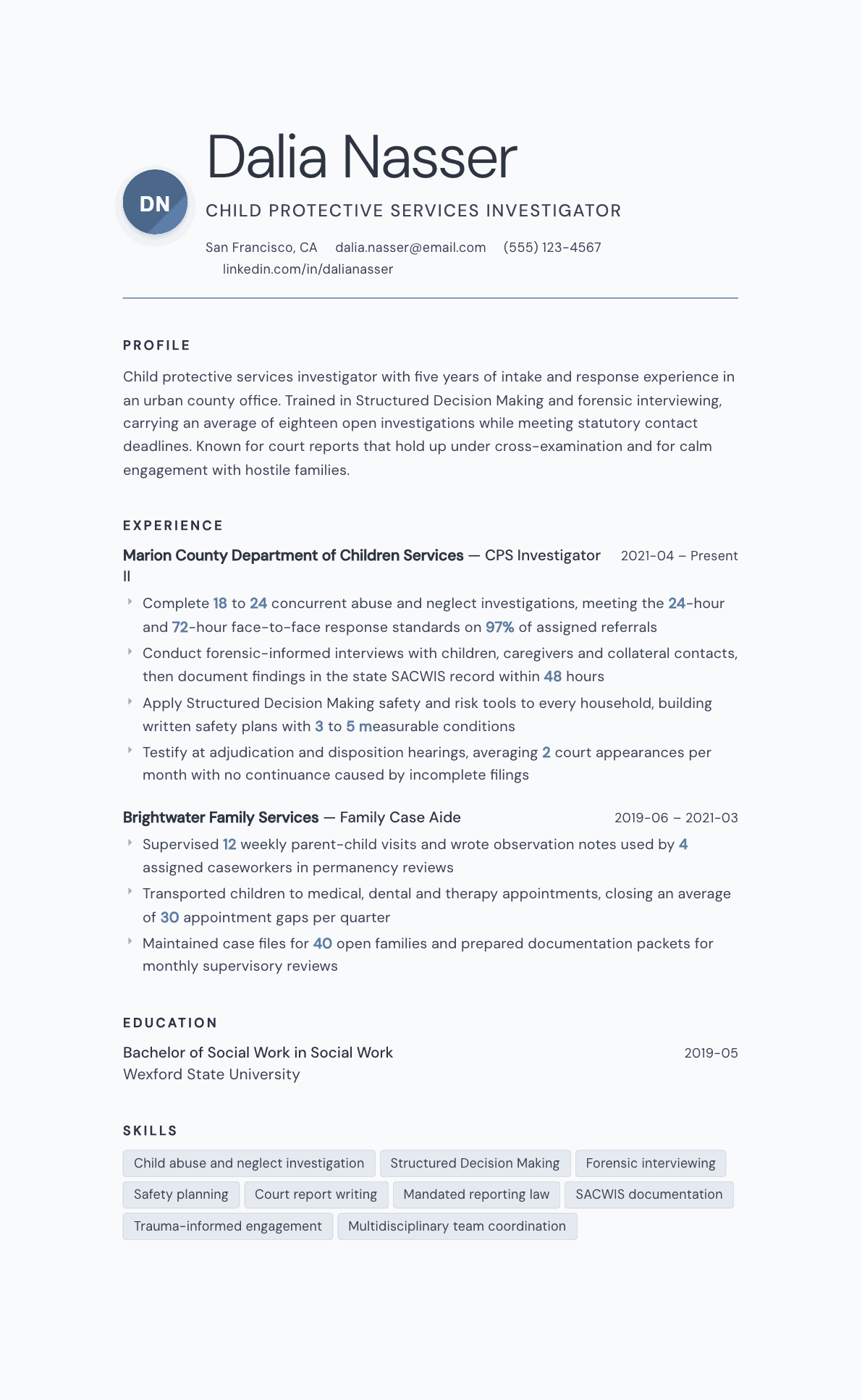
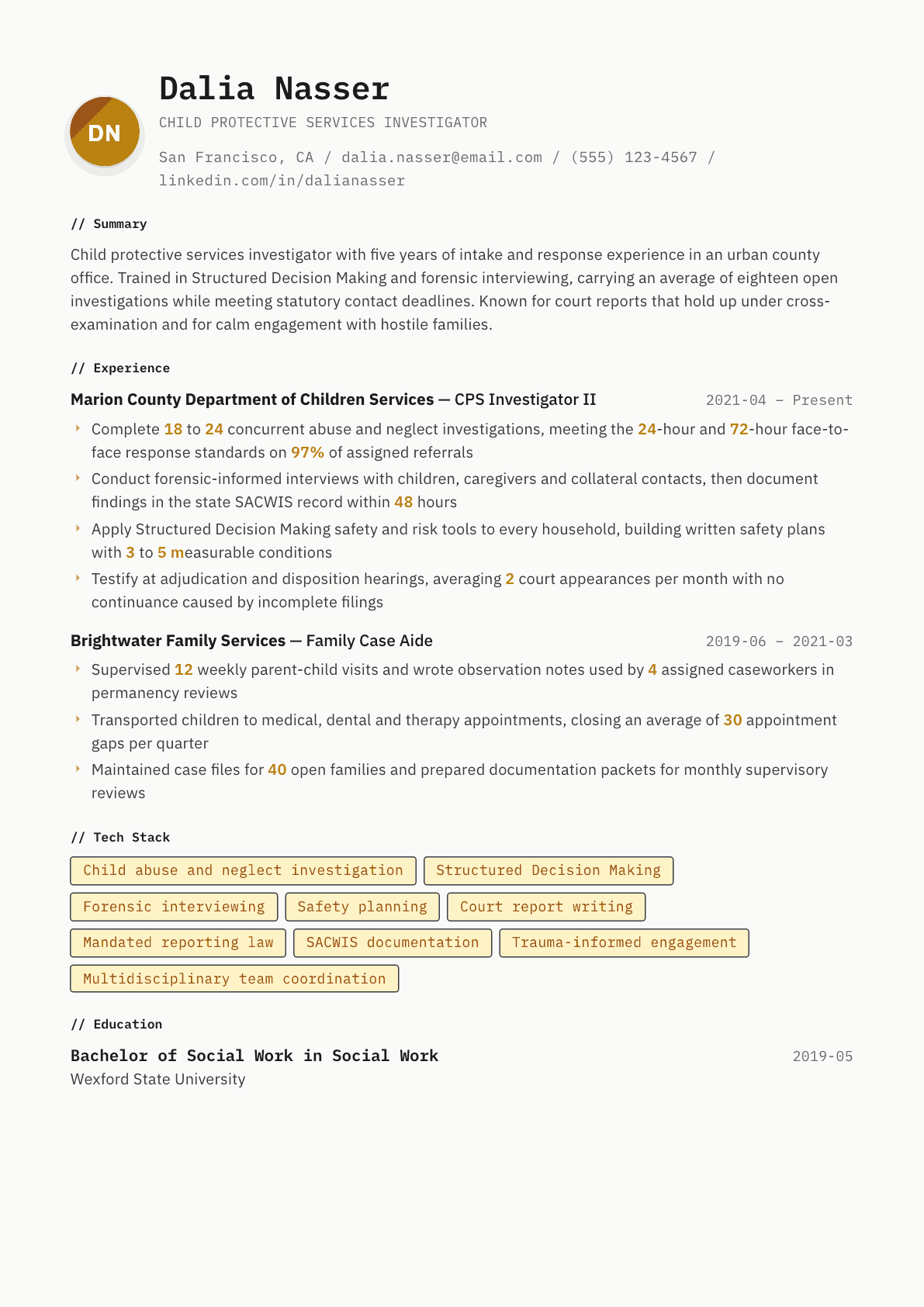
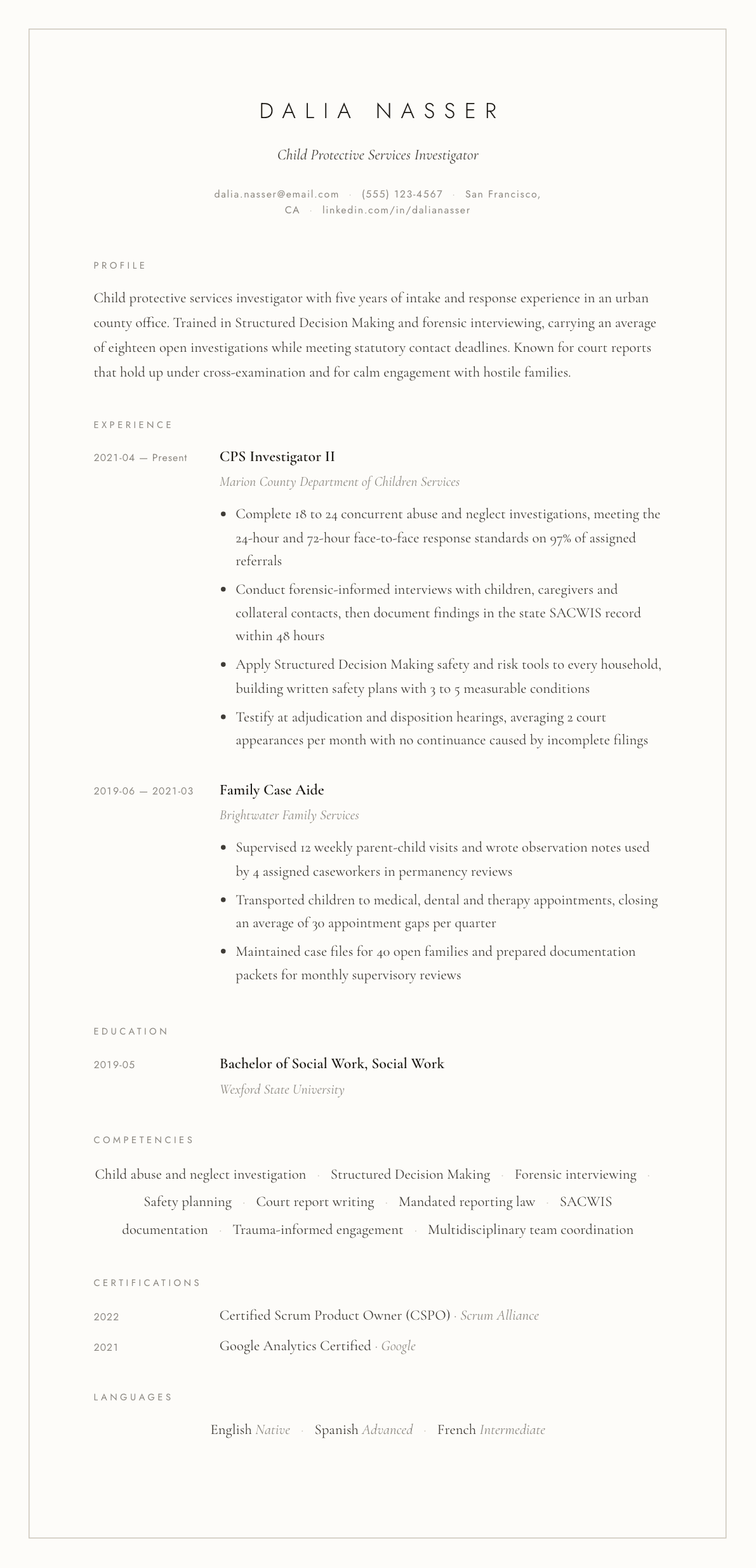
Example Child Protective Services Worker summary
Child protective services worker with five years of investigative practice in a high-volume county intake unit. Carries eighteen to twenty-four open referrals, completes safety and risk assessments using Structured Decision Making, and files court reports that survive cross-examination. Trained in forensic-informed interviewing and skilled at engaging families who open the door angry. Seeking a senior investigator role with mentoring responsibility.
Skills to list on a Child Protective Services Worker resume
- Child abuse and neglect investigation
- Structured Decision Making
- Safety and risk assessment
- Forensic-informed interviewing
- Safety planning
- Court testimony
- Affidavit and court report writing
- Mandated reporting statutes
- SACWIS and CCWIS documentation
- Trauma-informed practice
- Motivational interviewing
- Multidisciplinary team coordination
- Removal and placement procedures
- Crisis de-escalation
- Substance use and mental health screening
- Cultural humility
What actually gets this resume read
- Open every job with the county or agency, the unit you sat in, and the average number of open investigations you carried.
- Name the safety and risk instrument your state uses, whether that is Structured Decision Making or a state-specific matrix.
- Show that you met statutory response times, because a supervisor screens for timeliness before anything else on the page.
- Describe your court work in its own bullet: reports filed, hearings attended, and the outcomes you were able to support.
- List the child welfare information system you documented in, since agencies filter on the exact record system by name.
- Keep interview language precise: forensic-informed interviewing is a trained skill, and vague wording reads as untrained.
- Put your degree and any pre-service academy completion near the top, because eligibility is checked before experience is read.
How to write a child protective services worker resume
A child protective services resume is screened by a public agency recruiter against a state job specification, then read by an intake or investigations supervisor who is trying to work out one thing: can this person hold a caseload of contested, time-limited investigations without missing a statutory deadline. The recruiter checks degree, transcript hours and any pre-service academy. The supervisor checks whether you have ever knocked on a door alone at nine at night.
Most applications stall because the resume describes the mission instead of the work. Lines about advocating for vulnerable children appear on every file in the stack. What separates a hire is the specific machinery of the job: the referral volume, the response clock, the safety and risk instrument your state uses, the record system, and how your reports held up in front of a judge.
This guide walks the sections in the order a CPS supervisor reads them, with summaries for a new caseworker, a seasoned investigator and a unit lead, before-and-after bullets pulled from the way applicants really write, and the questions that come up most often when a child welfare worker sits down to rewrite the file.
Format and header: eligibility first, because a screener checks it first
Reverse chronological, one page under five years of practice and two pages after that. Public child welfare hiring runs on minimum qualifications, so the top of the page must answer them without a search: degree and major, any social work licensure, completion of a state pre-service or core academy, and a valid driver license with reliable transportation, since the job is a driving job before it is anything else.
Avoid two-column layouts and text boxes. County and state applicant systems parse them unevenly, and a dropped date on a child welfare file reads as a gap in employment rather than a formatting problem.
- Header: name, city and state, phone, email, degree abbreviation and any social work license.
- Section order: summary, education and credentials, child welfare experience, other relevant experience, skills.
- Applicants moving in from another county should name the state, since practice models and statutes differ.
Summary: unit, referral type, volume, and one thing you are trusted with
Three lines. Name the unit you sat in, whether that was screening and intake, initial assessment and investigation, ongoing in-home services, or a specialized sexual abuse or medical neglect unit. Give the county size in plain terms, the average number of open investigations you carried, and one responsibility a supervisor hands only to people she trusts, such as after-hours on-call rotation or training new caseworkers.
If you are moving into child protection from another field, say so directly and name the transferable ground. A probation officer or a domestic violence advocate already knows court process, safety assessment and hostile engagement, and should say that instead of hoping the reader infers it.
Experience: the response clock, the assessment tool, the decision
Every job needs the agency, the unit, the referral type and the caseload. Something like initial assessment unit, twenty open investigations, physical abuse and neglect referrals for children from birth to seventeen, tells a supervisor more than a paragraph of mission language. Then three to five bullets that follow the arc of an investigation: response within the assigned priority window, interviews with the child, the caregivers and collateral contacts, the safety and risk assessment, the safety plan or removal decision, and the documentation.
Write the decision, not only the activity. A bullet that says conducted investigations is invisible. A bullet that says applied the state safety assessment to determine present danger, built in-home safety plans with named participating adults, and petitioned for removal only when no safety plan could control the danger, shows the reasoning a supervisor is hiring.
Court work deserves its own bullet. Name what you personally produced: affidavits, dependency petitions, court reports, and how many hearings you appeared at in a typical month. Add whether your filings were ever the reason a hearing was continued, because a clean record there is a real differentiator.
Tools, systems and law: name them exactly
The keyword layer of a child welfare resume is made of instruments and systems. Name the safety and risk tool your state uses, whether that is Structured Decision Making, a state safety assessment matrix, or a signs of safety framework. Name the record system, which will be a state SACWIS or a newer CCWIS build, and say you documented in it rather than that you were familiar with it.
Name your interview training. Forensic-informed interviewing, a state child interview protocol, or a children advocacy center joint interview process are all trainable skills a supervisor can verify. Reference mandated reporting statute and the removal standard by function rather than by inventing a citation, since a hiring panel will ask you to explain it in the interview.
- Assessment: Structured Decision Making, state safety and risk matrices, family functioning assessment.
- Systems: state child welfare record system, court filing portals, background check databases.
- Practice: forensic-informed interviewing, motivational interviewing, family team meetings.
Skills and keywords the agency posting repeats
Public agency postings are written from a class specification, so the same phrases return: child abuse and neglect investigation, safety assessment, risk assessment, case planning, collateral contacts, court testimony, mandated reporting, multidisciplinary team. Mirror the exact phrasing once in the skills block and once inside a bullet where you show it happening. A block of keywords with no evidence behind it reads as padding to the human who opens the file after the software.
Leave soft skill lists thin. Cultural humility and de-escalation belong in a bullet about a family who refused entry, not in a row of adjectives.
Child Protective Services Worker resume summary examples
New caseworker
Bachelor of Social Work graduate with a 400-hour field placement in a county child welfare intake unit, where I shadowed 30 investigations and drafted contact notes for a supervising caseworker. Completed state pre-service academy and trained on Structured Decision Making. Seeking an initial assessment caseworker position.
Five years in investigations
CPS investigator with 5 years in a county initial assessment unit, carrying 18 to 24 open referrals and meeting 24-hour response standards on 97% of assignments. Trained in forensic-informed interviewing, testifies at adjudication monthly, and precepts new caseworkers through their first 10 investigations.
Unit lead
Child protective services unit lead supervising 7 investigators across a county averaging 90 monthly referrals. Reviews and approves every safety decision, chairs the joint response team with law enforcement and the child advocacy center, and reduced overdue investigations from 41 to 6 across two quarters.
Work experience bullets: before and after
Before: Investigated reports of child abuse and neglect.
After: Investigated 18 to 24 concurrent physical abuse and neglect referrals, meeting the 24-hour priority one and 72-hour priority two face-to-face response standards on 97% of assignments.
Volume plus the actual response clock lets a supervisor compare your workload with the one she is hiring for.
Before: Interviewed children and families.
After: Conducted forensic-informed interviews with children from age 4 upward, separate caregiver interviews, and an average of 5 collateral contacts per case including school, medical and law enforcement.
It names the trained method and the full contact structure rather than a task any adult could claim.
Before: Created safety plans for families.
After: Built in-home safety plans with 3 to 5 named participating adults and measurable conditions, monitored them at weekly contacts, and escalated to removal only when the plan could not control present danger.
The decision threshold is the skill; the plan itself is only paperwork without it.
Before: Testified in court when needed.
After: Filed dependency affidavits and court reports and testified at roughly 2 adjudication or disposition hearings per month, with no hearing continued because of an incomplete filing.
Frequency and a clean filing record turn a claim about court into evidence a county attorney can rely on.
Before: Used the state database to document cases.
After: Documented contacts, assessments and case decisions in the state child welfare record system within 48 hours of each event, closing 3 consecutive supervisory audits with no documentation deficiencies.
Timeliness and audit results are how child welfare supervisors actually measure documentation.
Hard skills
- Child abuse and neglect investigation
- Structured Decision Making
- Safety and risk assessment
- Forensic-informed interviewing
- In-home safety planning
- Removal and placement procedure
- Court report and affidavit writing
- Juvenile court testimony
- Mandated reporting statute
- State child welfare record systems
- Family team meeting facilitation
- Substance use and mental health screening
Soft skills
- Engagement with resistant families
- Decision making under time pressure
- De-escalation at the door
- Cross-agency coordination
- Emotional regulation after difficult removals
- Clear verbal reporting to supervisors
Certifications worth listing
- Certified Social Work Case Manager (C-SWCM) (National Association of Social Workers)
- Certified Advanced Social Work Case Manager (C-ASWCM) (National Association of Social Workers)
- Mental Health First Aid (National Council for Mental Wellbeing)
Mistakes that cost child protective services worker candidates the interview
- Writing mission statements about protecting children instead of the caseload, the response times and the decisions you made.
- Leaving out the safety and risk instrument, which is the one tool a child welfare supervisor screens for by name.
- Hiding court work inside a general duties paragraph when it deserves its own bullet with hearing frequency.
- Omitting the driver license and vehicle access, when the position specification lists both as minimum qualifications.
- Listing every training you ever attended, which buries the pre-service academy and the interview protocol that matter.
- Using clinical language borrowed from therapy roles, which signals you have not worked inside a statutory system.
Child Protective Services Worker resume questions
Do I need a social work degree to be a child protective services worker?
Many states accept a bachelor degree in social work, psychology, sociology, criminal justice or a related human services field, and some require a set number of relevant credit hours. Put your major and credit detail on the resume so the recruiter can check the minimum qualification without emailing you.
How do I show caseload size without making it look unmanageable?
Give a range rather than a peak, and pair it with a compliance figure such as response time or contact standards. A range with evidence of timeliness reads as capacity. A single dramatic number with no outcome next to it reads as a warning.
Should I describe a specific case on my resume?
No. Confidentiality rules apply to job applications the same way they apply anywhere else. Describe patterns, volumes and decision types instead, and save the single detailed narrative for an interview question where you can strip identifying facts.
How do I move from CPS investigation into ongoing services or another county?
Lead the summary with the move you want and reorder your bullets so the closest work appears first. For ongoing services that means case planning, service referral and family team meetings. For a new state, name the practice model and statutes you already worked under.
What do CPS supervisors look for on a resume from someone with no child welfare experience?
Evidence you can hold structure and conflict at the same time: statutory or regulated work, home visiting, court exposure, crisis response, and documentation under audit. Field placements count if you name the unit, the hours and the tasks you actually performed rather than observed.
Related resume examples
- Social Worker Resume example
- Case Manager Resume example
- Child Welfare Social Worker Resume example
- Foster Care Case Manager Resume example
- Victim Advocate Resume example
- Hospital Social Worker Resume example