Child Welfare Social Worker Resume Examples: free score
Build a Child Welfare Social Worker Resume That Survives Screening
By Mustafa Tarabya, founder of CVBooster · Published · Updated
A child welfare social worker resume guide with permanency keywords, court report examples, caseload detail, and a sample built for county hiring.
Sample resumes for a child welfare social worker
The same child welfare social worker content laid out in three CVBooster templates, so you can see what the finished document looks like before you write a word.
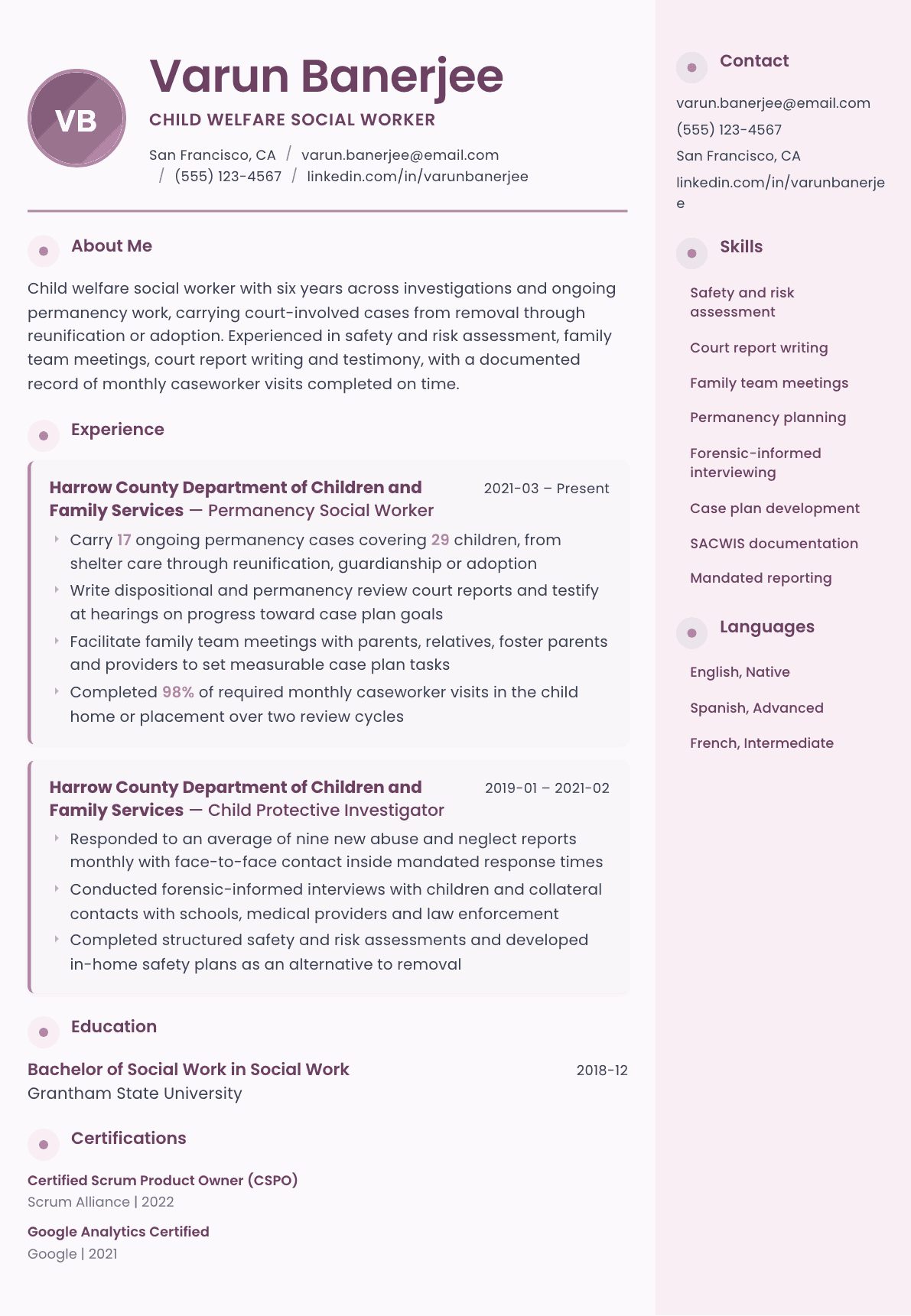
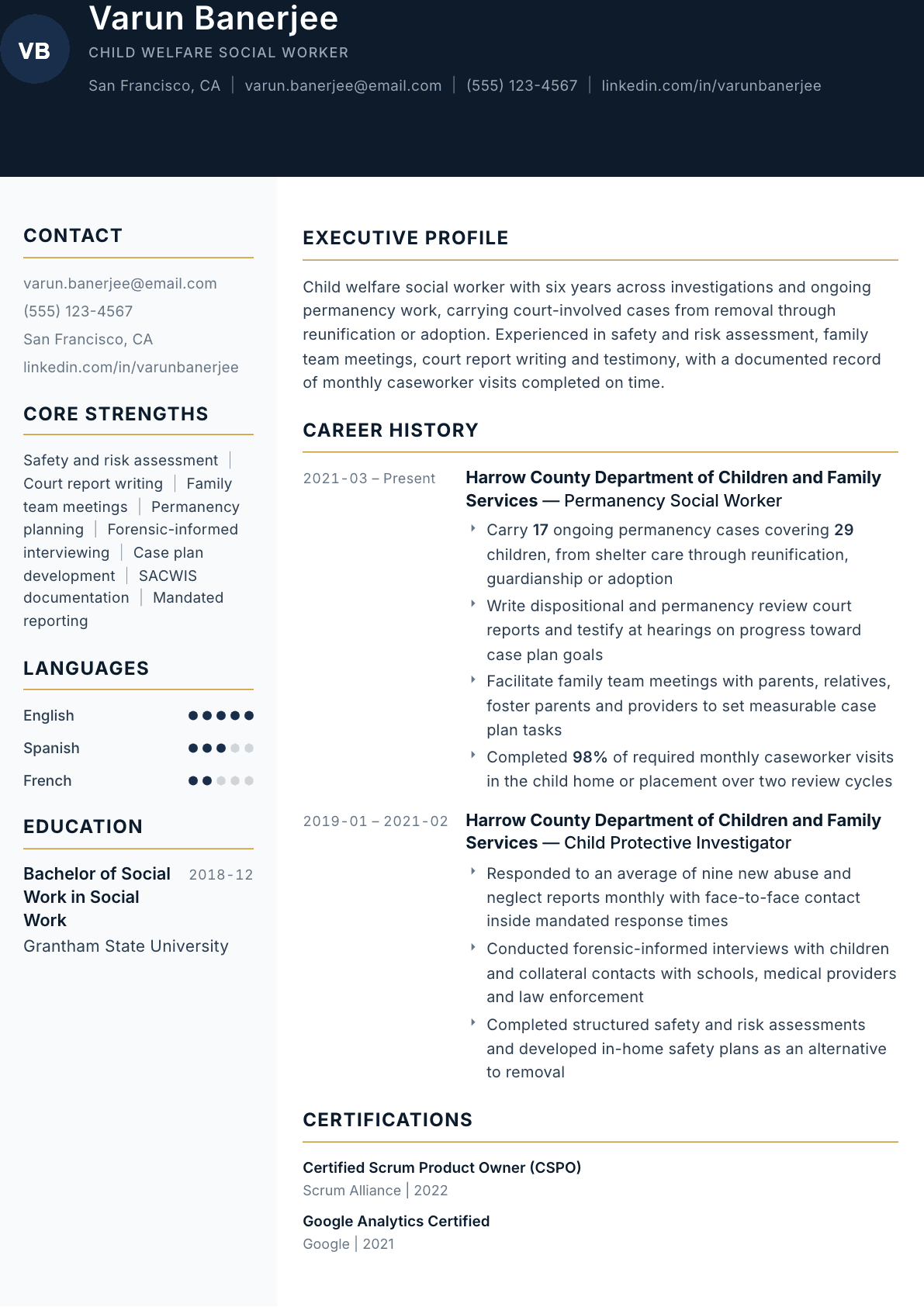
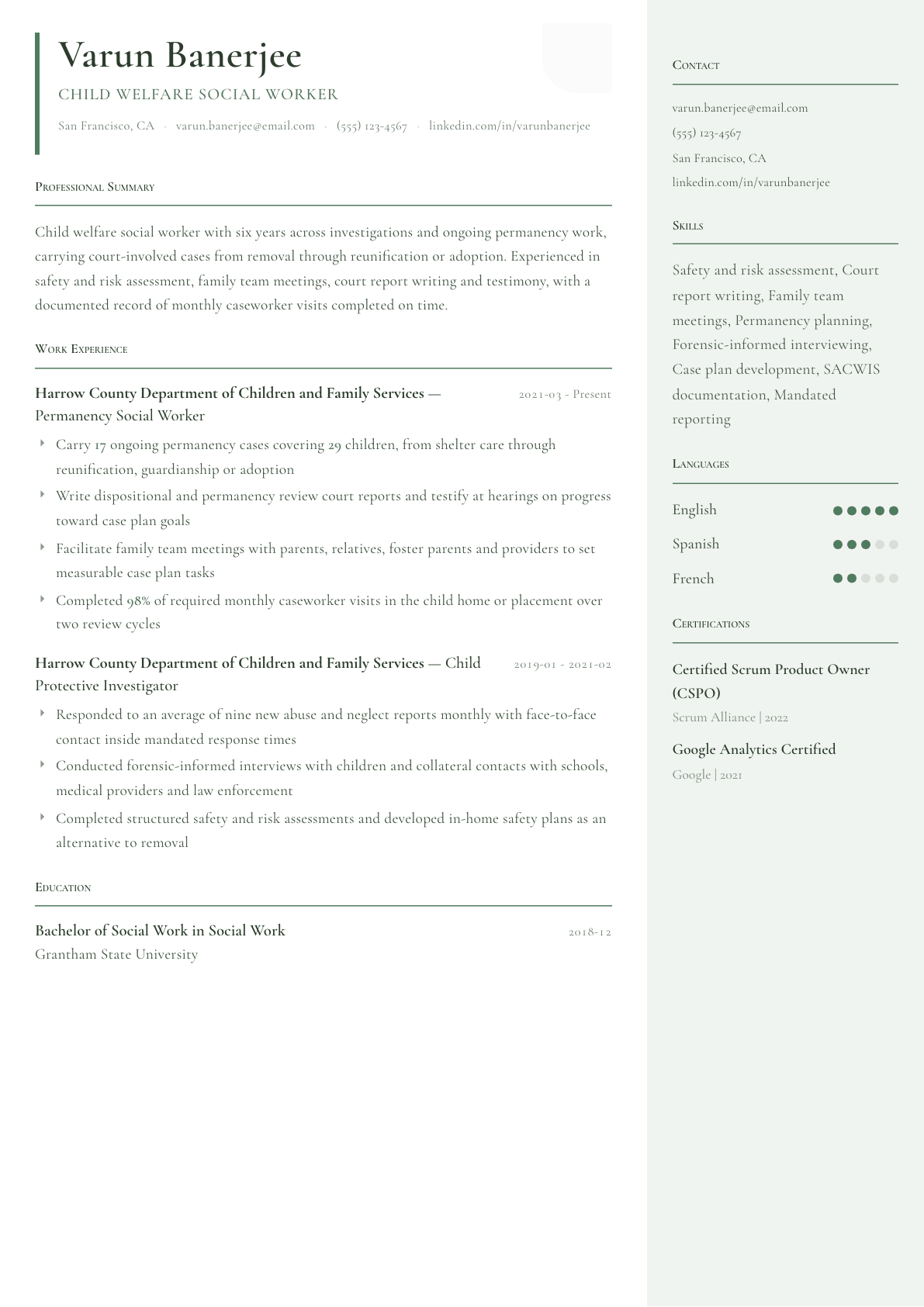
Example Child Welfare Social Worker summary
Child welfare social worker with six years of county experience spanning abuse and neglect investigations and ongoing permanency casework. Skilled in structured safety assessment, family team facilitation, court report writing and testimony, with strong monthly visit compliance across a court-involved caseload. Holds a bachelor of social work and current trauma-informed practice training. Seeking a permanency unit role with responsibility for complex sibling group cases.
Skills to list on a Child Welfare Social Worker resume
- Child safety assessment
- Structured risk assessment
- Permanency planning
- Court report writing
- Court testimony
- Family team decision making
- Case plan development
- Forensic-informed interviewing
- Kinship and relative placement
- Reunification services
- Concurrent planning
- Mandated reporting
- Trauma-informed practice
- Interagency coordination
What actually gets this resume read
- Separate investigation work from ongoing permanency work, because counties hire for those tracks differently.
- Give caseload size in both cases and children, since one case can cover a sibling group of five.
- Show court competence: reports written, hearing types attended, and whether you testified under cross-examination.
- Name the state case management system you documented in and your monthly visit compliance record.
- Include the assessment tools you used by name rather than writing that you assessed safety and risk.
- Mention trauma-informed and cultural humility training with the provider, because interview panels ask about it.
How to write a child welfare social worker resume
County child welfare hiring is unusual: the agency is almost always understaffed, the interview panel has read hundreds of applications, and the thing they are screening for is not enthusiasm but durability. Can this person carry seventeen open cases, drive to a home at eight at night, write a report a judge will accept, and still be here in eighteen months. Your resume answers that or it does not.
The other screening layer is track. Investigation, ongoing permanency, licensing and adoption are separate jobs inside the same agency, and a supervisor hiring for a permanency unit reads an investigations resume differently than an applicant expects. Say which track you worked, in what order, and for how long, because the transferable pieces are obvious once labeled and invisible when they are not.
This guide covers the section order county panels expect, how to describe caseload and court work honestly, the training that carries weight, three summaries from a new bachelor-level worker to a unit lead, and the bullets that turn a case description into evidence of competence.
Format: track, caseload and court work visible on page one
Reverse-chronological, one to two pages. Directly under the summary, name the track and the caseload you carry now. Panels move fast through a stack, and the two questions they answer first are what kind of casework you do and how much of it.
If you moved between units inside the same agency, list each as a separate position with its own dates rather than compressing them. Movement from investigations to permanency is a career progression that a supervisor reads as growth, and a merged entry hides it.
- Header: name with degree, city and state, phone, email, social work license or state child welfare certification.
- Order: summary, licensure and certification, child welfare experience by unit, other social service experience, education, training.
- State driving status and vehicle access, because home visits are mandatory and agencies verify it early.
Summary: unit, caseload, and court exposure
Give years in child welfare, the units you have worked, the current caseload in cases and in children, and your court exposure. A worker carrying seventeen ongoing permanency cases covering twenty-nine children who writes their own court reports and testifies at review hearings has answered the panel before the first question.
If you are entering child welfare from another field, name the transferable core: assessment under time pressure, documentation held to an external standard, home-based work, and coordination across agencies. Then name the training you completed toward the move so the panel sees a deliberate step, not a fallback.
Experience: case counts, safety decisions and the court file
Every position needs volume before narrative. Investigations: reports received monthly, response time standard, face-to-face contact rate. Ongoing: open cases, children served, monthly visit compliance, average case length. These numbers are the language supervisors use in their own unit meetings, so writing in them proves you have sat in those meetings.
Then bullets around decision points. Structured safety and risk assessments completed, in-home safety plans built as an alternative to removal, relative and kinship searches conducted, family team meetings facilitated, concurrent planning maintained while reunification services ran, and transitions to guardianship or adoption completed. Each one is a judgment call that a supervisor has to trust you with.
Court work deserves its own bullets. Dispositional reports, permanency review reports, court report timeliness, hearing types attended, and whether you have testified under cross-examination. A worker who has held up under a defense attorney is worth more to a unit than one who has only written reports.
- Give caseload in cases and in children, because sibling groups change the workload completely.
- Name the assessment instruments and the state case management system by name.
- Include monthly caseworker visit compliance if you tracked it, since federal review measures it.
- Describe collateral coordination: schools, pediatricians, treatment providers, law enforcement, tribal representatives.
Training and legal knowledge worth listing
List completed academy or pre-service training with the state or provider, plus specialized training that changes what you can be assigned. Forensic-informed interviewing, trauma-focused treatment models, family engagement frameworks and any court report writing training all qualify. Skip the annual compliance refreshers unless they are specialized.
Do not paraphrase statute on your resume. Naming the case types you have handled and the hearing types you have attended demonstrates legal familiarity far better than reciting standards, and it cannot be caught out by a panel member who works in a different state.
Keywords county applicant systems match against
The recurring terms are consistent across states: safety assessment, risk assessment, safety plan, case plan, permanency, reunification, concurrent planning, kinship placement, family team decision making, court report, dispositional hearing, monthly caseworker visit, mandated reporting and trauma-informed practice. Mirror the posting language rather than agency-specific jargon from your last county.
Name the case management system you documented in. Every state has one, panels know theirs, and an applicant who has used a comparable statewide system will be onboarded faster.
Child Welfare Social Worker resume summary examples
New to the agency
Bachelor of social work graduate with a field placement in a county child welfare unit, shadowing investigations, completing collateral contacts and drafting case notes under supervision. Completed state pre-service training and forensic-informed interviewing coursework. Seeking an investigations position with a county that invests in structured mentoring for new workers.
Four years, both tracks
Child welfare worker with two years in investigations and two in ongoing permanency, currently carrying 17 cases covering 29 children. Writes dispositional and permanency review reports, facilitates family team meetings and maintains concurrent planning while reunification services run. Completed 98% of monthly caseworker visits across two review cycles.
Unit lead
Senior child welfare social worker and acting unit lead with nine years across investigations, permanency and adoption. Reviews court reports for a team of six, carries the complex sibling group cases, and represents the agency at contested permanency hearings. Trained new workers through their first independent removals for four consecutive intake classes.
Work experience bullets: before and after
Before: Managed a caseload of children in foster care.
After: Carried 17 ongoing permanency cases covering 29 children, moving each from shelter care through reunification, guardianship or adoption with quarterly case plan reviews.
Cases, children and the permanency arc show the actual load, since one case can hold a sibling group of five.
Before: Wrote reports for court.
After: Wrote dispositional and permanency review court reports on filing deadlines and testified at hearings on progress toward case plan goals, including two contested matters.
Report types, deadline compliance and contested testimony demonstrate the court competence a supervisor must verify.
Before: Assessed families for safety concerns.
After: Completed structured safety and risk assessments on each new referral and built in-home safety plans with relatives and community supports as an alternative to removal where safety allowed.
The structured tool and the least restrictive outcome show a decision process rather than a general impression of a home.
Before: Held meetings with families and providers.
After: Facilitated family team meetings with parents, relatives, foster parents, therapists and school staff to set measurable case plan tasks with named owners and review dates.
Naming the participants and the output turns a meeting into a planning process that produces accountable tasks.
Before: Visited children regularly.
After: Completed 98% of required monthly caseworker visits in the child home or placement across two review cycles, documenting each contact in the state case management system within 72 hours.
A compliance rate and a documentation turnaround speak directly to the federal review measure the agency is graded on.
Hard skills
- Structured safety assessment
- Risk assessment instruments
- Permanency and concurrent planning
- Case plan development and review
- Court report writing
- Court testimony
- Family team decision making
- Forensic-informed child interviewing
- Kinship and relative search
- Reunification service coordination
- Statewide case management system documentation
- Mandated reporting procedure
- Placement stability planning
- Interagency and law enforcement coordination
Soft skills
- Composure in hostile home settings
- Engagement with resistant parents
- Decision making under time pressure
- Written clarity for a legal audience
- Boundaries and secondary trauma management
- Reliability on an on-call rotation
Certifications worth listing
- Certified Advanced Children, Youth and Family Social Worker (C-ACYFSW) (National Association of Social Workers)
- Forensic Interviewing of Children (National Children's Advocacy Center)
- Trauma-Focused Cognitive Behavioral Therapy Certification (TF-CBT National Therapist Certification Program)
- Licensed Bachelor Social Worker (LBSW) (State social work licensing board)
Mistakes that cost child welfare social worker candidates the interview
- Writing caseload only in cases, which understates the workload of a worker carrying several large sibling groups.
- Leaving the track unlabeled, so a permanency supervisor cannot tell whether your experience transfers to their unit.
- Omitting court work entirely, when report writing and testimony are the skills that take longest to develop.
- Including identifying case detail to show difficulty, which reads as a confidentiality risk to every reviewer.
- Listing only pre-service training and no specialized coursework, which suggests no development since the first year.
- Hiding a move between counties or agencies, when child welfare turnover is understood and honest dates raise no concern.
Child Welfare Social Worker resume questions
Do I need a social work degree to work in child welfare?
Many counties accept a related bachelor degree in psychology, sociology or human services, while others require a social work degree or give it hiring preference. Check the posting, list your degree accurately, and add any state child welfare certification you completed through a training partnership.
How do I write a child welfare resume after leaving the field and coming back?
Name the gap plainly with what you did during it, then lead with the child welfare experience rather than the recent unrelated job. Add any refresher or recertification training you completed. Agencies rehire returning workers regularly because the learning curve is already paid for.
Should I mention burnout or high caseloads on my resume?
Not as a complaint, but do state the caseload numbers you carried. High volume handled with good visit compliance and timely court reports is a strength on the page. Save the discussion of sustainability and what support you need for the interview conversation.
How do I move from investigations into permanency work?
Lead with the ongoing-facing parts of your investigations experience: safety plan development, service referrals, relative searches and the cases you carried past the initial assessment window. Then name any permanency training you completed. The gap a supervisor worries about is court report writing, so address that directly.
What should a child welfare resume say about on-call work?
State the rotation frequency and what you covered, such as after-hours removals, emergency placements or hospital responses. On-call reliability is a real staffing problem for agencies, and a worker with a documented history of taking that rotation is easier to hire.
Related resume examples
- Case Manager Resume example
- Social Worker Resume example
- Child Protective Services Worker Resume example
- Foster Care Case Manager Resume example
- Victim Advocate Resume example
- Licensed Clinical Social Worker Resume example