Caseworker Resume Examples: free ATS score and gap list
Write a Caseworker Resume That Proves You Can Carry the Load
By Mustafa Tarabya, founder of CVBooster · Published · Updated
A caseworker resume guide with caseload keywords, assessment and documentation examples, and a sample tuned to agency hiring panels.
Sample resumes for a caseworker
The same caseworker content laid out in three CVBooster templates, so you can see what the finished document looks like before you write a word.
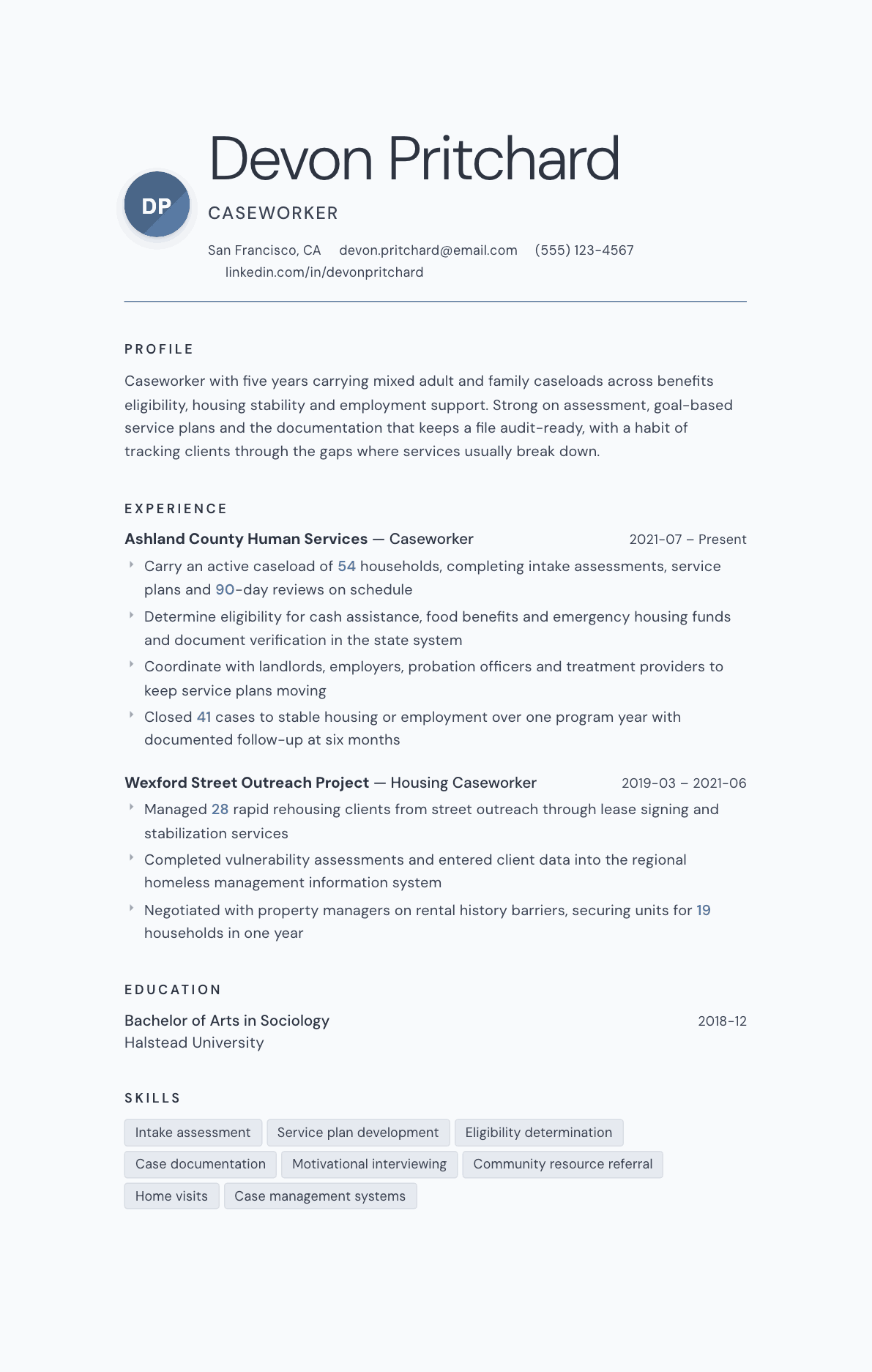
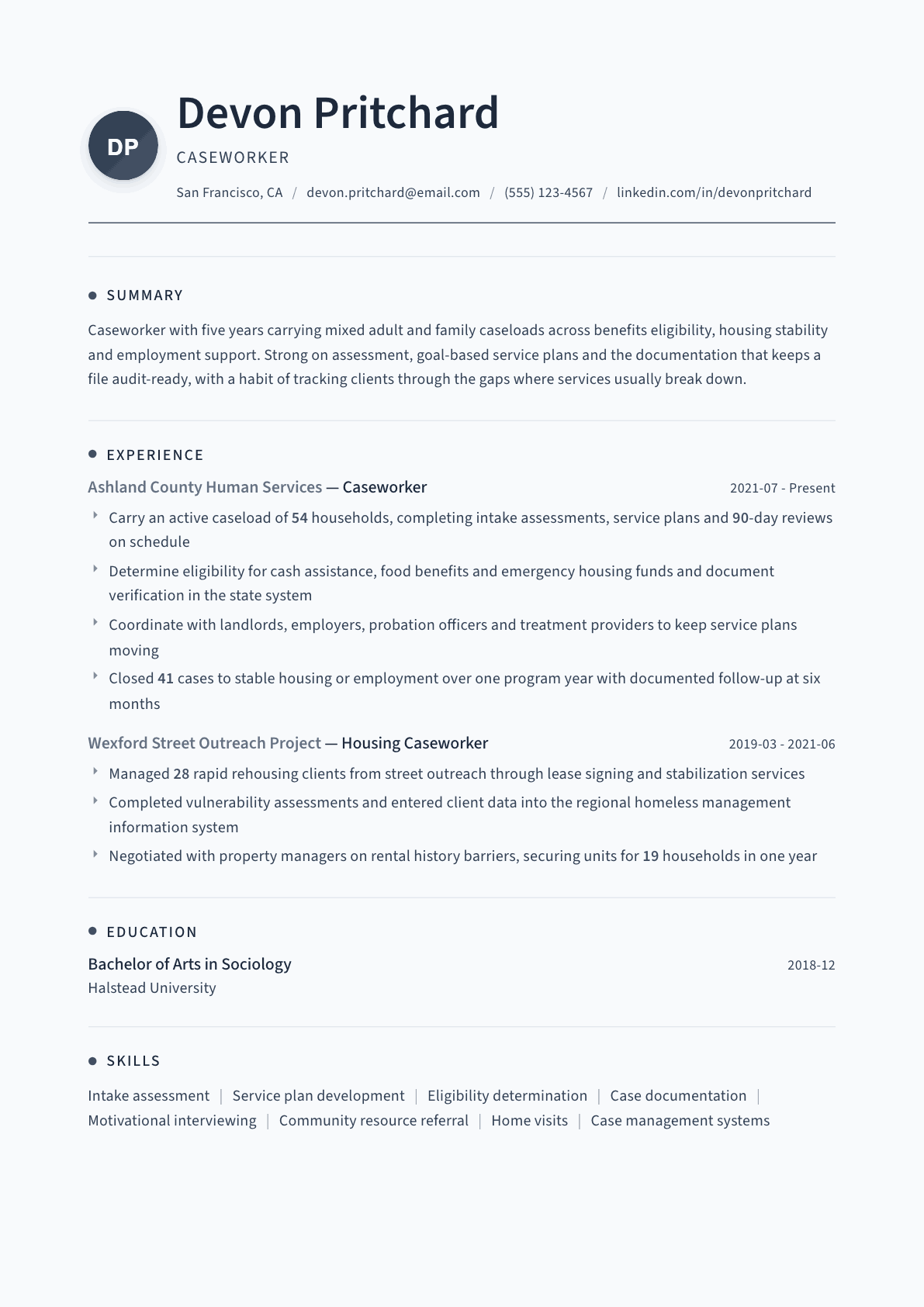
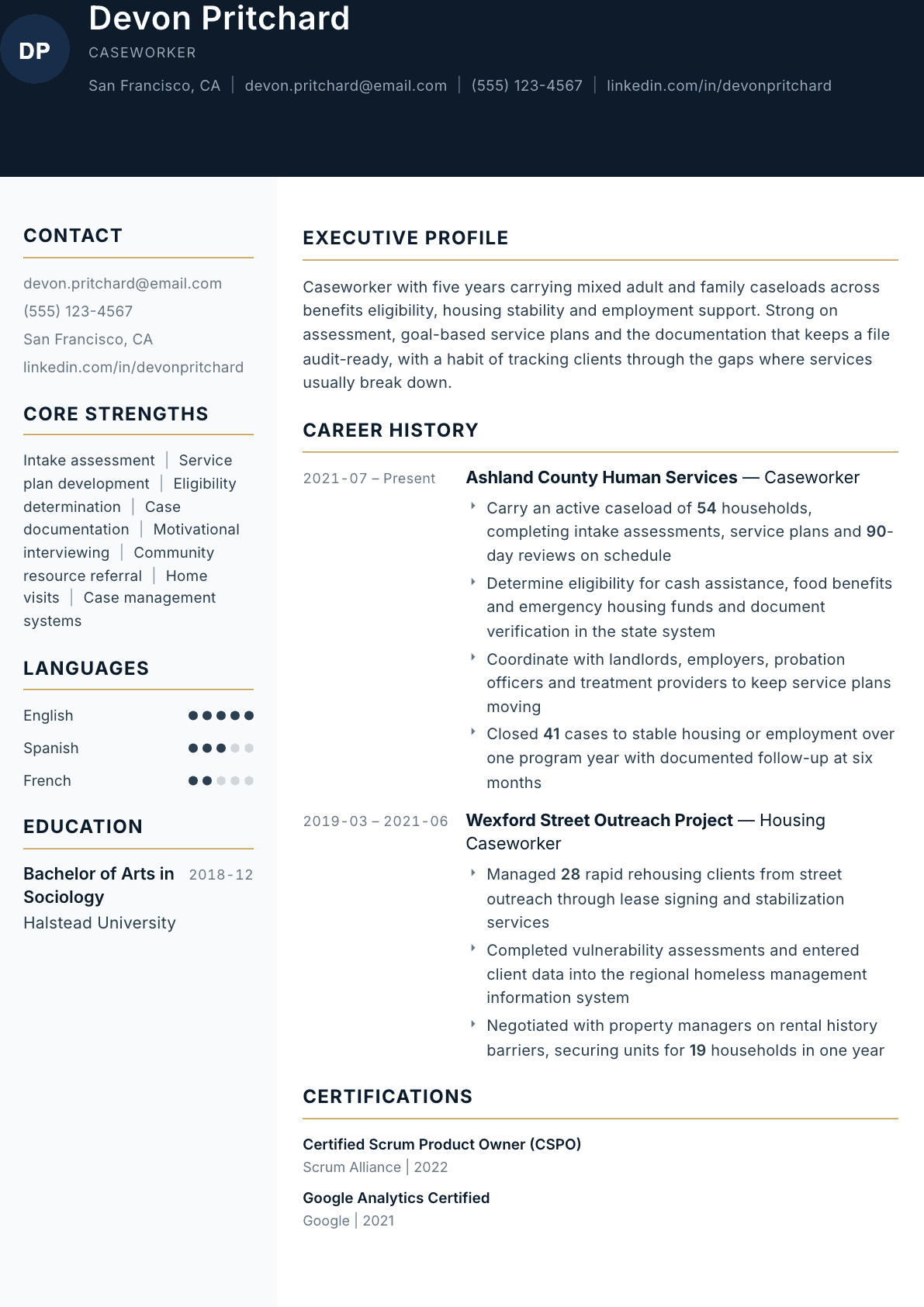
Example Caseworker summary
Caseworker with five years managing mixed household caseloads across benefits eligibility, housing stability and employment support. Runs a full case cycle from intake assessment through service planning, reviews and documented closure, and keeps files audit-ready under county and grant requirements. Trained in motivational interviewing and comfortable doing field visits in unpredictable settings. Seeking a caseworker position with a specialized housing or reentry population.
Skills to list on a Caseworker resume
- Caseload management
- Intake and needs assessment
- Service plan development
- Eligibility determination
- Motivational interviewing
- Case note documentation
- Home visits and field work
- Crisis de-escalation
- Community resource referral
- Homeless management information system
- Benefits navigation
- Court and provider collaboration
- Client advocacy
- Case closure and follow-up
What actually gets this resume read
- State your caseload in the unit your agency counts: households, individuals or families, and whether it was court-involved.
- Show the case cycle you ran, from intake assessment through service plan, review dates and closure.
- Name the eligibility programs and the state or regional database you documented in.
- Prove documentation quality with audit results, timeliness rates or review completion rather than adjectives.
- Describe collateral work with landlords, employers, courts and treatment providers, since coordination is the job.
- Include home visits, field safety practice and any de-escalation training you have completed with the provider named.
How to write a caseworker resume
Caseworker is one of the least standardized titles in human services. The same word covers eligibility determination at a county office, housing stabilization in a nonprofit, reentry support after incarceration, refugee resettlement and employment services. A hiring supervisor reading your resume is first trying to work out which version of the job you have done, and how much of it transfers to theirs.
So the resume has to answer that in the first inch of the page. Population served, caseload size, the case cycle you ran, whether the work was office-based or in the field, and what documentation standard your files were held to. Once those are clear, everything else you write lands. Without them, a strong candidate reads as generic.
This guide covers how to lay the page out, how to describe a caseload honestly, what to say about assessment and service planning, three summaries at different stages, and rewritten bullets that show a worker who closes cases rather than one who carries them indefinitely.
Format: one page early, two once the caseloads add up
Reverse-chronological order with a short capability line under the summary naming the populations you have served and the systems you have documented in. Supervisors sort applications by fit to their population first, so make that sortable at a glance.
Skip the objective statement. The summary should already say what you are looking for by describing what you carry, and a separate objective takes a line that a caseload figure could occupy.
- Header: name, city and state, phone, email, license or certification if you hold one, languages spoken.
- Order: summary, populations and systems line, casework experience, other human services experience, education, training.
- State driving status and field work experience, because home and community visits are standard in most caseworker roles.
Summary: population, caseload, and the cycle you run
Say the years, the populations, the active caseload and the cycle. A caseworker carrying fifty-four households through intake assessment, service planning and ninety-day reviews on schedule has described a complete case process, which is what a supervisor is actually buying.
If your caseload was smaller but more intensive, say that instead of hiding it. Twenty-eight rapid rehousing clients worked from street outreach through lease signing is a heavier job than a large eligibility caseload, and a supervisor who knows the field will read it correctly if you give the detail.
Experience: the case from intake to closure
Structure your bullets along the case cycle so a reader can see you run all of it. Intake and needs assessment with the tool you used, service plan development with measurable goals and review dates, ongoing contact frequency, collateral coordination, and closure with a documented outcome and follow-up. Most caseworker resumes stop at carrying a caseload and never mention closing one.
Collateral work is the part that separates experienced caseworkers. Landlords, employers, probation officers, treatment providers, schools, benefits offices and medical providers. Say who you coordinated with and what you were negotiating for, because that is where the actual progress on a case comes from.
Field practice deserves a bullet. Home visits, street outreach, meeting clients at a shelter or a courthouse, and how you managed safety in those settings. Supervisors hiring for a field position want to know you have worked outside an office and know how to do it without incident.
- Give caseload in the unit your agency counted: households, individuals or families.
- Name the assessment instrument and the database you documented in.
- Show the review cycle and your timeliness on it.
- Include closure outcomes and any follow-up interval you tracked.
Documentation: prove it rather than claim it
Every caseworker writes that they maintained accurate records. What distinguishes a resume is evidence: an audit result, a timeliness standard you held, a review completion rate, or a corrective action you closed. Files are the product a funder or a court actually inspects, and the ability to keep them clean under volume is a genuine skill.
If you have used a regional or statewide data system, name it. Homeless management information systems, state benefits platforms and county case management systems all take time to learn, and a candidate who already knows one starts producing sooner.
Keywords hiring supervisors search on
The stable vocabulary across caseworker postings: intake, needs assessment, service plan, goal setting, case notes, caseload management, eligibility determination, benefits navigation, resource referral, home visit, motivational interviewing, crisis de-escalation, client advocacy, case closure and follow-up. Use the posting language rather than your former agency shorthand.
Add the population terms the posting uses, whether that is households experiencing homelessness, justice-involved adults, refugees, families at risk of separation or older adults. Population match is the strongest filter in this field.
Caseworker resume summary examples
New caseworker
Sociology graduate with an internship at a community outreach project, completing intake forms, accompanying caseworkers on home visits and entering client data into a regional database. Trained in motivational interviewing basics and mandated reporting. Seeking a caseworker position serving families in a housing or benefits program.
Four years, mixed caseload
Caseworker carrying 54 households across benefits eligibility, housing stability and employment support. Completes intake assessments, service plans and 90-day reviews on schedule, and coordinates with landlords, employers and treatment providers. Closed 41 cases to stable housing or employment in one program year with six-month follow-up documented.
Senior caseworker
Senior caseworker with nine years across street outreach, rapid rehousing and reentry services, currently carrying the complex cases and mentoring three newer staff. Runs the intake triage rotation, leads the weekly case conference, and has held file audit compliance high across four monitoring cycles. Seeking a lead or supervisory role.
Work experience bullets: before and after
Before: Managed a caseload of clients in a social services program.
After: Carried an active caseload of 54 households, completing intake assessments, individualized service plans and 90-day reviews on schedule across benefits, housing and employment goals.
Caseload size, the case cycle and the goal areas describe the full job rather than the fact that a caseload existed.
Before: Determined whether clients were eligible for programs.
After: Determined eligibility for cash assistance, food benefits and emergency housing funds, verifying income and residency documentation in the state system before authorization.
Named programs and the verification step show the decision process an auditor would review.
Before: Referred clients to other agencies.
After: Coordinated with landlords, employers, probation officers and treatment providers to remove barriers in service plans, and confirmed each referral had started before the next review.
Naming the collateral contacts and confirming service start turns a referral list into coordination that produced movement.
Before: Helped clients find housing.
After: Negotiated with property managers on rental history and credit barriers for rapid rehousing clients, securing units for 19 households in one year.
The specific barrier, the negotiation and the housed count show how the outcome was actually achieved.
Before: Kept case files up to date.
After: Documented all client contacts in the case management system within 48 hours and maintained review timeliness through four funder monitoring cycles without a corrective action.
A documentation standard plus a monitoring result makes file quality verifiable instead of self-reported.
Hard skills
- Caseload management
- Intake and needs assessment
- Individualized service plan development
- Eligibility determination
- Benefits navigation
- Motivational interviewing
- Case note documentation
- Home visits and field outreach
- Crisis de-escalation
- Community resource referral
- Homeless management information system entry
- Case closure and follow-up tracking
- Court and provider collaboration
- Program reporting
Soft skills
- Persistence with hard to reach clients
- Nonjudgmental engagement
- Personal safety awareness in the field
- Prioritizing a full caseload
- Advocacy without overpromising
- Emotional durability
Certifications worth listing
- Certified Social Work Case Manager (C-SWCM) (National Association of Social Workers)
- Certified Case Manager (CCM) (Commission for Case Manager Certification)
- Mental Health First Aid (National Council for Mental Wellbeing)
- Licensed Bachelor Social Worker (LBSW) (State social work licensing board)
Mistakes that cost caseworker candidates the interview
- Using the title caseworker without naming the population, so a supervisor cannot tell eligibility work from intensive field casework.
- Giving no caseload number, which leaves the reader unable to judge whether you have worked at their volume.
- Describing only what clients received and never what you decided, which reads as an intake clerk rather than a caseworker.
- Ending the story at service delivery with no closure or follow-up, when outcomes are what the funder pays for.
- Listing motivational interviewing as a skill without any bullet showing how it changed a conversation with a client.
- Leaving field work implicit, when home visits and outreach carry safety and judgment expectations a supervisor must confirm.
Caseworker resume questions
What degree do I need to work as a caseworker?
Most positions ask for a bachelor degree in social work, psychology, sociology or human services, and some accept equivalent experience. Clinical assessment or supervision duties usually push the requirement to a social work degree with licensure, so read the posting rather than assuming.
How do I describe a caseload that changed constantly?
Give the typical active number and the range, then the annual total served. Saying you carried around fifty active households at any time and served roughly one hundred forty across the year is accurate and gives a supervisor both the load and the turnover picture.
Is caseworker the same as case manager on a resume?
The titles overlap and agencies use them differently. Use the title your employer gave you, then describe the work in enough detail that the reader can map it to their own structure. Never upgrade the title yourself, because references and background checks confirm it.
How do I show results when clients do not always succeed?
Report what you can defend: cases closed to a positive outcome, retention at a set interval, referral completion or plan review timeliness. Human services outcomes are partial by nature, and a supervisor trusts a candidate who reports honestly more than one claiming universal success.
Should I list de-escalation or safety training?
Yes, with the provider and the year completed. Field-based casework carries real safety expectations, and agencies want to see that you have been trained rather than relying on instinct. Pair it with a short line about how you plan visits and check in with the office.
Related resume examples
- Case Manager Resume example
- Social Worker Resume example
- Housing Case Manager Resume example
- Family Support Worker Resume example
- Social Services Assistant Resume example
- Peer Support Specialist Resume example