CNC Programmer Resume Examples: the lines they read
A CNC Programmer Resume That Shows CAM, Posts and Cycle Time
By Mustafa Tarabya, founder of CVBooster · Published · Updated
CNC programmer resume example with CAM, post processor and fixturing keywords, plus a guide to writing cycle time and tooling results.
Sample resumes for a cnc programmer
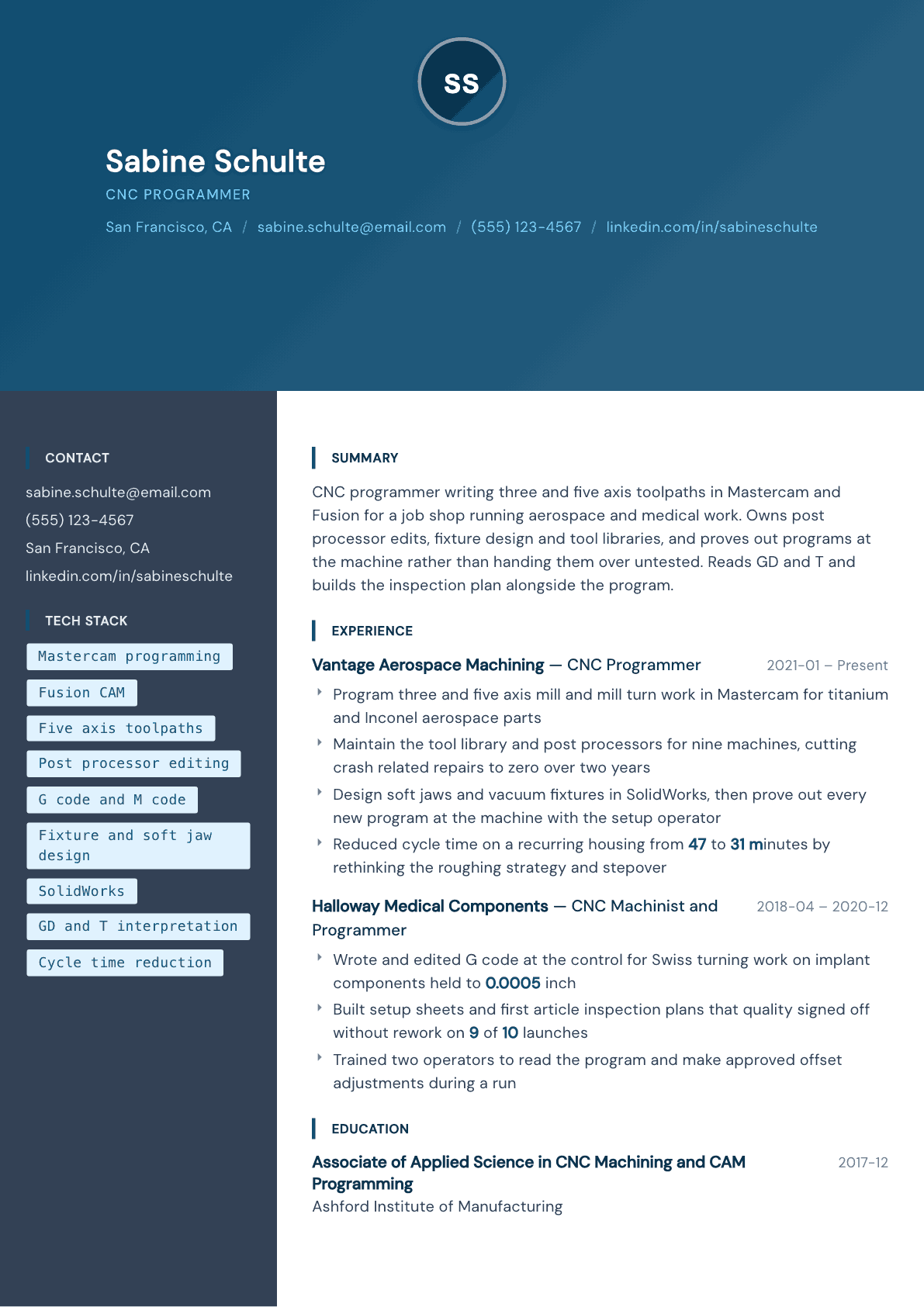
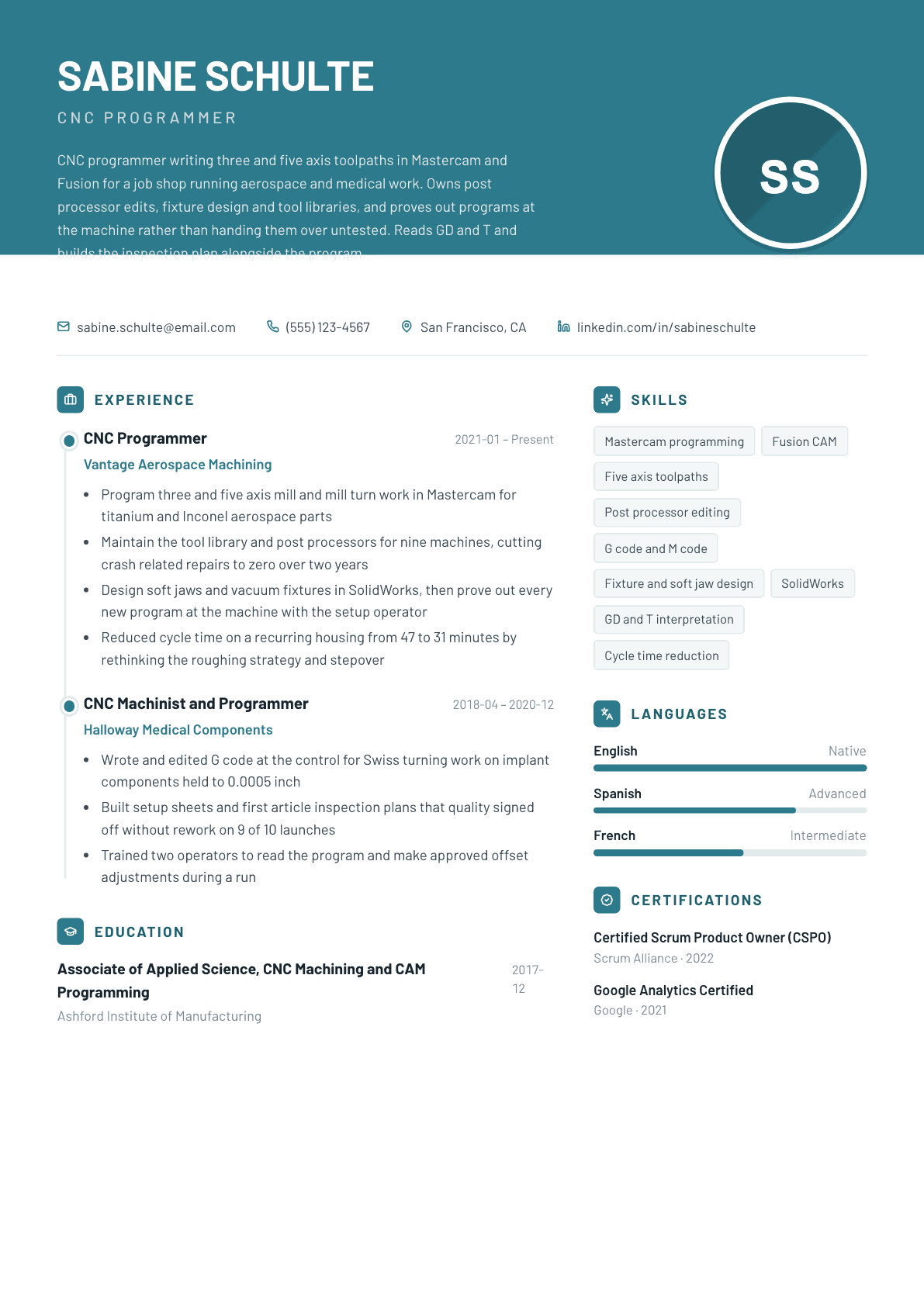
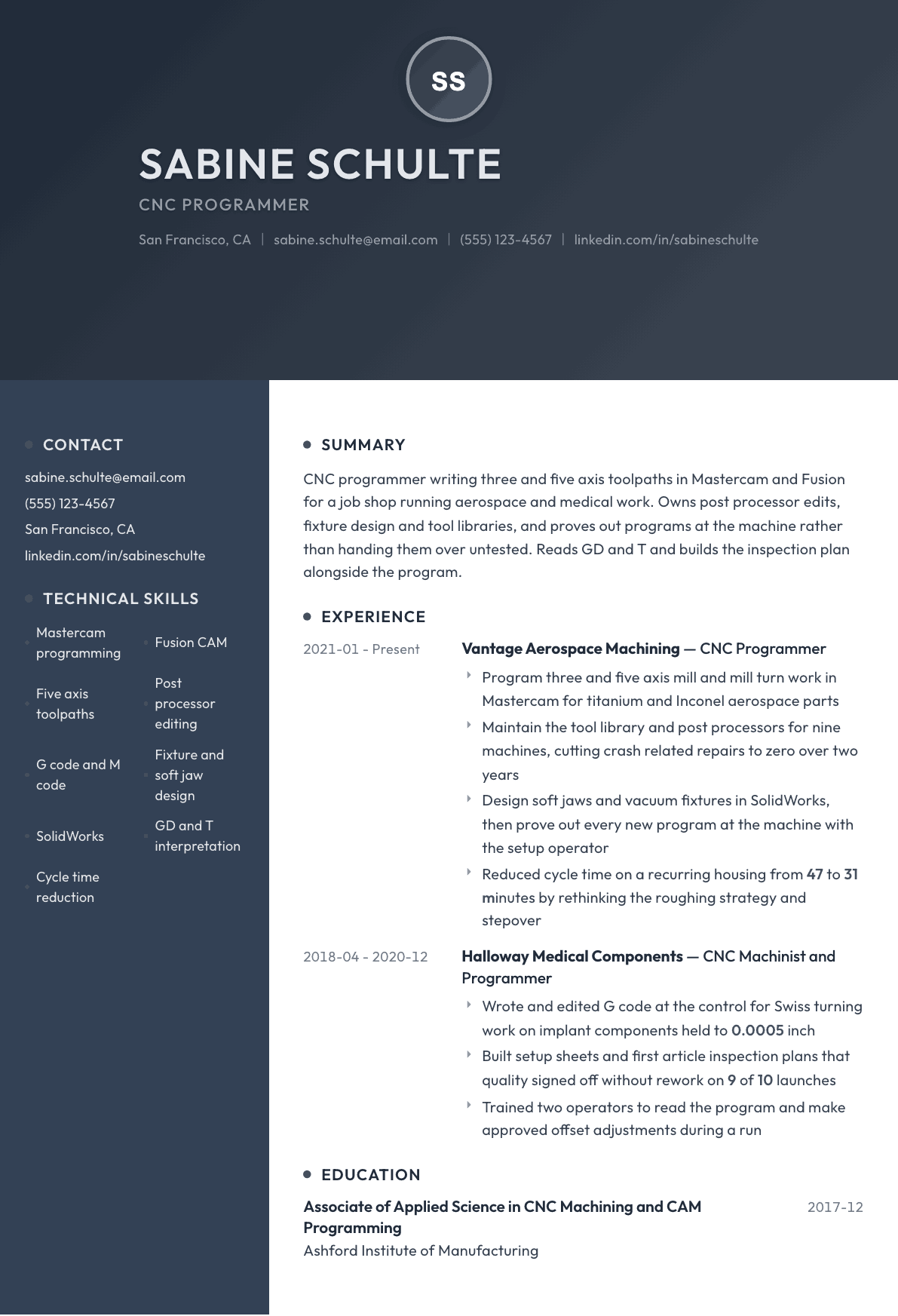
The same cnc programmer content laid out in three CVBooster templates, so you can see what the finished document looks like before you write a word.
Example CNC Programmer summary
CNC programmer writing three and five axis toolpaths in Mastercam and Fusion for aerospace and medical work in titanium, Inconel and stainless. Owns the tool library and post processors across nine machines, designs soft jaws and vacuum fixtures in SolidWorks, and proves out every program at the machine with the setup operator. Cut cycle time on a recurring housing by rethinking the roughing strategy.
Skills to list on a CNC Programmer resume
- Mastercam
- Fusion CAM
- Three, four and five axis programming
- Mill turn programming
- Post processor editing
- G code and M code editing
- Tool library management
- Speeds and feeds selection
- Fixture and soft jaw design
- SolidWorks modeling
- GD and T interpretation
- First article inspection planning
- Setup sheet authoring
- Cycle time reduction
- Program prove out
- Operator training
What actually gets this resume read
- Name your CAM package and version depth, because a shop on Mastercam will not interview a Fusion only programmer blindly.
- Separate three axis, four axis, five axis and mill turn work, since each one changes what a shop can hand you.
- Give a cycle time you cut and how you cut it, because that is the return a shop buys when it hires a programmer.
- Mention post processor editing, since owning the posts is what separates a programmer from a CAM operator.
- List the materials and the tolerances, especially titanium, Inconel, stainless and anything under a thousandth.
- Say whether you prove out at the machine, because programmers who never touch the floor are a known risk.
How to write a cnc programmer resume
A CNC programmer is hired to convert a model and a print into metal that passes inspection at a cost the shop can quote. So the resume is read as a business case: which CAM package you drive, how many axes you handle, what you cut, and what your programs did to cycle time, tool consumption and scrap on the first article.
The owner or engineering manager reading it is also checking for a specific risk. Programmers who never leave the office write toolpaths that look elegant in the simulation and crash on the floor. Evidence that you prove out at the machine with the setup operator is worth as much as any software skill you list.
This guide covers structuring the software and machine block, writing programming work as outcomes rather than as file counts, showing fixture and post processor ownership, and answering the questions programmers ask when moving between job shops, production shops and regulated work.
Format: one page early, two once you own posts and fixtures
One page until you have several years and multiple machine platforms behind you, then two. Reverse chronological with a technical block near the top listing CAM software, machine platforms and controls, axis capability and the design tool you model fixtures in. That block is the qualification summary for this role.
Resist the urge to design the page. Job shops care about what you can hold and how fast you can turn a quote into a running job. A clean two column free layout that prints correctly and lists real machines beats anything decorative, and it survives whatever applicant tracking system sits in front of the hiring manager.
- Technical block: CAM package, controls, machine platforms, axis counts, modeling software.
- Sections: summary, technical block, programming experience, materials and tolerances, certifications.
- Add a short line on the industries you have programmed for, since aerospace, medical and automotive differ sharply.
Summary: package, axes, material, and one result
Name the CAM package, the axis range, the materials and one measurable outcome. Writing three and five axis toolpaths in a named CAM system for titanium and nickel alloy aerospace parts, owning the posts across nine machines, and cutting a recurring housing cycle from forty seven to thirty one minutes covers every screening question at once.
Be exact about axis capability. Three axis with a fourth axis indexer is not the same claim as full simultaneous five axis, and a shop with a five axis machine sitting underused will find out on day one. State it precisely and the resume gains credibility everywhere else.
Experience: toolpaths, posts, fixtures and prove out
Anchor each job with the shop type, the machine count and the work mix. Then write bullets in four groups: the programming itself, the infrastructure you maintain, the fixturing you design, and the prove out you perform on the floor.
Programming bullets should carry the material and the outcome. Roughing strategy changes, stepover and stepdown decisions, high feed tooling and trochoidal paths are all worth naming when they produced a cycle time or tool life result you can quote.
Infrastructure is where programmers separate themselves. Maintaining the tool library so every program pulls the same holder and gauge length, and editing post processors so a program runs correctly on a specific control, are the tasks that turn a CAM operator into a programmer. Say plainly that you own the posts if you do.
Fixturing and prove out complete the picture. Soft jaws, vacuum plates, tombstone layouts and custom fixtures designed in a modeling package show you solve the whole problem, and proving out with the setup operator shows you carry the consequences of your own decisions.
- Name the CAM package and be precise about three, four, five axis and mill turn work.
- Quote one cycle time reduction with the method that produced it.
- State whether you edit post processors and how many machines you support.
- Say where you design fixtures and whether you prove out at the machine.
Materials, tolerances and the inspection plan
Material is a proxy for difficulty in this trade. Titanium, nickel alloys, hardened tool steel and thin walled aluminum each demand different strategies, and naming them establishes your ceiling faster than a list of software features. Pair them with the tolerances you programmed to and the surface finish requirements you met.
Then mention the quality side. Programmers who build the setup sheet and the first article inspection plan alongside the program save the quality department a full cycle of back and forth. In aerospace and medical work this is often an explicit requirement, so say whether your first articles have passed without rework.
Working with operators: the part shops quietly weigh most
The programs a shop keeps are the ones operators can run. Setup sheets with clear tool lists and gauge lengths, sensible program stops, comments at the tool changes, and offsets left where an operator can adjust them are all craft decisions that show up as reduced downtime rather than as a line in a CAM feature list.
Say whether you train operators to read the program and make approved offset adjustments during a run. It signals that you think about the floor, and it is exactly the evidence a shop uses to distinguish a programmer it can trust with a full machine list from one who must be supervised.
CNC Programmer resume summary examples
Machinist moving into programming
CNC machinist with four years at the control writing and editing G code for turning work, now programming in CAM after completing a machining and CAM associate degree. Builds setup sheets and first article inspection plans, and understands prove out because the mistakes have always come back to his own machine.
Three years programming
CNC programmer writing three and four axis mill toolpaths and Swiss turning programs for medical components held to half a thousandth. Builds setup sheets and inspection plans that quality signs off without rework, and trains operators to make approved offset adjustments during a run.
Senior programmer, five axis aerospace
Senior CNC programmer writing three and five axis mill and mill turn programs for titanium and nickel alloy aerospace parts. Maintains the tool library and post processors across nine machines, designs soft jaws and vacuum fixtures, and cut a recurring housing from 47 to 31 minutes by rethinking the roughing strategy.
Work experience bullets: before and after
Before: Wrote CNC programs using CAM software.
After: Programmed three and five axis mill and mill turn work in a CAM system for titanium and nickel alloy aerospace parts across nine machines.
Axis range, material and machine count define the difficulty, which a bare software mention leaves completely open.
Before: Improved cycle times on several jobs.
After: Reduced cycle time on a recurring housing from 47 to 31 minutes by changing the roughing strategy and the stepover after tool life testing.
A named part, real before and after figures and the method behind them make the improvement a business case.
Before: Managed tooling and post processors.
After: Maintained the tool library and post processors for nine machines so every program pulled matching holders and gauge lengths, taking crash related repairs to zero over two years.
Tying the infrastructure work to an outcome shows why the maintenance mattered rather than that it existed.
Before: Designed fixtures for machining jobs.
After: Designed soft jaws and vacuum fixtures in a modeling package, then proved out every new program at the machine alongside the setup operator.
Pairing fixture design with floor prove out answers the main risk a shop associates with hiring a programmer.
Before: Created setup documentation.
After: Built setup sheets and first article inspection plans that quality signed off without rework on 9 of 10 new part launches.
A launch success rate turns documentation from paperwork into evidence that your programs land correctly the first time.
Hard skills
- CAM toolpath programming
- Three, four and five axis strategies
- Mill turn and Swiss programming
- Post processor editing
- G code and M code editing at the control
- Tool library management
- Speeds, feeds and tool life selection
- Soft jaw and vacuum fixture design
- Solid modeling for fixturing
- Geometric tolerancing interpretation
- First article inspection planning
- Setup sheet authoring
- Cycle time reduction
- Program prove out on the floor
Soft skills
- Working with setup operators
- Cost awareness on tooling
- Precise written instructions
- Patience during prove out
- Curiosity about failed cuts
Certifications worth listing
- Machining Level II: CNC Milling Programming, Setup and Operations (National Institute for Metalworking Skills)
- Certified SOLIDWORKS Associate (CSWA) (Dassault Systemes)
- Certified Manufacturing Technologist (CMfgT) (SME)
Mistakes that cost cnc programmer candidates the interview
- Naming a CAM package without saying which axis configurations you actually program in it.
- Claiming five axis work when the machines were three axis with an indexer, which a shop discovers immediately.
- Listing programs written as a count, when a shop buys cycle time, tool cost and first article success.
- Never mentioning post processors, which is the clearest signal separating a programmer from a CAM operator.
- Leaving prove out off the page, so the reader assumes you hand programs over untested.
- Ignoring the setup sheet and inspection plan, which are half of what makes a program usable on the floor.
CNC Programmer resume questions
How much does the specific CAM package matter to employers?
A great deal, because retraining costs weeks of productivity. Name your primary package first and any secondary ones honestly, and mention post processor and tool library work, since that experience transfers across systems more than menu familiarity does.
Should I list the number of programs I have written?
No. A program count tells a shop nothing about difficulty or quality. Replace it with cycle time results, first article pass outcomes, the materials you have cut and the tolerances you have programmed to, which are the things being bought.
Do I need machining experience to be hired as a programmer?
Most shops strongly prefer it, because a programmer who has run parts writes toolpaths an operator can actually use. If your background is design led, emphasize your prove out work at the machine and any time spent setting jobs up yourself.
How do I present five axis experience honestly?
Distinguish three plus two positional work from full simultaneous motion, and say which machine platforms you programmed for. Being precise costs you nothing with shops that run three plus two and protects you from a job you cannot deliver.
What belongs on a programmer resume for aerospace or medical work?
Traceability and documentation. Setup sheets, first article inspection plans, revision control on programs, and the tolerance and finish requirements you met. Those regulated sectors are buying repeatability, so evidence of controlled process matters as much as speed.
Related resume examples
- CNC Machinist Resume example
- Machinist Resume example
- CNC Operator Resume example
- Manufacturing Engineer Resume example
- Metal Fabricator Resume example
- Machine Operator Resume example