CNC Operator Resume Examples: free ATS score and gap list
A CNC Operator Resume That Lists Controls, Tolerances and Parts
By Mustafa Tarabya, founder of CVBooster · Published · Updated
CNC operator resume example with control, offset and inspection keywords, plus a guide to writing tolerances, setups and cycle time results.
Sample resumes for a cnc operator
The same cnc operator content laid out in three CVBooster templates, so you can see what the finished document looks like before you write a word.
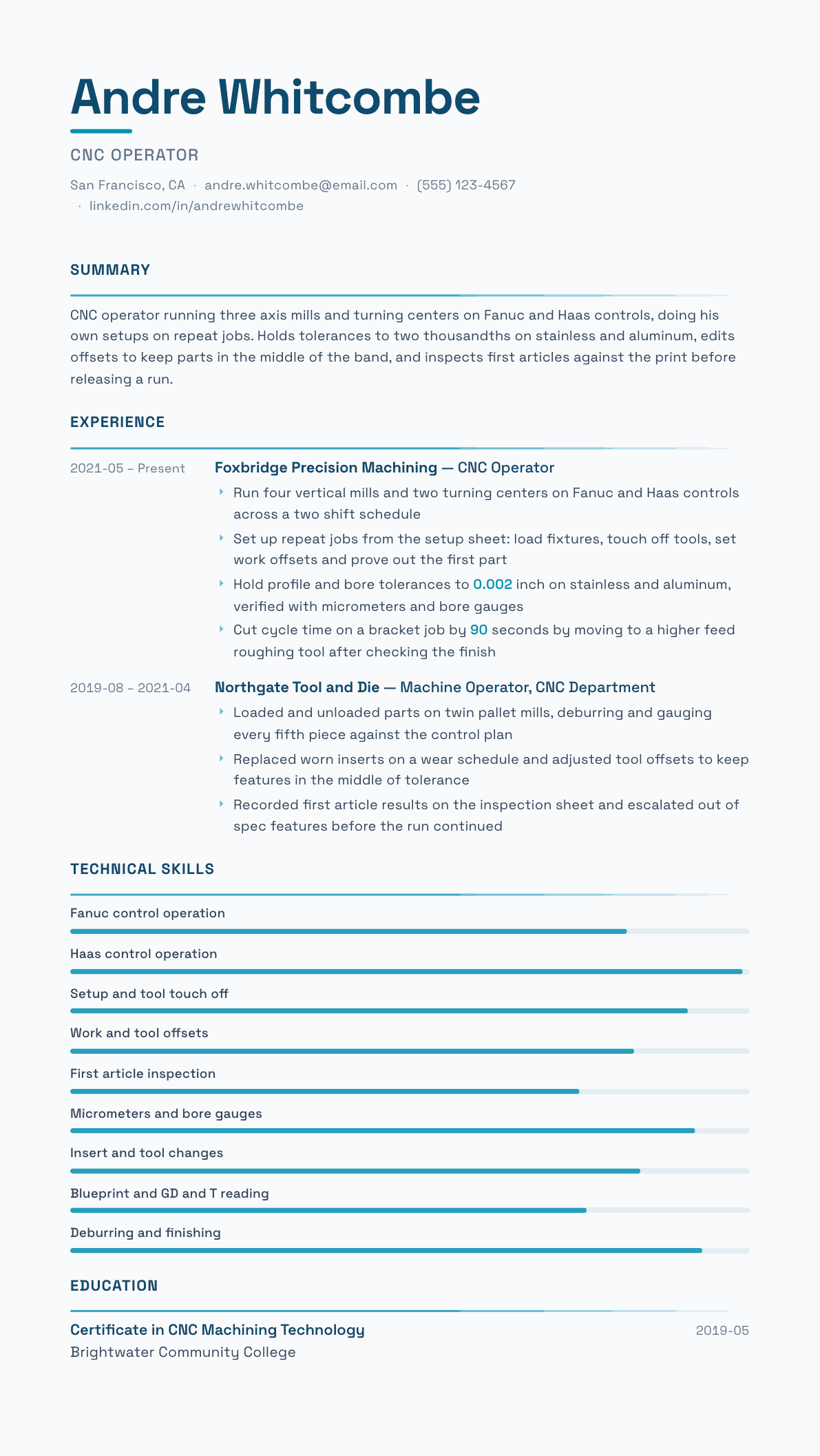
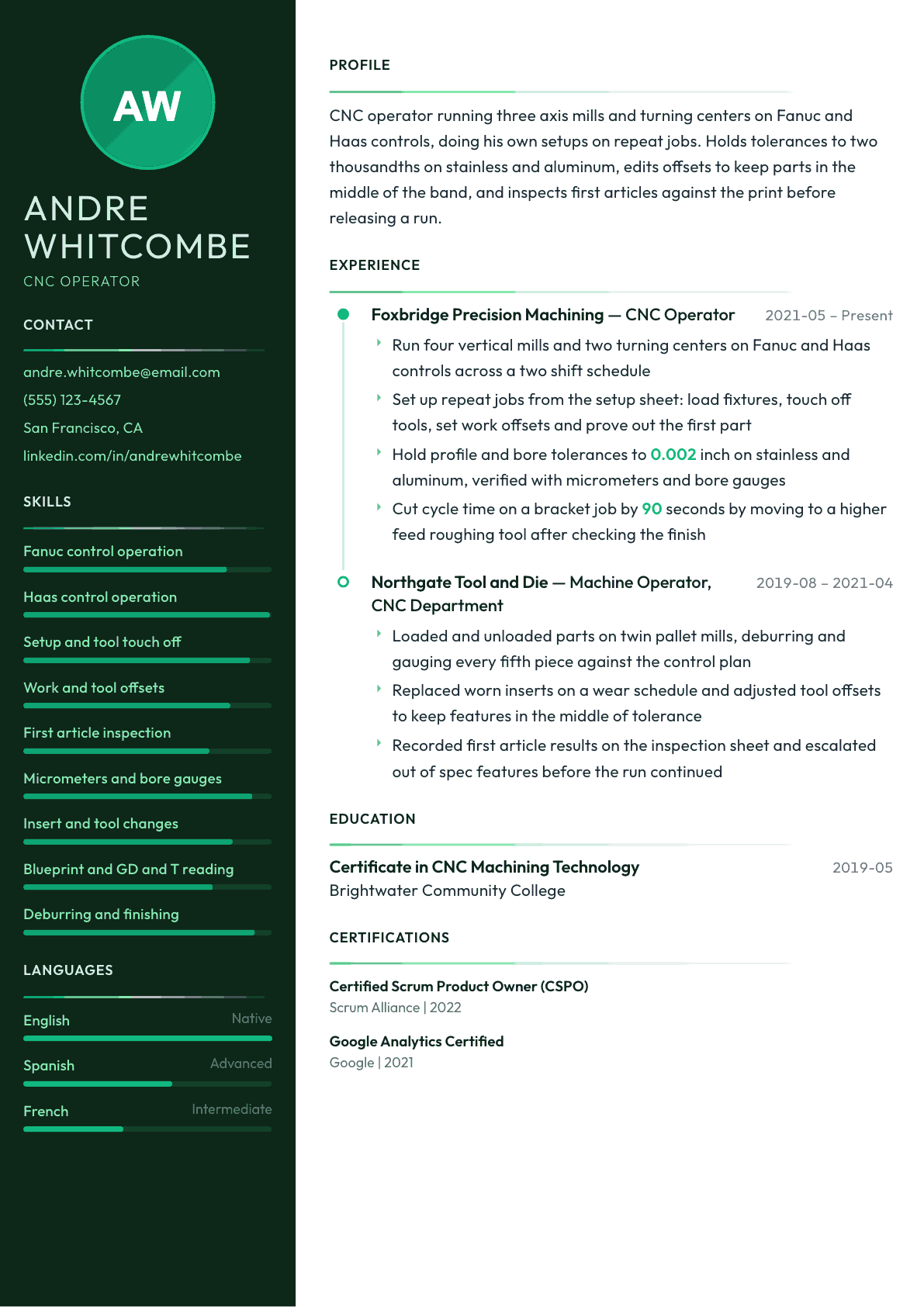
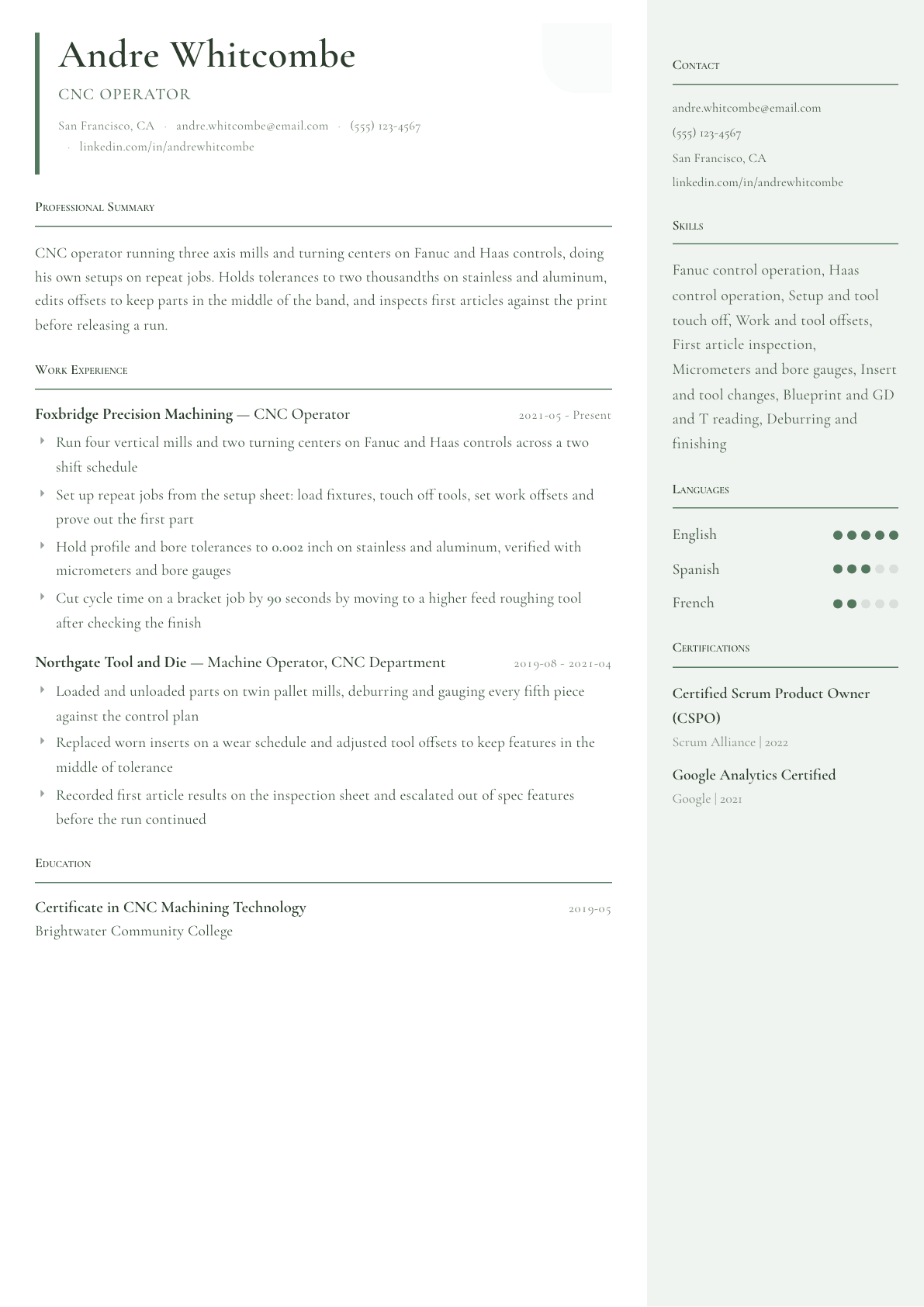
Example CNC Operator summary
CNC operator running vertical mills and turning centers on Fanuc and Haas controls, setting up repeat jobs from the setup sheet and proving out the first part. Holds profile and bore tolerances to two thousandths on stainless and aluminum, edits work and tool offsets to keep features centered, and inspects first articles with micrometers and bore gauges before releasing the run.
Skills to list on a CNC Operator resume
- CNC mill operation
- CNC lathe and turning center operation
- Fanuc and Haas controls
- Job setup and prove out
- Tool touch off and work offsets
- Insert and tooling changes
- First article inspection
- In process gauging
- Micrometers, calipers and bore gauges
- Blueprint reading
- GD and T interpretation
- Speeds and feeds adjustment
- Deburring and finishing
- Coolant and machine upkeep
What actually gets this resume read
- Name the controls you have run, because Fanuc, Haas, Okuma and Mazak experience are screened separately.
- State the tightest tolerance you hold in production, not the tightest you have ever measured once.
- Say whether you set up jobs or run parts that someone else set up, since the pay grades differ.
- List the materials you cut, since stainless, titanium and aluminum are three different machining conversations.
- Show the inspection you do at the machine: first article, in process checks and the gauges you use.
- Mention any offset editing or program tweaks you are authorized to make, and where you stop and call the programmer.
How to write a cnc operator resume
A CNC operator resume is read by a shop foreman who has a specific machine standing idle. He wants to know three things in the first ten seconds: which controls you have run, how tight a tolerance you hold in production, and whether you can set a job up or only run one that someone else set. Those three answers decide whether he calls you.
Everything else, including years of experience, is secondary to that trio. A candidate with three years who sets up jobs on a Fanuc control and holds two thousandths on stainless is more useful to most shops than a candidate with ten years of loading and unloading parts on a machine another person dialed in.
This guide covers writing the control and machine list so a shop recognizes its own floor, describing setup work honestly, using tolerance and material as the credibility anchors, and answering the questions operators ask when they want to move toward machinist or programming work.
Format: one page, controls and machines directly under the summary
One page for most operators. Reverse chronological, plain text, no columns or graphics, because job shops often print the resume and carry it to the floor. The critical structural choice is putting a machines and controls block immediately under the summary, since that is the block the foreman reads before anything else.
Keep the block factual: machine types, axis counts, control brands, and the inspection equipment you use at the machine. If you have run multiple pallet or bar fed machines, say so, because untended running time is a capability shops pay attention to.
- Machines and controls block: mill and lathe types, axis count, control brand, work holding.
- Sections: summary, machines and controls, machining experience, inspection tools, certifications.
- List materials separately, since stainless, titanium, aluminum and cast iron machine very differently.
Summary: control, tolerance, material, setup level
Pack the four decisive facts into three sentences. Running vertical mills and turning centers on Fanuc and Haas controls, setting up repeat jobs from the setup sheet, and holding two thousandths on stainless and aluminum is a complete answer to a foreman's screening questions.
State the tolerance you hold in production rather than the tightest measurement you have ever taken. Shops discover the difference on the first job, and a candidate who quoted a tenth and works to five thousandths loses trust immediately. An honest number with a material attached earns more interviews than an impressive one without.
Experience: setup, offsets, first article, tool life
Anchor each job with the shop type, the machines you were assigned and the volume model: production runs, small batches, or one off prototype work. A shop running thousands of the same bracket and a shop running batches of five want different habits, and saying which you come from prevents a bad match.
Then write the setup sequence you own. Loading fixtures, touching off tools, setting work offsets, running the first part in single block with the feed override down, and checking the first article against the print is the sequence a foreman recognizes. Writing it out shows you actually perform it rather than watching someone else.
Cover offset editing carefully. Adjusting a tool offset to bring a feature back to the middle of tolerance is normal operator authority. Editing the program is usually not. Saying where your authority ends is one of the most reassuring lines an operator can put on a resume.
Close with tool life and cycle work: replacing inserts on a wear schedule rather than after a bad part, and any cycle time improvement you suggested and got approved.
- Name the controls and whether you set up or only run.
- Give the tightest production tolerance with the material and the feature type.
- Describe your first article routine and the gauges you use.
- State what you adjust yourself and when you call the programmer.
Inspection at the machine: the part that proves you can be trusted
A CNC operator who inspects properly saves a shop from scrapping a whole run. Name the instruments: micrometers, calipers, bore gauges, pin gauges, height gauges, thread gauges, surface finish comparators, and any coordinate measuring machine work you have submitted parts for.
Say what you check and how often. Every fifth piece against the control plan is a specific claim. Checked parts regularly is not. Also mention what you do with an out of tolerance feature, because containing a run before it fills a bin is the behavior a quality manager is buying.
Reading the print: where operators separate themselves
Print reading is where operator resumes usually go vague. Be specific about what you take off the drawing: the datum scheme, the position and profile callouts you check, basic dimensions, the tolerance block and the revision level. Verifying the revision before starting a run is a habit shops value because it prevents the most expensive mistake in the building.
If your geometric dimensioning and tolerancing knowledge is partial, say what you use rather than claiming the whole system. An operator who confidently reads position and profile callouts and asks about anything beyond them is a safer hire than one who claims everything.
CNC Operator resume summary examples
Machining certificate graduate
CNC machining certificate graduate trained on vertical mills and turning centers with Fanuc and Haas controls. Comfortable loading parts, deburring, gauging with calipers and micrometers, and reading a print to the tolerance block. Seeking a production operator seat with progression into setup work.
Two years running production
CNC operator running twin pallet mills in a production shop, deburring and gauging every fifth piece against the control plan. Replaces worn inserts on a wear schedule and adjusts tool offsets to keep features centered in tolerance. Records first article results and escalates out of spec features before a run continues.
Setup capable operator
CNC operator running four vertical mills and two turning centers on Fanuc and Haas controls across two shifts. Sets up repeat jobs from the setup sheet, proves out the first part, and holds profile and bore tolerances to 0.002 inch on stainless and aluminum, verified with micrometers and bore gauges.
Work experience bullets: before and after
Before: Operated CNC machines to produce parts.
After: Ran four vertical mills and two turning centers on Fanuc and Haas controls across a two shift schedule, loading, gauging and deburring to the control plan.
Machine count, control brands and the shift model tell a foreman whether your floor resembles his.
Before: Set up machines for production runs.
After: Set up repeat jobs from the setup sheet by loading fixtures, touching off tools, setting work offsets and proving out the first part in single block.
Spelling out the sequence proves you perform the setup rather than assisting someone who does.
Before: Held tight tolerances on machined parts.
After: Held profile and bore tolerances to 0.002 inch on stainless and aluminum, verified with micrometers and bore gauges before each run was released.
A named tolerance with the material and the verifying instrument is checkable, and tight is not.
Before: Made adjustments to keep parts in spec.
After: Adjusted tool offsets on a wear schedule to keep features in the middle of tolerance and replaced inserts before finish degraded rather than after a bad part.
Acting on a schedule instead of on a failure is exactly the habit that keeps a production run alive.
Before: Helped reduce cycle time on a job.
After: Cut cycle time on a bracket job by 90 seconds by moving to a higher feed roughing tool after checking the finish and getting the change approved.
The saving, the method and the approval step show initiative that respects the shop's process.
Hard skills
- Vertical machining center operation
- Turning center and lathe operation
- Fanuc and Haas control navigation
- Job setup and prove out
- Tool touch off and work offsets
- Insert and tool holder changes
- First article inspection
- Micrometers, bore gauges and pin gauges
- Print reading and tolerance blocks
- Position and profile callout interpretation
- Speeds and feeds override use
- Deburring and finishing
Soft skills
- Consistency across long runs
- Care with expensive material
- Knowing when to stop a run
- Clear handover notes
- Willingness to ask before editing
Certifications worth listing
- Machining Level I: CNC Milling Operations (National Institute for Metalworking Skills)
- Machining Level I: CNC Turning Operations (National Institute for Metalworking Skills)
- OSHA 10-Hour General Industry (OSHA Outreach Training Program)
Mistakes that cost cnc operator candidates the interview
- Leaving the control brand off the page, when Fanuc, Haas, Okuma and Mazak experience are screened as separate skills.
- Quoting the tightest tolerance you ever measured instead of the one you hold across a production run.
- Being vague about setup, which lets a shop assume you only load and unload parts.
- Skipping the material list, since stainless, titanium and aluminum demand different speeds, feeds and patience.
- Claiming full geometric tolerancing knowledge when you read only a few callout types.
- Listing no inspection instruments, which leaves a quality manager unable to trust any dimension you mention.
CNC Operator resume questions
What is the difference between a CNC operator and a CNC machinist on a resume?
An operator runs jobs and makes approved offset adjustments, while a machinist sets up, proves out and often edits programs at the control. Write the tasks you truly perform, since the interview will test the boundary within the first few questions.
How do I show setup experience if my shop calls me an operator?
Describe the setup steps you personally complete: fixture loading, tool touch off, work offset setting and first part prove out. Titles vary by shop, but a described sequence is understood everywhere and it is what the foreman is really asking about.
Which tolerance should I put on my resume?
The tightest one you hold repeatedly in production, with the material and feature named. Two thousandths on a stainless bore is a stronger claim than a tenth quoted without context, because the reader can picture the job and believe it.
Do I need to know G code as a CNC operator?
Reading it helps a great deal even when you never write it. Being able to follow a program, find the tool call and understand where the cycle is in the sequence makes you far more useful during a prove out or a mid run problem.
How do I move from operator toward programming?
Build the evidence on the resume first: setup ownership, offset work, tool life management, first article inspection and any cycle time suggestion you had approved. Then add CAM coursework, because shops promote operators who already think about the process.
Related resume examples
- CNC Machinist Resume example
- Machinist Resume example
- Machine Operator Resume example
- CNC Programmer Resume example
- Press Operator Resume example
- Woodworker Resume example