Woodworker Resume Examples: free ATS score and gap list
Write a Woodworker Resume That Shows Real Joinery
By Mustafa Tarabya, founder of CVBooster · Published · Updated
Woodworker resume example with joinery, millwork and finishing keywords, plus a guide to portfolios, machines and shop production evidence.
Sample resumes for a woodworker
The same woodworker content laid out in three CVBooster templates, so you can see what the finished document looks like before you write a word.
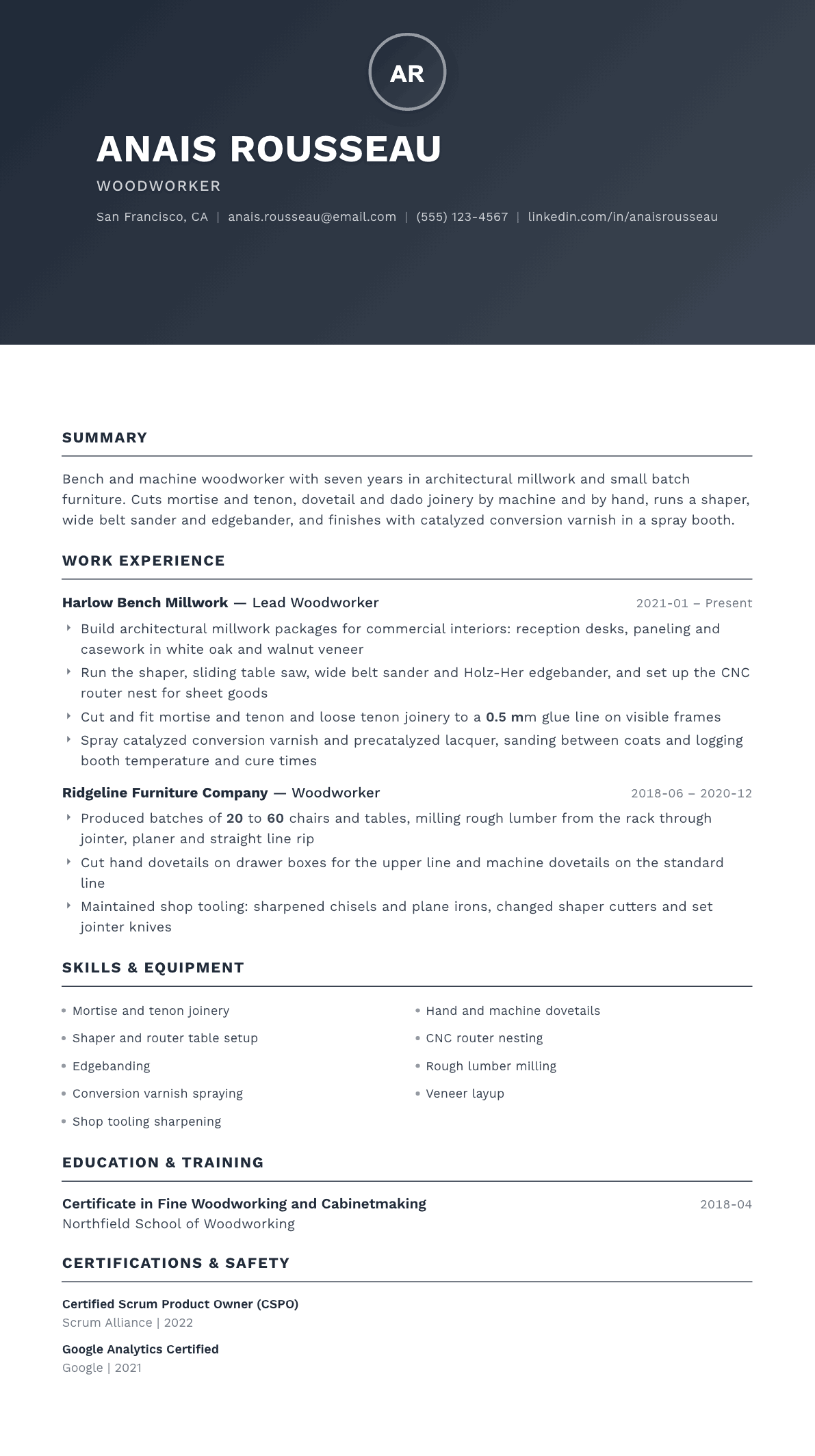
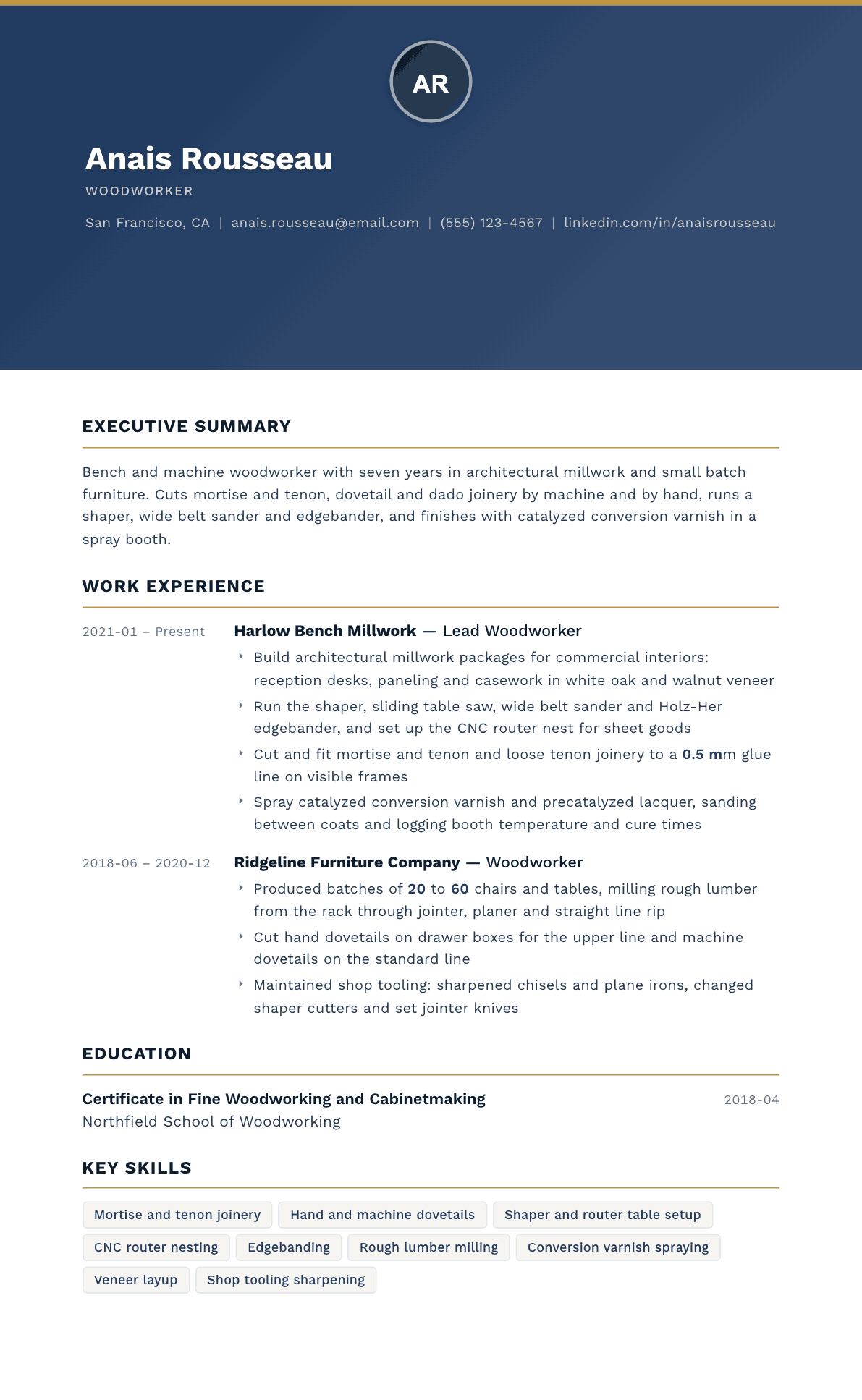
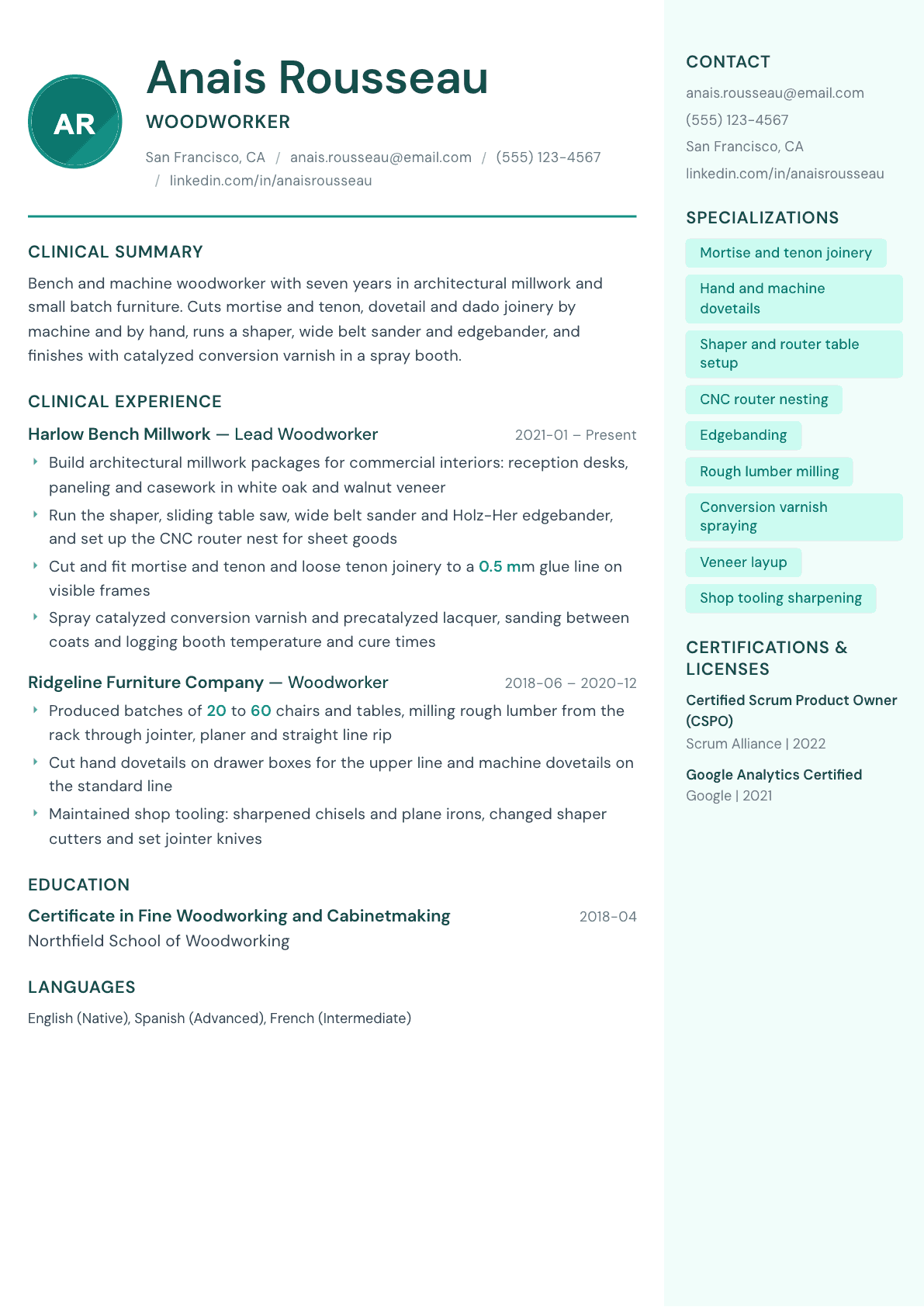
Example Woodworker summary
Woodworker with seven years across architectural millwork and small batch furniture, cutting mortise and tenon, dovetail and dado joinery by hand and by machine. Sets up the shaper, sliding table saw, wide belt sander and edgebander, and nests sheet goods on a CNC router. Mills rough lumber from the rack and sprays catalyzed conversion varnish in a booth. Works to shop drawings and installs on site when the package calls for it.
Skills to list on a Woodworker resume
- Mortise and tenon joinery
- Dovetail joinery
- Dado and rabbet joinery
- Face frame and frameless casework
- Shaper and router table work
- Sliding table saw operation
- CNC router nesting
- Edgebanding
- Jointer and planer milling
- Veneer layup and vacuum press
- Wide belt sanding
- Spray finishing and lacquer
- Stain and glaze matching
- Shop drawing interpretation
- Hand tool sharpening
- Installation and site fitting
What actually gets this resume read
- Name the joinery you cut and whether you cut it by hand, by machine, or both, because shops hire for the difference.
- List every machine you set up rather than operate, since setup is the skill a shop is short of.
- State the species and sheet goods you work, and say whether you handle veneer layup and solid wood movement.
- Put finishing on the page with the products and the booth, not just the word finishing.
- Give batch sizes and lead times so a shop can tell production woodwork from one-off custom work.
- Add a portfolio link line and keep the photos of joinery and finish detail, not only finished room shots.
How to write a woodworker resume
A woodworker resume is read by a shop owner or a lead who already knows what he is short of. It is usually one of three things: someone who can set up machines rather than only feed them, someone who can cut joinery that will still be tight in five years, or someone who can finish without runs and orange peel. Your page should make it obvious which of those you are, and honest about the ones you are not.
The trouble with most woodworker resumes is that they read like a hobby description. "Skilled in a variety of woodworking techniques with attention to detail" could be written by a weekend furniture maker or by a hand who has milled ten thousand board feet. What replaces it is machine names, joinery names, species, finish products and batch sizes, because those are the things a shop schedules around.
This guide covers the layout a millwork or furniture shop expects, how to separate machine setup from machine operation, how to present finishing as a real skill, and how to use a portfolio without letting pretty photographs do work that words should be doing.
Format: machines and joinery on the first screen
One page, reverse chronological, with two blocks that a shop owner can find in seconds: the machines you set up and the joinery you cut. Everything else is supporting evidence. Two pages are only worth it when you have both architectural millwork and fine furniture history and want to keep the detail from each.
Name the shop type in every job, because it changes what the work meant. A cabinet shop building frameless casework from sheet goods, an architectural millwork shop doing commercial interiors, a small furniture studio doing solid wood one offs and a factory running a nested CNC line are four different working lives, and the vocabulary you use should match wherever you are applying.
- Contact line: name, phone, email, city, plus whether you have your own hand tools and travel for installations.
- Joinery block: the joints you cut and whether by hand, by machine, or both.
- Machine block: table saw or sliding table, shaper, jointer, planer, wide belt, edgebander, CNC router, each with the make where you know it.
- Finishing block: products sprayed, equipment used and whether you have booth experience.
- Experience: shop type, batch sizes, species and sheet goods, then what you owned in the sequence.
Setup is the skill shops are short of
Any shop can find someone to push panels through a saw. What is hard to find is a hand who can set a shaper with a power feeder and the right cutter, dial in a jointer's knives and outfeed table, tram a planer to stop snipe, or set an edgebander's glue temperature and trimming stations for a new tape. Say directly which machines you set up rather than run, because that distinction is most of your value.
The same applies to the CNC router if the shop has one. Loading a nest someone else programmed is operation. Building the nest, choosing the tooling and tabs, setting the vacuum zones and dialing feed rates for a laminate sheet without chipout is setup. Both are worth listing, but only if you label them accurately.
Joinery, species and wood movement
Name the joints. Mortise and tenon, loose tenon, dovetail by hand and by jig, box joints, dadoes and rabbets, cope and stick for frame and panel doors, biscuits and dominos, pocket screws for the work where they belong. Add the standard you hold, such as a glue line you can barely see on a visible frame, because a joint that is technically correct but gappy is not a selling point.
Species and sheet goods belong on the page too. White oak, walnut, maple, cherry, sapele and the veneers over MDF or particle core each behave differently under a cutter and under finish. Mention any experience with solid wood movement: breadboard ends, floating panels, allowance for seasonal change in a wide top. That single sentence separates a woodworker from a panel assembler.
If you mill rough lumber, say so, and describe the sequence: reading the board, face jointing, planing, straight line ripping and letting stock rest before final dimension. Shops that buy rough stock need someone who can do this without wasting material, and shops that buy surfaced stock still like knowing you can.
- List joints separately for hand cut and machine cut work.
- Give the species and the sheet goods you have actually worked, not a generic word like hardwood.
- Mention veneer work with the method: vacuum press, cold press or hot press.
- Say whether you mill rough lumber from the rack and how you handle stock that moves.
- Note any solid surface, laminate or metal accent work if the shop mixes materials.
Finishing: the half of the job people leave out
A finish is the part of the piece a client touches, and shops constantly need people who can spray without runs, sags, blush or dry spray. Name the products: precatalyzed lacquer, catalyzed conversion varnish, water based acrylic, oil and wax, hardwax oil, stain and glaze systems. Then name the equipment: HVLP gun, air assisted airless, pressure pot, spray booth with a specified airflow.
Add the process discipline behind it, because that is what a shop lead recognizes as skill. Sanding schedule between coats, mil thickness on the wet film gauge, booth temperature and humidity, flash and cure times, color matching a stain to an approved sample. If you have kept a finishing log or matched to an architect's control sample, that is worth a bullet.
Portfolio, drawings and installation
A short portfolio helps a woodworker more than most trades, but only if it shows the right things. Photograph joinery, a drawer fit, a mitered return, a finish under raking light. Room shots prove you were in the building; a tight dovetail under a lens proves you cut it. Put the link on one line and keep the file small enough to open on a phone in the shop.
Say whether you work from shop drawings and who produces them. Taking a set of architectural millwork drawings, working out the cut list, allowing for scribes and reveals, and building to submittal is a distinct skill from building from a sketch. If you install as well as build, mention site work, scribing to out of square walls and running trim, since that is a separate day rate for most shops.
Woodworker resume summary examples
First shop job
Woodworking graduate with 800 program hours in cabinetmaking and joinery. Cuts mortise and tenon and dadoes on the router table, mills rough lumber through jointer and planer, and has sprayed precatalyzed lacquer under supervision. Owns a full hand tool kit and sharpens chisels and plane irons.
Bench hand with seven years
Woodworker with seven years in architectural millwork and small batch furniture, cutting mortise and tenon, dovetail and dado joinery by hand and by machine. Sets up the shaper, sliding table saw, wide belt and edgebander, nests sheet goods on a CNC router, and sprays catalyzed conversion varnish in a booth.
Shop lead
Lead woodworker with fourteen years running a six bench shop and the finishing room. Takes architectural drawings to cut list, schedules batches through milling, machining and finish, trains apprentices on shaper and edgebander setup, and installs commercial casework on site including scribes and site trim.
Work experience bullets: before and after
Before: Built cabinets and furniture in a woodworking shop.
After: Built architectural millwork packages for commercial interiors including reception desks, wall paneling and casework in white oak and walnut veneer over MDF core.
Naming the products, species and substrate tells a shop owner exactly which of his jobs you could walk onto.
Before: Operated shop machinery.
After: Set up and ran the shaper with power feeder, sliding table saw, wide belt sander and Holz-Her edgebander, including cutter changes, glue temperature and trim station adjustment.
Setup tasks named machine by machine prove the skill a shop is short of, where operated could mean anything.
Before: Made joints for furniture pieces.
After: Cut mortise and tenon and loose tenon joinery to a 0.5 mm glue line on visible frames, and hand cut dovetails on drawer boxes for the upper furniture line.
A tolerance on the glue line and a split between hand and machine work shows the standard you actually hold.
Before: Applied finishes to completed products.
After: Sprayed catalyzed conversion varnish and precatalyzed lacquer with an HVLP gun, sanding between coats to schedule and logging booth temperature, wet film thickness and cure times.
Products, equipment and process control turn finishing from a chore into a documented skill.
Before: Worked on production runs of furniture.
After: Produced batches of 20 to 60 chairs and tables, milling rough lumber from the rack through jointer, planer and straight line rip before machining and assembly.
Batch size and the milling sequence let a shop judge whether you can hold a production pace, not just build one piece.
Hard skills
- Mortise and tenon joinery
- Hand and machine dovetails
- Cope and stick frame and panel doors
- Face frame and frameless casework
- Shaper and router table setup
- Sliding table saw operation
- CNC router nesting and tooling
- Edgebanding setup and trimming
- Jointer, planer and rough lumber milling
- Veneer layup and vacuum pressing
- Wide belt and hand sanding schedules
- Spray finishing with HVLP equipment
- Stain, glaze and color matching
- Shop drawing and cut list preparation
- Site installation and scribing
Soft skills
- Reading a board before cutting it
- Working to someone else's design without improvising
- Keeping a batch moving without losing the fit on the last piece
- Sharing a machine and a dust system with a busy shop
- Owning a mistake in expensive stock instead of hiding it
Certifications worth listing
- Sawblade Certificate (Woodwork Career Alliance of North America)
- Green Credential (Woodwork Career Alliance of North America)
- OSHA 10-Hour General Industry (OSHA Training Institute)
Mistakes that cost woodworker candidates the interview
- Describing skills as a variety of woodworking techniques instead of naming joints, machines, species and finishes.
- Listing machines you have run without saying which ones you can set up, which is the whole difference in value.
- Leaving finishing off the page entirely, when many shops are hiring specifically for someone who can spray cleanly.
- Sending only room shots in a portfolio, so nobody can see whether your joinery and finish stand up close.
- Ignoring the shop type, so a millwork employer cannot tell whether your background was sheet goods or solid furniture.
- Saying nothing about batch sizes or lead times, which hides whether you can hold a production pace.
Woodworker resume questions
How do I move from hobby woodworking into a paid shop job?
Present your own projects with the same detail a shop would use: species, joinery, finish products, and how long each piece took. Then be honest that the work was self directed. Shops hire beginners who show real technique and no exaggeration far more readily than ones who inflate.
Does CNC experience help or hurt a traditional woodworker?
It helps almost everywhere now, because even small shops nest casework parts. Keep your hand and machine joinery prominent and add the CNC work as another capability. The combination of bench skill and router programming is rarer than either one alone.
Should I list the hand tools I own?
One short line is enough, mentioning chisels, planes, marking tools and any specialty items like a shoulder plane or a router plane. Shops read it as a signal of seriousness, but a full inventory takes space that machine setup and finishing detail should be using.
How do I write about installation work?
Treat it as its own capability with the site conditions you have handled: scribing to out of square walls, leveling long runs, dealing with existing conditions, and coordinating with other trades. Shops that install commercial casework pay for that separately from bench time.
What if my experience is all in one narrow product?
Go deep rather than pretending to breadth. Someone who has built stair parts or windows for years knows tooling, tolerances and species behavior that transfer well, and saying exactly what you mastered is more convincing than a padded list of things you touched once.
Related resume examples
- Carpenter Resume example
- Finish Carpenter Resume example
- Fabricator Resume example
- Production Worker Resume example
- CNC Operator Resume example
- Machinist Resume example