Changing and Improving Civil Service Example: AO to G7
By Mustafa Tarabya, founder of CVBooster · Published · Updated
14 min read
A changing and improving civil service example is marked on the improvement you started, not on a change that happened to you while you were in the room. Adverts normally cap the behaviour at 250 words, and the resistance you met has to fit inside them. The bullets quoted on this page are lifted from Success Profiles: Civil Service behaviours on gov.uk, checked on 12 September 2026. Four finished statements follow at AO, HEO, SEO and Grade 7, marked up bullet by bullet for the grade they were written for. Written by Mustafa Tarabya, who hired for his own company, read every application himself and now writes CVBooster's guides.
What the scoring actually rewards
Two sentences in the framework carry the whole behaviour.
The behaviour, quoted: "Seek out opportunities to create effective change and suggest innovative ideas for improvement. Review ways of working, including seeking and providing feedback" (gov.uk, Changing and improving).
Read the verbs. Seek out. Suggest. Review. Seek and provide feedback. All four belong to you, which is why a statement about a reorganisation that landed on your team scores so badly.
Sifters look for the idea's origin first. Was it yours, or did you implement somebody else's? Then for the objection, because a change nobody argued with was not worth making. Then for the feedback loop, since the framework names it twice.
One more trap. From HEO the bullets ask for "managed risks", which means you have to name a risk you accepted, not just the benefits you hoped for.
The word budget: 40 / 40 / 120 / 50
Two hundred and fifty words divide cleanly. Around forty to set the scene, forty for the problem you found, a hundred and twenty for what you did about it, and the last fifty for proof.
This behaviour needs one extra sentence the others do not: where the idea came from. Buy it by cutting the background. Nobody marks the background.
Tip: write the objection before you write the fix. The person who argued with you is the cheapest evidence that a real change happened.
Example at AO, annotated
Written for an AO post in Defra. The bullets at this band are about suggesting, learning and querying, not about leading anything.
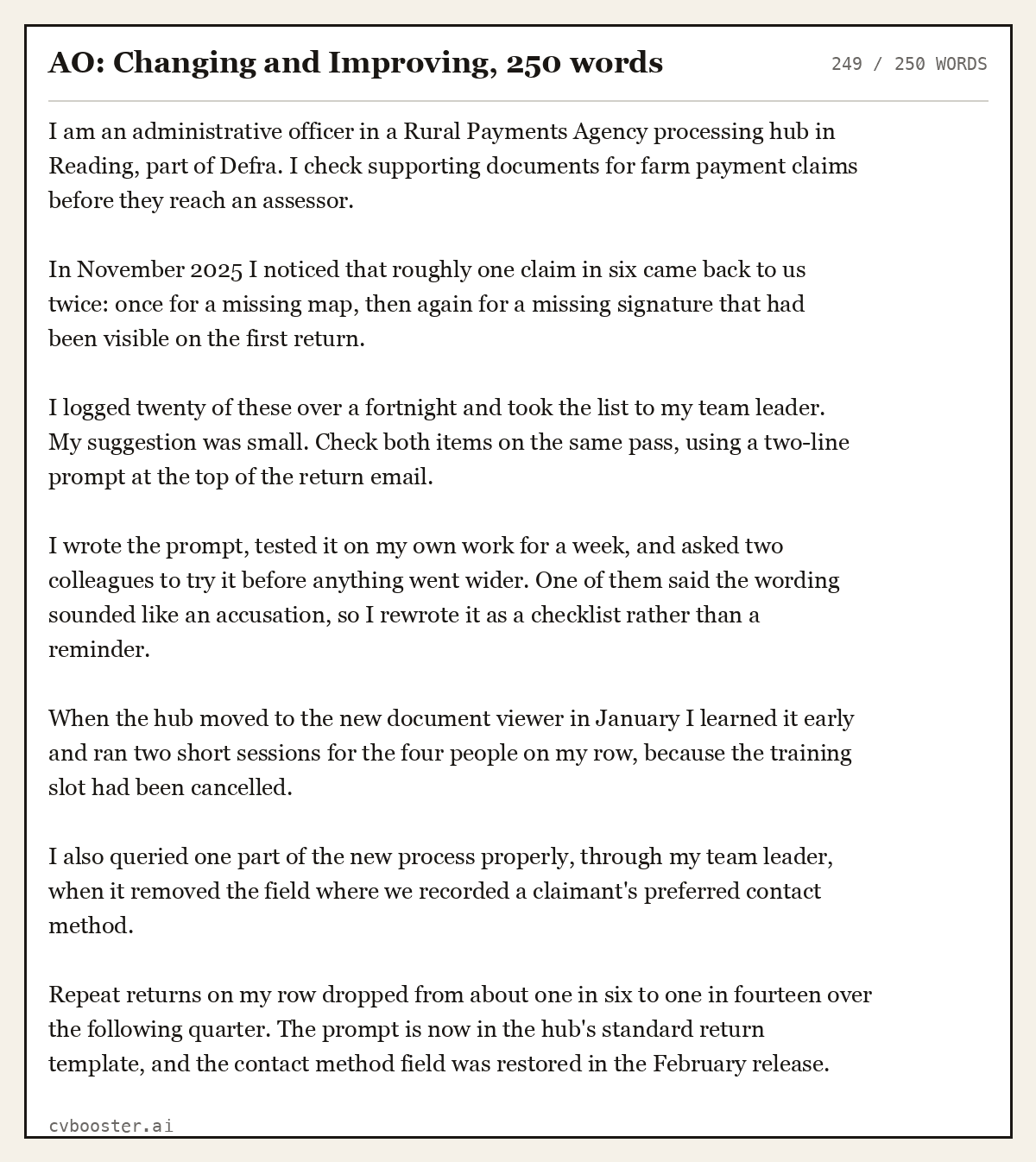
AO: Changing and Improving, 250 words (249 words)
I am an administrative officer in a Rural Payments Agency processing hub in Reading, part of Defra. I check supporting documents for farm payment claims before they reach an assessor.
In November 2025 I noticed that roughly one claim in six came back to us twice: once for a missing map, then again for a missing signature that had been visible on the first return.
I logged twenty of these over a fortnight and took the list to my team leader. My suggestion was small. Check both items on the same pass, using a two-line prompt at the top of the return email.
I wrote the prompt, tested it on my own work for a week, and asked two colleagues to try it before anything went wider. One of them said the wording sounded like an accusation, so I rewrote it as a checklist rather than a reminder.
When the hub moved to the new document viewer in January I learned it early and ran two short sessions for the four people on my row, because the training slot had been cancelled.
I also queried one part of the new process properly, through my team leader, when it removed the field where we recorded a claimant's preferred contact method.
Repeat returns on my row dropped from about one in six to one in fourteen over the following quarter. The prompt is now in the hub's standard return template, and the contact method field was restored in the February release.
What the sifter is scoring
- Indicator quoted: "review ways of working and suggest improvements, including how to make full use of new digital technologies" (gov.uk, AA and AO). Where it shows: twenty logged returns turned into a two-line prompt.
- Indicator quoted: "learn new procedures and help colleagues to do the same" (gov.uk, AA and AO). Where it shows: learning the document viewer early and running two sessions for the row.
- Indicator quoted: "query any issues that arise from changes in a suitable way" (gov.uk, AA and AO). Where it shows: the missing contact method field, raised through the team leader and restored.
- Indicator quoted: "respond in an effective and appropriate manner when emergencies arise" (gov.uk, AA and AO). Where it shows: covering the cancelled training slot rather than letting the row go live untrained.
Example at HEO, annotated
HEO and SEO share one list. At HEO the reach is your own unit, and the risk you accepted is usually small enough to name precisely.
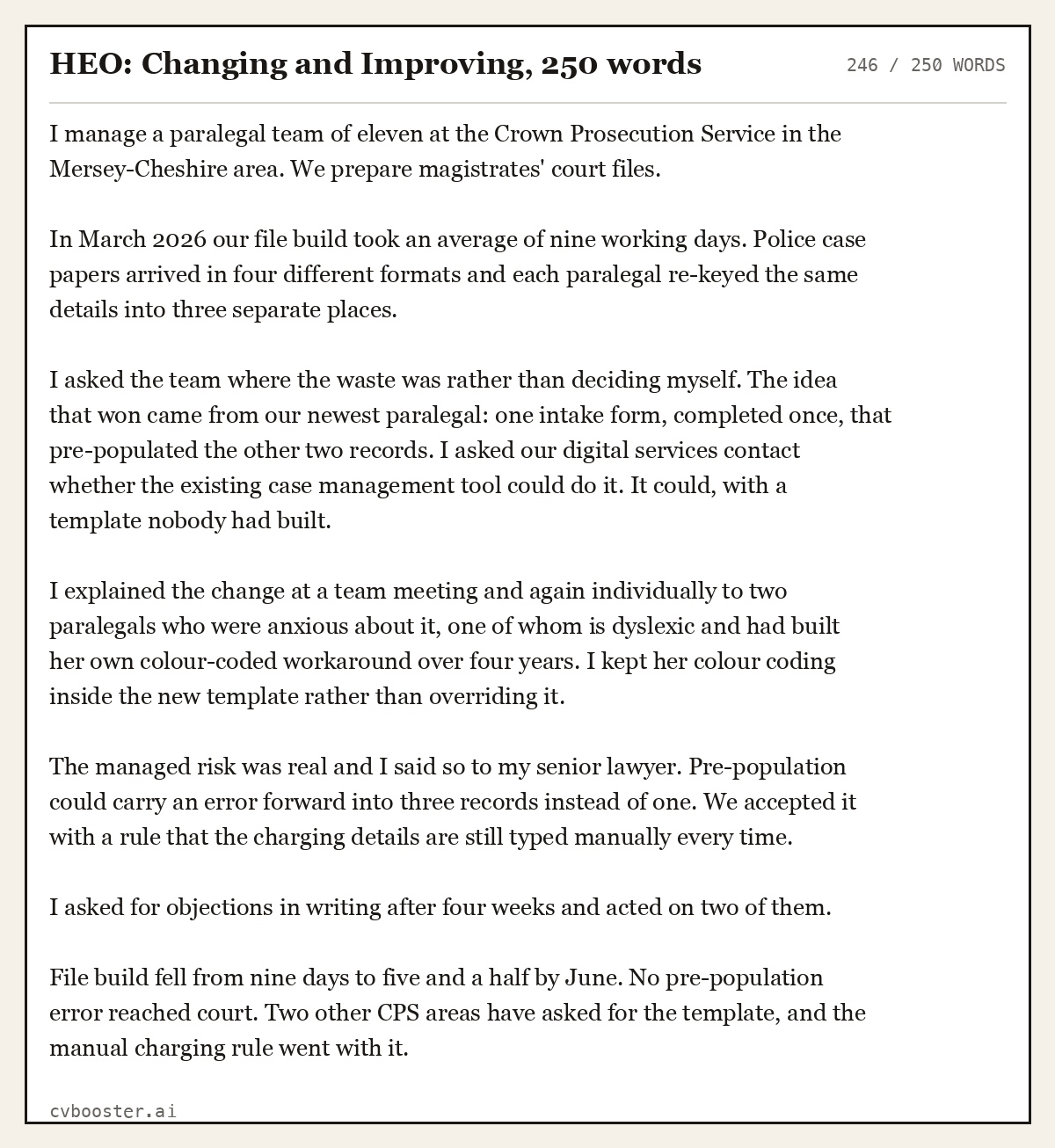
HEO: Changing and Improving, 250 words (246 words)
I manage a paralegal team of eleven at the Crown Prosecution Service in the Mersey-Cheshire area. We prepare magistrates' court files.
In March 2026 our file build took an average of nine working days. Police case papers arrived in four different formats and each paralegal re-keyed the same details into three separate places.
I asked the team where the waste was rather than deciding myself. The idea that won came from our newest paralegal: one intake form, completed once, that pre-populated the other two records. I asked our digital services contact whether the existing case management tool could do it. It could, with a template nobody had built.
I explained the change at a team meeting and again individually to two paralegals who were anxious about it, one of whom is dyslexic and had built her own colour-coded workaround over four years. I kept her colour coding inside the new template rather than overriding it.
The managed risk was real and I said so to my senior lawyer. Pre-population could carry an error forward into three records instead of one. We accepted it with a rule that the charging details are still typed manually every time.
I asked for objections in writing after four weeks and acted on two of them.
File build fell from nine days to five and a half by June. No pre-population error reached court. Two other CPS areas have asked for the template, and the manual charging rule went with it.
What the sifter is scoring
- Indicator quoted: "work with others to identify areas for improvement and simplify processes to use fewer resources" (gov.uk, HEO and SEO). Where it shows: asking the team where the waste sat, then removing two re-keying steps.
- Indicator quoted: "encourage ideas for change from a wide range of sources" (gov.uk, HEO and SEO). Where it shows: the winning idea coming from the newest member of the team.
- Indicator quoted: "clearly explain the reasons for change to colleagues and how to implement them, supporting individuals with different needs to adapt to change" (gov.uk, HEO and SEO). Where it shows: the dyslexic colleague's colour coding kept inside the template.
- Indicator quoted: "take managed risks by fully considering the varied impacts changes could have on the diverse range of end users" (gov.uk, HEO and SEO). Where it shows: the named error risk and the manual charging rule that contained it.
Example at SEO, annotated
At SEO the same bullets have to cover people who do not report to you, and a challenge culture you built rather than inherited.
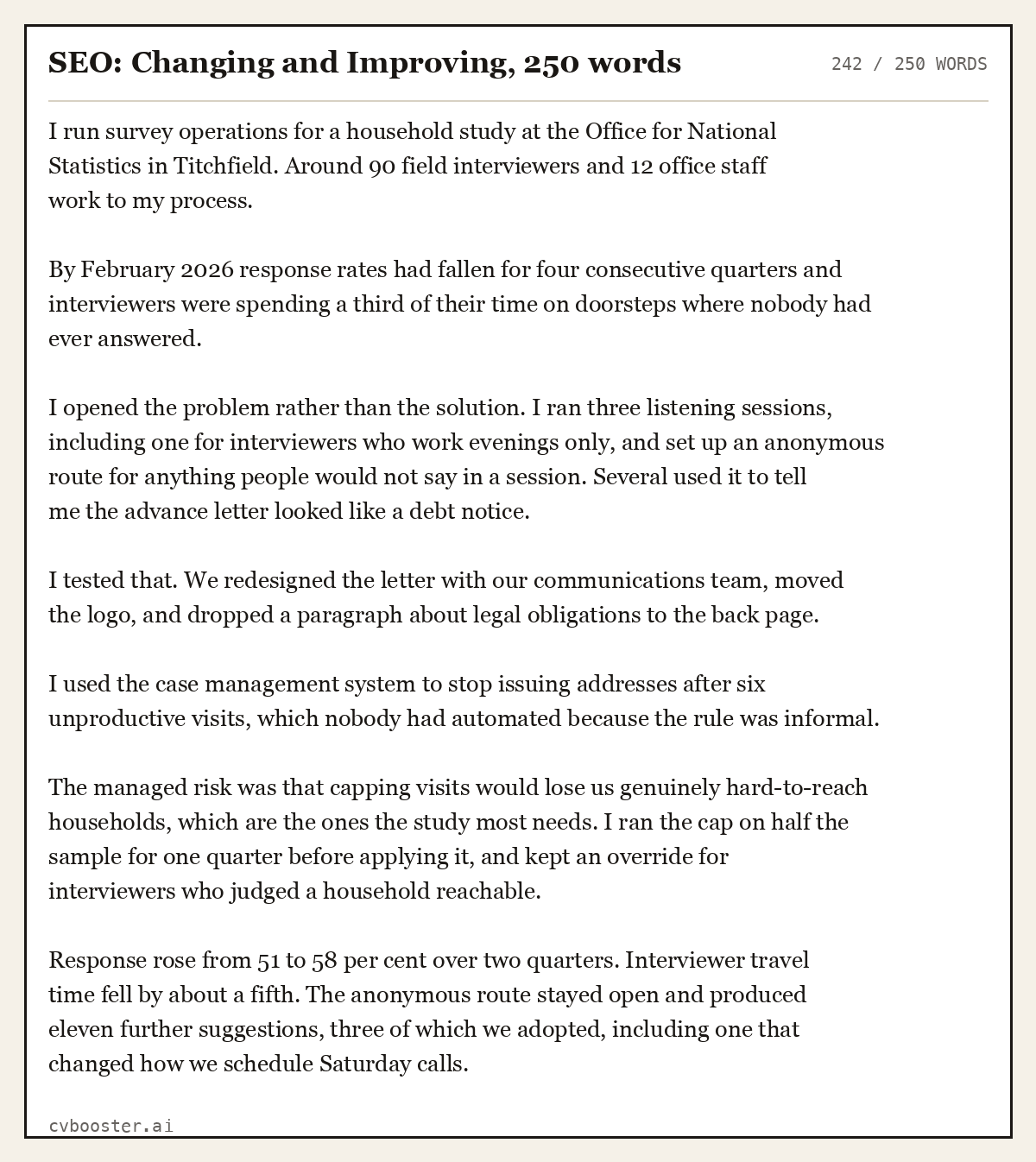
SEO: Changing and Improving, 250 words (242 words)
I run survey operations for a household study at the Office for National Statistics in Titchfield. Around 90 field interviewers and 12 office staff work to my process.
By February 2026 response rates had fallen for four consecutive quarters and interviewers were spending a third of their time on doorsteps where nobody had ever answered.
I opened the problem rather than the solution. I ran three listening sessions, including one for interviewers who work evenings only, and set up an anonymous route for anything people would not say in a session. Several used it to tell me the advance letter looked like a debt notice.
I tested that. We redesigned the letter with our communications team, moved the logo, and dropped a paragraph about legal obligations to the back page.
I used the case management system to stop issuing addresses after six unproductive visits, which nobody had automated because the rule was informal.
The managed risk was that capping visits would lose us genuinely hard-to-reach households, which are the ones the study most needs. I ran the cap on half the sample for one quarter before applying it, and kept an override for interviewers who judged a household reachable.
Response rose from 51 to 58 per cent over two quarters. Interviewer travel time fell by about a fifth. The anonymous route stayed open and produced eleven further suggestions, three of which we adopted, including one that changed how we schedule Saturday calls.
What the sifter is scoring
- Indicator quoted: "encourage an environment where colleagues know that they can challenge decisions and issues safely" (gov.uk, HEO and SEO). Where it shows: the anonymous route that stayed open after the change, and the eleven suggestions it produced.
- Indicator quoted: "use technology where possible to increase efficiency" (gov.uk, HEO and SEO). Where it shows: automating a visit cap that had only ever been an informal rule.
- Indicator quoted: "take managed risks by fully considering the varied impacts changes could have on the diverse range of end users" (gov.uk, HEO and SEO). Where it shows: the half-sample test and the interviewer override protecting hard-to-reach households.
- Indicator quoted: "encourage ideas for change from a wide range of sources" (gov.uk, HEO and SEO). Where it shows: a separate session for evening-only interviewers, whose feedback changed the letter.
Example at Grade 7, annotated
The Grade 7 bullets add early warning signs and challenge aimed upwards, which is where most promotion drafts fall short.
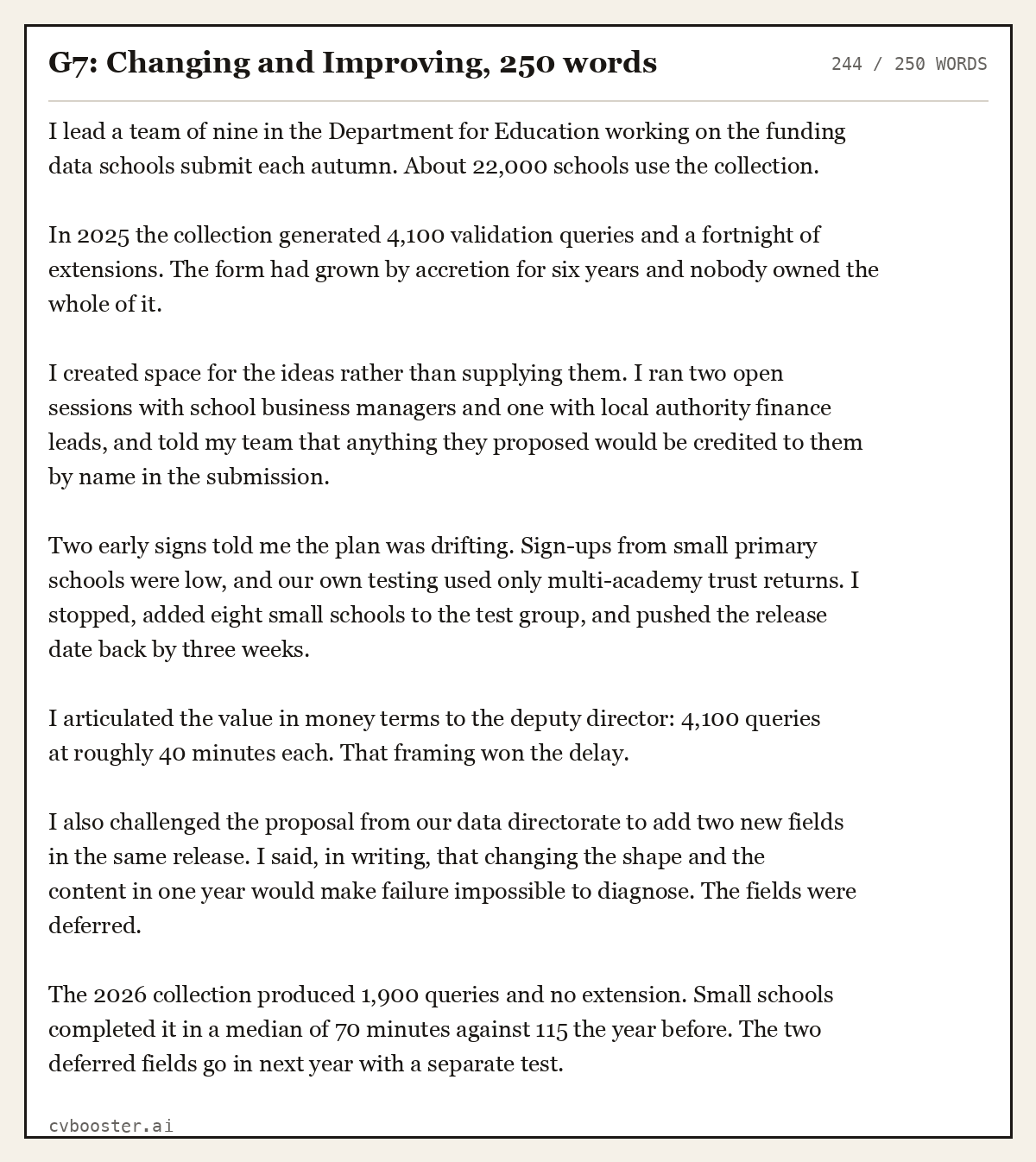
G7: Changing and Improving, 250 words (244 words)
I lead a team of nine in the Department for Education working on the funding data schools submit each autumn. About 22,000 schools use the collection.
In 2025 the collection generated 4,100 validation queries and a fortnight of extensions. The form had grown by accretion for six years and nobody owned the whole of it.
I created space for the ideas rather than supplying them. I ran two open sessions with school business managers and one with local authority finance leads, and told my team that anything they proposed would be credited to them by name in the submission.
Two early signs told me the plan was drifting. Sign-ups from small primary schools were low, and our own testing used only multi-academy trust returns. I stopped, added eight small schools to the test group, and pushed the release date back by three weeks.
I articulated the value in money terms to the deputy director: 4,100 queries at roughly 40 minutes each. That framing won the delay.
I also challenged the proposal from our data directorate to add two new fields in the same release. I said, in writing, that changing the shape and the content in one year would make failure impossible to diagnose. The fields were deferred.
The 2026 collection produced 1,900 queries and no extension. Small schools completed it in a median of 70 minutes against 115 the year before. The two deferred fields go in next year with a separate test.
What the sifter is scoring
- Indicator quoted: "create an environment where people feel safe to challenge and know their voice will be heard" (gov.uk, Grade 6 and Grade 7). Where it shows: open sessions with school and local authority staff, and credit by name for the team's ideas.
- Indicator quoted: "identify early signs that things are going wrong and respond promptly" (gov.uk, Grade 6 and Grade 7). Where it shows: low small-school sign-ups and a skewed test group, caught before release.
- Indicator quoted: "make changes which add value and clearly articulate how changes will benefit the business" (gov.uk, Grade 6 and Grade 7). Where it shows: 4,100 queries priced in staff time to win a three-week delay.
- Indicator quoted: "provide constructive challenge to senior management on change proposals" (gov.uk, Grade 6 and Grade 7). Where it shows: the written objection that deferred two new fields to the following year.
What changed between the four
Every statement above has the same skeleton: a waste found, an idea sourced, an objection handled, a number at the end. The grade decides how far the change travelled and how uncomfortable the risk was.
| Level | Where the idea came from | The risk that was named | Scale of the change |
|---|---|---|---|
| AO | The writer, from twenty logged returns | None required at this band | One row, then a hub template |
| HEO | The newest paralegal on the team | An error copied into three records | Eleven staff, then two more CPS areas |
| SEO | An anonymous route and an evening session | Losing hard-to-reach households | 90 interviewers, a national study |
| G7 | Open sessions with schools and councils | Confounding two changes in one release | 22,000 schools |
At AO you suggest and you learn. At HEO you simplify something and contain what it might break. At SEO you build the route that lets people disagree with you. At Grade 7 you say no to a senior proposal in writing. If your G7 draft has no upward challenge in it, it is an SEO statement wearing a bigger number.
The sentences that cost marks
Same facts, different marks. The first sentence in each pair could have been written by anyone in the building.
- Before: I am always looking for ways to improve processes and drive efficiency. After: I logged twenty repeat returns over a fortnight before I proposed anything.
- Before: I embraced the new system and supported my colleagues through the transition. After: I learned the document viewer early and ran two sessions when the training slot was cancelled.
- Before: I gathered feedback from stakeholders and incorporated it. After: A colleague said my wording read as an accusation, so I rewrote it as a checklist.
- Before: The change was implemented successfully with minimal disruption. After: File build fell from nine days to five and a half, with no pre-population error reaching court.
- Before: I took a calculated risk to deliver the improvement. After: Capping visits at six could lose hard-to-reach households, so I ran it on half the sample first.
- Before: I influenced senior stakeholders to adopt my approach. After: I wrote that changing the form's shape and its content together would make failure impossible to diagnose.
Before you submit
- Say where the idea came from in one sentence. If it was not yours, say whose it was and what you did with it.
- Name one person who objected and what you changed because of them.
- From HEO upwards, name a risk you accepted, not only the benefit you expected.
- Check the change outlived the project. A pilot that stopped when you left is a weaker story.
- Put the before number and the after number in the same sentence.
- Follow the civil-service-careers.gov.uk instruction to "read the job specification so you are clear about the job requirements" before you pick which improvement to write about.
- The Success Profiles: Civil Service Behaviours PDF states that "Civil Service Behaviours are specific to the grade level of the job role", so check the band before you draft.
- Departments publish the sift scale. The Crown Office and Procurator Fiscal Service describes a 4 as "Adequate positive evidence and any negative evidence would not cause concern".
- Worked at four grades alongside this one: Leadership and Developing Self and Others.
- Also complete: Making Effective Decisions and Working Together.
- For the full framework read the behaviours framework guide, and for the other four elements the Success Profiles guide.
Frequently asked questions
What is a good example of changing and improving?
A good example starts with a problem you found yourself, names the person who resisted the fix, and ends with a number that moved. The AO statement above is the smallest usable version: twenty logged returns, a two-line prompt, one colleague who said the wording was wrong, and a repeat-return rate that fell from one in six to one in fourteen.
How do you answer changing and improving in a civil service interview?
Tell the same story you wrote, out loud, in about ninety seconds, and be ready for two follow-ups. Panels ask who disagreed with you, and they ask what you would do differently. Have an honest answer to the second. Saying that you would have tested with small schools sooner scores better than claiming the change went perfectly.
What does changing and improving mean in the civil service?
gov.uk defines it as seeking out opportunities to create effective change, suggesting innovative ideas for improvement, and reviewing ways of working including seeking and providing feedback. It is one of the nine Success Profiles behaviours, and the published bullets change by grade band, from suggesting improvements at AA and AO to challenging senior change proposals at Grade 6 and Grade 7.
How many words should a changing and improving statement be?
Most Civil Service Jobs adverts ask for 250 words per behaviour and the form enforces the limit. Some ask for 500, and some replace the behaviour boxes with a single personal statement covering several behaviours. Write to the number in the advert, and spend roughly half of it on your own actions rather than on background.
Can I use an example from outside the civil service?
Yes. The framework does not require civil service experience, and the AO bullets are written in ordinary workplace language. A change you made in retail stock control, in a school office or in a care home scores on the same evidence: your idea, the objection, the managed risk and the result. Name the organisation and the dates so the panel can picture it.
More in this series: Civil Service applications
- Civil Service Behaviours Framework: All 9, Level by Level
- Civil Service Behaviours: 9 Examples, One Per Behaviour
- Civil Service Interview Questions and 15 Full Answers
- Civil Service Judgement Test: 8 Questions and Answers
- Civil Service Strengths Examples: 10 Worked Answers
- Civil Service Success Profiles: the Five Elements, Explained
- Communicating and Influencing: 4 Civil Service Examples
- Delivering at Pace: 4 Civil Service Examples, EO to G7
- Developing Self and Others: 4 Civil Service Examples
- Leadership Civil Service Example: 4 Statements, EO to G7
- Making Effective Decisions: 4 Civil Service Examples
- Managing a Quality Service: 4 Worked Examples, EO to G7
- Seeing the Big Picture Civil Service Example: AO to G7
- Statement of Suitability Civil Service Example: EO and HEO
- Working Together Civil Service Example: AO to Grade 7
Related articles
- Civil Service Behaviours Framework: All 9, Level by Level
- Civil Service Judgement Test: 8 Questions and Answers
- Civil Service Success Profiles: the Five Elements, Explained
- Communicating and Influencing: 4 Civil Service Examples
More articles
- Character Reference Letter: How to Write One That Is Taken Seriously
- Chronological Resume Format: Template & Examples
- Civil Service Behaviours: 9 Examples, One Per Behaviour
Looking for a worked example for your job title? Browse the resume examples by job title.