Junior Software Engineer Resume Examples: free ATS score
Create a Junior Software Engineer Resume With Little Experience
By Mustafa Tarabya, founder of CVBooster · Published · Updated
Junior software engineer resume examples, project wording that works without job history, ATS keywords and a full section by section guide.
Sample resumes for a junior software engineer
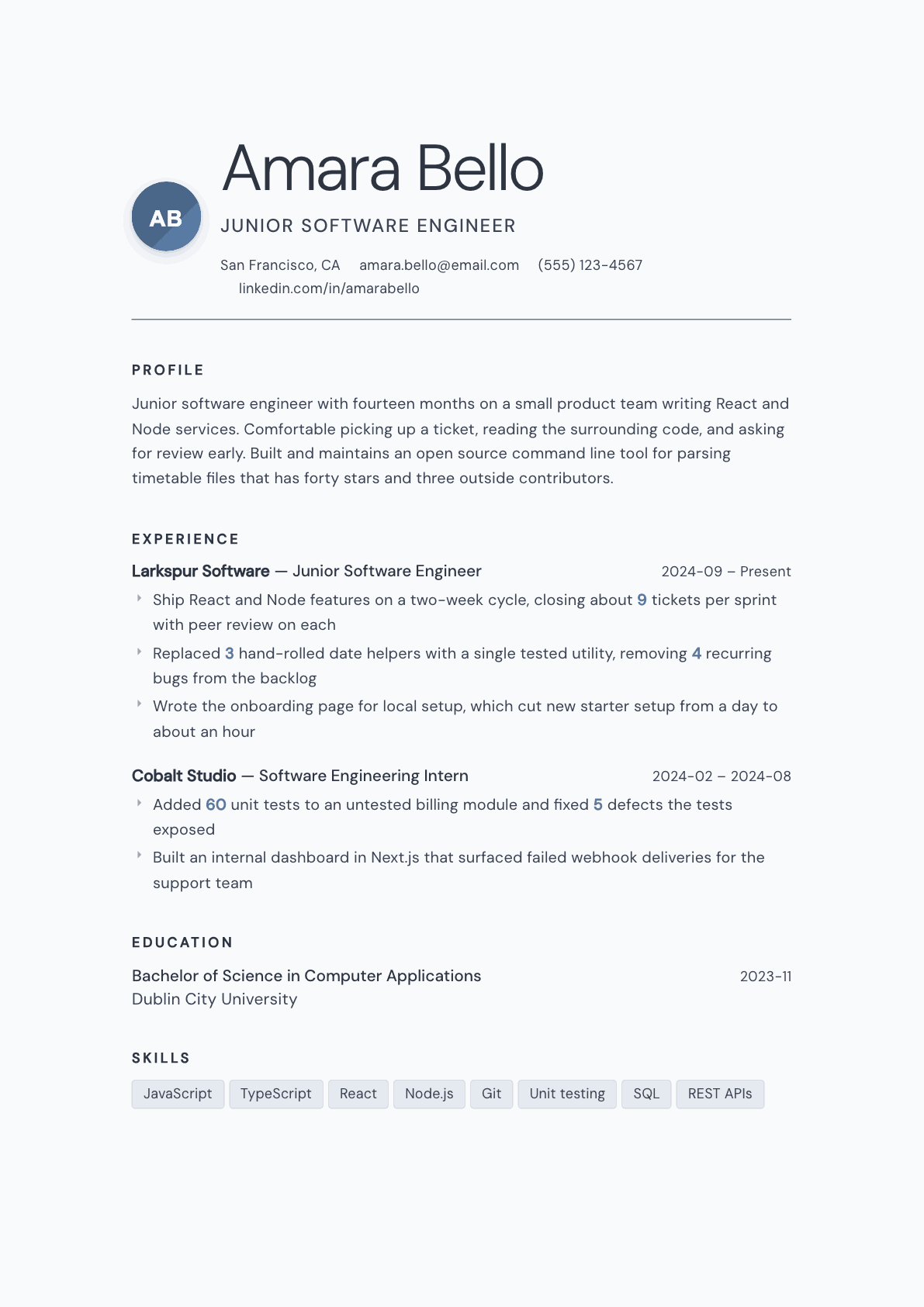
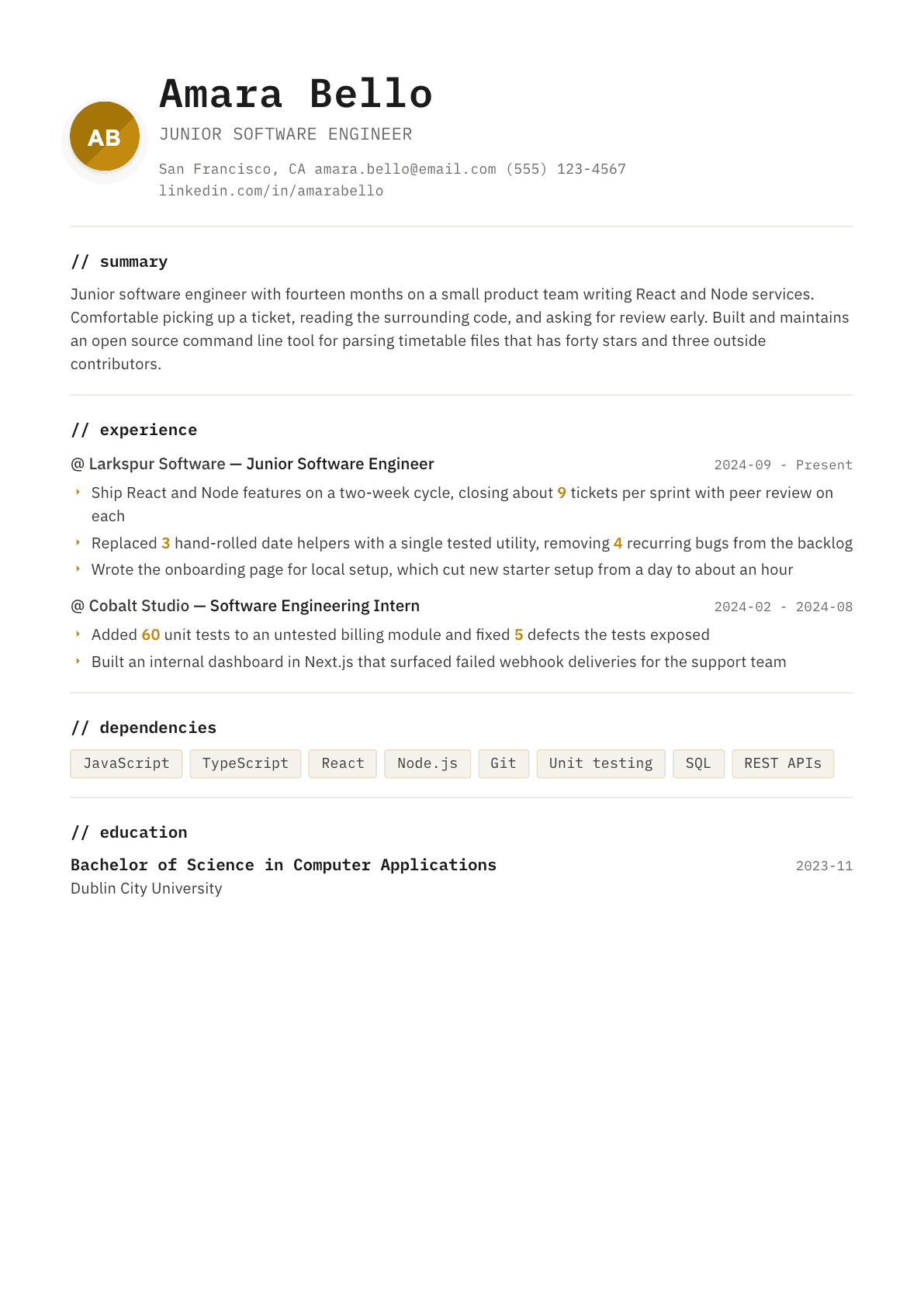
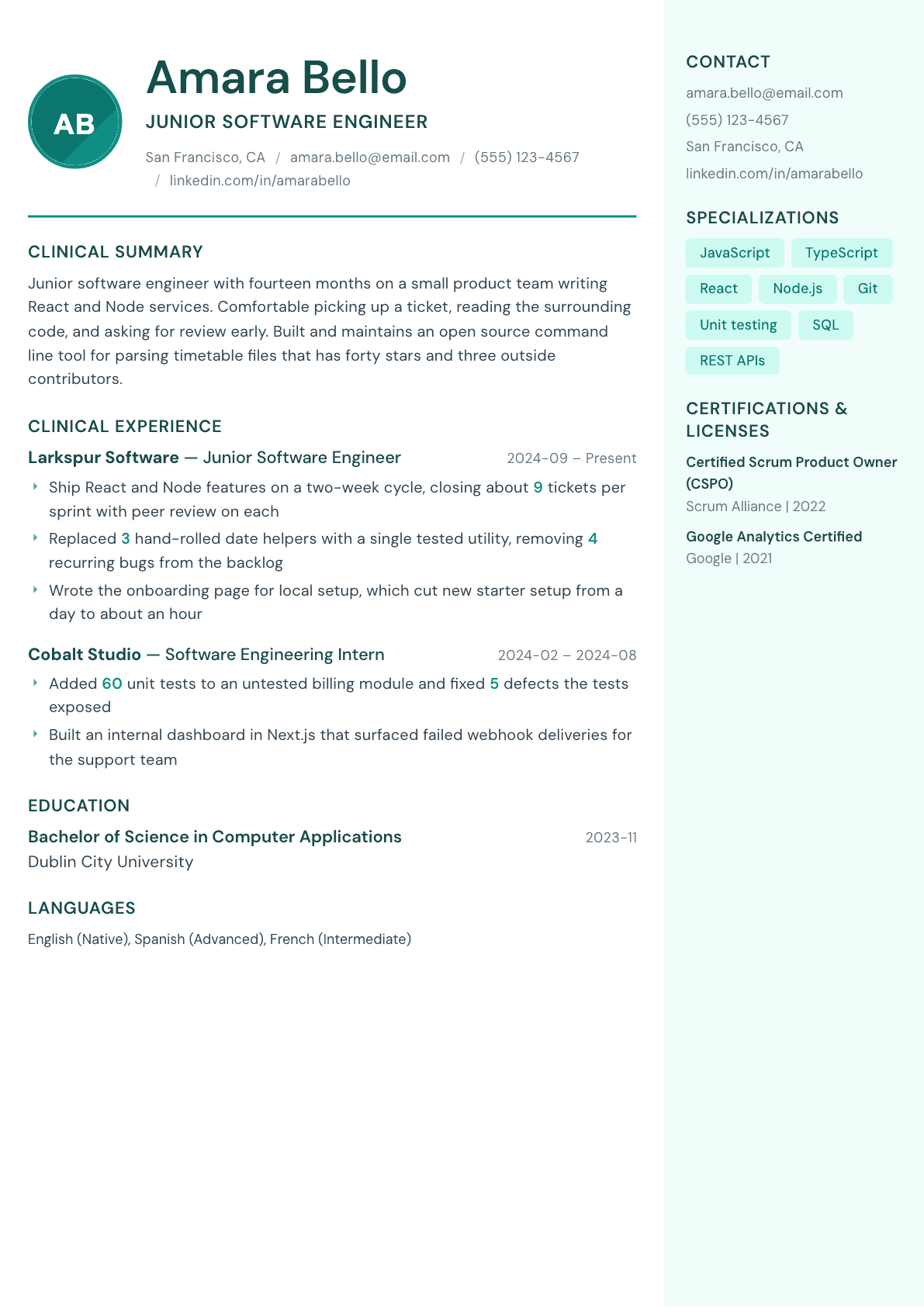
The same junior software engineer content laid out in three CVBooster templates, so you can see what the finished document looks like before you write a word.
Example Junior Software Engineer summary
Junior software engineer with just over a year building React and Node features on a small product team, plus a six-month internship focused on test coverage and internal tooling. Comfortable reading unfamiliar code before changing it and asking for review early. Maintains an open source parsing tool with outside contributors and is looking for a team with strong review culture.
Skills to list on a Junior Software Engineer resume
- JavaScript
- TypeScript
- Python
- React
- Node.js
- SQL
- Git and GitHub
- REST APIs
- Unit testing
- Debugging
- Docker basics
- Data structures
- Code review participation
- Agile ceremonies
What actually gets this resume read
- Put projects above work history when your paid experience is short, and treat each project like a job entry.
- Link a public repository and make sure the readme explains what the project does and how to run it.
- Name the exact stack in each bullet, because junior postings are filtered hard on language and framework terms.
- Show that you work inside a team: pull requests reviewed, pairing sessions, tickets picked from a shared board.
- Keep the resume to one page and drop unrelated part-time jobs once you have any engineering experience.
- Say what you learned to do rather than what you were exposed to, since exposure reads as passive to reviewers.
How to write a junior software engineer resume
A junior software engineer resume is competing against a large pile of pages that all look the same: a degree, three tutorial projects, and a skills list containing every language the writer has heard of. The reviewer is usually a senior engineer who has fifteen minutes and one question in mind, which is whether you can be given a real ticket without creating more work than you finish.
That question is answered by evidence of working inside a codebase you did not write. Reading unfamiliar code, opening a small pull request, responding to review comments, adding a test, and delivering a fix that stayed fixed. Every part of this resume should push toward that, which is why a modest internship or an open source contribution often beats three solo projects built from a course.
This guide covers the section order that works when your paid history is short, how to write a project entry so it reads like real work, how to handle the skills list without overclaiming, and what to do about the gap between graduation and your first job.
Format: one page, projects promoted while experience is thin
One page, single column, no photo, no skill rating bars. Order the sections by what is strongest. With under a year of paid work, put education first, then projects, then experience. Once you have a full year of engineering work, experience moves above projects and education drops to the bottom.
Applicant tracking systems at large employers still parse poorly from two-column layouts and icon-heavy headers. A plain layout with clear section titles costs you nothing visually and removes a real risk of the parser dropping your dates.
- Header: name, city, phone, email, GitHub link, and a portfolio only if the site actually works.
- Sections: summary, education, projects, experience, technical skills. Reorder once paid work is stronger.
- Include graduation month and, if you are a student, your expected finish date.
Summary: what you build, in what stack, and how you work
Two or three lines and no adjectives. Say how long you have been writing code professionally, the stack you are strongest in, and one habit that makes you easy to work with, such as asking for review early or writing tests before opening a pull request. A junior summary that promises passion and eagerness is indistinguishable from every other one in the pile.
If you are a career changer, use the summary to connect the previous field to engineering in one sentence, then move on. Reviewers are interested for exactly that long.
Projects: write them like jobs, not like assignments
Give each project a title, a stack, a time period, and two or three bullets. Say what it does, who uses it, and one hard part you solved. A project with real users, even thirty of them, outranks a clone of a well-known application because it forced you to handle input you did not control.
Say what you personally built when it was a team project. Reviewers assume shared credit unless you split it out. If the code is public, make sure the readme explains what the project is and how to run it, because a link to a repository with no readme is a link nobody follows.
Drop the course projects that everyone submits: the to-do list, the weather app, the calculator. If one is genuinely your best work, keep it but write it around the interesting part, such as the caching you added or the rate limit you had to respect.
Experience: show you can operate inside a team
For internships and first roles, write bullets that show the loop of professional development: picking a ticket, reading the surrounding code, opening a change, taking review comments, and getting it merged. Numbers help even when they are small. Tickets closed per sprint, tests added, defects fixed, or the time a setup guide saved a new starter.
Keep unrelated jobs only while the page needs them, and compress them to one line each. Retail and hospitality work does show reliability, but two bullets about a coffee shop take space that a project needs.
Technical skills without overclaiming
Group the list: languages, frameworks, databases, tools. Only list something you could answer questions on for ten minutes. Remove percentage bars and star ratings entirely, because a reviewer reads a claim of eighty on a language you used for one semester as a judgment problem rather than a strength.
Match the vocabulary of the posting where it is honest. If the role asks for React and you have built with React, use the word React rather than front-end frameworks, since that is what the filter is searching for.
Junior Software Engineer resume summary examples
Straight out of university
Computer science graduate with a six-month internship adding test coverage and internal tooling to a billing product. Strongest in TypeScript and Node, comfortable reading unfamiliar code before changing it, and used to opening small pull requests and responding to review rather than working alone for a week.
One year in
Junior software engineer with fourteen months building React and Node features on a five-person product team. Closes around nine tickets a sprint with review on each, wrote the local setup guide the team still uses, and maintains a small open source parsing tool with three outside contributors.
Career changer, two years
Junior software engineer with two years in web development after six years in laboratory operations. Built the internal sample tracking tool that started the move, now works in Python and React on a data-facing product, and brings a habit of writing procedures other people can follow.
Work experience bullets: before and after
Before: Worked on the front end of the company web application.
After: Built and maintained React components for the account settings area, closing about 9 tickets a sprint with a peer review on every change and no rollbacks in the last two quarters.
A specific area of the product plus a delivery rhythm shows steady contribution rather than vague involvement.
Before: Created a personal project using JavaScript.
After: Built a command line tool in TypeScript that parses university timetable exports into calendar files, now used by about 200 students and accepting changes from three outside contributors.
Users and outside contributors turn a hobby project into evidence that other people rely on your code.
Before: Helped fix bugs in the codebase.
After: Replaced three hand-rolled date helpers with a single tested utility, which removed four recurring bugs that had been reopened repeatedly over the previous year.
Naming the root cause and the recurrence shows you fixed the source rather than the symptom.
Before: Wrote unit tests for existing code.
After: Added 60 unit tests to an untested billing module during an internship and fixed the five defects the new tests exposed before the module went into a release.
The count and the defects found prove the tests were useful rather than written to satisfy a rule.
Before: Improved documentation for the team.
After: Wrote the local environment setup page after my own onboarding took a full day, bringing the next three new starters to a running application in about an hour each.
The trigger and the measured result show initiative and an eye for what slows a team down.
Hard skills
- JavaScript and TypeScript
- Python
- React
- Node.js
- SQL and relational databases
- Git and pull request workflow
- REST API consumption and design
- Unit and integration testing
- Debugging and reading stack traces
- HTML and CSS
- Linux command line
- Docker basics
Soft skills
- Asking for help early
- Responding to code review
- Written updates
- Breaking work into small changes
- Curiosity about unfamiliar code
Certifications worth listing
- AWS Certified Cloud Practitioner (Amazon Web Services)
- Microsoft Certified: Azure Fundamentals (AZ-900) (Microsoft)
- Oracle Certified Associate, Java SE Programmer (Oracle)
Mistakes that cost junior software engineer candidates the interview
- Listing ten languages when you could only answer questions on three, which turns the first interview against you.
- Using skill rating bars or percentages, since no reviewer knows what eighty out of a hundred in Python means.
- Submitting only tutorial projects, which tells a reviewer you have never handled input you did not control.
- Linking a repository with no readme, no commits in a year, or code that does not run when cloned.
- Writing a summary made of adjectives such as passionate, motivated and hard-working with no evidence attached.
- Hiding a gap after graduation instead of filling it with study, freelance work or a project with a date range.
- Going to two pages when a year of experience genuinely fits on one.
Junior Software Engineer resume questions
How do I write a junior software engineer resume with no professional experience?
Promote education and projects above experience, and write each project with a stack, a time period and a hard problem you solved. Add any collaborative coding you have done, such as open source contributions, hackathons or a group capstone where you name your own part.
Should a junior developer resume be one page?
Yes. Under five years of experience one page is the expectation, and under two years it is close to a rule. If yours runs over, cut unrelated jobs, trim the skills list and reduce each project to its two strongest bullets.
Do personal projects actually get read?
The good ones do. A reviewer scans for something with real users, an unusual constraint or code they can open quickly. Generic clones get skipped. One project written properly is worth more than four listed by name only.
Should I include my grade point average or degree classification?
Include it while it is strong and recent, within roughly two years of graduating. Drop it once you have professional experience worth the space. Never include secondary school results if you hold a degree.
How do I explain a gap between graduating and my first job?
Fill it with a dated entry rather than leaving a hole. Self-directed study with a named curriculum, freelance work, an open source contribution or a volunteer build all count. Say what you produced during the period, not only that you were learning.
Related resume examples
- Software Engineer Resume example
- Web Developer Resume example
- Software Engineering Intern Resume example
- React Developer Resume example
- Computer Science Student Resume example
- Full-Stack Developer Resume example