Collision Repair Technician Resume Examples: free score
Build a Collision Repair Technician Resume Shops Take Seriously
By Mustafa Tarabya, founder of CVBooster · Published · Updated
Collision repair technician resume example with keywords and a guide to writing structural repair, welding, ADAS and cycle time experience.
Sample resumes for a collision repair technician
The same collision repair technician content laid out in three CVBooster templates, so you can see what the finished document looks like before you write a word.
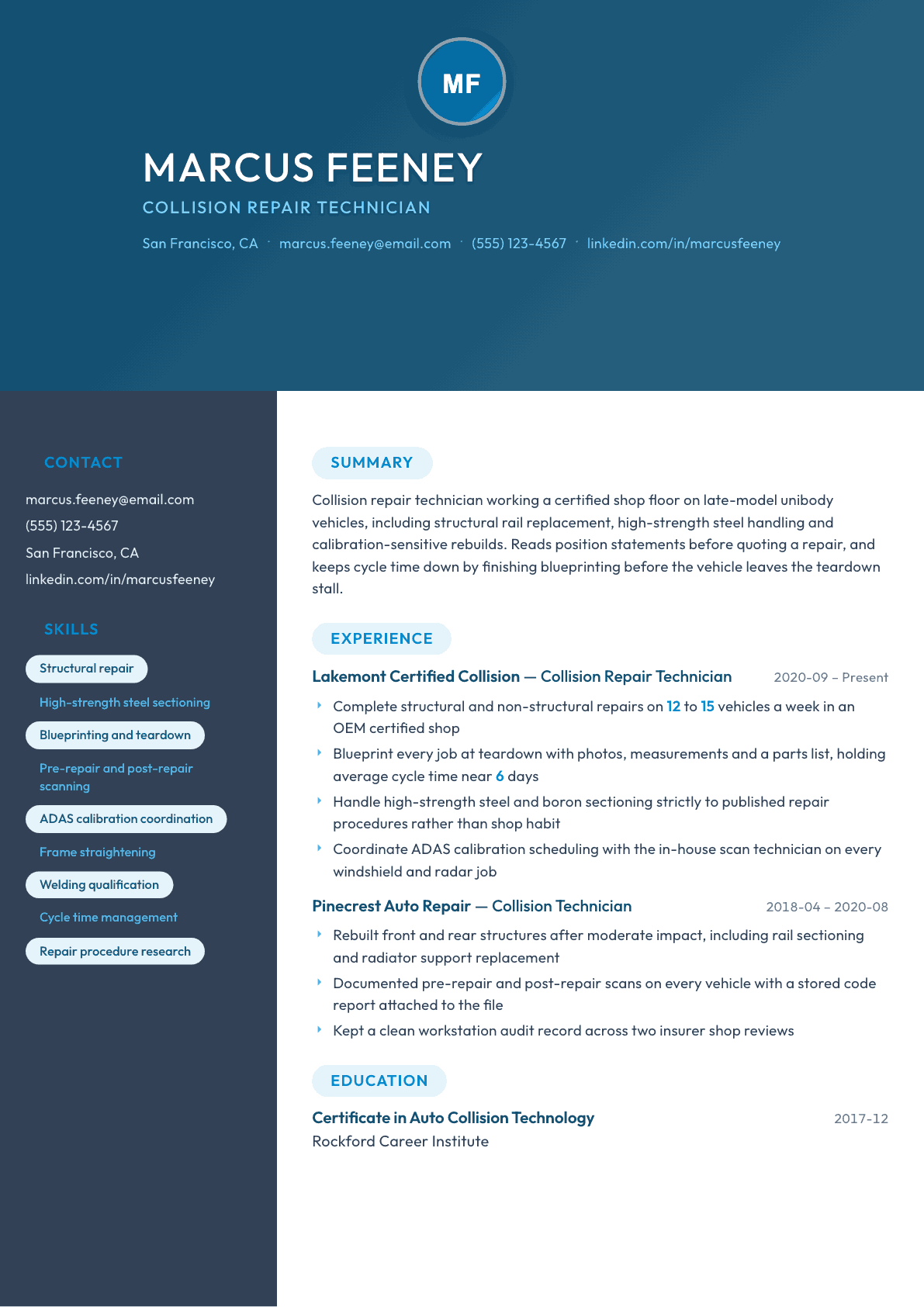
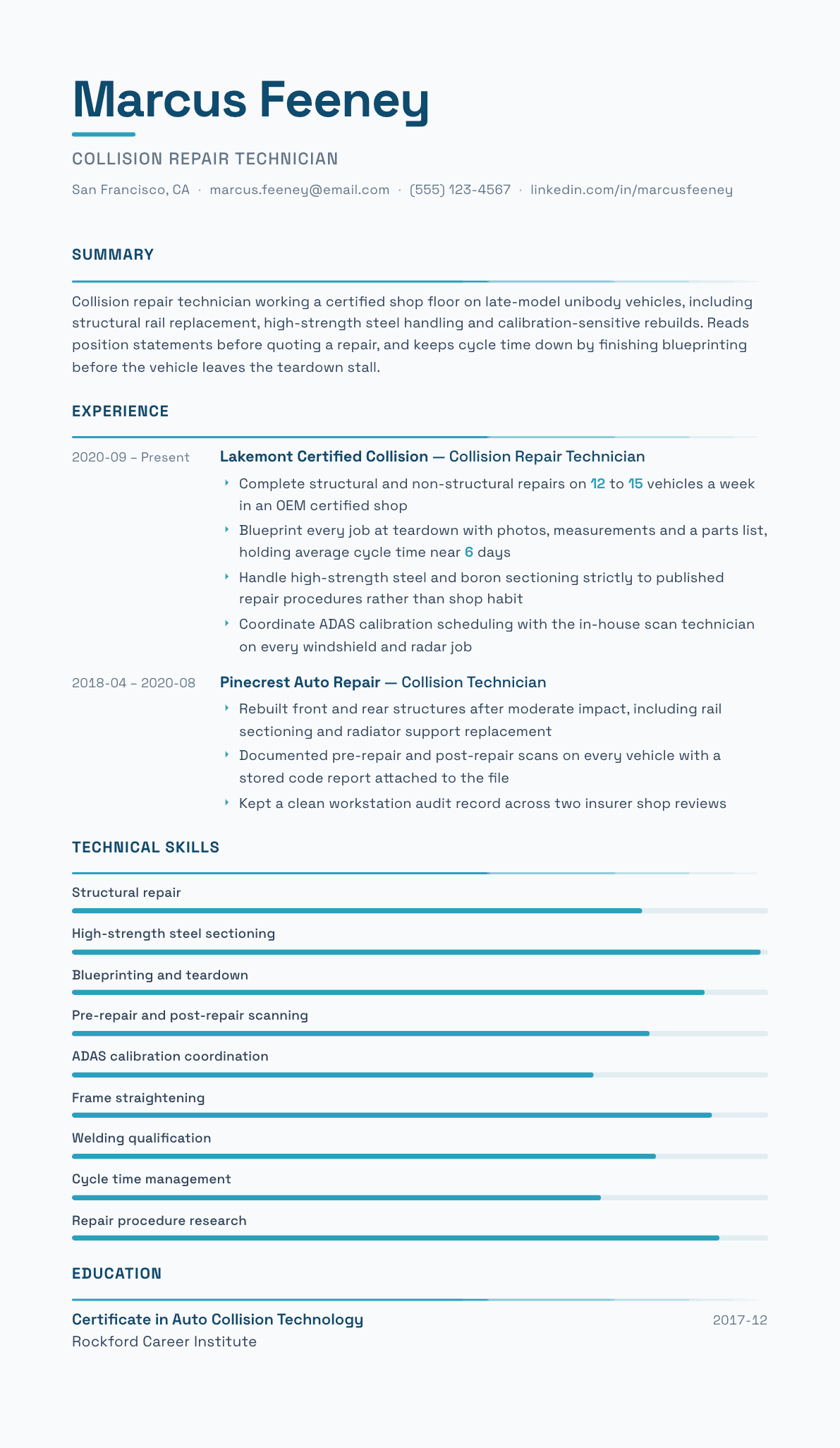
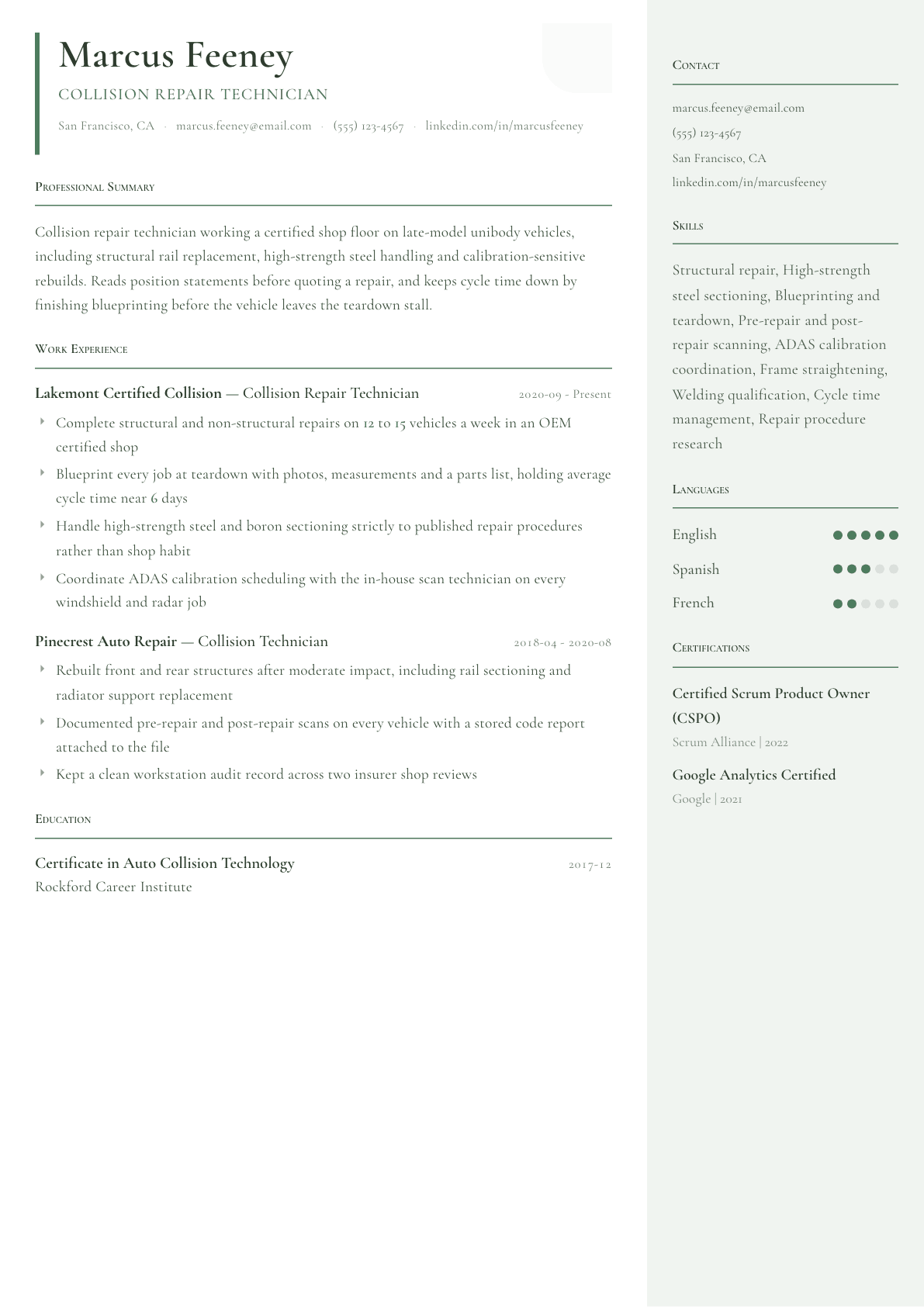
Example Collision Repair Technician summary
Collision repair technician with six years on late-model unibody vehicles in certified shops, covering rail sectioning, high-strength steel handling and calibration-sensitive rebuilds. Blueprints each job during teardown so parts and procedures land before the vehicle moves, documents pre-repair and post-repair scans, and follows published position statements instead of shop habit. Steady on cycle time in a production environment.
Skills to list on a Collision Repair Technician resume
- Structural collision repair
- Rail and rocker sectioning
- High-strength and boron steel handling
- Frame bench and measuring systems
- MIG and silicon bronze welding
- Blueprinting and damage analysis
- Pre-repair and post-repair scanning
- ADAS calibration coordination
- Parts identification and ordering
- Cycle time and workflow control
- Adhesive bonding and rivets
- Anti-corrosion treatment
- Insurer documentation
- Repair procedure research
What actually gets this resume read
- Lead with structural work if you have it, since that is the skill a certified shop struggles to hire.
- Say which OEM certifications your shops held, because it tells a manager which procedures you already follow.
- Include blueprinting and teardown documentation, which is where cycle time is won or lost in a shop.
- Name your scanning tools and whether you handled calibration scheduling, not just the physical repair.
- Give cycle time or vehicles per week so a production manager can slot you into the current schedule.
- List your welding qualification with the material types, since steel and aluminum are treated as separate skills.
How to write a collision repair technician resume
Collision repair hiring has moved. A shop used to want a technician with good hands and a heavy hammer. It now wants someone who will look up the published repair procedure for a specific vehicle, follow it exactly, document what was done, and hand the vehicle off for calibration without anyone chasing him. The craft still matters, but the discipline around it is what a shop cannot afford to be missing.
That is why so many collision resumes underperform. They describe repairs in general terms and never show the process: blueprinting at teardown, scanning before and after, sectioning to the procedure rather than to habit, documenting the file so the repair holds up under review. A production manager scanning ten resumes is looking for that discipline and usually cannot find it.
This guide takes the resume apart section by section for a collision repair technician, with summaries for someone new to the trade, a technician holding a production stall and a lead who takes the hard structural work, plus rewritten bullets and the questions technicians ask when they move into a certified shop.
Format: production facts first, certification list grouped
Reverse chronological, one page for most technicians, two once you have a long certification list and several shops behind you. Keep it plain and single column so it survives the systems large operators use to sort applicants.
Directly under the summary, place the facts a production manager is hunting for: repair depth, vehicles a week, average cycle time on your jobs, the certifications you hold and the scan or calibration tools you have used. Everything else in the resume supports those lines.
- Header: name, city and state, phone, email, and the state you are willing to work in if you are relocating.
- Production block: structural and non-structural depth, vehicles a week, cycle time, and severity of the jobs you take.
- Certification block: collision certifications, welding qualification with material types, and any manufacturer specific courses.
- Then experience by shop, then technical school and training, then a skills list that keeps process terms next to repair terms.
Summary: severity, certification and process
Three lines carrying severity, certification and process. Severity means what kind of damage you take: light cosmetic work, moderate impact with panel replacement, or heavy structural rebuilds with rail and rocker sectioning. Certification means what a certified shop needs on file. Process means blueprinting, scanning and documentation.
A technician who writes that he completes structural repairs on late-model unibody vehicles to published procedure, blueprints at teardown and documents pre-repair and post-repair scans has said more in one sentence than three paragraphs of general description. That is the sentence to build first and edit last.
Experience: blueprint, repair, document
Open each job with the shop type, whether it held manufacturer certifications, the number of technicians on the floor and the vehicles you personally completed a week. Production managers convert those numbers into a schedule slot before they read anything else.
Then structure your bullets around the three stages of a modern repair. Blueprinting: what you did at teardown, whether you photographed, measured, built the parts list and wrote the supplement so parts arrived before the vehicle needed them. Repair: the structural work, the materials, the weld types and the procedure you followed. Documentation: scans, calibration hand-offs, measurement printouts and the notes attached to the file.
Cycle time belongs in this section because it is how a shop earns. If your jobs moved through in a predictable number of days, say so and say what you did to make that true, such as finishing teardown documentation before the vehicle left the stall so nothing stalled waiting on a part.
Scanning, calibration and high voltage work
Driver assistance systems have changed what a collision technician must handle. Say which scan tools you have used, whether you performed pre-repair and post-repair scans yourself or coordinated them, and how calibration was scheduled on jobs involving windshields, radar units and cameras. Even if a specialist did the calibration, showing that you built it into the plan proves you understand the job is not finished when the panel fits.
Electric and hybrid vehicles are the second addition. Note any training on high voltage disable procedures and battery handling, and any experience working around a damaged pack. Shops are cautious about this work, and a technician who can show trained awareness rather than confidence is exactly what a manager wants to read.
Skills and keywords that get you through the first filter
Collision postings repeat a specific set of terms: structural repair, sectioning, high-strength steel, blueprinting, damage analysis, pre-repair scan, post-repair scan, calibration, cycle time, repair procedures, welding qualification. Place each one where the work is visible, because the shop will test any of them in a working interview.
Keep the insurer side of the vocabulary too. Supplement writing, photo documentation and estimate accuracy show that you understand the paperwork the repair rides on, and technicians who reduce friction between the shop and the insurer are worth keeping for reasons that have nothing to do with a hammer.
Collision Repair Technician resume summary examples
New to the trade
Auto collision graduate with a shop internship covering teardown, parts organization, bumper and bolt-on panel replacement and plastic repair. Trained in steel MIG welding, measuring setup and pre-repair scanning. Looking for an apprentice stall in a shop that will build me toward structural work over the next few years.
Holding a production stall
Collision repair technician completing 12 to 15 vehicles a week in an OEM certified shop, from moderate impact panel replacement through to rail sectioning. Blueprints every job at teardown with photos, measurements and a parts list, documents pre-repair and post-repair scans, and holds cycle time near six days.
Lead structural technician
Lead collision technician with ten years taking the heaviest structural work on the floor, including boron and high-strength steel sectioning on late-model unibody vehicles. Sets repair plans from published procedures, coordinates calibration scheduling, and mentors two technicians through their welding qualification and blueprinting routine.
Work experience bullets: before and after
Before: Repaired vehicles after accidents.
After: Completed structural and non-structural repairs on 12 to 15 vehicles a week, from moderate impact panel replacement to rail sectioning on late-model unibody platforms.
Severity and weekly volume let a production manager place you on the board instead of guessing.
Before: Wrote up the damage before repairs started.
After: Blueprinted every job at teardown with photos, measurements and a complete parts list, so supplements were submitted before the vehicle reached the frame rack.
It shows the teardown produced a plan, which is where cycle time is actually won.
Before: Followed manufacturer guidelines.
After: Sectioned high-strength and boron steel strictly to published repair procedures, pulling the document for each vehicle rather than repeating what the last similar job needed.
Naming the material and the habit of pulling the procedure is the discipline a certified shop screens for.
Before: Scanned vehicles for codes.
After: Ran pre-repair and post-repair scans on every vehicle and attached the stored code reports to the file, then scheduled radar and camera calibration with the in-house technician.
Documented scans plus a calibration hand-off show the whole job was closed, not just the metal.
Before: Worked quickly to meet deadlines.
After: Held average cycle time near six days on assigned jobs by clearing parts and procedure questions during teardown instead of after the vehicle was already in the stall.
The number plus the method behind it makes speed credible rather than a claim about attitude.
Hard skills
- Structural collision repair
- Rail, rocker and pillar sectioning
- High-strength and boron steel handling
- Frame bench operation and electronic measuring
- MIG and silicon bronze welding
- Blueprinting and damage analysis
- Supplement writing and photo documentation
- Pre-repair and post-repair scanning
- ADAS calibration coordination
- Adhesive bonding and rivet systems
- Anti-corrosion treatment after repair
- Parts identification and ordering
- Cycle time and workflow management
- High voltage disable awareness on electric vehicles
Soft skills
- Following a procedure even when experience says otherwise
- Communicating a delay early instead of at the promise date
- Working next to an estimator without treating him as an obstacle
- Keeping documentation current under production pressure
- Mentoring a newer technician through a job you could finish faster alone
Certifications worth listing
- Collision Repair and Refinish Certification (B Series) (National Institute for Automotive Service Excellence)
- ProLevel Structural Repair Certification (I-CAR)
- Welding Training and Certification, Steel GMA (I-CAR)
Mistakes that cost collision repair technician candidates the interview
- Describing repairs without ever naming severity, so a manager cannot tell whether you belong on the rack.
- Leaving blueprinting and teardown documentation out, which are the parts of the job that protect the schedule.
- Never mentioning scanning or calibration, which reads as a technician working from an older version of the trade.
- Claiming speed with no cycle time figure and no explanation of how the speed was achieved.
- Listing certifications you let expire without saying so, which surfaces awkwardly when a certified shop checks.
- Using the same resume for a small independent shop and a certified facility when they weigh your history differently.
Collision Repair Technician resume questions
What is the difference between a body technician and a collision repair technician?
The titles overlap, and many shops use them interchangeably. Where they differ, collision repair usually implies the full job including damage analysis, scanning and calibration coordination, while body technician can mean the metal and panel work alone. Match your resume to the title in the posting.
Do I need to be certified to work structural repairs?
A manufacturer certified shop generally needs current training and welding qualification on file for anyone touching structure, because its status depends on it. An independent shop may hire on demonstrated skill, but the certification still shortens the interview and usually raises the offer.
How do I show cycle time if my shop never measured it?
Give what you can honestly support: the typical days between teardown and delivery on your jobs, or the number of vehicles you completed in a week. Then describe the habits that kept things moving, such as clearing parts questions during teardown rather than after.
How much should I write about ADAS?
Enough to prove it is part of how you plan a job. Name the scan tools, say whether you performed or coordinated calibration, and give an example of a repair where calibration requirements changed the sequence of work. Overclaiming here is risky because it is easy to test.
What if most of my experience is light cosmetic work?
Say so plainly and lead with volume, quality and turnaround, which is what a high-throughput shop values. Then list any structural exposure you have had, and state that you want to build toward it. Honest positioning gets you a stall; overclaiming gets you a working interview you fail.
Related resume examples
- Auto Body Technician Resume example
- Painter Resume example
- Automotive Technician Resume example
- Auto Mechanic Resume example
- Auto Technician Resume example
- Medical Equipment Technician Resume example