Auto Body Technician Resume Examples: what gets the call
Write an Auto Body Technician Resume That Proves Panel Skill
By Mustafa Tarabya, founder of CVBooster · Published · Updated
Auto body technician resume example, keywords and a guide to writing panel repair, welding, frame work and refinish experience for a collision shop.
Sample resumes for a auto body technician
The same auto body technician content laid out in three CVBooster templates, so you can see what the finished document looks like before you write a word.
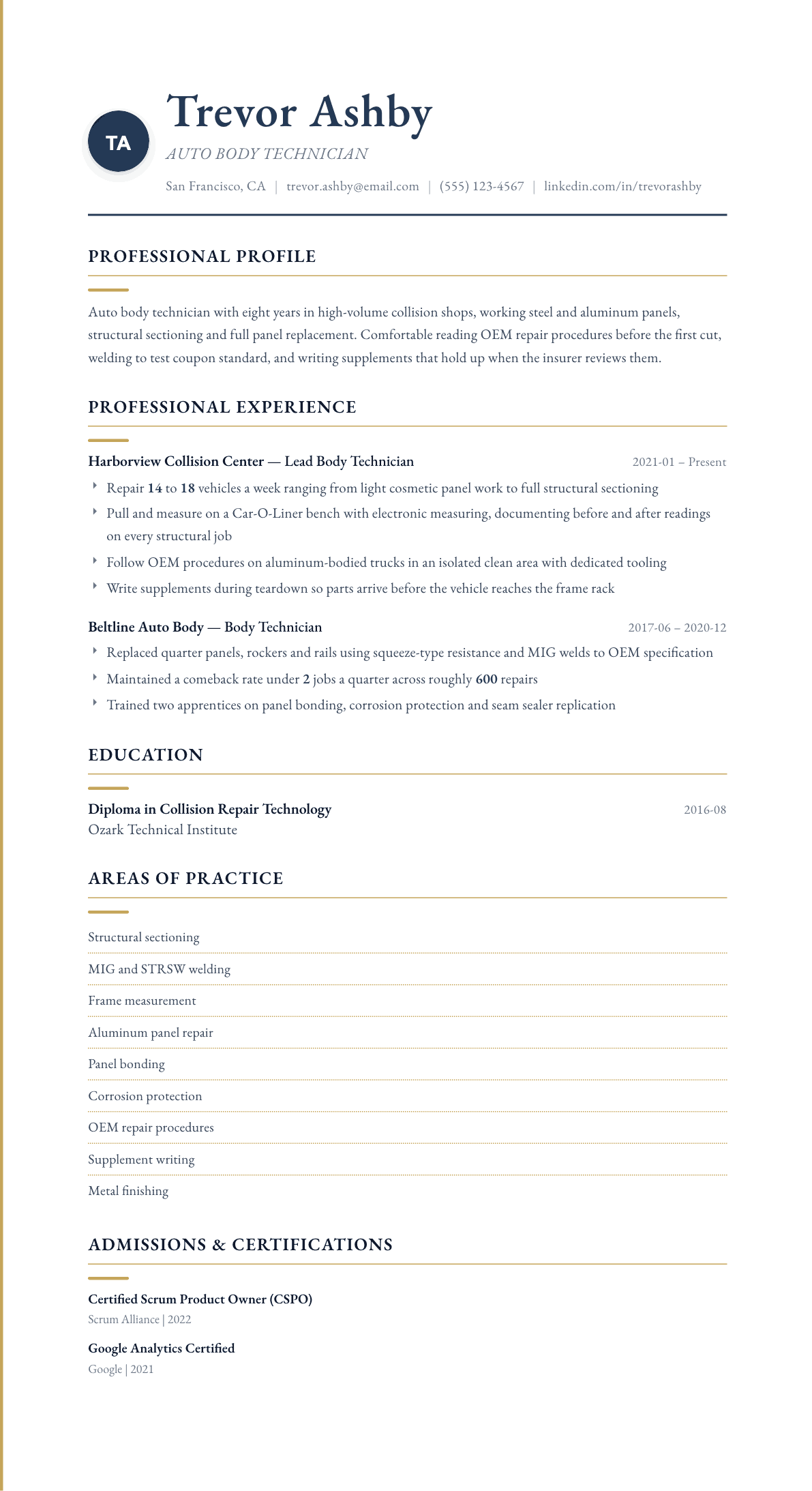
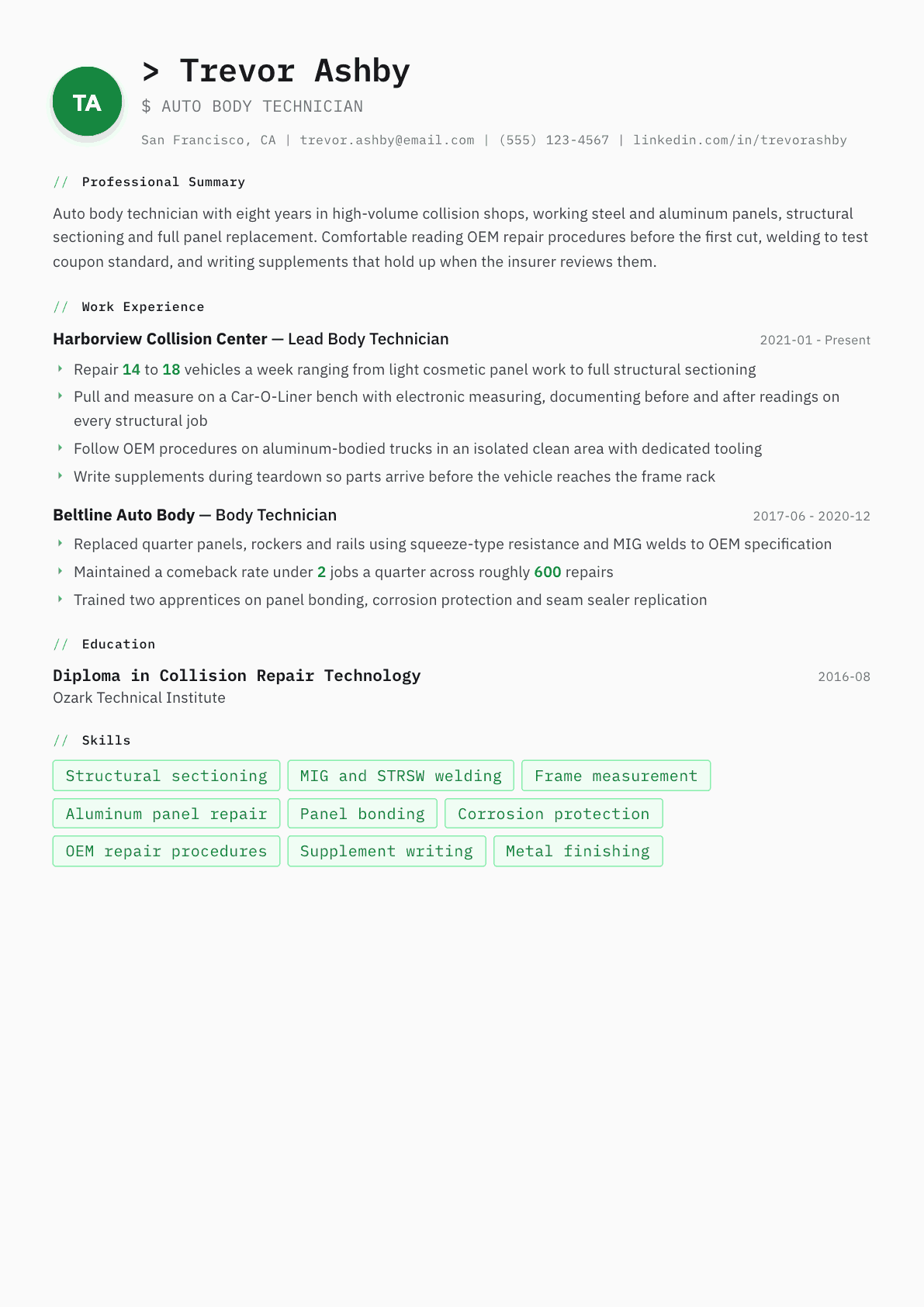
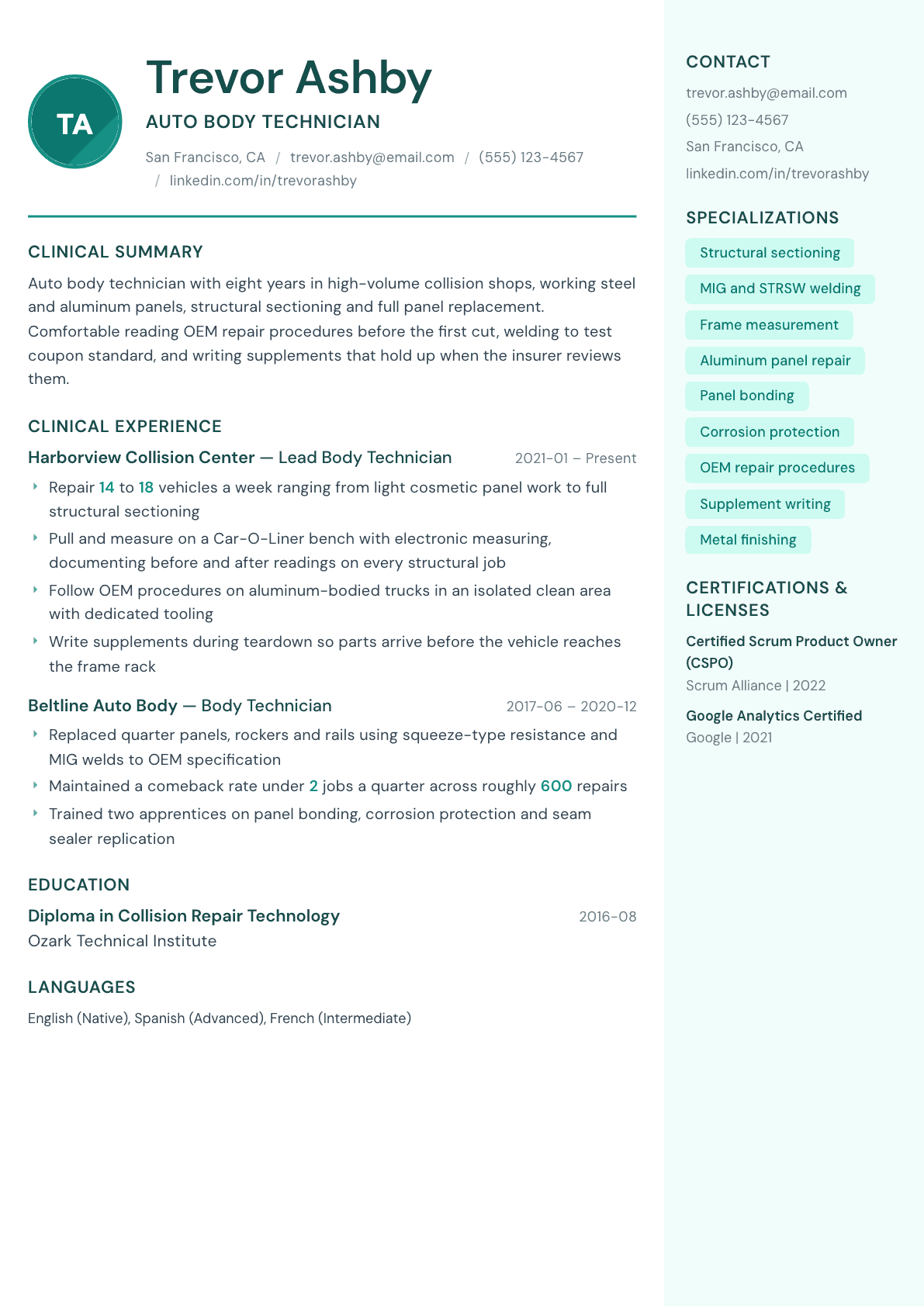
Example Auto Body Technician summary
Auto body technician with eight years in collision shops handling everything from bumper covers to full rail replacement. Measures and pulls on an electronic bench, welds to test coupon standard in steel and aluminum, and researches OEM procedures before cutting. Writes teardown supplements that keep parts ahead of the schedule and holds a comeback record the shop uses as its benchmark for quality.
Skills to list on a Auto Body Technician resume
- Structural panel sectioning
- Frame and unibody measurement
- MIG welding
- Squeeze-type resistance spot welding
- Aluminum repair and isolation
- Panel bonding and adhesives
- Metal finishing and body filler
- Corrosion protection
- Seam sealer replication
- OEM repair procedure research
- Estimate and supplement writing
- Plastic bumper repair
- Glass and trim removal
- ADAS component handling
What actually gets this resume read
- Say which frame bench and measuring system you have run, because shops buy toward the equipment they own.
- Split structural work from cosmetic work so a manager knows whether you can be put on the rack.
- Name aluminum experience separately, since it needs isolated tooling and a shop pays extra for it.
- Show your welding qualification and the joint types you have run rather than the word welding alone.
- Give repaired vehicle counts per week, which is how a body shop converts your history into flag hours.
- Mention comebacks honestly, because a low comeback record is worth more than a long list of tasks.
How to write a auto body technician resume
A body shop manager reading resumes has a production board on the wall and a hole in it. He is trying to work out one thing: what can he put in front of you on your first Monday. A technician who only does bolt-on panels and bumper covers fills a different hole from one who can be trusted on the frame rack with a late-model unibody, and your resume decides which of the two he thinks you are.
Most auto body resumes fail because they describe the trade instead of the technician. Repaired damaged vehicles, replaced panels, prepared surfaces for paint: every applicant in the pile wrote those lines. What the manager cannot find is the welding you are qualified for, the measuring system you have run, whether you have worked aluminum in an isolated area, and how many vehicles a week you turn.
This guide covers the sections a body shop reads, in the order it reads them, with summaries for an apprentice, a settled panel technician and a lead, before and after bullets, and the questions technicians ask when they move from a small independent shop into a certified facility.
Format: one page, capability block above the job history
One page unless you have more than a decade across several shops. A body shop manager reads fast and hires on capability, so give him a capability block right under the summary: the repair types you perform, the welding processes you are qualified in, the frame equipment you have operated and the materials you have worked.
Certifications belong in one grouped section rather than scattered through the jobs. Collision training is course based and a manager wants to scan the list against the vehicles that come through his doors, particularly for structural, aluminum and material specific courses.
- Header: name, city and state, phone, email, and a line naming your welding qualification and material types.
- Capability block: structural and non-structural repair, panel replacement, sectioning, bonding, metal finishing, plastic repair.
- Equipment line: the frame bench, the measuring system, the welder brands and the aluminum tooling you have used.
- Then experience with vehicles per week, then training and certification, then any shop certifications your employers held.
Summary: repair depth, volume and materials
Three lines. Give the years, the depth of repair you perform, the materials you work and the volume you carry. A manager staffing a production floor wants to know whether you are a two-vehicle-a-day cosmetic technician or someone who takes a week on a structural job and gets it right.
If you have aluminum experience, put it in the first line. Aluminum work needs isolated tooling, a separate work area and its own training, and shops that have invested in that setup struggle to find technicians who can use it. The same goes for any manufacturer certification your shops held while you worked there.
Experience: panels, welds and the measurements behind them
Start each job with the shop type and its throughput: independent, dealership body shop, multi-shop operator or a manufacturer certified facility, plus vehicles repaired a week. That frames everything that follows.
Then write the metal work in detail. Which panels have you replaced at the factory seam, which have you sectioned, what welds did the procedure call for, and how did you verify them. A bullet that mentions destructive test coupons before a structural weld tells a manager you were trained properly and you did not skip the step when nobody was watching.
Measuring is the other proof. Say which bench and measuring system you ran, that you recorded readings before and after the pull, and what tolerance you worked to. Anyone can hook chains to a car. The technician who documents the frame back into specification is the one who gets the structural work.
Add the finish quality bullets last: metal finishing standards, filler thickness discipline, corrosion protection, seam sealer replication and cavity wax. Those are the details that decide whether a repair still looks right a few winters later, and an experienced manager reads them as a sign of craft.
Quality, comebacks and how you work with the paint side
Comebacks are the number a body shop lives with, so give yours honestly with the volume behind it. A technician who says his comeback rate stayed under a couple of jobs a quarter across several hundred repairs has said something no adjective can match.
Say how you hand off to the refinish department. Body technicians who deliver panels with the surface ready, the gaps set and the parts test fitted save the painter hours, and shops know exactly which technicians do that. A bullet about test fitting all parts before the vehicle goes to paint is small on the page and large on the floor.
Skills and keywords a collision shop screens for
The words repeat across postings: structural repair, sectioning, unibody, frame measurement, resistance spot welding, panel bonding, corrosion protection, aluminum, plastic repair, metal finishing. Use them where the work is shown, not in a list on its own, because a manager will ask you to talk through any one of them.
Add the newer items that many resumes still miss: repair procedure research, handling of driver assistance components during removal, and battery disconnection or high voltage awareness on hybrid and electric vehicles. Those show that you keep up with what arrives in the shop rather than working from habit.
Auto Body Technician resume summary examples
Apprentice body technician
Collision repair graduate with a shop apprenticeship covering bumper covers, bolt-on panel replacement, plastic repair and parts preparation. Trained in steel MIG welding to test coupon standard and in corrosion protection. Comfortable stripping and mounting a vehicle for a lead technician and looking for a full apprenticeship in a production shop.
Five years on the floor
Auto body technician repairing 14 to 18 vehicles a week in a high-volume shop, covering cosmetic panel work through to quarter panel and rocker sectioning. Runs an electronic measuring system on the bench, welds steel and aluminum to procedure, and holds a comeback record used as the shop benchmark.
Lead body technician
Lead body technician with 12 years across independent and manufacturer certified shops, taking the structural work that other technicians pass on. Researches repair procedures before quoting, runs the aluminum area with dedicated tooling, writes teardown supplements, and has trained four apprentices through their welding qualification.
Work experience bullets: before and after
Before: Replaced damaged body panels on vehicles.
After: Replaced quarter panels, rockers and rear body panels at factory seams using the weld type and spacing the repair procedure specified, with destructive coupons tested before each structural weld.
Named panels, a procedure and a verified weld replace a sentence that could describe any technician.
Before: Used the frame machine to straighten cars.
After: Pulled and measured on an electronic bench, recording datum readings before and after every structural repair and attaching the printouts to the job file.
Documented measurement is the evidence a manager needs before handing over structural work.
Before: Worked on aluminum vehicles.
After: Repaired aluminum-bodied trucks in an isolated clean area with dedicated tooling, following the manufacturer procedure for bonding, riveting and dent repair on the panel material.
Isolation, tooling and procedure show the aluminum work was done properly rather than in a shared bay.
Before: Made sure repairs were high quality.
After: Kept comebacks under two jobs a quarter across roughly 600 repairs by test fitting every part before paint and checking gap and flush against the undamaged side.
A quality claim only counts when a number and the habit that produced it are on the page with it.
Before: Helped train new staff.
After: Trained two apprentices through steel welding qualification, panel bonding and corrosion protection, and signed off their first structural jobs alongside the shop lead.
It names what was taught and the checkpoint reached, which is what makes a training claim believable.
Hard skills
- Structural and non-structural panel replacement
- Factory seam sectioning
- MIG welding on steel
- Squeeze-type resistance spot welding
- Aluminum panel repair and isolated tooling
- Frame and unibody measurement systems
- Panel bonding and rivet bonding
- Metal finishing and filler control
- Corrosion protection and cavity wax
- Seam sealer replication
- Plastic and bumper cover repair
- Repair procedure research
- Parts removal, test fitting and reassembly
- Supplement writing during teardown
Soft skills
- Patience with a panel that is nearly right but not yet right
- Working to a production board without cutting a step
- Handing a vehicle to the painter in the state you would want it
- Asking for the repair procedure instead of trusting habit
- Taking correction on a weld without taking it personally
Certifications worth listing
- Collision Repair and Refinish Certification (B Series) (National Institute for Automotive Service Excellence)
- ProLevel Structural and Non-Structural Repair (I-CAR)
- Welding Training and Certification, Steel GMA (I-CAR)
Mistakes that cost auto body technician candidates the interview
- Writing repaired vehicles to customer satisfaction, a sentence that gives a body shop manager nothing to hire on.
- Leaving welding qualification off the page, so a manager has to assume you cannot be put on structural work.
- Failing to say which frame bench and measuring system you ran, when shops buy toward the equipment they own.
- Treating aluminum as just another panel material instead of naming the tooling, isolation and training behind it.
- Skipping vehicles per week, which is how a production shop converts your history into a place on the board.
- Listing paint work you have only assisted with, which invites an interview question you cannot answer.
Auto Body Technician resume questions
Should an auto body technician resume mention flag hours?
Give volume in vehicles a week and, if you know it, average hours produced. Shops pay on flat rate, so a technician who can state what he consistently turns without cutting corners is answering the question a manager was going to ask anyway.
How much detail should I give about welding?
Name the processes, the materials, the joint types and the qualification you hold. Then add one line about how you verify a weld, such as destructive testing a coupon set up the same way as the joint. That detail is what a certified shop is screening for.
Do I need I-CAR training to get hired?
Independent shops will often hire skill first and put you through courses afterward, but manufacturer certified shops usually need the training on file to keep their status. Listing the courses you have completed removes a reason to pass over your resume.
How do I show quality if I have no formal numbers?
Describe the habits that produce it: test fitting parts before paint, checking gaps against the undamaged side, keeping filler thin over properly worked metal, restoring corrosion protection. A manager who has run a floor recognizes those as the practices of someone whose work does not come back.
Is it worth listing the shops certifications on my resume?
Yes, because it tells a reader which procedures and equipment you worked under daily. Name the shop type and any manufacturer programs it held, then make clear which parts of that work you personally performed rather than implying the whole facility on your behalf.
Related resume examples
- Collision Repair Technician Resume example
- Painter Resume example
- Auto Mechanic Resume example
- Automotive Technician Resume example
- Auto Technician Resume example
- Electronics Technician Resume example