Medical Equipment Technician Resume Examples: free score
Write a Medical Equipment Technician Resume Hospitals Trust
By Mustafa Tarabya, founder of CVBooster · Published · Updated
Medical equipment technician resume example with keywords and a guide to writing preventive maintenance, CMMS records, device types and uptime.
Sample resumes for a medical equipment technician
The same medical equipment technician content laid out in three CVBooster templates, so you can see what the finished document looks like before you write a word.
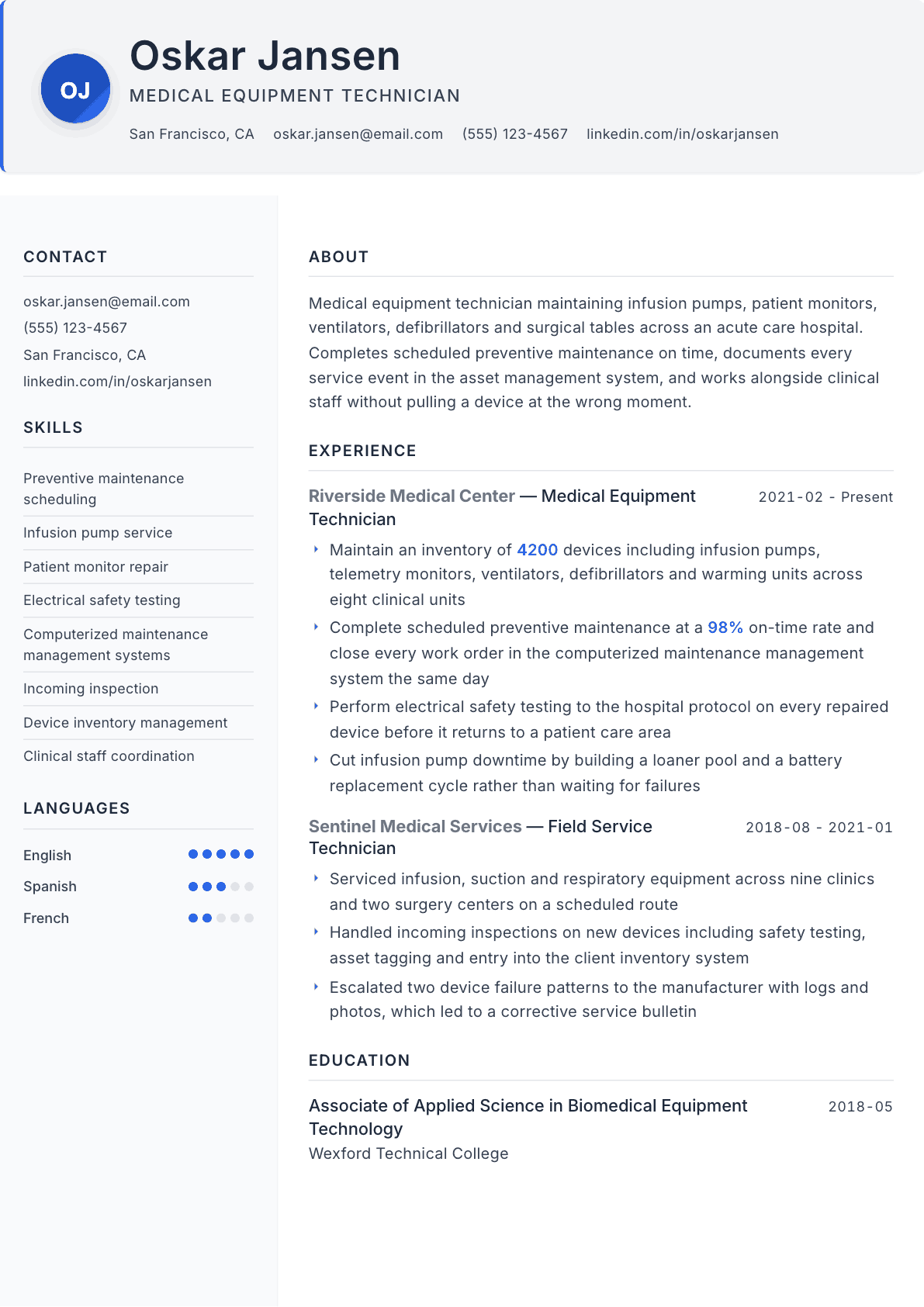
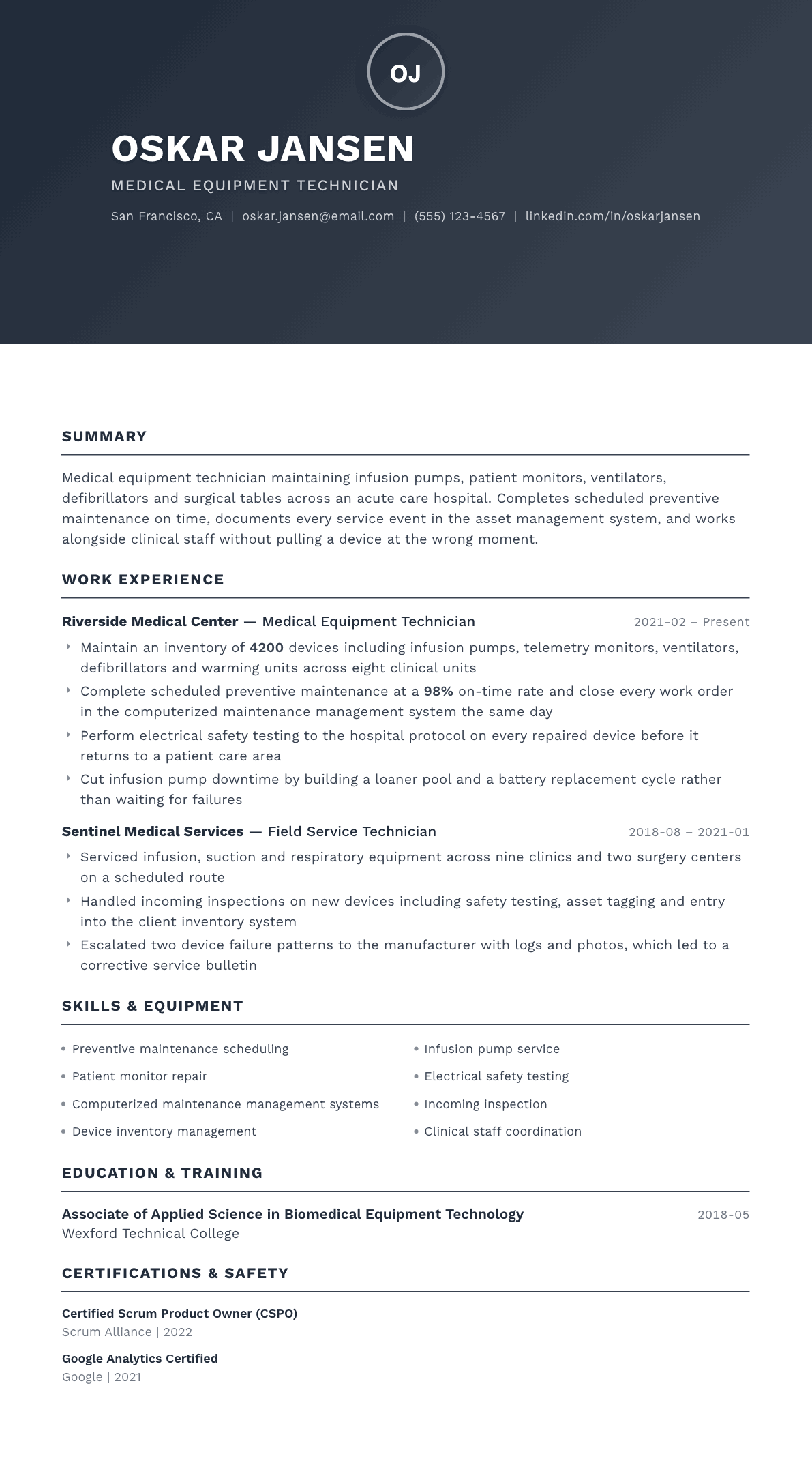
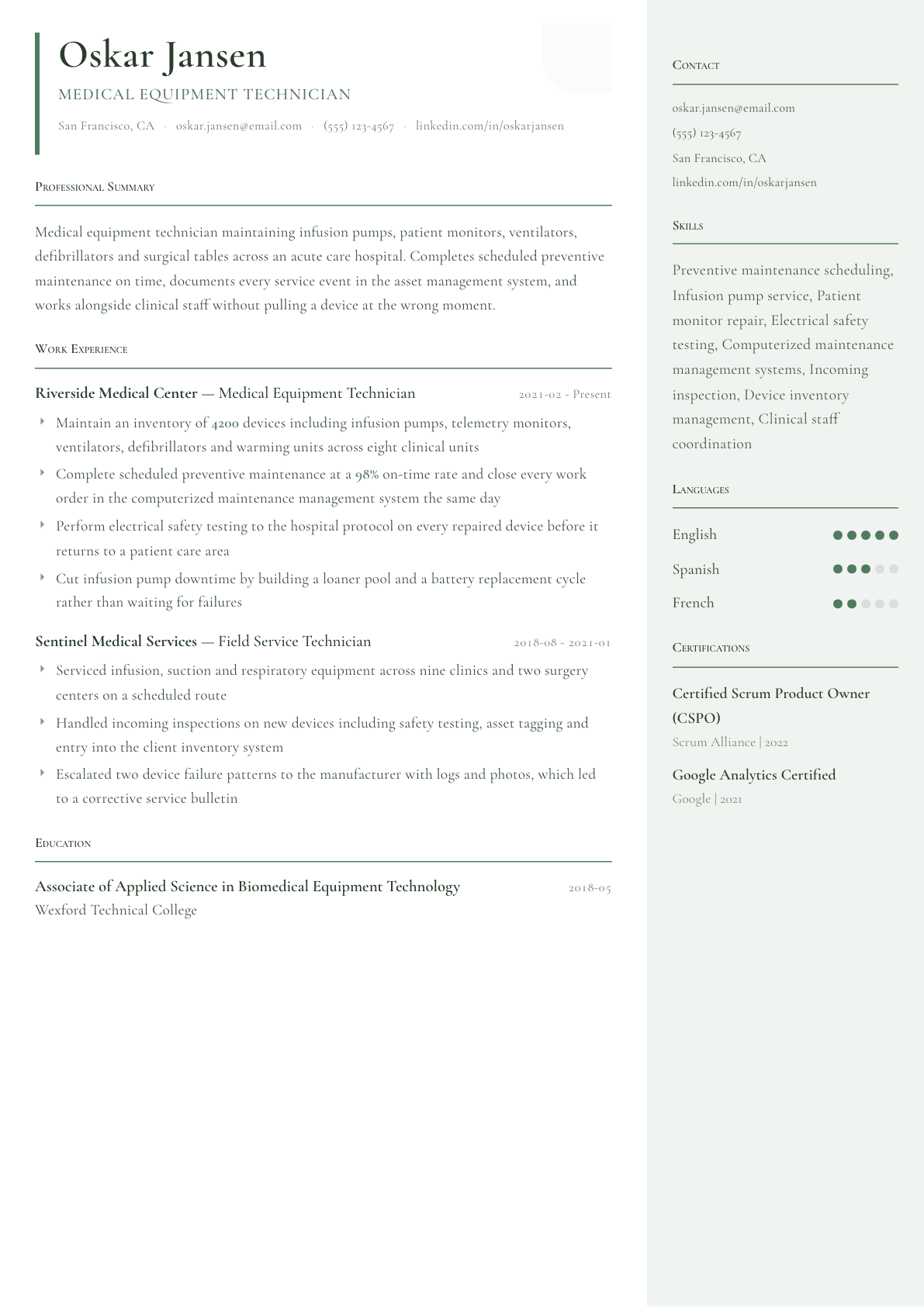
Example Medical Equipment Technician summary
Medical equipment technician maintaining an acute care inventory of infusion pumps, telemetry monitors, ventilators and defibrillators. Keeps scheduled preventive maintenance on time, closes work orders in the maintenance management system the same day, and runs electrical safety testing before any device returns to a patient care area. Built a loaner pump pool that removed the downtime nurses used to absorb.
Skills to list on a Medical Equipment Technician resume
- Preventive maintenance scheduling
- Infusion pump service and calibration
- Patient monitor and telemetry repair
- Ventilator and respiratory equipment
- Defibrillator testing
- Electrical safety testing
- Incoming inspection and asset tagging
- Computerized maintenance management systems
- Device inventory and recall tracking
- Manufacturer service manuals
- Test equipment and analyzers
- Work order documentation
- Clinical staff coordination
- Parts ordering and loaner pools
- Infection control practice
- Accreditation readiness
What actually gets this resume read
- List the device families you service by name, because a hospital hires against its own equipment inventory.
- Give your preventive maintenance completion rate, since that number is audited and a manager will ask for it.
- Name the maintenance management system you work in, as migrating a technician between platforms costs weeks.
- Show electrical safety testing and incoming inspection work, which are the tasks accreditation surveyors check.
- Describe how you coordinate with nurses to pull a device, because clinical disruption is the complaint managers hear.
- Put your manufacturer training courses on the page with the device line each one covered.
- Say whether you have worked in house, under a service contract, or on a field route, since the roles differ.
How to write a medical equipment technician resume
The manager hiring a medical equipment technician has an inventory list, a preventive maintenance completion figure that gets reported upward every month, and an accreditation survey coming at some point he cannot predict. He is looking for someone who will keep that figure high, keep the records defensible, and do it without pulling a pump off a unit at the worst possible moment.
That is why the strongest resumes in this field read like an equipment inventory with a compliance record attached. The device families serviced. The completion rate. The maintenance system the work was documented in. The safety testing performed before a device went back to a patient care area. A page built on those facts answers the manager's real anxieties in the order he feels them.
This guide covers what a healthcare technology manager or service company supervisor reads first, with summaries for a new graduate, a working technician and a senior, before and after bullets drawn from real device work, and answers to the questions technicians ask when they move between hospital departments and field service contracts.
Format: device families, then the compliance record
Reverse chronological, one page under ten years, plain layout. Directly beneath the header, list the device families you service in groups a manager recognizes: infusion and pumps, patient monitoring, respiratory, defibrillation and resuscitation, surgical support, examination and mobility equipment. He is matching that list against his own inventory before he reads a bullet.
Then a short compliance line: the preventive maintenance completion rate you held, the maintenance management system you documented in, and the safety testing you performed before release. Those three facts make the difference between a resume that looks like a repair history and one that looks like a department asset.
- Header: name, city and state, phone, email, and any AAMI credential you hold.
- Device family block grouped by clinical area rather than listed alphabetically.
- Each job names the setting: acute care hospital, surgery center, clinic network, long term care, rental fleet, or a field service route under contract.
- Graduates lead with the biomedical equipment technology program, clinical internship hours and the device families covered during them.
Summary: inventory size, completion rate, and where you worked
Three lines carrying four facts: the size of the inventory you supported, the device families inside it, your preventive maintenance completion rate, and the setting. Inventory size and completion rate are the two figures a healthcare technology manager reports to his own leadership, so a technician who supplies both is already speaking his language.
If you have worked both in house and under a service contract, say which one you prefer and why. In house work rewards relationships with clinical staff and deep knowledge of one inventory. Contract field work rewards route discipline, documentation and the ability to arrive cold at a site. Managers hire differently for each.
Experience: scheduled work, repairs and the release check
Open each job with the inventory. Four thousand two hundred devices across eight clinical units is a picture. Serviced a variety of medical equipment is the sentence that appears on most of the pile and communicates nothing. Then write bullets in three groups: scheduled maintenance, corrective repair, and the checks a device passes before it goes back into service.
Scheduled work bullets need a rate and a mechanism. How you got the completion rate up, not just what it was. Rebuilding the schedule around unit availability, chasing devices that hide in storage rooms, staging loaner equipment so a pump can leave the floor without a nurse losing a line. Managers know how hard those completion numbers are, and they recognize a real method instantly.
Repair bullets should show diagnosis. A pump failing occlusion alarms traced to a worn pumping mechanism rather than a sensor. A monitor dropping telemetry traced to a failing antenna module rather than the network. And every repair closes with the release check: electrical safety testing, performance verification against the service manual, and the work order documented the same day.
- Give the device count and the number of clinical areas or sites you covered.
- State your preventive maintenance completion rate and how it was measured.
- Name the maintenance management system by product family, since migrating platforms costs a department weeks.
- Include incoming inspection work on new capital equipment: safety testing, asset tagging and entry into the inventory.
Working with clinical staff without becoming a disruption
The technical half of this job is learnable. The half that gets a technician kept is knowing how to take a device off a floor. A nurse who loses a monitor during a busy shift remembers the technician who did it, and so does the manager who takes the call. Write that skill as procedure: how you time visits, how you coordinate with the charge nurse, how loaner equipment covers the gap.
The same applies to infection control and to entering patient areas. Say what you follow: hand hygiene, equipment wipe-down before and after, isolation precautions, and how you handle a device that comes out of a room under contact precautions. Those sentences tell a manager you can be trusted in a clinical space unescorted.
Skills and keywords a healthcare technology posting filters on
Postings repeat a narrow vocabulary: preventive maintenance, corrective maintenance, electrical safety testing, incoming inspection, work order, computerized maintenance management system, service manual, test equipment, asset tagging, recall, uptime, patient care area. Mirror the posting words in your skills block and again in a bullet where the work is visible.
Manufacturer training is its own filter. Name the courses you completed and the device line each covered, because a manager with those devices in his inventory will move your resume for that reason alone. If your training was delivered internally rather than by the manufacturer, say so honestly and name who trained you.
Medical Equipment Technician resume summary examples
New graduate
Biomedical equipment technology graduate with 400 clinical internship hours across infusion pumps, patient monitors, suction units and examination equipment. Trained on electrical safety testing, work order documentation and service manual use. Seeking a first medical equipment technician seat in an acute care or clinic setting.
Four years in a hospital
Medical equipment technician supporting an inventory of 4200 devices across 8 clinical units including infusion pumps, telemetry monitors, ventilators and defibrillators. Holds a 98% preventive maintenance completion rate, closes work orders the same day, and safety tests every repaired device before it returns to a patient area.
Senior technician
Senior medical equipment technician with 9 years across hospital and contract field service. Owns scheduling for two sites, manages the loaner pool and parts strategy, completed manufacturer training on 3 infusion platforms, and rebuilt an incoming inspection process that closed two accreditation surveys without a finding.
Work experience bullets: before and after
Before: Performed preventive maintenance on medical devices.
After: Completed scheduled preventive maintenance on an inventory of 4200 devices at a 98% on-time rate, covering infusion pumps, telemetry monitors, ventilators, defibrillators and warming units.
The inventory size, the rate and the device families give a manager the number he reports upward every month.
Before: Repaired infusion pumps when they broke.
After: Traced repeat occlusion alarms on a pump family to worn pumping mechanisms rather than pressure sensors, replaced the mechanisms across the fleet and removed a recurring service call from the queue.
A named misdiagnosis corrected across a fleet shows analysis rather than one-device repair.
Before: Tested equipment for safety.
After: Performed electrical safety testing and performance verification against the service manual on every repaired device before release to a patient care area, and recorded the readings in the work order.
The specific test, the reference and the recorded result are exactly what an accreditation surveyor asks to see.
Before: Reduced equipment downtime.
After: Cut infusion pump downtime by building a loaner pool and a scheduled battery replacement cycle, so units left the floor on a plan instead of after a failure.
The mechanism explains the outcome and shows preventive thinking rather than faster reaction.
Before: Worked with nurses and clinical staff.
After: Coordinated device pulls with the charge nurse on each unit, staged replacements before removal, and scheduled routine work around procedure times so no clinical area lost equipment mid-shift.
A described coordination routine addresses the complaint managers actually receive about biomedical visits.
Hard skills
- Preventive maintenance scheduling and completion tracking
- Infusion pump service and performance verification
- Patient monitor and telemetry repair
- Ventilator and respiratory equipment service
- Defibrillator testing with an analyzer
- Electrical safety testing
- Incoming inspection and asset tagging
- Computerized maintenance management systems
- Service manual interpretation
- Work order and parts documentation
- Recall and safety notice handling
- Loaner pool and inventory management
- Infection control practice in patient areas
- Accreditation readiness documentation
Soft skills
- Timing device removals around clinical workload
- Explaining a device fault to a nurse in plain language
- Keeping composure when equipment is needed urgently
- Documenting the same day rather than at the end of the week
- Asking a clinical user what the device actually did before assuming
Certifications worth listing
- Certified Biomedical Equipment Technician (CBET) (AAMI Credentials Institute)
- Certified Associate in Biomedical Technology (CABT) (AAMI Credentials Institute)
- CompTIA Network+ (CompTIA)
Mistakes that cost medical equipment technician candidates the interview
- Listing devices alphabetically instead of grouping them by clinical area the way a manager reads his inventory.
- Omitting the preventive maintenance completion rate, which is the number the department is judged on every month.
- Writing repaired and maintained equipment without a single diagnosis or a device family named.
- Leaving out the maintenance management system, when platform familiarity shortens onboarding considerably.
- Ignoring incoming inspection and asset entry, the tasks that keep a capital purchase from disappearing off the books.
- Saying nothing about working around clinical staff, which is where most technician complaints actually come from.
Medical Equipment Technician resume questions
Do I need a CBET credential to get a medical equipment technician job?
It is not required everywhere, but it removes doubt and some postings screen on it directly. If you are not yet eligible, list your degree, your clinical hours and the device families you have serviced, and state that you intend to sit the exam once you meet the experience requirement.
How do I show device experience when I trained on manufacturer platforms I cannot name?
Name the device category and the training source instead. Say you completed manufacturer training on a volumetric infusion platform, or vendor-delivered training on a telemetry system. A manager can read that accurately without needing the brand, and the honesty holds up at interview.
Is field service or in-house hospital work better on a resume?
Neither is better, but they read differently. Field service shows route discipline, documentation and independence. In-house work shows inventory depth, clinical relationships and accreditation exposure. Lead with whichever matches the posting and keep the other as evidence of range.
What should a new graduate put in the experience section?
Your internship, written with the same specifics a paid job would carry. Give the site type, the hours, the device families you worked on, the tests you performed and how work orders were documented. Managers accept documented clinical hours as experience when they are presented concretely.
How do I write about accreditation surveys without overclaiming?
Describe your part precisely. Say you prepared maintenance records, verified that scheduled work was current for a device group, or answered surveyor questions on safety testing. Claiming to have passed a survey single-handedly reads as inflated, while a clear supporting role reads as experience.
Related resume examples
- Biomedical Technician Resume example
- Maintenance Technician Resume example
- Lab Technician Resume example
- Instrument Technician Resume example
- Maintenance Manager Resume example
- Maintenance Supervisor Resume example