International Student Resume Examples: read this first
Write an International Student Resume for the Local Market
By Mustafa Tarabya, founder of CVBooster · Published · Updated
International student resume example with a work authorization line, local formatting rules and keywords for a first job abroad.
Sample resumes for a international student
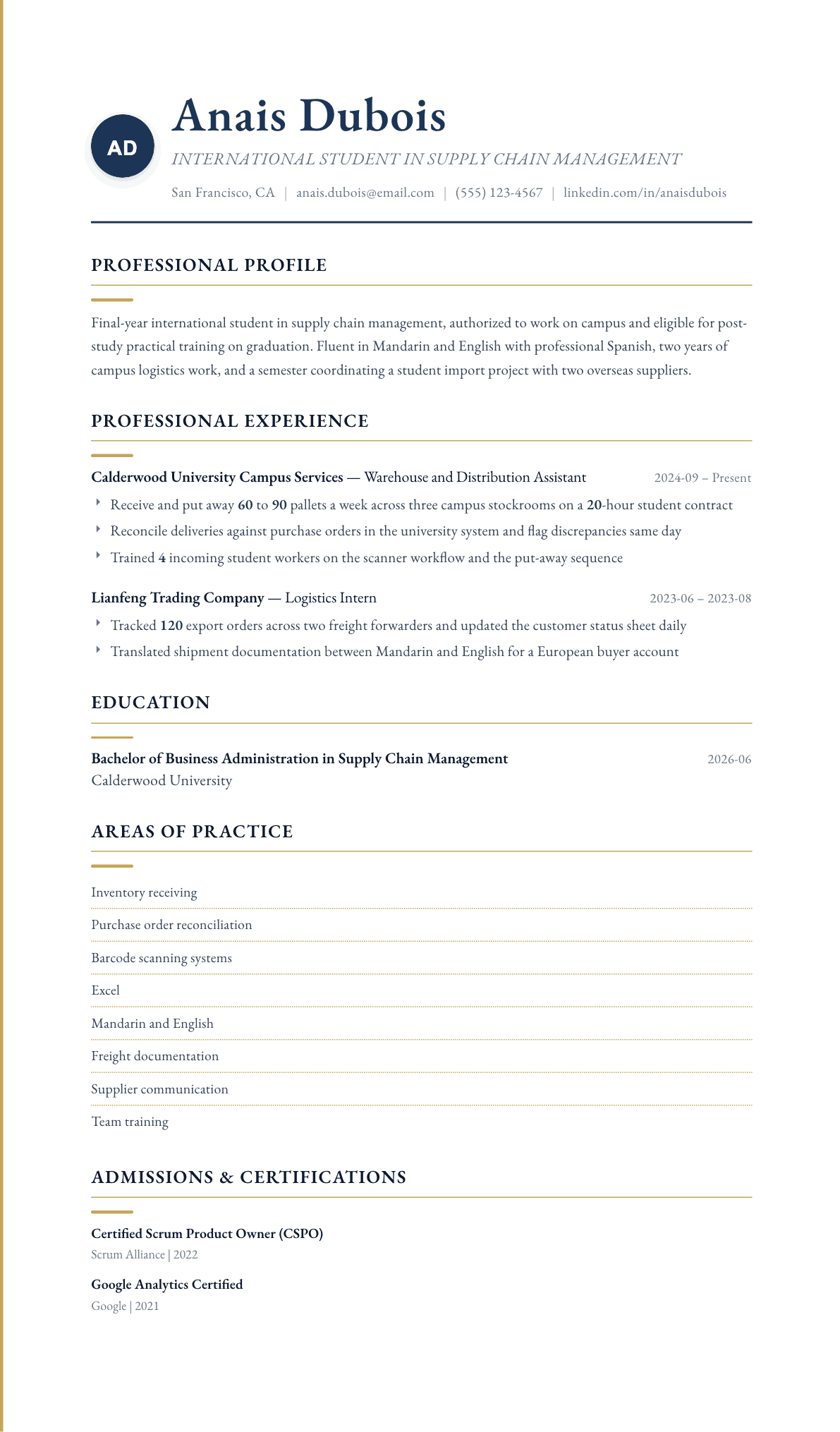
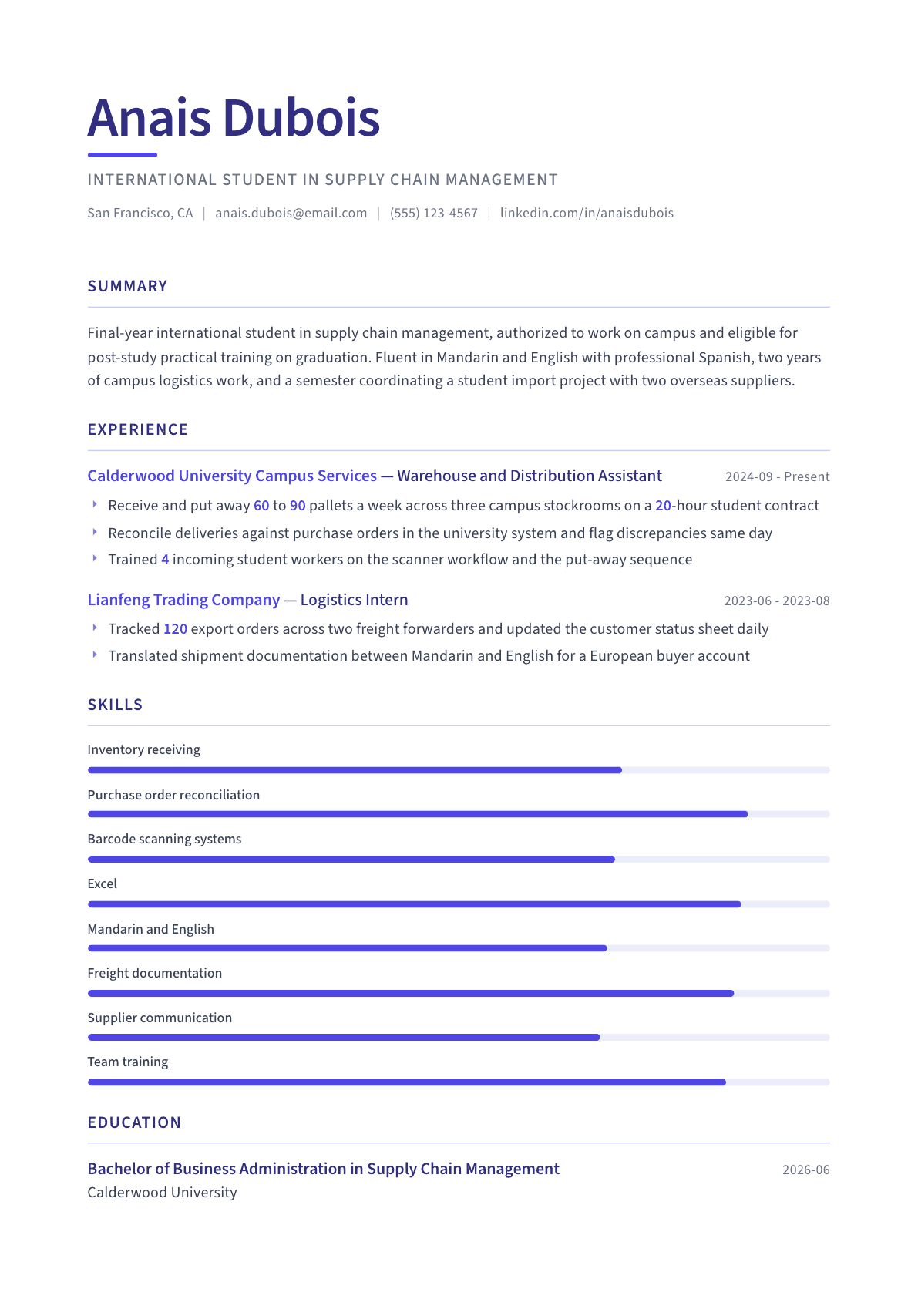
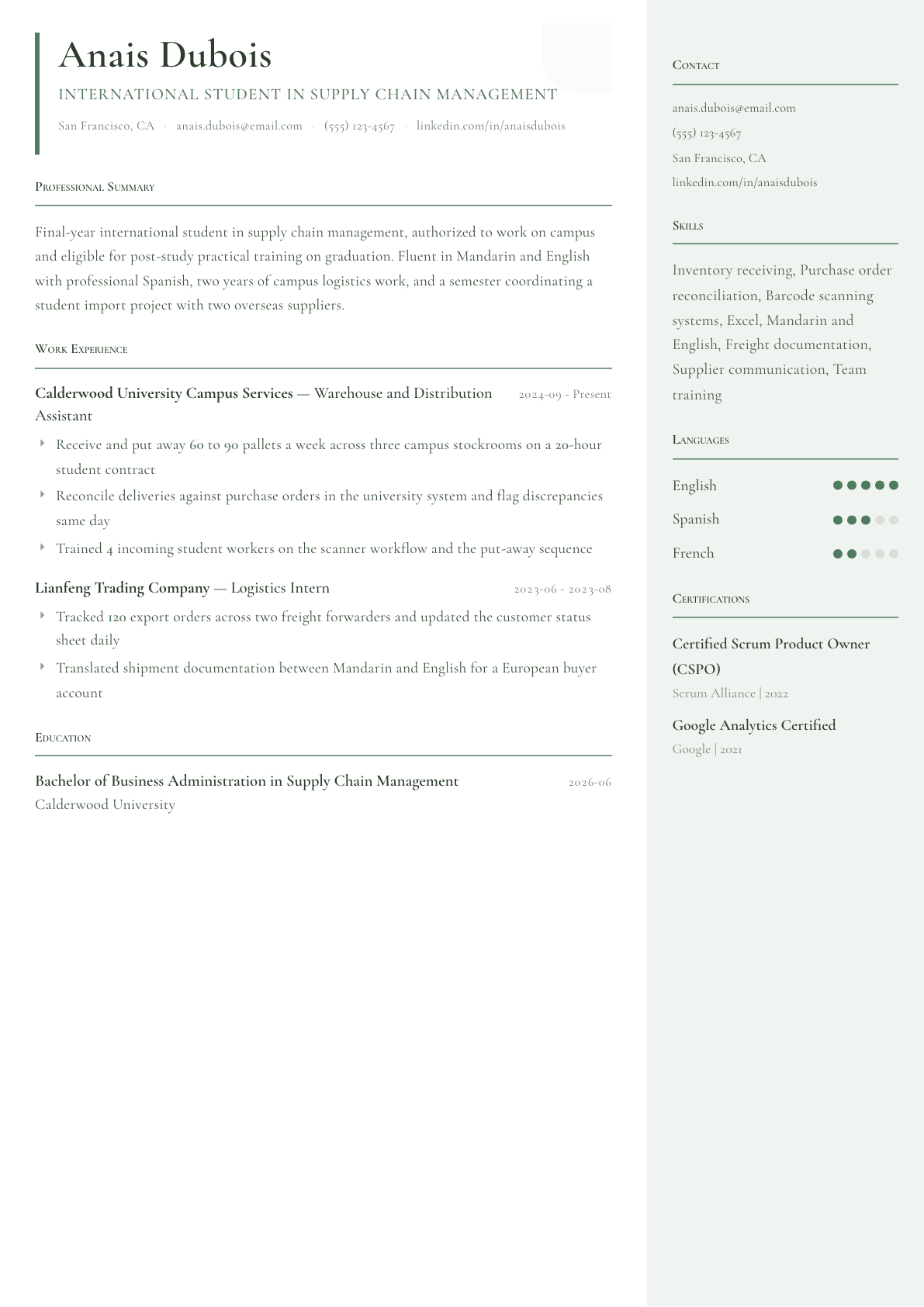
The same international student content laid out in three CVBooster templates, so you can see what the finished document looks like before you write a word.
Example International Student summary
Final-year international student in supply chain management, authorized for on-campus work now and for post-study practical training at graduation. Handles up to ninety pallets a week across three campus stockrooms, reconciles receipts against purchase orders daily, and interned with an export trading company tracking orders across two freight forwarders. Fluent in Mandarin and English, professional Spanish, and holds a local reference and payroll history.
Skills to list on a International Student resume
- Work authorization awareness
- Local resume formatting
- Degree equivalency framing
- Multilingual communication
- Cross-cultural teamwork
- Campus employment history
- Excel and reporting
- Supplier and vendor contact
- Documentation and records
- Translation and interpreting
- Adaptability to new systems
- Networking and referrals
- Interview preparation
What actually gets this resume read
- Say your work authorization status in one plain line near your contact details, because silence reads as a risk.
- Use a local phone number and a local city, since an overseas number quietly removes you from callback lists.
- Drop the photo, date of birth, marital status and nationality that your home country format expects.
- Translate your degree and grading into the local equivalent, and keep the original institution name intact.
- List languages with a level a reader understands, and say which one you have worked in rather than studied.
- Convert overseas job titles into the local title for the same work, and keep the employer name unchanged.
- Put campus work on the page, because it proves you already hold a local reference and a payroll record.
How to write a international student resume
An international student's resume gets screened for two things at once: whether you can do the work, and whether hiring you creates a paperwork problem. The second question is the one nobody writes on the page, and the silence around it is what sinks most applications. A recruiter who cannot tell your status will often move on rather than start a conversation she is not sure she is allowed to have.
The other obstacle is format. Resume conventions do not travel. A page that is entirely correct in Germany, India, Brazil or China may carry a photograph, a date of birth, a marital status, a father's name or a signature at the bottom, and in the market you are now applying to those elements range from unhelpful to disqualifying. The content is fine. The packaging was built for a different reader.
This guide covers the authorization line, the local formatting rules that quietly remove applicants, how to translate a degree and a job title without inflating either, what to do with languages, and how campus employment builds the local track record that makes the rest believable.
Say your work authorization in one plain line
Put a short, factual status line near your contact details. Something like authorized to work on campus and eligible for post-study practical training on graduation tells a recruiter what she needs without asking her to guess or to ask a question she may be nervous about asking. Ambiguity is read as a problem, and a problem gets skipped.
Say what is true and nothing more. Do not claim you will not need sponsorship at some future point if that depends on a process you have not started, and do not bury the truth in a hope. Recruiters check, and a status that turns out to be different from the page ends the candidacy immediately regardless of how strong the rest was.
Where an employer is open about sponsorship, address it in the cover letter instead of expanding the resume line. Keep the resume line to a single clause so it informs without dominating the top of the page.
- One status line, factual, placed with the contact block rather than in a summary paragraph.
- Any category you are eligible for at graduation, named the way the employer would name it.
- Nothing about visa history, previous refusals or family status, none of which belongs on a resume.
- A local email address and a professional handle, since an overseas domain adds friction for no gain.
Reformat for the local market before you rewrite anything
Strip the elements the local market does not use: photograph, date of birth, nationality, marital status, gender, religion, identity number, parents' names and the handwritten signature block. In many markets these are not merely unnecessary, they create a compliance problem for the employer, and some screening teams are instructed to set aside any resume that contains them.
Use a local phone number and a local city. An overseas number reads as a candidate who is not yet in the country, and recruiters filling roles quickly will not test that assumption. If you have a preferred name you use every day, put it in the header alongside your legal name so an interviewer knows what to call you.
Convert dates and page conventions too. Order sections the way local employers expect: contact, status line, education or experience depending on which is stronger, then skills and languages. Two pages at most, one where possible.
Translate the degree, the grading and the job title
Keep the institution name in its own language and add the local equivalent of the qualification beside it. A reader who has never heard of your university still understands a four-year engineering degree completed at a national technical institution. Never translate the institution into something it is not, and never invent an accreditation.
Grading is the same problem. A number that means excellent at home may mean nothing or the opposite here. Give the local equivalent, or express your standing as a rank within a class if your institution issues one, and say which system the figure comes from.
Job titles from previous employment need the same treatment. Keep the employer name unchanged and describe the work in the local title's vocabulary underneath it. Someone whose title translates literally to responsible officer may have been doing what this market calls an operations coordinator, and only the second version will be understood.
- Institution in its original name, with a one-clause local equivalent for the qualification.
- Grade or standing expressed in a system the reader recognizes, with the source system named.
- Employer names kept intact, with the local-equivalent role described in the bullets.
- A one-line note where a former employer is large at home but unknown here.
Languages, and the difference between studied and worked in
List languages with a level a reader can act on, and say which ones you have actually worked in. There is a large gap between a language you studied for years and a language you used to handle a supplier complaint on the phone, and a hiring manager cares only about the second. Naming a test score is fine when the employer asks for one, otherwise a working level statement is clearer.
Multilingual ability is a genuine asset rather than a footnote, so place it where the relevant reader will see it. A team with suppliers, customers or research partners in your first language should find that fact without hunting, ideally attached to a bullet where you used the language to get something done.
Build a local track record while you are still studying
Campus employment is worth far more than its hours suggest. A stockroom job, a library desk, a teaching assistantship or a research post gives you a local employer, a local payroll record and a local reference, and each of those answers a doubt that a purely overseas history leaves open. Put it on the page with hours and outcomes like any other job.
Volunteer roles, student society positions and course projects with local organizations do similar work. They show that you can operate inside the local workplace culture: the meeting norms, the directness or indirectness of feedback, the way deadlines are negotiated. Managers rarely say this out loud, but it is often the real hesitation behind a rejection, and evidence beats reassurance.
International Student resume summary examples
First year, seeking campus work
First-year international student in business administration, authorized for on-campus employment and seeking a term-time role in library or campus services. Fluent in Portuguese and English, ran a school store inventory for two years before arriving, and is available 18 hours a week around a fixed timetable.
Final year, seeking a first professional role
Final-year international student in supply chain management, authorized for on-campus work and eligible for post-study practical training at graduation. Handles up to ninety pallets a week across three campus stockrooms and interned with an export trading company tracking orders across two freight forwarders. Fluent in Mandarin and English.
Graduate student with overseas experience
Master's student with five years as a process engineer at a national manufacturer before relocating, now completing a degree in industrial engineering. Ran a line changeover project that cut setup time across three cells. Fluent in Hindi and English, working German, and holds a local reference from two years of research assistant work.
Work experience bullets: before and after
Before: I am an international student looking for opportunities.
After: Authorized for on-campus employment now and eligible for post-study practical training on graduation in June, available full time from the following month.
It answers the unspoken screening question with facts and a date instead of leaving the recruiter to guess.
Before: Worked at a trading company in my home country.
After: Tracked 120 export orders across two freight forwarders at a regional trading company, updating the customer status sheet daily and escalating delays to the account manager.
Volume and process detail make an unfamiliar employer legible to a reader who has never heard of it.
Before: Fluent in Mandarin and English.
After: Translated shipment documentation between Mandarin and English for a European buyer account, and handled supplier calls in both languages during the delivery window.
Language becomes a capability once it is attached to work you completed rather than listed as a fact.
Before: Part-time job on campus.
After: Receive and put away 60 to 90 pallets a week across three campus stockrooms on a 20-hour student contract, and trained 4 incoming student workers on the scanner workflow.
Campus work described with volume and training gives you a local employer reference that carries weight.
Before: Graduated with a good grade from my university.
After: Completed a four-year bachelor of business administration ranked in the top 15% of a cohort of 240, with a specialization in logistics.
A standing a local reader can interpret replaces a grading scale that means nothing outside its own system.
Hard skills
- Work authorization documentation
- Local resume formatting
- Degree and grade equivalency framing
- Bilingual and multilingual communication
- Translation of technical documents
- Campus employment systems
- Excel and reporting
- Purchase order and record reconciliation
- Supplier and vendor correspondence
- Cross-border logistics documentation
- Applicant tracking keyword matching
- Reference and portfolio preparation
Soft skills
- Adapting to a new workplace culture
- Asking clarifying questions early
- Building a local network from zero
- Handling direct feedback
- Persistence across a long job search
- Working across time zones with family and former colleagues
Mistakes that cost international student candidates the interview
- Leaving work authorization unstated, so a cautious screener sets the application aside rather than asking.
- Keeping the photograph, date of birth and marital status that a home-country format expects, which can disqualify the file outright.
- Using an overseas phone number and address, which reads as a candidate who has not yet arrived.
- Reporting a grade on a scale the local reader cannot interpret, or converting it upward into something it is not.
- Translating a job title literally when the local market has a different name for the same work.
- Listing languages without saying which ones you have used at work rather than studied.
- Skipping campus jobs, which are the fastest route to a local reference and a local payroll record.
International Student resume questions
Should I mention my visa status on my resume?
Yes, in one short factual line near your contact details. State what you are authorized to do now and what you become eligible for at graduation. Leaving it blank makes a recruiter guess, and guessing usually ends with your application in the no pile.
Do I remove my photograph and date of birth?
Remove both, along with nationality, marital status, gender and any identity number. Many local employers treat that information as a compliance risk and some screening teams are told to set aside resumes containing it, whatever the quality of the candidate underneath.
How do I explain a university nobody here has heard of?
Keep the institution name as it is and add a short clause giving the local equivalent of the qualification and the length of the program. Where the school is well regarded at home, a rank within your cohort communicates more than a name ever will.
Is it worth applying to employers who say they do not sponsor?
Focus your effort elsewhere, but check what the posting actually says. Some employers who will not sponsor long term will still hire during a post-study work period. Spend the time you save on employers who have hired international graduates before.
How do I get references when all my previous managers are overseas?
Build local ones deliberately while you study. A campus supervisor, a project client, a faculty member who has seen your work and a volunteer coordinator are all reachable in the local time zone, which matters more to a hiring manager than seniority abroad.