Community Manager Resume Examples: the lines they read
Build a Community Manager Resume That Brings People Together
By Mustafa Tarabya, founder of CVBooster · Published · Updated
Create an engaging community manager resume with member growth metrics, engagement strategies, and community-building expertise that companies seek.
Sample resumes for a community manager
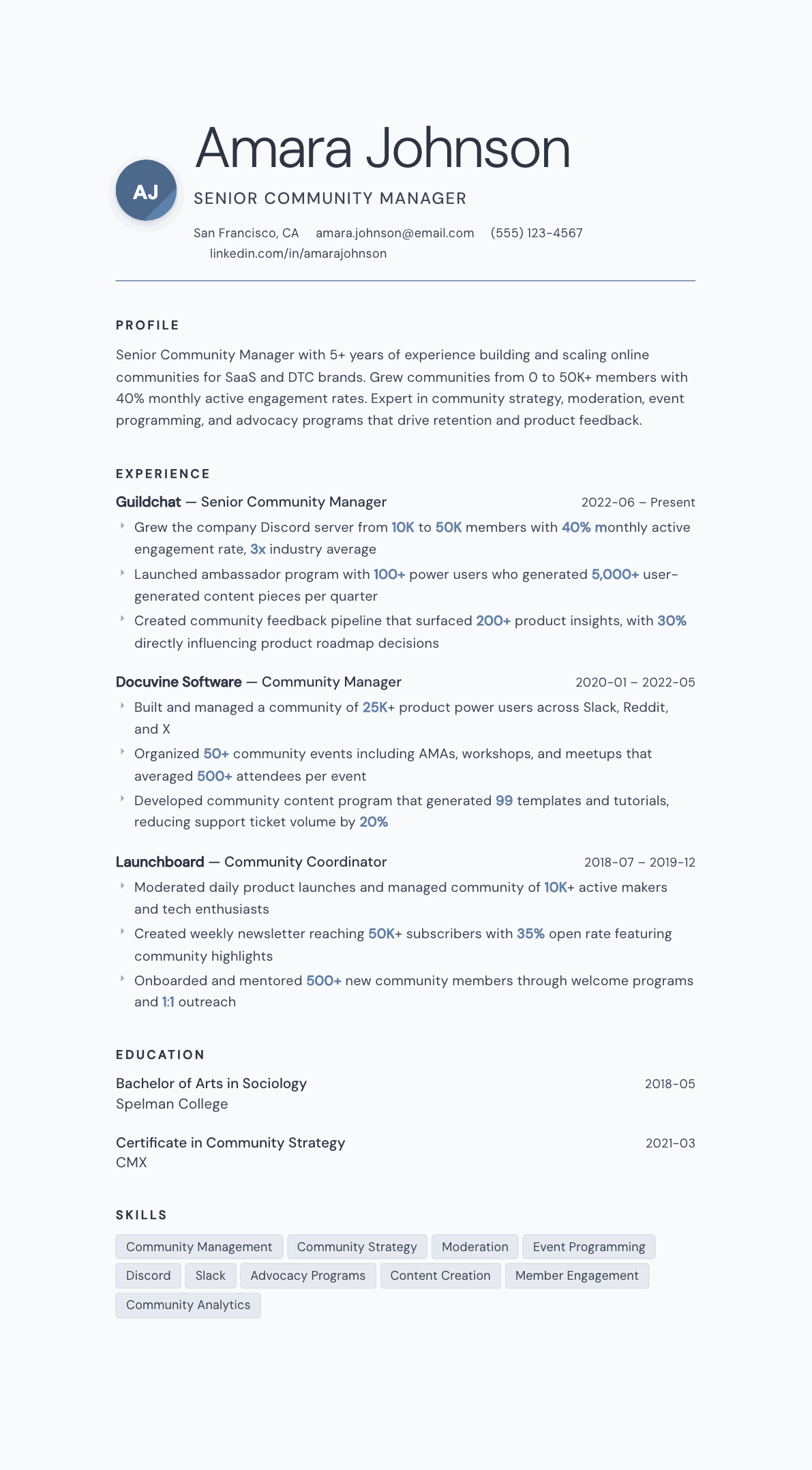
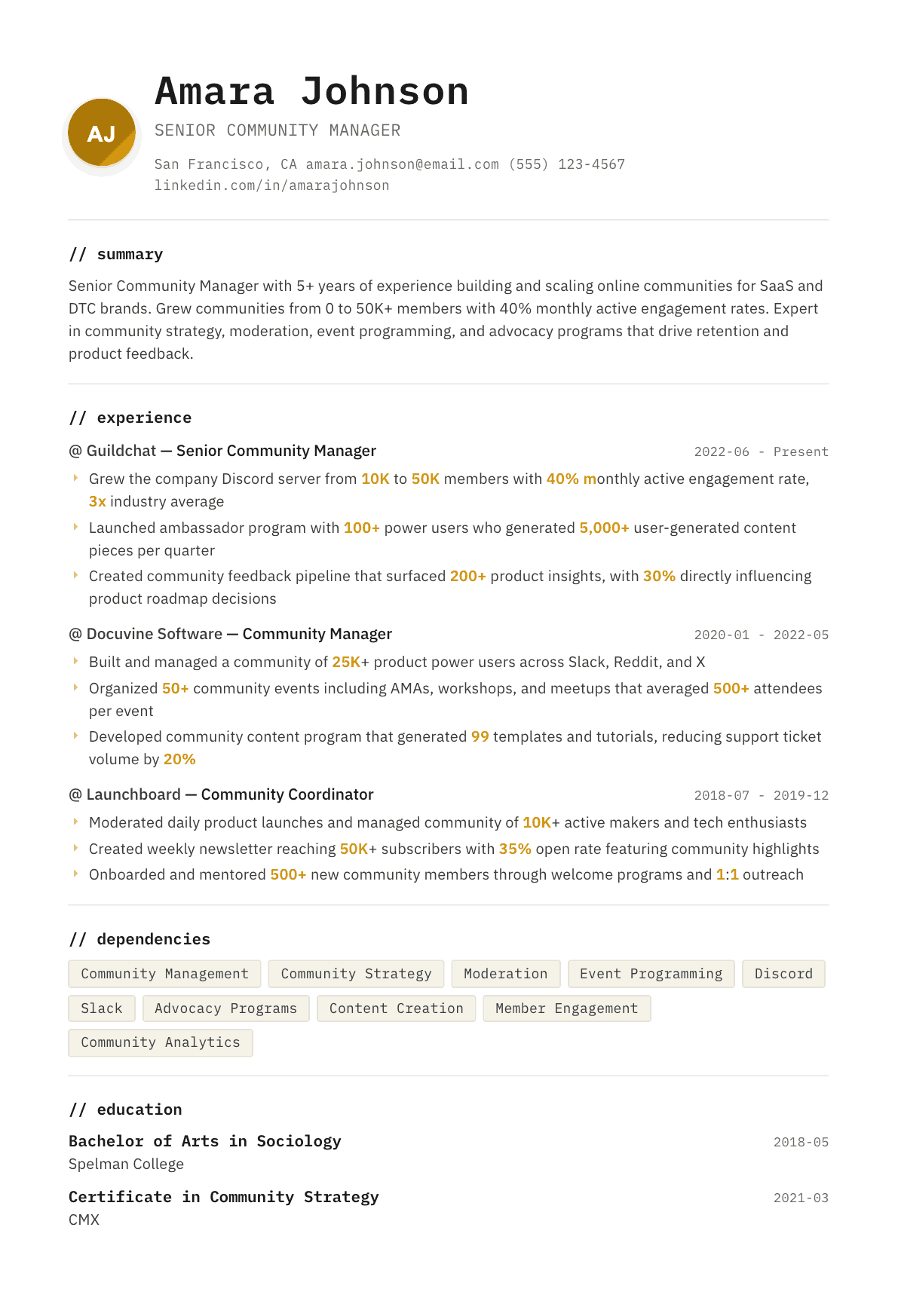
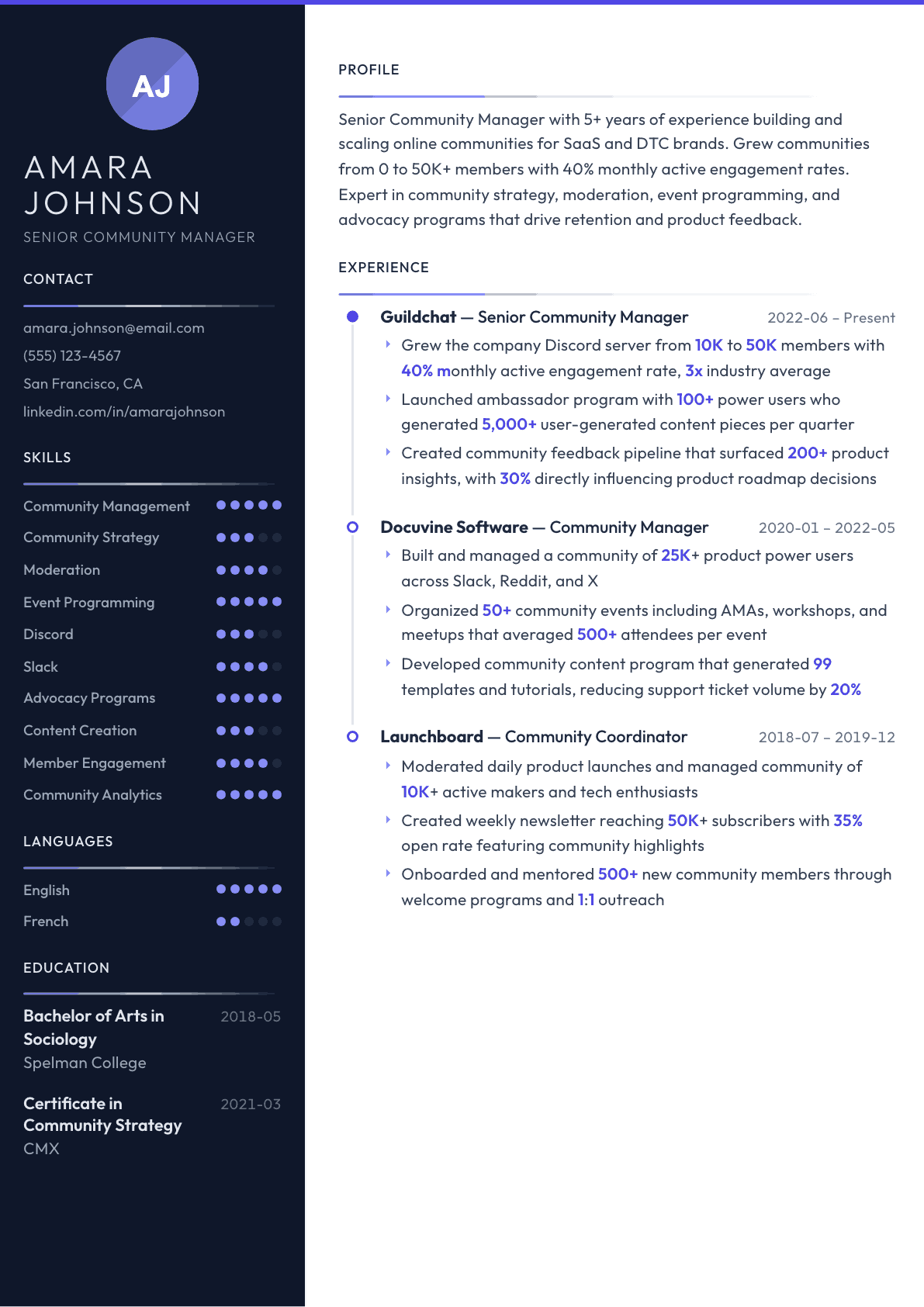
The same community manager content laid out in three CVBooster templates, so you can see what the finished document looks like before you write a word.
Example Community Manager summary
Community Manager with 5 years growing online communities to 50K+ members for SaaS and DTC brands. Holds 40% monthly active engagement, three times the category norm, and runs an ambassador program producing 5,000+ user-generated posts a quarter. Turns member feedback into product roadmap input.
Skills to list on a Community Manager resume
- Community Management
- Community Strategy
- Moderation
- Event Programming
- Discord
- Slack
- Circle
- Discourse
- Member Engagement
- Advocacy Programs
- Content Creation
- Community Analytics
- Customer Success
What actually gets this resume read
- Quantify community growth: member count, engagement rates, retention rates, and NPS scores.
- Highlight the business impact of your community: product feedback influenced, support costs reduced, revenue attributed.
- Showcase experience across platforms: Discord, Slack, Reddit, Facebook Groups, Circle, Discourse.
- Include event programming experience: AMAs, workshops, meetups, hackathons, conferences.
- Demonstrate advocacy and ambassador program design that turns members into brand advocates.
How to write a community manager resume
Community manager is one of the least standardized titles in marketing, which is why the resumes fail. At one company the job is moderation and member support inside a Discord server. At another it is developer relations with a conference track. At a third it is an advocacy program feeding case studies to sales. A hiring manager reads your document to work out which of those jobs you have actually done, and a generic community resume answers none of the three.
The people who screen these applications look for four concrete things: the platform you ran, the size and health of the membership, what you did when the room turned hostile, and whether the community produced anything the business could use. Member count alone means very little, because a dormant group of forty thousand is worth less than an active one of two thousand.
This guide covers how to structure the document, how to describe a community without reciting vanity numbers, three summaries for a first community role, a five-year practitioner and a head of community, before-and-after bullets, and the questions that come up when you try to prove soft work in hard terms.
Format: one page, with the community profile up front
One page until you have led a team. Directly under the summary, add a short community profile block: the platforms you have run, the member scale you have worked at, the audience type (customers, developers, players, creators, patients), and the moderation model. Hiring managers scan for that block because it tells them instantly whether your experience transfers.
Keep the layout simple and text-based. Add a link line for communities you can publicly point at, and be careful to link only spaces you are permitted to share. A private customer community should be described, not linked.
- Header: name, title, city, email, and links to public communities or profiles you ran.
- Community profile block: platforms, audience type, member scale, moderation model, languages covered.
- Sections in this order: summary, community profile, experience, programs and events, skills, education.
Summary: audience, platform, and what the community produced
Three lines. Name the audience, the platform, the scale, and the business outcome the community fed. A community that generates support deflection is a different hire from one that generates product feedback or user-generated content, and the summary is where you claim one of them.
Avoid words like passionate and people person. Every applicant for this job claims warmth. What separates candidates is evidence of judgment under pressure: a moderation policy you wrote, an incident you handled, a program you sunset because it was not working.
Experience: engagement over headcount, and the programs behind it
Give each role the platform, the audience and the scale in a context line, then bullets on what you built. Lead with engagement quality rather than raw membership: weekly active members, share of members who post, answer rate on questions, median time to first reply. Those are the metrics a community lead actually reviews, and quoting them signals you have run a real program rather than a landing page with a chat link.
Programs are the substance of the job. Ambassador and champion tiers, onboarding sequences for new members, AMA and office hours cadence, meetup or user group support, recognition systems, beta cohorts. For each, say how you selected members, how you kept the program running, and what it produced.
Include at least one bullet on moderation and safety. Describe the code of conduct you enforced, an escalation path you built with legal or trust and safety, or how you handled a coordinated pile-on. Managers ask about this in every interview, so putting it on the page moves you forward.
Proving business value without a revenue line
Community rarely owns a revenue target, so the resume has to show contribution instead. Three routes work. Support deflection: questions answered by members rather than by the help desk. Product influence: feature requests and bug reports routed into the roadmap, and the ones that were built. Advocacy supply: reviews, case studies, references, testimonials and user-generated content the community produced for other teams.
Name the receiving team every time. A feedback loop that ends in a report nobody reads is not an outcome. A feedback loop that ends with product management running a monthly review of community themes is.
- Support deflection: member-answered question rate, resolution time, load taken off the support queue.
- Product influence: themes reported, requests accepted, the release notes that credit community input.
- Advocacy: reviews collected, references sourced, case studies enabled, content contributed by members.
- Retention signals: renewal or repeat behavior among members compared with non-members, when you can measure it.
Tools and keywords that get parsed
Name the platforms exactly as postings write them: Discord, Slack, Reddit, Circle, Discourse, Khoros, Higher Logic, Facebook Groups, Bettermode. Add the operational tools around them, such as the moderation bots you configured, the analytics you used, the CRM or ticketing system you connected, and the automation that routed member issues to the right owner.
Postings also lean on program vocabulary: community strategy, member onboarding, ambassador program, code of conduct, escalation, engagement rate, user-generated content, community health. Use the ones that are true of your work rather than sprinkling all of them.
Community Manager resume summary examples
First community role
Community coordinator for a 9,000-member Discord serving a consumer app, handling daily moderation, weekly office hours and the new member onboarding flow. Wrote the current code of conduct, trained four volunteer moderators, and lifted the share of questions answered by members rather than support from 20% to 48%.
Five years in
Community manager with five years running customer communities on Discourse and Slack for B2B software, most recently a forum of twenty-four thousand members with 31% monthly active participation. Built an ambassador program of 60 members that supplies references and case studies to sales and routes product themes into a monthly roadmap review.
Head of community
Head of community leading a team of five across forum, events and advocacy for a developer platform with members in nine countries. Rebuilt the moderation model and escalation path with trust and safety, launched a regional user group program covering seven cities, and cut median time to first reply from 14 hours to under two.
Work experience bullets: before and after
Before: Grew the community to fifty thousand members.
After: Grew a Discourse forum from twelve thousand to fifty thousand members while lifting monthly active participation from 14% to 29% through a rewritten onboarding flow and a weekly unanswered questions sweep.
Membership without an activity number is a vanity figure; pairing growth with participation shows the room is alive.
Before: Moderated the community and enforced the rules.
After: Rewrote the code of conduct, trained six volunteer moderators on a tiered warning system, and built an escalation path with trust and safety that resolved harassment reports within one business day.
Moderation judgment is the part managers worry about, and a named policy plus an escalation path proves it.
Before: Collected user feedback and shared it with the product team.
After: Tagged and clustered member feedback into a monthly themes report reviewed by three product managers, with 11 requests from the top themes accepted into the roadmap over a year.
The rewrite shows the loop closing, which is the difference between listening and influencing.
Before: Ran events for the community.
After: Ran a monthly AMA and quarterly virtual meetup series with named guests, averaging 400 live attendees, and turned each recording into a forum thread that kept the discussion going for weeks.
Cadence, format and the follow-on life of the content show program design rather than one-off event help.
Before: Built an ambassador program.
After: Designed a three-tier ambassador program with clear selection criteria and quarterly rewards, recruited 60 members, and sourced 22 customer references and 9 case studies for sales from that group.
Selection criteria and downstream supply turn a program name into a working system with an owner on the other end.
Hard skills
- Community strategy
- Moderation and code of conduct enforcement
- Member onboarding design
- Ambassador and advocacy programs
- Discord
- Slack
- Discourse
- Circle
- Community analytics
- Event and AMA programming
- User-generated content programs
- Feedback routing into product
- Escalation and incident handling
Soft skills
- De-escalation
- Written tone control
- Volunteer leadership
- Cross-team advocacy
- Boundary setting
- Judgment under public scrutiny
Mistakes that cost community manager candidates the interview
- Quoting member count alone, which tells a hiring manager nothing about whether anyone posts.
- Leaving moderation off the resume, when handling conflict is the part of the job managers screen hardest for.
- Describing the community as a channel you posted into rather than a room you designed rules and rituals for.
- Linking a private customer community you do not have permission to share, which raises a confidentiality flag.
- Listing every platform you have ever opened an account on instead of the two or three you actually operated.
- Skipping the receiving team, so feedback, advocacy and content programs read as work that went nowhere.
Community Manager resume questions
What metrics belong on a community manager resume?
Pair a scale number with a health number. Members plus monthly active participation, questions asked plus member answer rate, events run plus average live attendance. Add one business-facing figure such as support deflection, references sourced, or accepted product requests.
Is community management a marketing job or a support job?
It depends on the company, and your resume should match the posting rather than argue with it. If the role sits in marketing, lead with advocacy, content and events. If it sits in support or product, lead with deflection, response times and feedback routing.
Should I include volunteer or hobby communities I moderated?
Yes when the scale or the difficulty is real. A gaming server of several thousand members with a moderator team you trained is genuine experience for a first paid role. Describe it the same way you would paid work, with platform, scale and what you built.
How do I show community work when the numbers are confidential?
Use ranges, multiples and rates instead of raw counts. Saying participation roughly doubled after an onboarding rewrite, or that member answers covered about half of incoming questions, keeps the evidence intact without exposing figures you are not free to publish.
Do I need experience with a specific platform to apply?
Usually not, if you show transferable operating skill. Name the platforms you have run, then make clear you have handled the things that carry across: onboarding, permissions and roles, moderation tooling, analytics, and migrating a community without losing its regulars.