PR Specialist Resume Examples: free ATS score and gap list
PR Resume Sample for a PR Specialist Who Earns Coverage
By Mustafa Tarabya, founder of CVBooster · Published · Updated
PR resume sample and example for a PR specialist: a complete one page resume, placements written with beat and outlet, and three summaries by level.
Sample resumes for a pr specialist
The same pr specialist content laid out in three CVBooster templates, so you can see what the finished document looks like before you write a word.
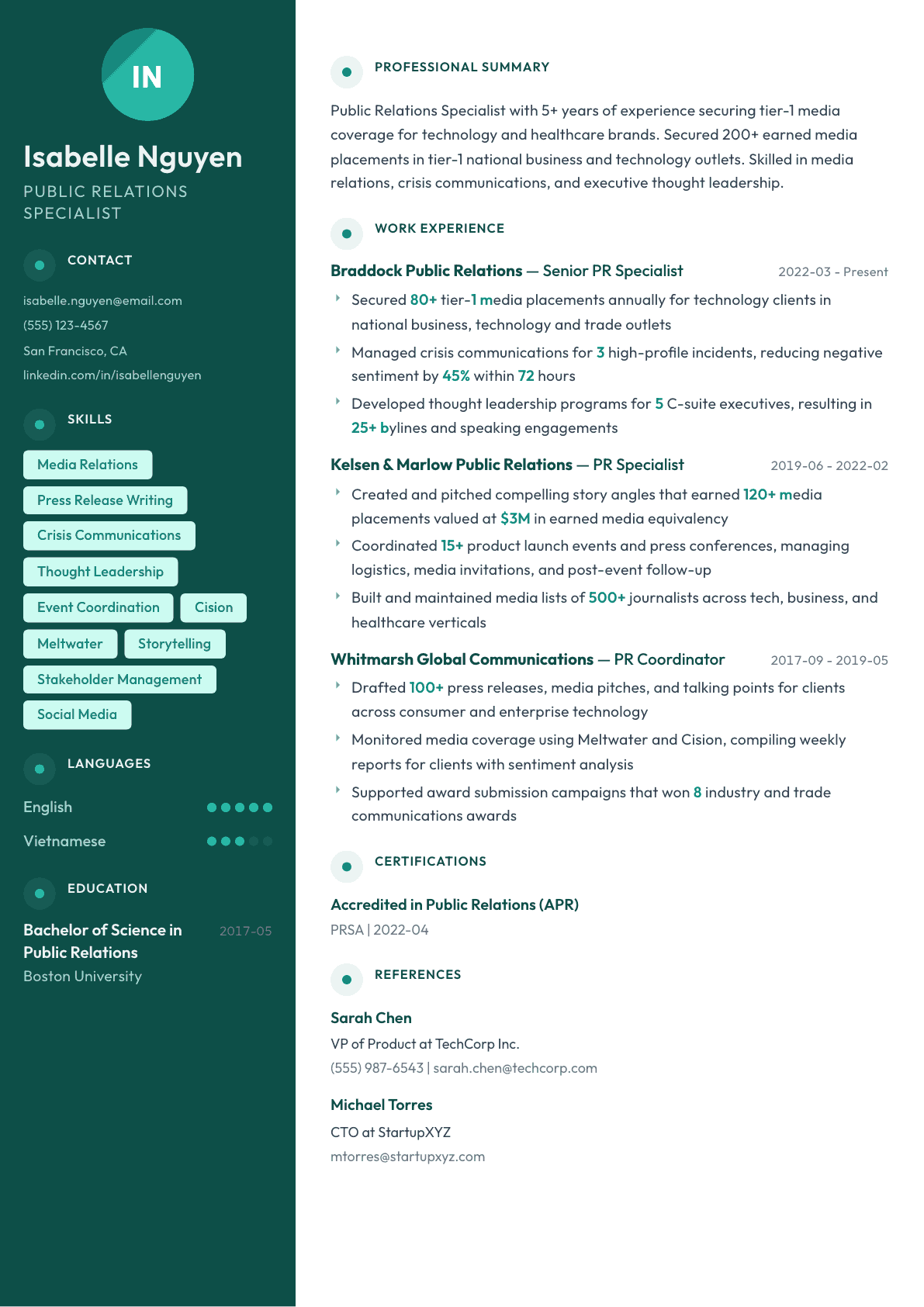
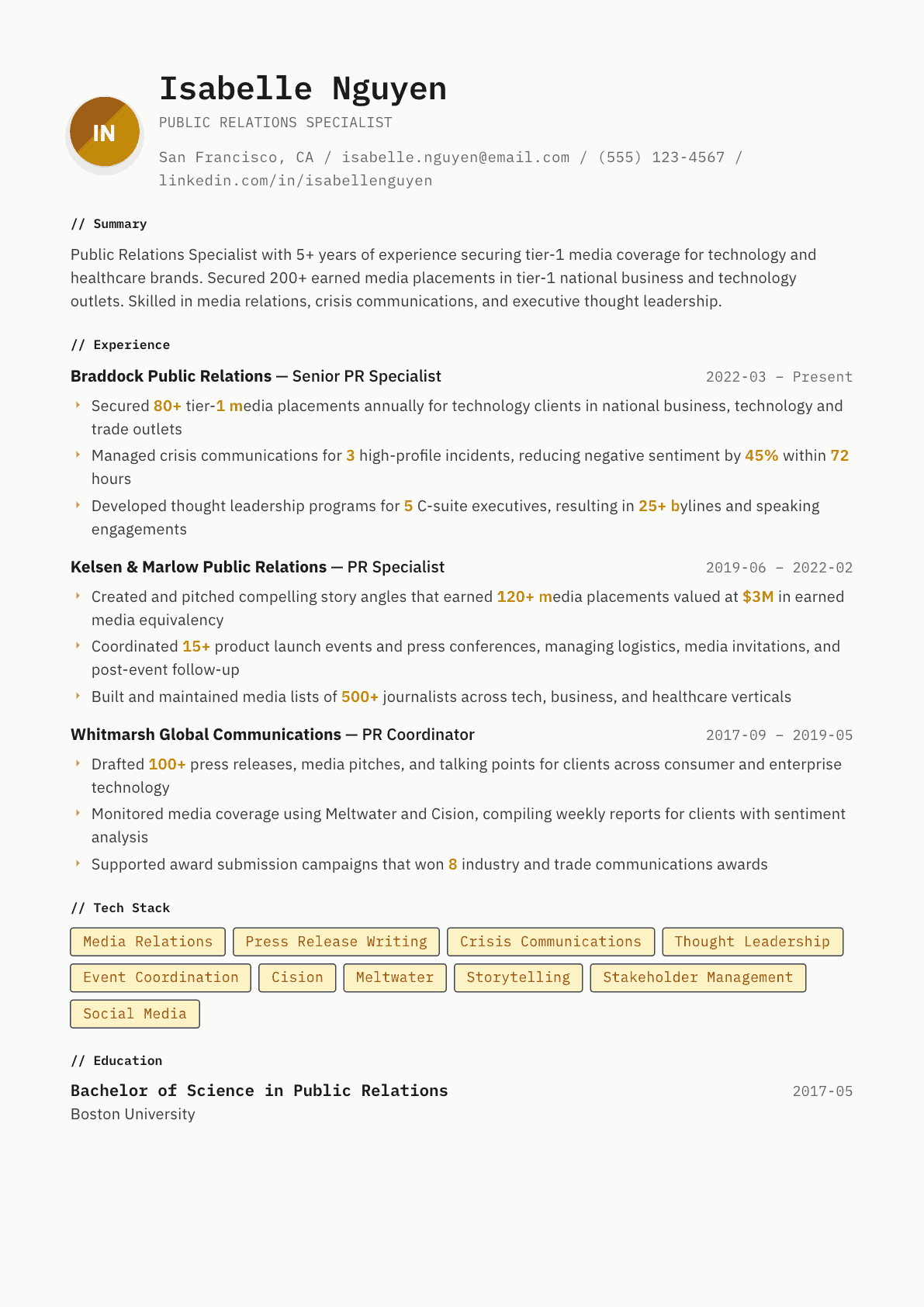
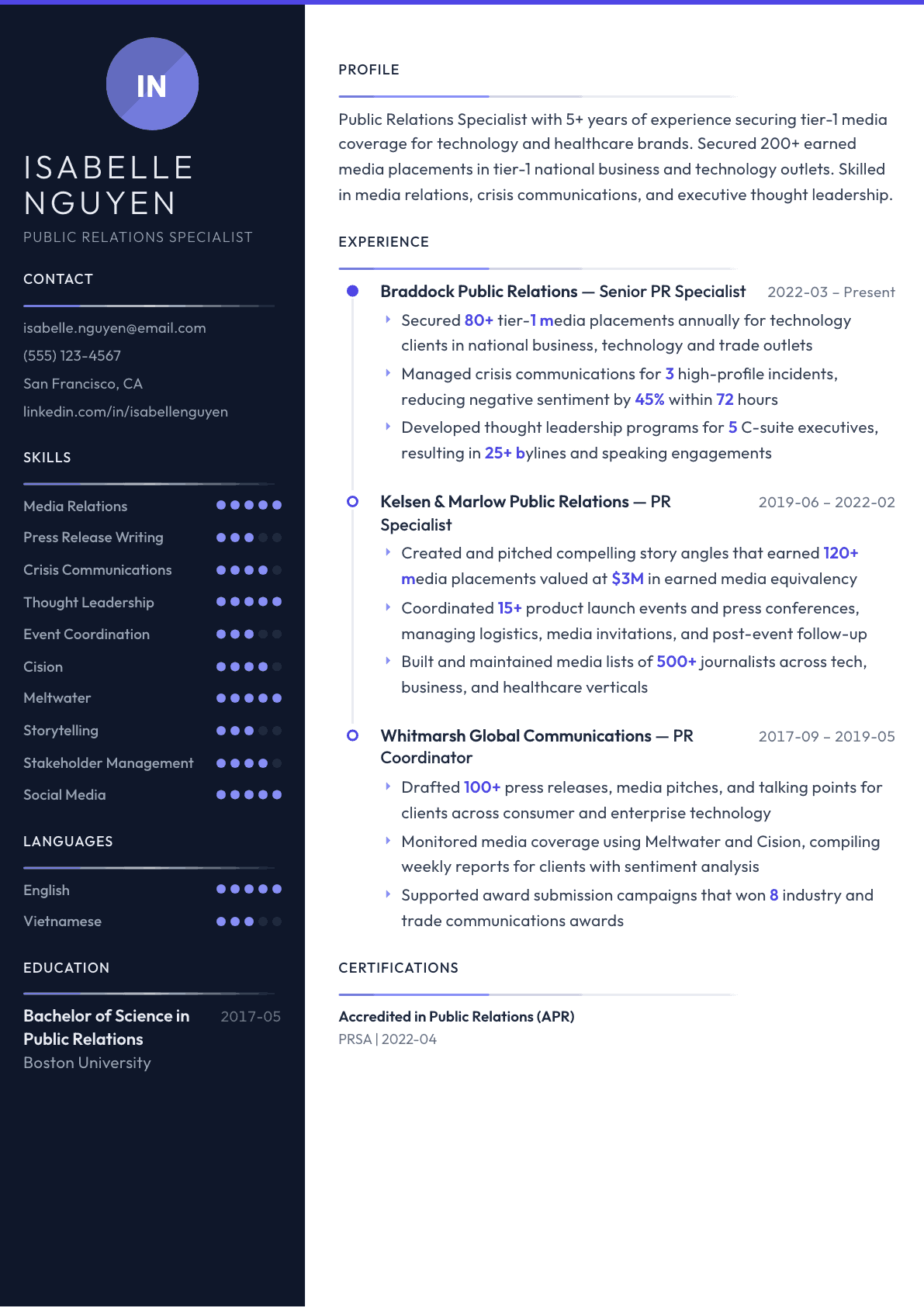
Example PR Specialist summary
PR Specialist with 5 years placing 200+ earned stories in tier-1 business, technology and healthcare press. Runs crisis response, executive thought leadership and media training, including 3 incidents where negative sentiment fell 45% inside 72 hours. Accredited in Public Relations (APR).
Skills to list on a PR Specialist resume
- Media Relations
- Press Releases
- Crisis Communications
- Thought Leadership
- Event Management
- Storytelling
- Media Monitoring
- Stakeholder Communications
- Cision
- Meltwater
- MuckRack
- Social Media PR
- Executive Ghostwriting
- Brand Reputation
What actually gets this resume read
- Quantify media placements by outlet tier, total volume, and estimated earned media value.
- Showcase crisis management experience with specific outcomes: sentiment recovery, response time, stakeholder alignment.
- Include a list of media outlets where you have placed stories to demonstrate your network and credibility.
- Highlight writing samples or link to published press releases, bylines, and thought leadership pieces.
- Mention PR tools and monitoring platforms: Cision, Meltwater, MuckRack, Brandwatch.
How to write a pr specialist resume
A PR specialist is hired for a relationship and a reflex. The relationship is with reporters who will open your email; the reflex is knowing, at nine on a bad morning, whether to respond, correct, or say nothing at all. Neither shows up on a resume written as a list of duties, which is why so many communications resumes read as interchangeable.
The reader is usually a communications director or an agency account director. They screen for beat fit first: a specialist who has placed enterprise technology stories has a different contact list from one who has worked consumer health or local government, and a contact list does not transfer between beats. Then they read for whether you can write, because in this field the resume is a writing sample.
This guide includes a complete PR resume sample, then covers how to present placements without sounding like a clipping service, how to write about crisis work you cannot fully describe, three summaries by career stage, before and after bullets, and the questions PR people ask when their best results were quiet ones.
Format: one page, and treat every sentence as a writing test
Reverse chronological, one page for under eight years. Keep the design plain and the prose tight. A communications director reads your resume the way they read a pitch, and a loose sentence in the summary suggests loose sentences in a press release.
Add a short selected coverage block after your experience: five or six placements, each as outlet, story angle and your role. This is the section that gets you the interview, and it should be curated for the beat you are applying into rather than the biggest names you ever touched.
- Order: summary, experience, selected coverage, skills and tools, education.
- Name your beats explicitly: technology, health, consumer, finance, public sector, nonprofit.
- Link to two or three bylines or bylined pieces you ghostwrote, if you are permitted to claim them.
Summary: beat, tier, and the kind of story you land
Three lines. Name the industries you cover, the tier of outlet you place in, whether you work agency side or in house, and the specialty you lead with: media relations, executive thought leadership, crisis and issues, or internal communications.
Say what kind of story you are good at getting. Feature placements built from customer proof are a different craft from funding announcements or from getting an executive quoted in a reactive news cycle. Directors are staffing a gap, and naming your strength lets them see whether you fill it.
Experience: pitches, placements, and the relationship behind them
For each role, give the client set or the business you represented, the beats you covered, and the volume and quality of what you placed. Volume alone is unpersuasive: forty placements in trade newsletters is not forty placements in national business press, and any director knows it. Say the tier, and name three outlets.
Describe the pitching craft, because that is the transferable skill. How you found the angle, how you built exclusives, how you paired a spokesperson with a beat reporter, how you turned a customer story into a feature. A bullet describing a single well built exclusive with the outcome is stronger than a bullet counting emails sent.
Cover the adjacent work that fills most weeks: press release and media kit writing, executive briefing documents, message houses, spokesperson training, awards submissions, speaking abstract entries, analyst relations, and the media monitoring report that lands on an executive desk every Monday.
For crisis and issues work, describe your role and the mechanics without breaching confidence: the holding statement inside a stated response time, the stakeholder sequence you followed, the single spokesperson protocol, the coordination with legal. You can be specific about process while staying silent about the incident, and process is what the interviewer is testing.
Measurement: what to claim and what to leave alone
Report what you can defend. Placement counts by tier, share of voice against named competitors, message pull through in coverage, sentiment shift over a defined period, and inbound inquiry volume are all measurable and standard. Advertising value equivalency is not respected by serious practitioners and using it will cost you credibility with a senior reader.
Where the value was defensive, say so plainly. A story that ran smaller than it would have, a correction secured within a day, an interview declined and a written statement placed instead: these are the wins that experienced directors recognize, and almost nobody puts them on a resume.
Skills and tools: the stack behind the relationships
Name the monitoring and database platforms you work in, since agencies screen on them: Cision, Meltwater, Muck Rack, Brandwatch, Signal. Add newsroom and distribution tooling, social listening, and the reporting formats you build. Being fast in a media database is a real skill and a real time saver on an account team.
Then list the writing forms you produce, not generic writing skill. Press release, media alert, backgrounder, byline, op ed, executive keynote, holding statement, question and answer document, internal announcement. Each is a distinct craft and naming them signals range.
PR resume sample: a complete example for a PR specialist
Here is a complete PR resume sample for a specialist with four years at an agency, applying for an in house role. Read it for order and density, then swap in your own beat, outlets and results. The same shape works as a PR resume example for a coordinator or a senior specialist; only the scope lines change.
Notice what it leaves out: no list of every outlet you ever emailed, no claim about advertising value equivalency, and no adjective about being a strong communicator. The pitches and placements carry that.
- Header: Dana Brooks, PR Specialist, city, phone, email, and a link to a short portfolio of three released pieces.
- Summary: PR specialist with four years at a technology agency, placing enterprise software and cybersecurity stories with national business and trade press. Writes the release, the briefing document and the follow up the same day. Looking for an in house communications role on a technology team.
- Experience, agency: secured feature coverage for a client product launch in two national business outlets and four trade titles, from a pitch list of reporters built and kept current in Cision.
- Experience, agency: drafted holding statements and reporter questions and answers during a client data incident, working with legal so every external line was approved before release.
- Experience, agency: ran monthly coverage reports that tracked message pull through and share of voice against three named competitors, replacing a raw clip count.
- Earlier role: PR coordinator, two bullets on media lists, press kits and event logistics.
- Education: bachelor degree in communications or journalism, plus any APR or agency training.
- Skills: media relations, press releases, bylines, crisis communications, Cision, Muck Rack, Meltwater, AP style.
PR Specialist resume summary examples
Account coordinator
PR coordinator with 18 months at a technology agency supporting three enterprise software accounts. Build media lists, draft releases and pitches, run daily monitoring in Muck Rack, and placed 22 trade stories in my first year including two features. Journalism degree.
Five years in
PR specialist with five years across agency and in house roles in health technology. Own media relations for a clinical software business, place regularly in national business and trade press, and run executive thought leadership including bylines and conference abstracts. Handled two product issues under a same day response protocol.
Senior specialist or account lead
Senior PR specialist with nine years in consumer and financial communications, leading a three person account team. Built the crisis playbook and spokesperson training program, run analyst and media relations across two markets, and secured recurring national coverage through a customer story pipeline.
Work experience bullets: before and after
Before: Secured media coverage for clients.
After: Placed 60 stories a year for three enterprise software clients, including 11 in national business press and two exclusive features built from customer data.
Splitting the count by tier and naming how the features were built shows quality behind the volume.
Before: Wrote press releases and pitches.
After: Wrote the release, backgrounder and question and answer document for a funding announcement, then pitched under embargo to 14 reporters and landed nine pieces on the day of announcement.
The document set and the embargo mechanics show a full announcement process rather than writing alone.
Before: Handled crisis communications.
After: Ran the response to a product issue: drafted the holding statement within 90 minutes, aligned legal and customer support on a single message, and briefed one named spokesperson for all inbound inquiries.
Describing the response time and the process proves crisis capability without disclosing the incident.
Before: Built relationships with journalists.
After: Maintained working relationships with roughly 40 reporters across health technology and enterprise software beats, meeting reporters off news cycle and offering background briefings ahead of announcements.
Naming the beats and the off cycle habit shows a real contact list rather than a media database export.
Before: Supported executive thought leadership.
After: Ghostwrote 15 bylines and op eds a year for the chief executive and chief technology officer, placed 11 of them, and built the quarterly topic calendar that fed both the bylines and conference abstracts.
Volume, placement rate and the calendar behind them turn support into an owned program.
Hard skills
- Media relations
- Press release and media alert writing
- Byline and op ed ghostwriting
- Media list building and pitching
- Embargo and exclusive management
- Crisis and issues communications
- Spokesperson preparation
- Message house development
- Awards and speaking submissions
- Cision
- Meltwater
- Muck Rack
- Social listening and sentiment reporting
- Coverage and share of voice reporting
Soft skills
- Judgment under a live news cycle
- Discretion with confidential information
- Persuading executives to say less
- Building reporter trust over time
- Working to a same day deadline
Certifications worth listing
- Accreditation in Public Relations (APR) (Public Relations Society of America)
- Certificate in Principles of Public Relations (Universal Accreditation Board)
Mistakes that cost pr specialist candidates the interview
- Listing placements as a raw count with no outlet tier, which a director reads as padding.
- Using advertising value equivalency as a results metric, which senior practitioners do not accept.
- Writing a resume with loose sentences when the resume is itself the writing sample for the role.
- Claiming crisis experience without describing any process, response time or stakeholder sequence.
- Omitting the beats you cover, when beat fit is the first thing a hiring director screens for.
- Naming clients or incidents you are not permitted to disclose, which signals you would do the same to the next employer.
PR Specialist resume questions
How do I list media placements without breaking client confidentiality?
Describe the client by category and size rather than by name, for example a series B health technology company, and name the outlet and the angle instead. Anything already public under your byline or a named announcement is safe to cite directly.
What metrics should a PR specialist use on a resume?
Placement counts split by outlet tier, share of voice against named competitors, message pull through in coverage, sentiment change over a defined window, and inbound inquiry volume. These are all defensible in an interview, unlike advertising value equivalency.
Do I need a portfolio with my PR resume for a PR job?
Yes, and it should be short. Two or three released pieces you wrote, one byline you ghostwrote if you are permitted to claim it, and a coverage list for one campaign. Directors want proof you can write in a corporate voice under a deadline.
How do I move from agency to in house communications?
Reframe your bullets from campaign delivery to program ownership: message architecture, spokesperson development, the monitoring report leadership reads, and the internal coordination with legal and product. In house teams hire for continuity and judgment more than for pitch volume.
Is an APR accreditation worth pursuing?
It carries real weight in nonprofit, government, healthcare and association communications, and less in technology or consumer agency work. Check the postings in your target sector: if the accreditation appears as preferred in several, it is worth the study and the panel presentation.