Social Media Specialist Resume Examples: free ATS score
Write a Social Media Specialist Resume That Connects Content to Results
By Mustafa Tarabya, founder of CVBooster · Published · Updated
A social media specialist resume example with paid and organic bullets, platform keywords, analytics skills, and a detailed writing guide.
Sample resumes for a social media specialist
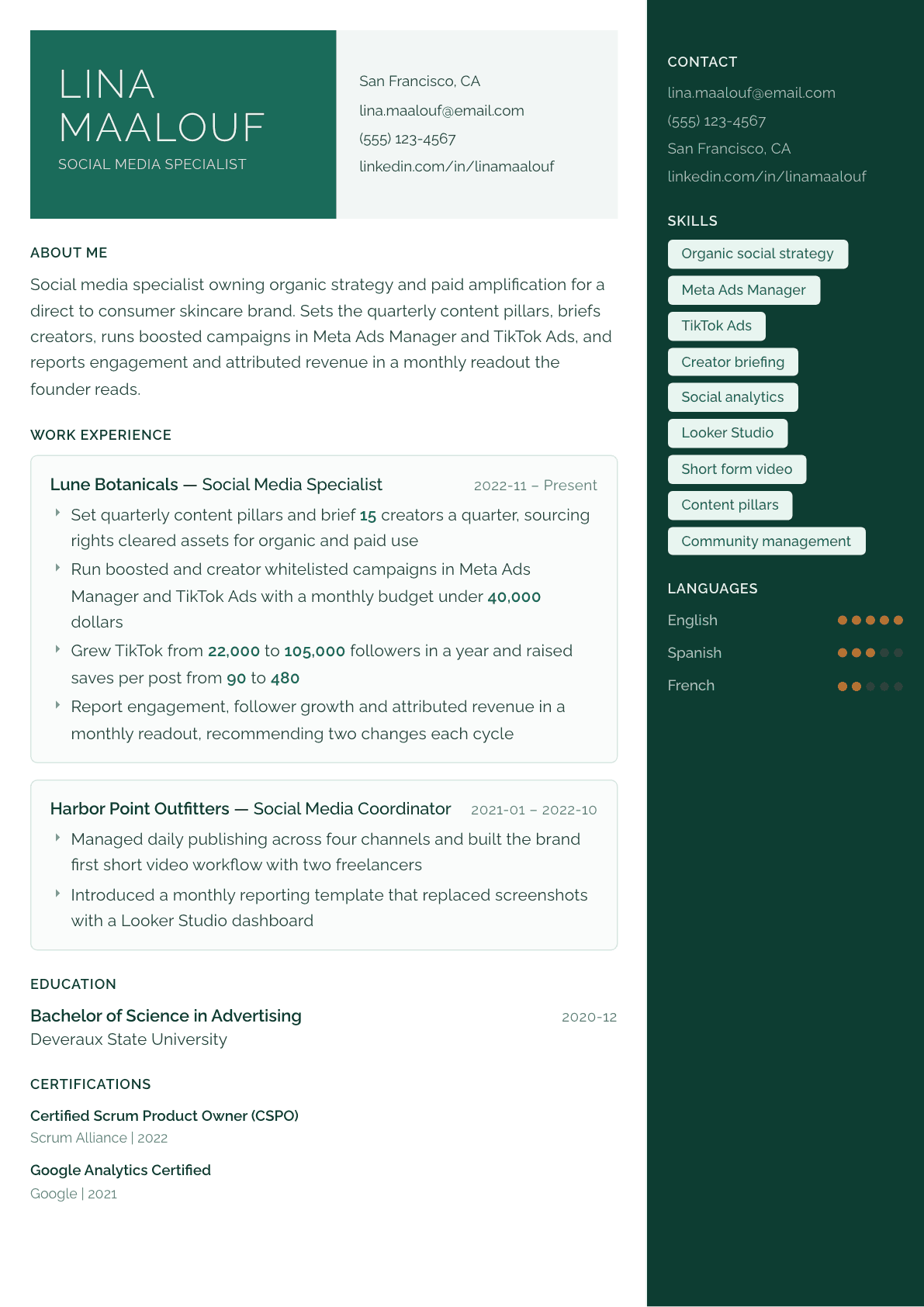
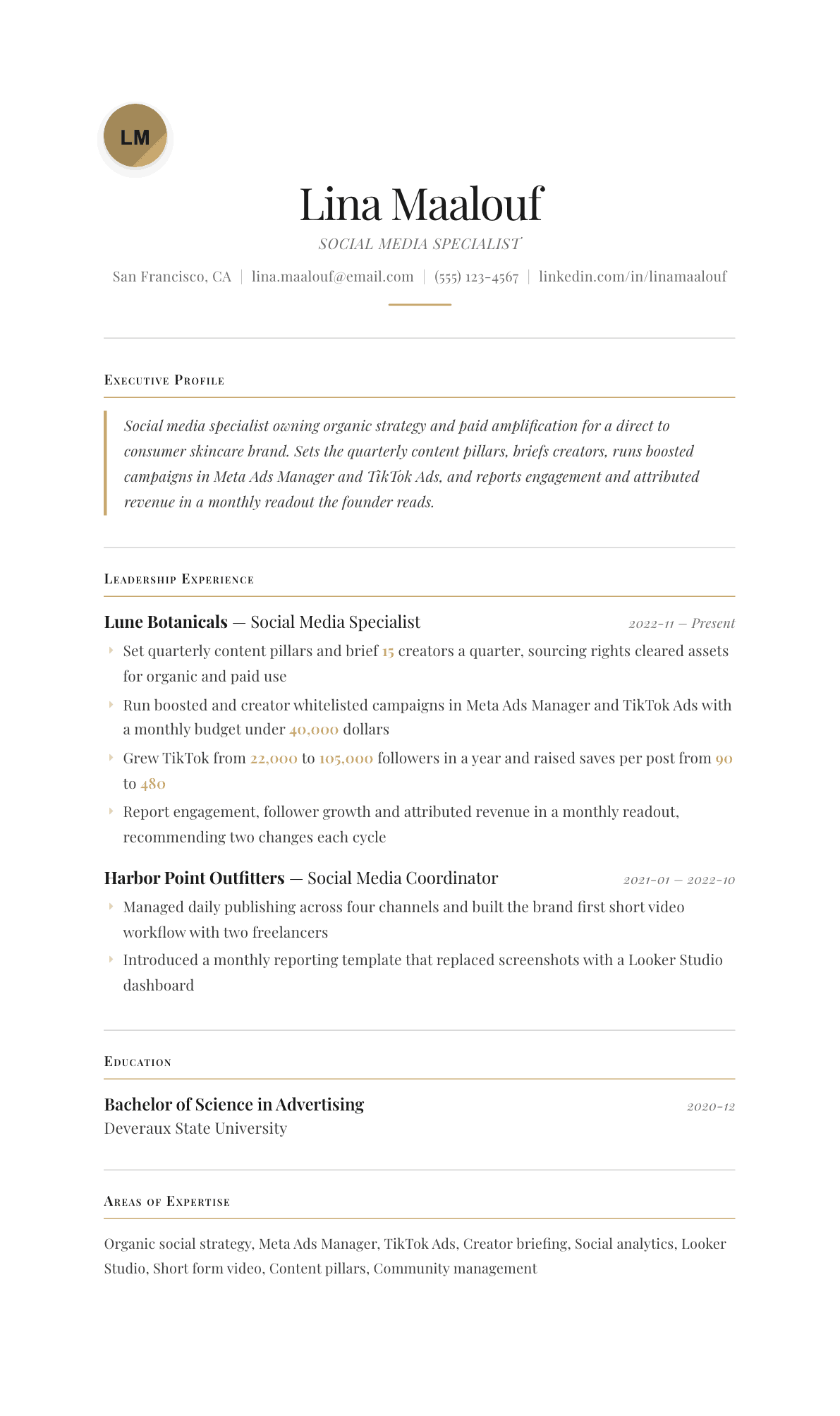
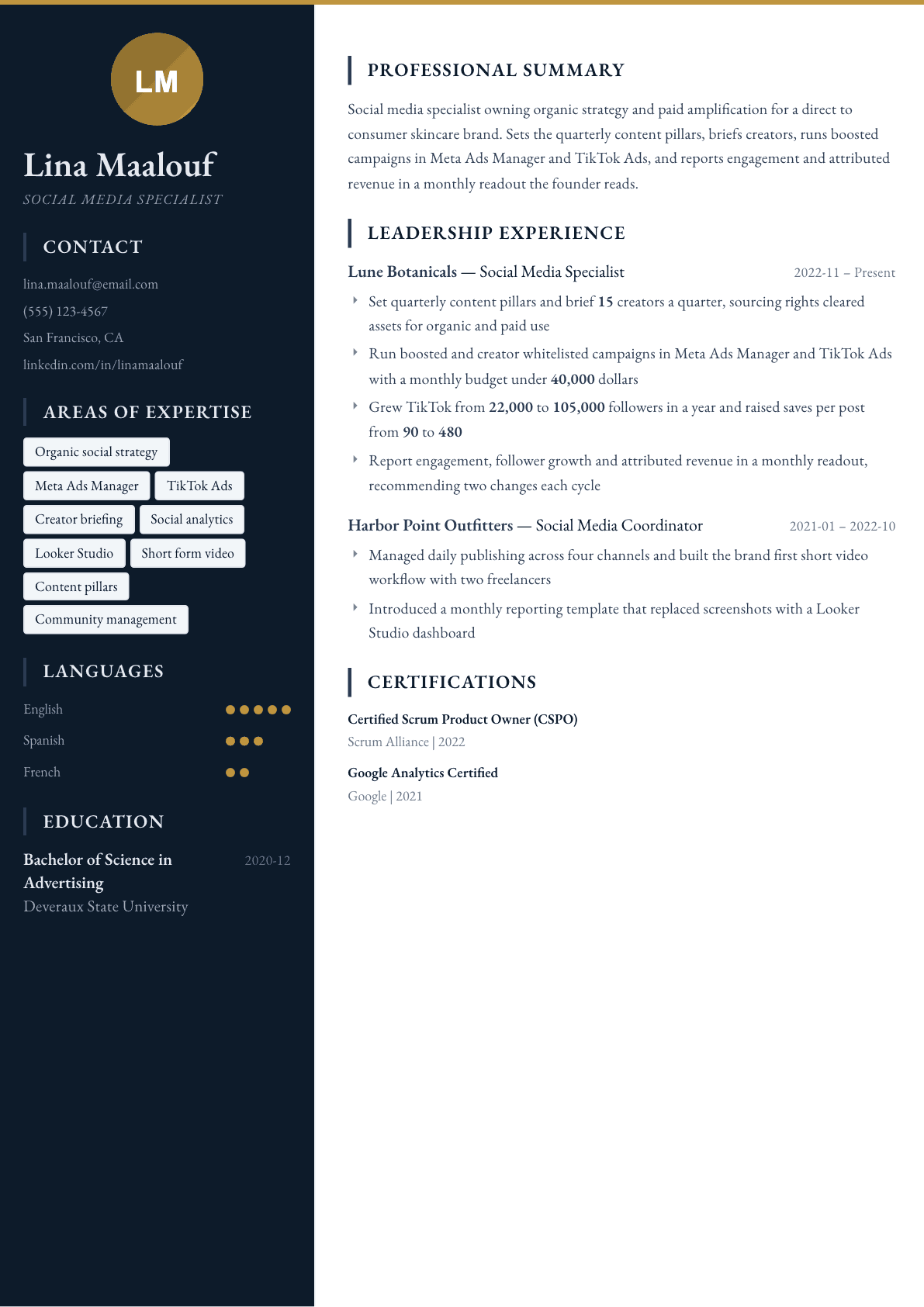
The same social media specialist content laid out in three CVBooster templates, so you can see what the finished document looks like before you write a word.
Example Social Media Specialist summary
Social media specialist with five years owning organic strategy and paid amplification for consumer brands. Sets quarterly content pillars, briefs creators and runs whitelisted campaigns in Meta Ads Manager and TikTok Ads. Grew a brand TikTok account from twenty two thousand to one hundred five thousand followers in a year while raising saves per post more than fivefold, and reports attributed revenue monthly to the founder.
Skills to list on a Social Media Specialist resume
- Organic social strategy
- Paid social
- Meta Ads Manager
- TikTok Ads
- Creator and influencer briefing
- Short form video
- Social analytics
- Community management
- Content pillars
- Copywriting
- Looker Studio
- Brand voice
- Campaign reporting
- Rights and usage management
What actually gets this resume read
- Say whether you own organic, paid, or both, because that single distinction decides which social postings you match.
- Move past follower counts to saves, shares, watch time or attributed revenue, which is what a marketing lead reviews.
- Describe your creator workflow: sourcing, briefing, usage rights and how you turn a creator asset into a paid ad.
- Show a reporting habit, such as a monthly readout with recommendations, since specialists are expected to interpret data.
- Name the native analytics and any dashboard tool, because most social postings list a reporting requirement explicitly.
- Keep a portfolio link that shows the accounts and campaigns, and be specific about which pieces you made yourself.
How to write a social media specialist resume
The gap between a coordinator and a social media specialist is decision making. A coordinator keeps the calendar full and the inbox answered. A specialist decides what the brand talks about this quarter, which creators represent it, which posts get money behind them, and what to stop doing when the saves flatten. Hiring managers read specialist resumes hunting for those decisions, and a resume made entirely of publishing volume reads as a coordinator applying up.
The second signal is whether you can connect content to money. Social teams lose budget arguments when their reporting stops at reach, so the specialists who get hired are the ones who bring a monthly readout with attributed revenue or qualified leads beside the engagement numbers, and a recommendation attached to each.
This guide covers the resume structure for a specialist seat, how to write organic and paid bullets in the same job without blurring them, three summaries by stage, before and after rewrites, and the questions people ask when they take on creators, rights and a media budget for the first time.
Format: one page, with paid and organic clearly separated
One page through roughly seven years. Single column, portfolio and account links in the header. Under the summary add two short lines: platforms you own organically, and the ad platforms you buy on. Many postings are written for one or the other, and a reader who cannot tell will move on.
Keep the design restrained even though the field is creative. Put the visual proof in the portfolio, where a hiring manager can see the actual work, and keep the resume readable by both a parser and a marketing director skimming on a phone.
- Header: name, title, city and state, phone, email, portfolio link, account links.
- Sections: summary, platforms and ad accounts, experience, selected campaigns, education, certifications.
- Include a selected campaigns block only when you have two or three with real results.
Summary: strategy scope, budget, and the metric you defend
Three lines. The brand category and audience, whether you own organic, paid or both, the budget scale if you buy, and one result that is not a follower count. Saves, shares, watch time, attributed revenue and qualified leads all read as senior; follower growth alone reads as junior.
Say who receives your reporting. A specialist who presents to a founder every month operates differently from one whose numbers stop at a manager, and that detail tells a hiring team how much autonomy you are used to.
Experience: strategy, creators, and amplification
Start each role with the strategy work: the content pillars you set, how you chose them, and how often you revisit them. Then the production model, whether in house, freelance or creator led, and how you keep quality consistent across contributors.
Creator work deserves its own bullet because it is where specialists most often get exposed. Sourcing, briefing, negotiating usage rights, whitelisting assets for paid, and measuring whether a creator actually produced anything. Naming the rights and whitelisting steps proves you have run the process rather than admired it.
The paid bullet should show what amplification adds rather than duplicating a media buyer's resume. Which organic posts you boost and on what evidence, the budget scale, the audiences you build, and what changed in cost per result once creator assets replaced brand made ones.
- Give a starting and ending figure for the engagement metric you optimize toward.
- Name the ad platforms individually and say whether you built the audiences yourself.
- Include the reporting cadence and one recommendation that was adopted.
Reporting that survives a budget review
Build the readout habit into the resume. A monthly report combining engagement, follower growth, link traffic and attributed revenue, with two recommended changes each cycle, is a concrete artifact and a hiring manager will ask to hear about it.
Name the measurement stack: the native platform analytics, the scheduler analytics, the dashboard tool and whatever the company uses for attribution. Social attribution is imperfect, so describing your method honestly reads as competence, not as hedging.
Skills and platform credentials
Posting language to mirror: organic social strategy, paid social, content pillars, influencer and creator marketing, community management, short form video, engagement rate, social listening and brand voice. Place each where you can prove it.
Real credentials in this field come from the platforms themselves. The Meta media buying and digital marketing associate credentials, the TikTok Academy courses, the Hootsuite and Sprout Social platform certifications are all issued by named organizations and are worth listing when you hold them.
Social Media Specialist resume summary examples
Moving up from coordinator
Social media specialist with two years of coordinator experience at an outdoor retailer, now setting monthly themes and running boosted posts. Built the brand's first short video workflow with two freelancers and replaced screenshot reporting with a dashboard covering engagement, follower growth and link traffic.
Organic plus paid
Social media specialist owning organic strategy and paid amplification for a skincare brand. Sets quarterly content pillars, briefs fifteen creators a quarter, and runs whitelisted campaigns in Meta Ads Manager and TikTok Ads. Grew TikTok from twenty two thousand to one hundred five thousand followers in a year and raised saves per post from 90 to 480.
Senior specialist
Senior social media specialist leading strategy across four platforms, a creator roster and a monthly amplification budget for a consumer brand. Owns rights and usage terms, sets the testing calendar for formats and hooks, and presents attributed revenue alongside engagement to the founder each month.
Work experience bullets: before and after
Before: Developed the social media content strategy.
After: Set quarterly content pillars from customer review themes and comment analysis, then mapped each pillar to a format and a posting cadence the team could sustain across three platforms.
Naming where the pillars came from and how they turned into a schedule shows method rather than assertion.
Before: Worked with influencers on brand campaigns.
After: Briefed fifteen creators a quarter, negotiated usage rights for organic and paid, and whitelisted the strongest assets into Meta campaigns where they beat brand made creative on cost per purchase.
Rights, whitelisting and a performance comparison show the full creator workflow, not just outreach.
Before: Increased engagement across social channels.
After: Raised saves per post from 90 to 480 over a year by moving from product photography to short educational video, testing three hook styles a month and retiring the two that consistently underperformed.
A specific engagement metric plus the testing behind it explains why the number moved.
Before: Managed the paid social budget.
After: Ran boosted and creator whitelisted campaigns in Meta Ads Manager and TikTok Ads with a defined monthly budget, building lookalike and retention audiences from purchase data rather than broad interest targeting.
The audience construction detail is what separates a social specialist who buys from one who clicks boost.
Before: Reported on social performance to leadership.
After: Delivered a monthly readout covering engagement, follower growth and attributed revenue with two recommended changes each cycle, of which the founder adopted the shift from static carousels to creator video.
Reporting becomes influence once a recommendation and the decision it produced are visible.
Hard skills
- Organic social strategy
- Content pillar planning
- Paid social buying
- Meta Ads Manager
- TikTok Ads Manager
- Creator sourcing and briefing
- Usage rights and whitelisting
- Short form video direction
- Social listening
- Looker Studio reporting
- Community management
- Caption and hook copywriting
Soft skills
- Taste and brand judgment
- Negotiation with creators
- Clear recommendations to executives
- Willingness to kill a format that stops working
- Steady tone in public conflict
Certifications worth listing
- Meta Certified Media Buying Professional (Meta)
- Meta Certified Digital Marketing Associate (Meta)
- Hootsuite Advanced Social Advertising Certification (Hootsuite Academy)
- Sprout Social Platform Certification (Sprout Social)
Mistakes that cost social media specialist candidates the interview
- Writing a publishing volume resume for a strategy seat, which reads as a coordinator asking for a promotion.
- Reporting reach and impressions when the hiring team measures saves, watch time or attributed revenue.
- Mentioning creators without the rights, briefing and measurement steps that make the program repeatable.
- Blurring organic and paid work together so the reader cannot tell which one you actually own.
- Skipping the reporting cadence, which is the artifact that proves you can defend the budget.
- Presenting one viral post as a track record instead of a format change that held up over months.
- Leaving the portfolio out, when this is a field where the work is visible and expected to be shown.
Social Media Specialist resume questions
What separates a social media specialist resume from a coordinator resume?
Decisions. A specialist resume shows content pillars you set, creators you selected, budget you directed and formats you retired. Publishing volume still belongs on the page, but it should sit underneath the strategic choices rather than being the whole story.
Which social metrics should I put on my resume?
The ones that indicate real attention and business effect: saves, shares, watch time, click through to site, qualified leads and attributed revenue. Follower growth is worth one line with a start and end point, not the center of the resume.
How do I show influencer marketing experience credibly?
Give the number of creators per period, the way you sourced and screened them, how usage rights were handled, and what the assets produced once they ran in paid. Naming the operational steps is what proves the program existed at scale.
Do I need paid social experience to be a social media specialist?
Not always, but it widens the pool of roles substantially and most consumer brands now expect at least boosting and audience building. If you have none, say clearly that you own organic and show a strong strategy and reporting record instead.
How should I present a brand account I no longer manage?
Write it with dates, scope and results as you would any role, and keep exported reports or screenshots for the interview. If someone else has taken the account in a different direction since, note the period you owned so your work is judged against the right posts.