Influencer Marketing Manager Resume Examples: free score
Build an Influencer Marketing Manager Resume That Goes Viral
By Mustafa Tarabya, founder of CVBooster · Published · Updated
Create a compelling influencer marketing manager resume with creator partnerships, campaign ROI, and social media expertise that brands are actively hiring for.
Sample resumes for a influencer marketing manager
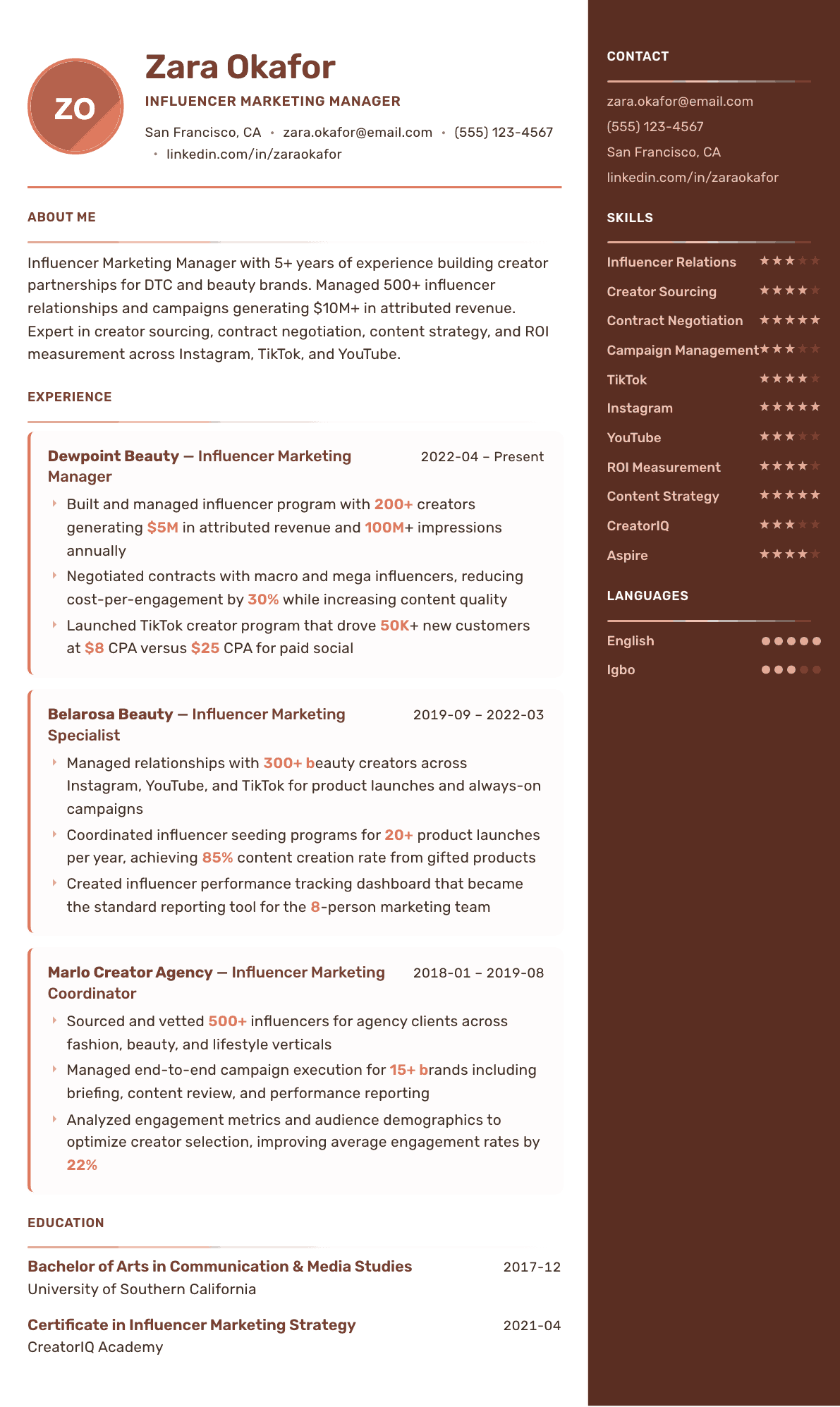
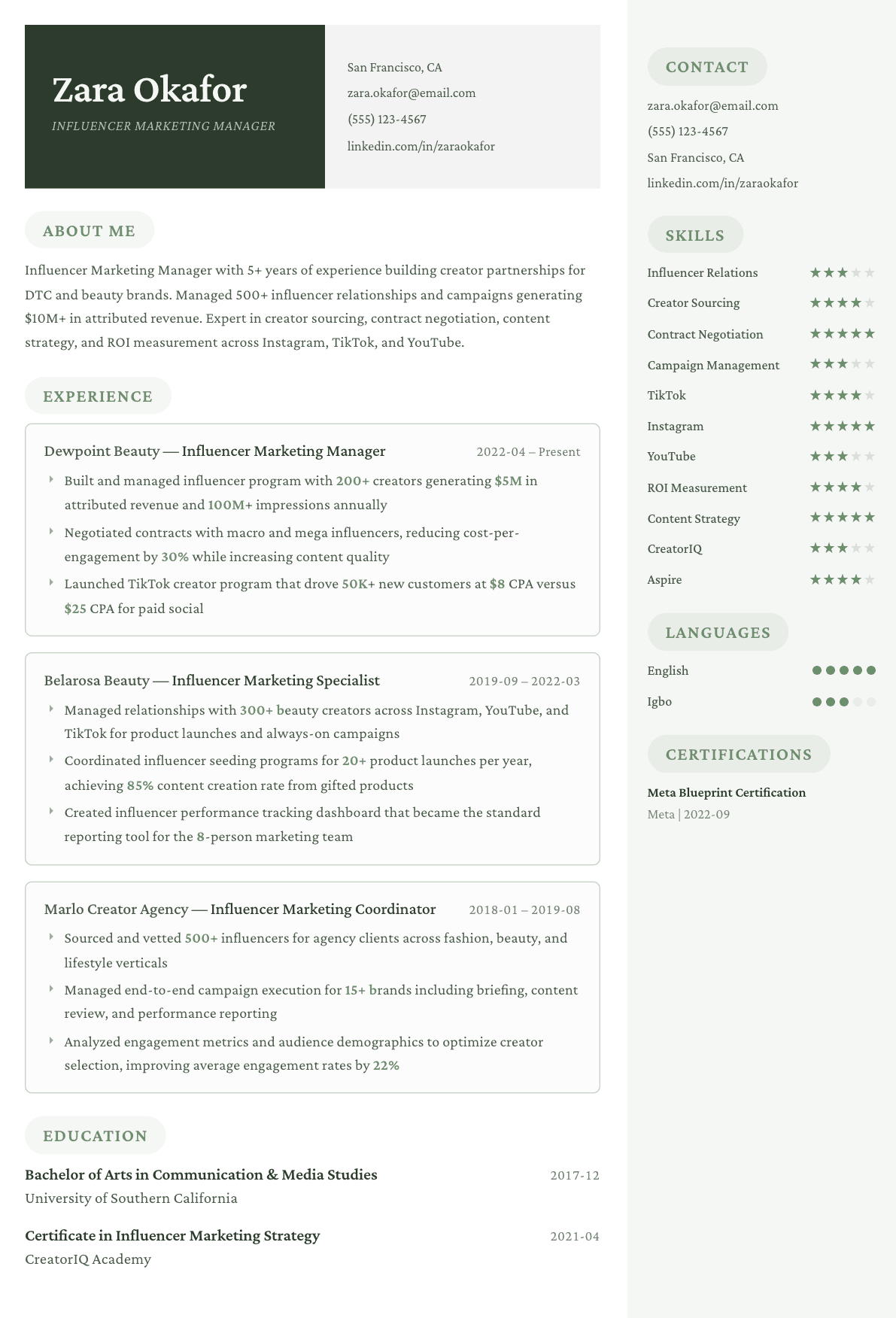
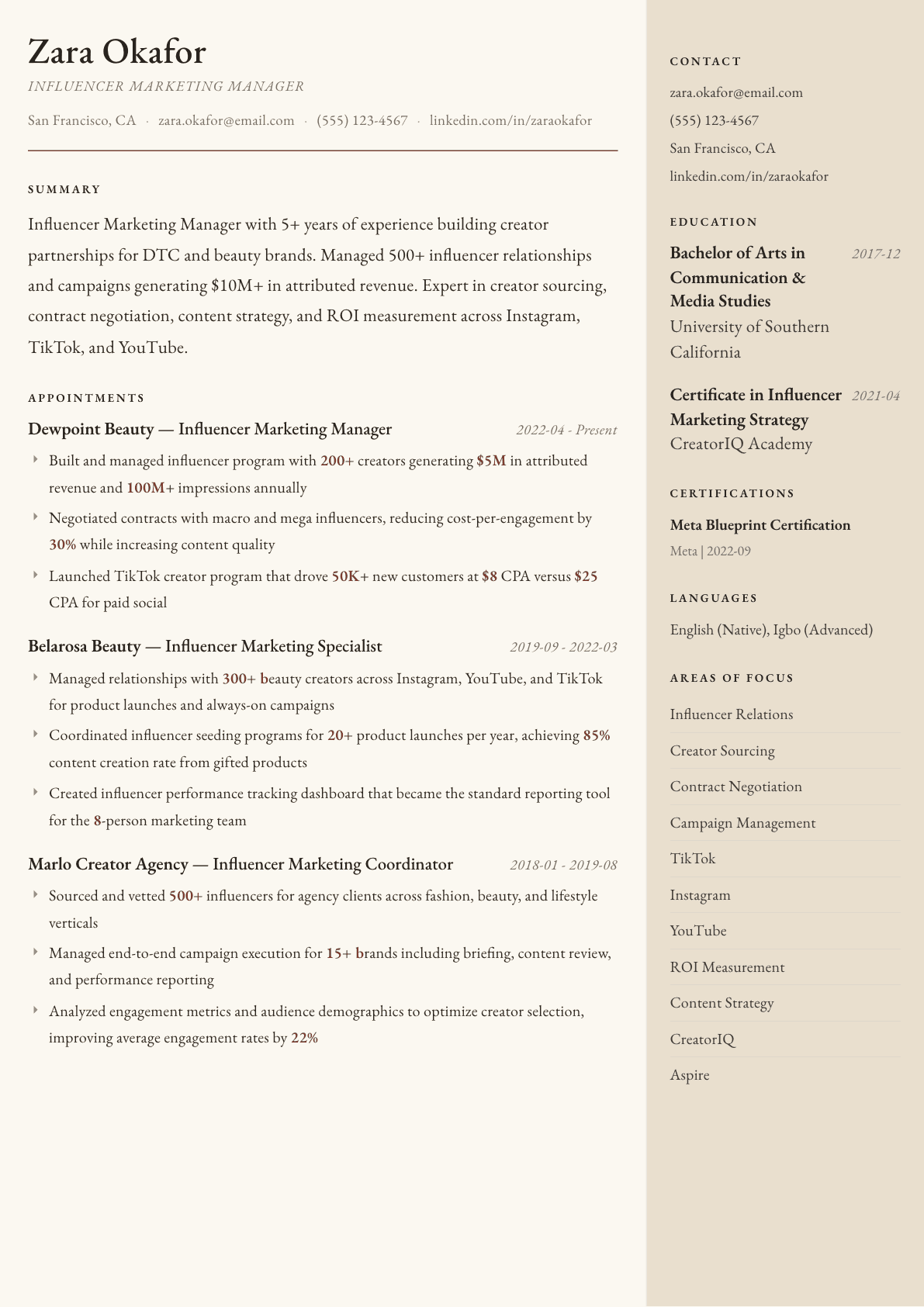
The same influencer marketing manager content laid out in three CVBooster templates, so you can see what the finished document looks like before you write a word.
Example Influencer Marketing Manager summary
Influencer Marketing Manager with 5 years building 500+ creator partnerships for beauty and DTC brands. Programs generated $10M+ in attributed revenue and 100M+ impressions, including a TikTok creator channel acquiring customers at $8 CPA against $25 on paid social. Handles sourcing, contracts and ROI measurement.
Skills to list on a Influencer Marketing Manager resume
- Influencer Marketing
- Creator Relations
- Campaign Management
- Contract Negotiation
- TikTok Marketing
- Instagram Marketing
- YouTube Partnerships
- ROI Measurement
- Content Strategy
- CreatorIQ
- Aspire
- Grin
- Brand Partnerships
- Social Media Strategy
What actually gets this resume read
- Quantify creator partnerships: number of influencers managed, total reach, engagement rates, and attributed revenue.
- Highlight your experience across platforms: TikTok, Instagram, YouTube, Twitch -- and note which formats you specialize in.
- Showcase negotiation skills: cost-per-engagement improvements, contract structuring, usage rights management.
- Include influencer marketing platforms: CreatorIQ, Aspire, Grin, Traackr, HYPR.
- Demonstrate ROI measurement: attribution models, tracking links, discount code performance, brand lift studies.
- Mention creator relationship management -- long-term partnerships are valued over one-off campaigns.
How to write a influencer marketing manager resume
Influencer marketing managers are hired to solve a supply problem and a measurement problem at the same time. The supply problem is finding, negotiating with and keeping creators who will actually deliver on time and on brief. The measurement problem is proving that the money spent on them did something, in a channel where the tracking is imperfect and the finance team is skeptical. A resume that only shows follower reach solves neither, which is why so many of them stall.
The reader is usually a brand or social lead who has run a program that went wrong: a creator who posted a competitor two weeks later, a usage rights window that expired mid-campaign, an undisclosed paid post that drew a complaint, a talent invoice nobody had approved. They read your resume for evidence that you handle contracts, disclosure and rights as carefully as you handle creative briefs.
This guide covers how to structure the document, how to report creator results without leaning on impressions, three summaries from a first coordinator role through a program lead, before-and-after bullets, and the questions influencer marketers ask when their strongest campaigns cannot be attributed cleanly.
Format: one page with a program profile and a category line
One page until you manage a team. Under the summary, add a program profile: the platforms you run on, the creator tiers you work with from nano through celebrity, the annual number of partnerships, the budget band, and whether the model is gifting, paid partnership, affiliate, ambassador or a mix.
Add a category line, because category credibility is a real hiring factor. Beauty, fitness, gaming, food, parenting, finance and business software all have different creator economies, rate expectations and compliance pressures, and a manager hiring in a regulated category will look for that experience first.
- Header: name, title, city, email, and a link to campaign work you are permitted to share.
- Program profile: platforms, creator tiers, partnerships per year, budget band, partnership models.
- Sections in this order: summary, program profile, experience, selected campaigns, skills, education.
Summary: platforms, creator scale, and the result you can defend
Three lines. Name the platforms, the volume and tier of creator relationships you manage, the category, and one outcome you can defend under questioning: revenue tracked through creator codes and links, cost per engagement improvement, content volume delivered for paid usage, or a retained ambassador roster with its renewal rate.
Impressions and total reach are weak leads because they are the numbers creators quote in their own media kits. A hiring manager wants the numbers you produced, not the ones you were sold.
Experience: sourcing, negotiation, briefing and delivery
Follow the real workflow. Sourcing and vetting, which includes audience checks for authenticity and fit rather than follower counts alone. Negotiation, covering fee, deliverables, exclusivity window, usage rights and duration, whitelisting or paid amplification permission, and approval rounds. Briefing, which means giving direction without flattening the creator voice that made them worth hiring. Delivery, which means chasing drafts, running approvals, and checking disclosure before anything goes live.
Say what your contracts covered. Usage rights and their term, exclusivity against named competitor categories, content ownership, approval rights, and what happens when a deliverable is late or off brief. Managers screen for this because rights errors are expensive and public.
Include compliance explicitly. Disclosure requirements for paid partnerships, the platform tools that mark commercial content, and how you verify a creator applied them. In regulated categories add the claims review you worked inside. This is one of the shortest paths to standing out in this applicant pool.
Measurement: creator codes, links and honest attribution
Show the tracking you set up: unique discount codes per creator, tracked links with parameters, affiliate platforms, landing pages built for a specific partnership, and post-campaign surveys asking how people heard about the brand. Then report the results those systems produced, with the window and the caveats.
Include the content value side, which many teams underweight. If a partnership produced twenty pieces of usable content with paid usage rights, and that content then outperformed studio assets in paid social, that is a strong and defensible result. Say how many assets, what rights term, and where they were reused.
Engagement rate belongs on the page but define it. State whether it is against followers or against views, and give the benchmark you compared it to inside the same program rather than a general industry claim.
Tools, roster management and the vocabulary that gets parsed
Name the platforms you have run programs in, such as CreatorIQ, Aspire, Grin, Traackr or an affiliate network, and say whether you administered them or worked in an agency-managed account. Add the gifting and fulfillment logistics you handled and the finance workflow for talent payments, since late payments cost you creators faster than anything else.
Postings use a compact vocabulary: influencer marketing, creator partnerships, talent negotiation, usage rights, whitelisting, gifting, ambassador program, affiliate, engagement rate, brand safety, disclosure. Use the ones you can speak to and pair each with an accomplishment.
Influencer Marketing Manager resume summary examples
First influencer role
Influencer marketing coordinator running a gifting program of 120 nano and micro creators a year for a skincare brand across Instagram and TikTok. Built the current vetting checklist and disclosure review step, and grew usable content delivered per gifting cycle from 40 pieces to 95 without increasing product cost.
Five years in
Influencer marketing manager with five years in consumer goods, managing 200 paid creator partnerships a year across TikTok, Instagram and YouTube on a budget in the mid six figures. Negotiates usage rights and category exclusivity directly, and tracks partnership revenue through unique codes and tracked links reconciled monthly with finance.
Program lead
Influencer program lead managing two coordinators and an agency roster across four markets and two regulated categories. Built the ambassador tier that now renews at 70% year over year, moved talent payments to a 30-day cycle, and stood up a claims and disclosure review with legal before any post goes live.
Work experience bullets: before and after
Before: Managed influencer partnerships reaching millions of people.
After: Managed 200 paid creator partnerships a year across TikTok, Instagram and YouTube, from sourcing and vetting through contracting, briefing, approvals and payment.
Partnership volume and the workflow you owned describe the job, while reach describes what the creators already had.
Before: Negotiated rates with influencers.
After: Negotiated fees, three-month usage rights and category exclusivity directly with creators and their agents, and cut average cost per delivered asset by 27% by bundling multi-post deals.
Naming the contract terms and a cost outcome turns negotiation into a commercial skill the reader can price.
Before: Tracked campaign performance for influencer programs.
After: Issued unique discount codes and tracked links to every creator, reconciled attributed orders with finance monthly, and reported a blended cost per acquisition alongside the codes each creator drove.
A described tracking system and a finance reconciliation give the numbers credibility they never have on their own.
Before: Made sure influencer posts followed the rules.
After: Built a disclosure and claims review step with legal, checked every post against the brief and the platform paid partnership label within 24 hours of going live, and had two posts corrected before wider distribution.
A named review process and a caught error show the compliance judgment this role is quietly screened for.
Before: Built long-term relationships with creators.
After: Created a three-tier ambassador roster of 45 creators with quarterly briefs, guaranteed minimum bookings and 30-day payment terms, holding year over year renewal at 70%.
Structure, commitments and a renewal rate prove retention rather than claiming good relationships.
Hard skills
- Creator sourcing and vetting
- Talent negotiation
- Usage rights and exclusivity terms
- Campaign briefing
- Ambassador program design
- Affiliate and code tracking
- Whitelisting and paid amplification
- Disclosure and compliance review
- Budget planning and talent payments
- CreatorIQ
- Grin
- Gifting and fulfillment logistics
- Performance reporting and reconciliation
- Content rights management
Soft skills
- Relationship management with talent
- Clear briefing without over-directing
- Negotiating under a fixed budget
- Risk judgment on brand safety
- Working across legal and finance
- Diplomacy when work is off brief
Mistakes that cost influencer marketing manager candidates the interview
- Leading with total reach and impressions, which are the creators' numbers rather than your results.
- Leaving out contract terms, so nothing shows you can handle usage rights, exclusivity and approvals.
- Never mentioning disclosure, which suggests you have not run a program where compliance was checked.
- Counting creators contacted instead of partnerships delivered, which inflates volume without evidence of execution.
- Quoting an engagement rate with no definition and no comparison inside your own program.
- Ignoring the content value of a partnership, which is often the most defensible return the program produces.
- Naming a management platform you saw in an agency dashboard rather than one you administered.
Influencer Marketing Manager resume questions
What metrics belong on an influencer marketing resume?
Use the numbers your program generated: partnerships delivered, cost per delivered asset, revenue tracked through creator codes and links, engagement rate with a stated definition, ambassador renewal rate, and content volume secured with usage rights.
How do I show results when influencer sales cannot be tracked?
Report the tracked share honestly and add the signals around it. Unique codes and links capture part of the effect, and you can support it with lift in branded search, landing page traffic during flight, and survey answers on how customers found the brand.
Should I list the creators I have worked with by name?
Name a few only if the partnerships were public and you have no confidentiality restriction. Otherwise describe tier, category and follower band. Hiring managers care more about how you negotiate and manage creators than about which names appear on the page.
How important is contract and rights knowledge for this role?
It is one of the strongest differentiators. Usage rights terms, category exclusivity, approval rights and payment schedules are where programs create legal and financial risk, so a candidate who writes about them plainly moves ahead of one who writes only about creative.
How do I move from social media management into influencer marketing?
Lead with any creator work you already do: gifting, community creators, partnerships you sourced or briefed. Then show the commercial side by learning rate benchmarks in your category, drafting a simple brief and contract checklist, and setting up code-based tracking on a small test.