Social Media Manager Resume Examples: what gets the call
Social Media Resume Example for a Social Media Manager
By Mustafa Tarabya, founder of CVBooster · Published · Updated
Marketing and social media resume example for a social media manager: a full sample, numbers with a denominator, and three summaries by level.
Sample resumes for a social media manager
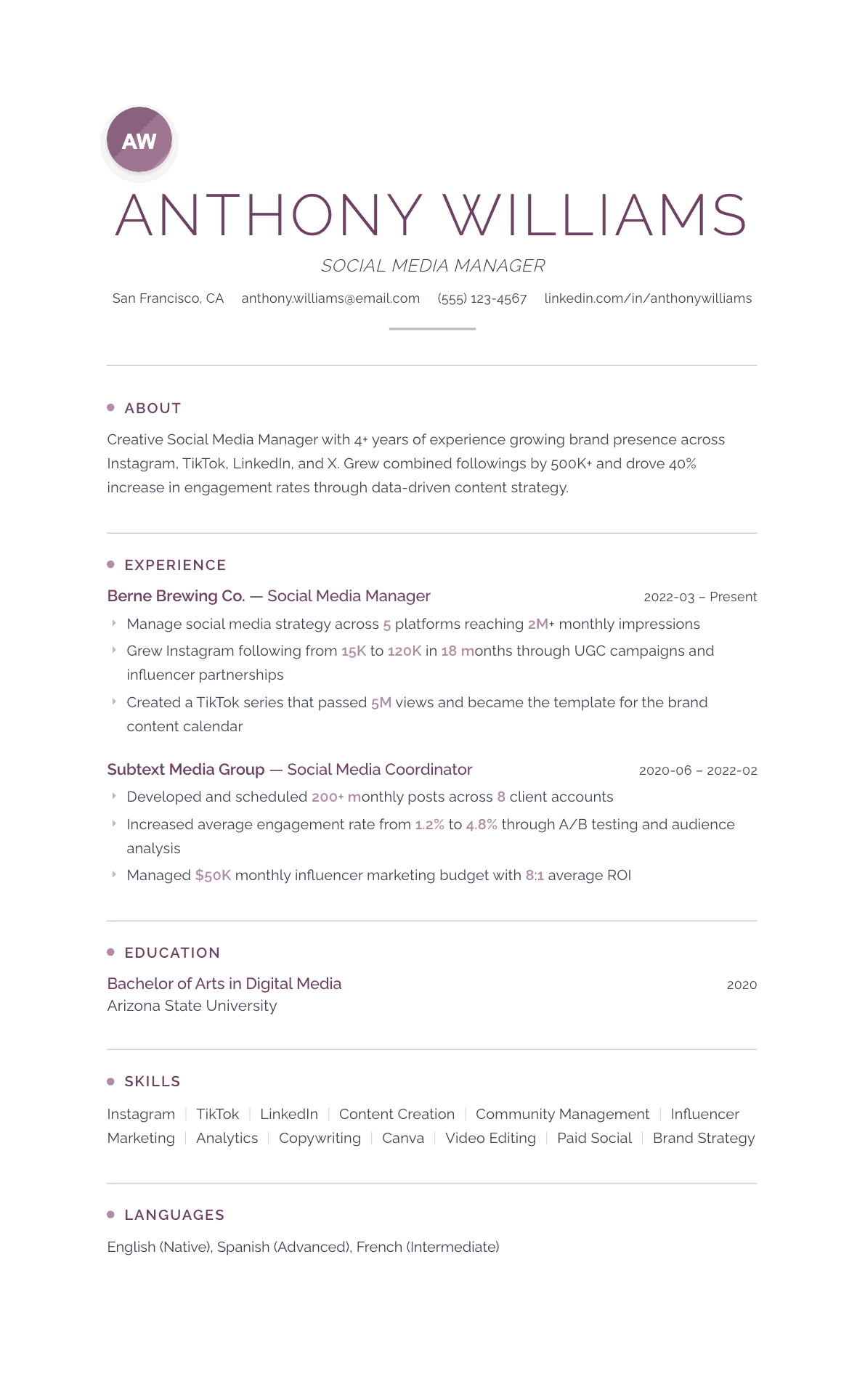
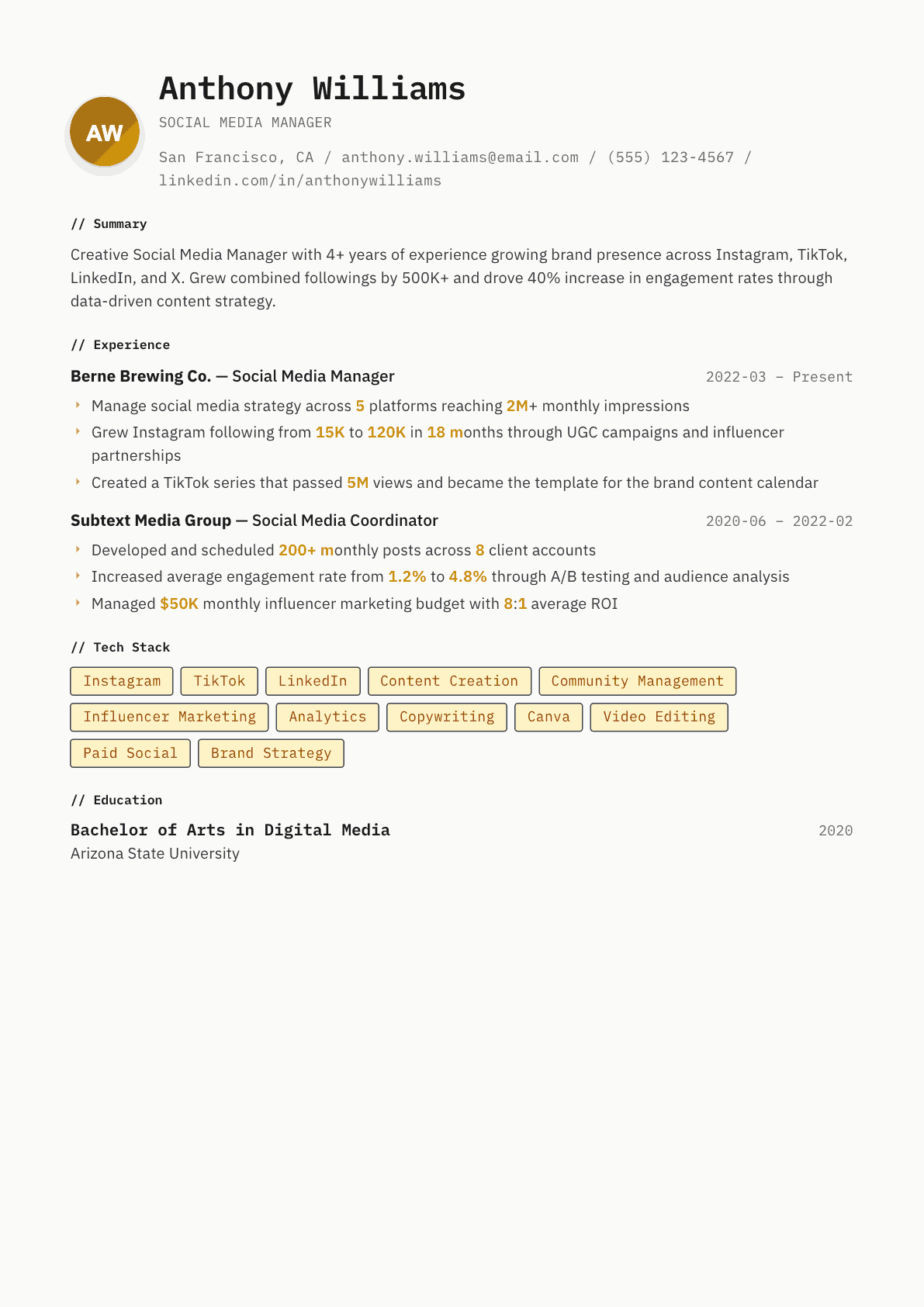
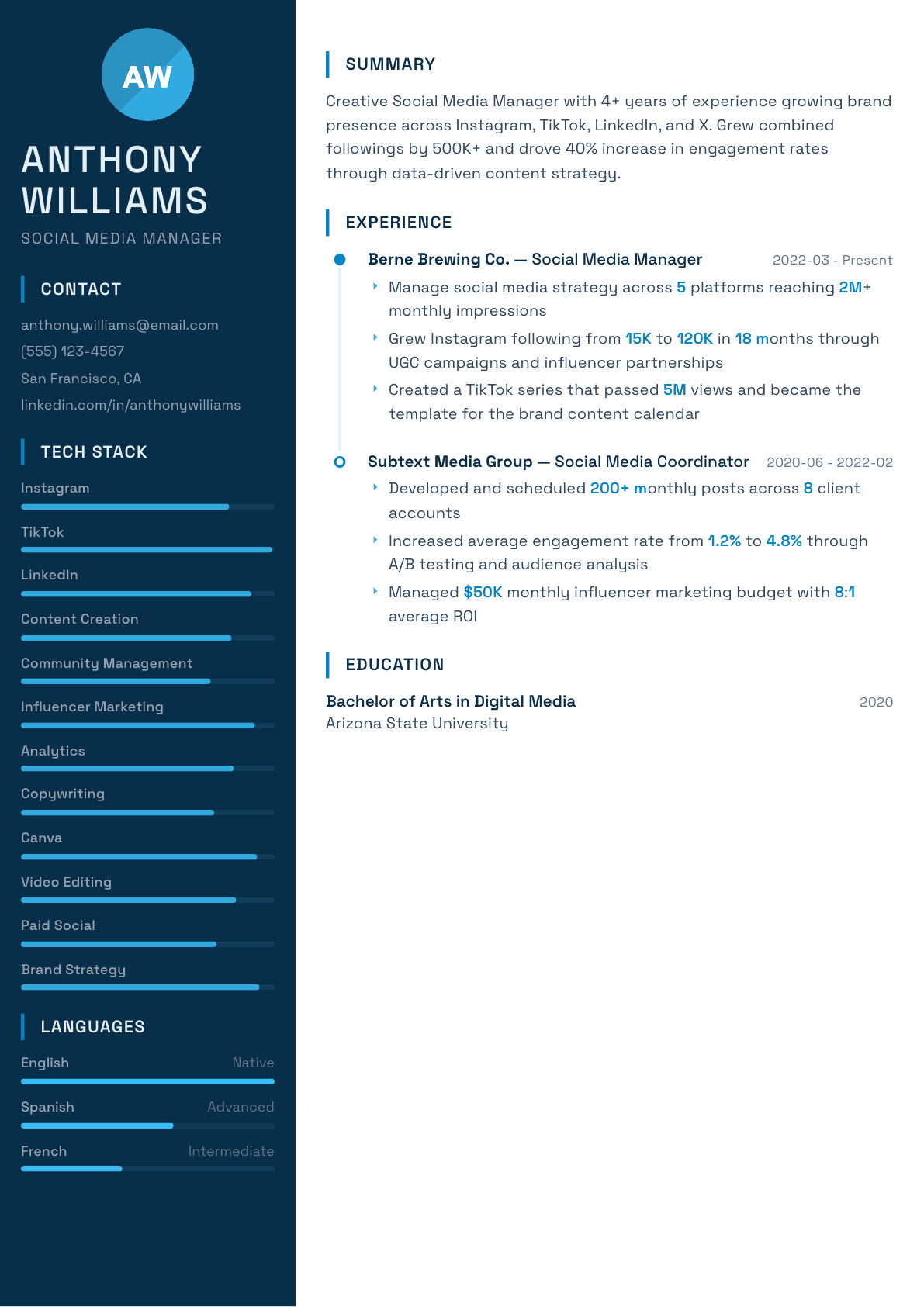
The same social media manager content laid out in three CVBooster templates, so you can see what the finished document looks like before you write a word.
Example Social Media Manager summary
Social media manager, 4 years, five platforms and 2M monthly impressions for a consumer brand. Took an Instagram account from 15K to 120K in 18 months with user-generated content and creator partnerships, and runs a $50K monthly influencer budget at roughly eight to one.
Skills to list on a Social Media Manager resume
- TikTok
- Content Creation
- Community Management
- Influencer Marketing
- Analytics
- Copywriting
- Canva
- Video Editing
- Paid Social
- Brand Strategy
What actually gets this resume read
- Show follower growth, engagement rates, and viral content metrics.
- Include links to accounts you've managed (with permission).
- Highlight platform-specific expertise. Each network is different.
- Show both organic and paid social media experience.
- Include content creation skills: photography, video, copywriting.
How to write a social media manager resume
Social media manager is a title stretched over three different jobs, and a marketing and social media resume has to say which one you do. One is creator: you shoot, edit and appear in the content. One is strategist: you own the calendar, the brand voice and the paid and organic split. One is community: you live in the replies, the direct messages and the escalation path when something goes wrong. Most postings want a specific mix, and a resume that does not declare its mix gets read as the applicant who does none of it well.
The hiring manager will look you up. That is unique to this role and it changes how you write. Whatever accounts you claim, they will open, scroll and compare against what you wrote. So the resume has to be conservative enough to survive that check and specific enough to earn it.
This guide includes a complete social media resume example, then covers how to present platform depth without listing every app, how to report growth in numbers that mean something, three summaries by career stage, before and after bullets, and the questions social media managers ask when the work is public and the credit is shared. The same page works as a social media marketing CV for UK and Irish applications, and the social media marketing resume examples by career stage sit in the summaries further down.
Format: one page, accounts named, work linked
Reverse chronological, one page. Under each role, name the accounts you managed and the platforms, and state whether you were the sole manager or part of a team. If a brand had six people touching the feed, saying so and naming your slice reads as honest and costs you nothing.
Link to a short portfolio: a handful of posts or videos with the objective, your role, and the result on each. Do not link to a raw feed, because the reader ends up judging you on whatever happened to be posted last week rather than your best work.
- Header: name, city, email, portfolio link, and the accounts you are permitted to cite.
- Per role: platforms, whether organic, paid or both, and team size.
- Separate the accounts you owned from the ones you contributed to.
Social media marketing resume examples: summaries by platform and category
Three lines. Name the two or three platforms you are genuinely deep in, the brand category you have worked in, and your center of gravity: short form video production, community and moderation, paid social buying, or full channel strategy. Depth in two platforms beats a list of eight, because the algorithms, formats and audiences do not transfer as cleanly as generalist resumes pretend.
Include whether you make the content yourself. A manager who can shoot and edit vertical video on a phone in an afternoon is a different hire from one who briefs a studio, and small teams screen for the first specifically.
Experience: calendar, creation, community, paid
Cover four areas per role. Calendar and strategy: the posting cadence per platform, the content pillars, how you planned around launches and seasons, and the approval workflow you worked inside. Creation: what you personally produced, in which formats, with which tools. Community: response times, moderation rules, escalation to support or communications, and any user generated content program you ran. Paid: the platforms you bought on, the budget band, and the objectives you optimized to.
Name the operational tools, because agencies and larger brands screen for them: the scheduling and listening platform, the asset library, the editing apps, and the analytics you report from. Sprout Social, Later, Hootsuite, Buffer, Brandwatch, Adobe Premiere, CapCut, Canva and the native platform business managers are all recognizable and checkable.
Show that you understand the difference between organic and paid outcomes. A creative that performed organically and a creative that survived contact with a cost per acquisition target are different achievements, and treating them as one exposes you in an interview with anyone who buys media.
Include the crisis and moderation side if you have it. A community manager who has handled a review pile on, an angry comment section during an outage or a moderation policy rollout has experience most applicants lack, and brand teams value it disproportionately.
Numbers: rates over totals, with the denominator
Follower growth is the weakest metric in this field and the most quoted. Use rates and give the denominator: engagement rate per post on a stated follower base, average view through rate on video, saves and shares per thousand impressions, click through to site, and cost per result on paid. A percentage growth from a very small base should be stated with the base attached, because a reader will assume the worst otherwise.
Attribute a viral result carefully. Say what you did that was repeatable, and what was luck. Managers who say a video reached a wide audience and here is the format we then built from it read as far more competent than managers who present one spike as a strategy.
Skills: production, platform, and analysis
Split the block into what you can make, where you can publish and how you measure. Production covers shooting, editing, captioning, thumbnails, and basic design. Platform covers the specific business tools and ad managers. Analysis covers native analytics, listening platforms and any attribution work you have touched.
Do not list a platform you have only used personally. Brand accounts have approval flows, rights management, accessibility requirements and paid tooling that a personal account never exposes you to, and interviewers ask about exactly those.
Social media resume and CV example: a complete sample
Here is a complete social media resume example for a social media marketing manager with five years of experience, applying to a consumer brand. Read it as a social media resume sample for order and density; a coordinator would use the same sections with smaller scope, and a specialist would lead with the platform they own.
Every number in it has a denominator and a time frame, and every account it claims is one the hiring manager can open. That is the standard yours has to meet.
A social media CV is the same document under the name used in the UK, Ireland, Australia and most of Europe. The sections and the sample below do not change. What changes is the spelling, the date format and, in the UK and Ireland, leaving out a photo. Your own profiles still matter more than the file: link the account that best shows your work, and tidy the ones a recruiter will find anyway.
- Header: Alex Rivera, Social Media Marketing Manager, city, email, phone, and a link to two brand accounts you ran.
- Summary: Social media marketing manager with five years in consumer food and beverage, owning organic and paid social across Instagram, TikTok and LinkedIn. Built a short video format that raised average engagement rate per post across two quarters, and runs a team of two creators and a community coordinator. Looking for a head of social role.
- Experience: owned the content calendar, brand voice guide and approval flow for three brand accounts, with weekly reporting to the marketing director.
- Experience: managed the paid social budget in Meta Ads Manager and TikTok Ads, reporting cost per result against the campaign goal rather than impressions.
- Experience: set up the community escalation path with customer care and legal, and ran it during a product recall.
- Earlier role: social media coordinator, two bullets on scheduling, community replies and monthly analytics.
- Education: bachelor degree in marketing or communications, plus platform certifications if you hold them.
- Skills: content strategy, short form video, community management, paid social, Sprout Social, Canva, CapCut, Google Analytics.
Social Media Manager resume summary examples
Social media coordinator
Social media coordinator with 18 months running Instagram and TikTok for a regional food brand. Shoot and edit vertical video on a phone, maintain a three week content calendar, and answer community messages within a working day. Grew the TikTok account from a standing start to 24 thousand followers.
Four years in
Social media manager with four years owning Instagram, TikTok and LinkedIn for a consumer skincare brand. Produce most short form video in house, run a monthly creator program with 12 partners, and hold an engagement rate above 4% on a following in the low hundreds of thousands.
Social lead managing a team
Social media lead with eight years across consumer and business brands, managing two creators and a community specialist. Own the organic strategy, the paid social budget and the moderation policy across four platforms, and rebuilt the content pillars after an audience research project shifted the brand voice.
Work experience bullets: before and after
Before: Grew the brand social media following significantly.
After: Grew the TikTok account from 3 thousand to 90 thousand followers in a year by moving from polished studio clips to a weekly founder led explainer format posted four times a week.
The starting base, the timeframe and the format change make the growth credible and repeatable.
Before: Created content for Instagram and TikTok.
After: Wrote, shot and edited roughly 20 vertical videos a month across Instagram Reels and TikTok, cutting in CapCut and shooting everything on a phone with a two person crew.
Volume, format and the production setup show what you can personally deliver rather than merely oversee.
Before: Managed the community and responded to comments.
After: Handled roughly 400 comments and direct messages a week within a four hour response target, wrote the moderation and escalation policy, and routed product complaints to support with a shared tracker.
Volume, a response target and a written policy turn community work into an operational system.
Before: Ran paid social campaigns.
After: Bought paid social on Meta and TikTok against a mid five figure monthly budget, tested creative in weekly batches of six, and held cost per acquisition below the target through two seasonal peaks.
Naming the platforms, the testing rhythm and the acquisition target proves media buying rather than boosting posts.
Before: Worked with influencers.
After: Ran a creator program with 12 partners a quarter: briefed, negotiated usage rights, tracked delivery, and repurposed the three best performing pieces into paid creative.
Rights, tracking and repurposing show the program management that separates a creator lead from someone who sends free product.
Hard skills
- Short form vertical video production
- Video editing in CapCut and Premiere Pro
- Content calendar planning
- Copywriting for social
- Community management and moderation
- Creator and influencer program management
- Paid social buying on Meta and TikTok
- Sprout Social or Hootsuite
- Social listening and sentiment tracking
- Native platform analytics
- Canva and basic design
- Accessibility captions and alt text
Soft skills
- Brand voice consistency
- Judgment on what not to post
- Working with legal and support
- Fast turnaround under a live news cycle
- Taking creative feedback
Certifications worth listing
- Meta Certified Digital Marketing Associate (Meta Blueprint)
- TikTok Media Buying Certification (TikTok Academy)
- Hootsuite Social Marketing Certification (Hootsuite Academy)
- Sprout Social Platform Certification (Sprout Social)
Mistakes that cost social media manager candidates the interview
- Listing eight platforms when you are only deep in two, which collapses in an interview about algorithm changes.
- Quoting follower growth with no starting base, so the reader assumes the base was tiny.
- Linking to a live feed instead of a curated set of posts with your role and the objective on each.
- Claiming accounts you contributed to as accounts you owned, when the hiring manager will check.
- Presenting one viral post as a strategy with nothing repeatable behind it.
- Leaving out community and moderation work, which is often the part of the job the brand is most worried about.
- Treating organic engagement and paid performance as the same achievement.
Social Media Manager resume questions
Which social media metrics belong on a resume?
Engagement rate with the follower base stated, average view through rate on video, saves and shares, click through to the site, and cost per result on paid. Give rates rather than totals so the numbers stay comparable across companies of different sizes.
Can I list brand accounts I managed?
Yes if your employment agreement allows it, and it is worth checking. Naming the accounts makes everything else verifiable and is a strong signal. Where you cannot name them, describe the category and size and link to specific posts you are permitted to share.
What goes on a social media marketing CV?
The same core as a social media marketing resume: the platforms you ran, the category, a rate with its denominator such as engagement per post or cost per lead, the tools you used for scheduling and analytics, and links to live work. A UK or Irish CV may run to two pages; keep numbers in the first half.
How do I write a social media resume with no brand roles yet?
Grow one account of your own or for a small local business and document it properly: the starting base, the format you settled on, the cadence and the analytics screenshots. One well explained account you built beats an internship where you only scheduled posts somebody else wrote.
Should a social media resume or CV look designed?
Keep the file plain and put the design proof in the portfolio. Heavily styled two column resumes often lose their dates in parsers, and hiring managers in this field judge your visual ability from the content you link to rather than from your document.