Crime Analyst Resume Examples: free ATS score and gap list
Write a Crime Analyst Resume That Moves the Patrol Plan
By Mustafa Tarabya, founder of CVBooster · Published · Updated
Crime analyst resume example, keyword list and writing guide covering hot spot mapping, series identification, bulletins and deployment outcomes.
Sample resumes for a crime analyst
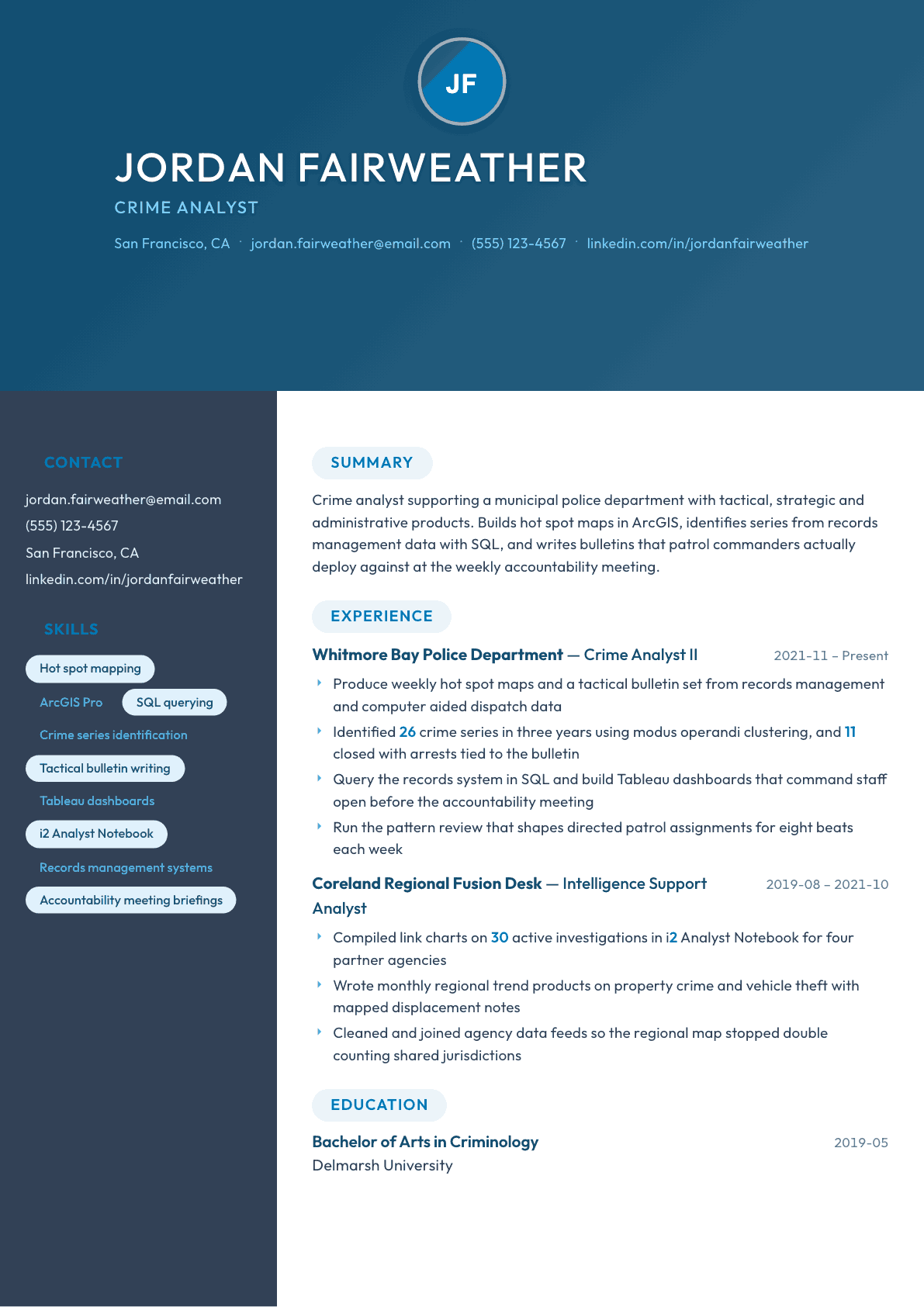
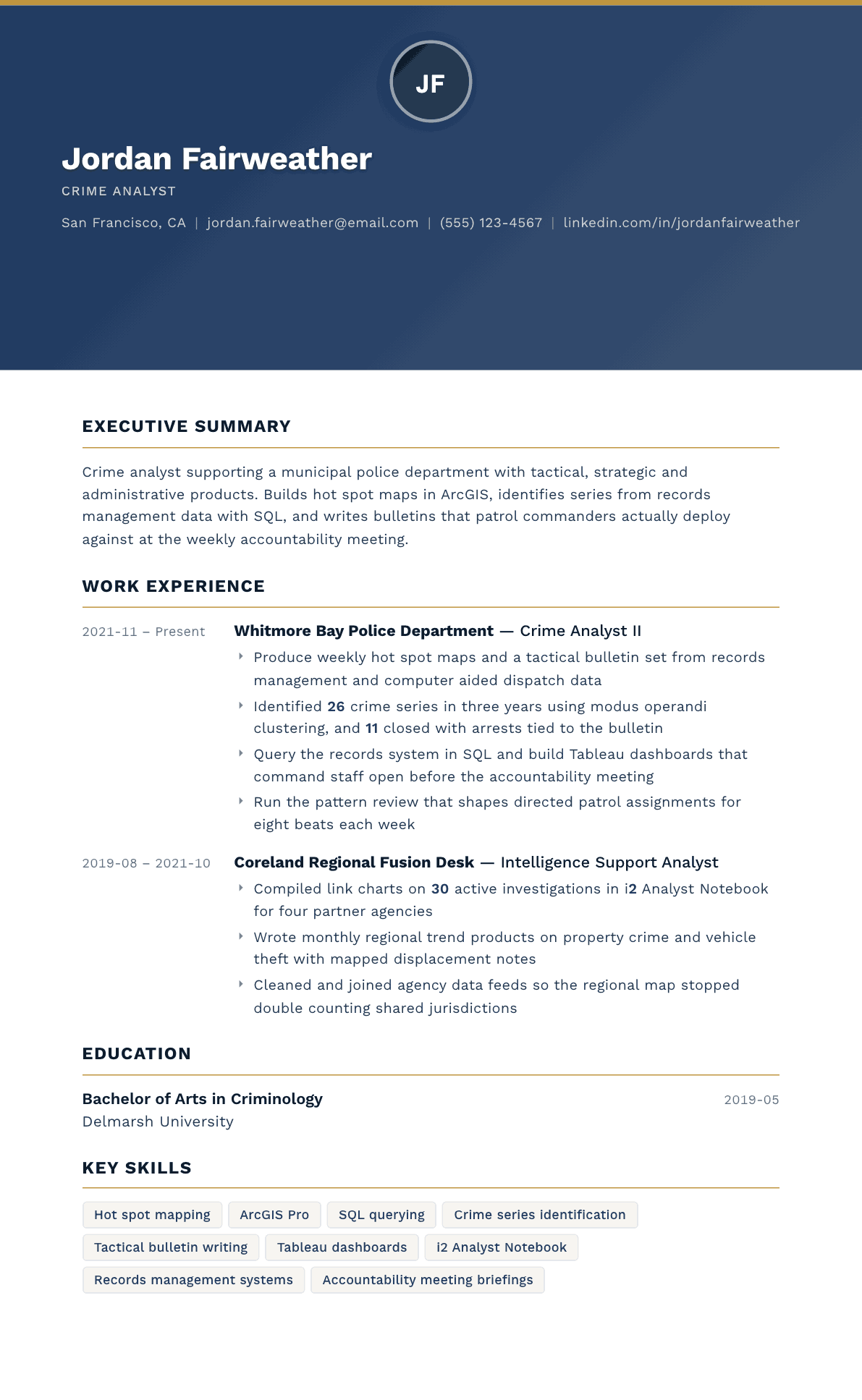
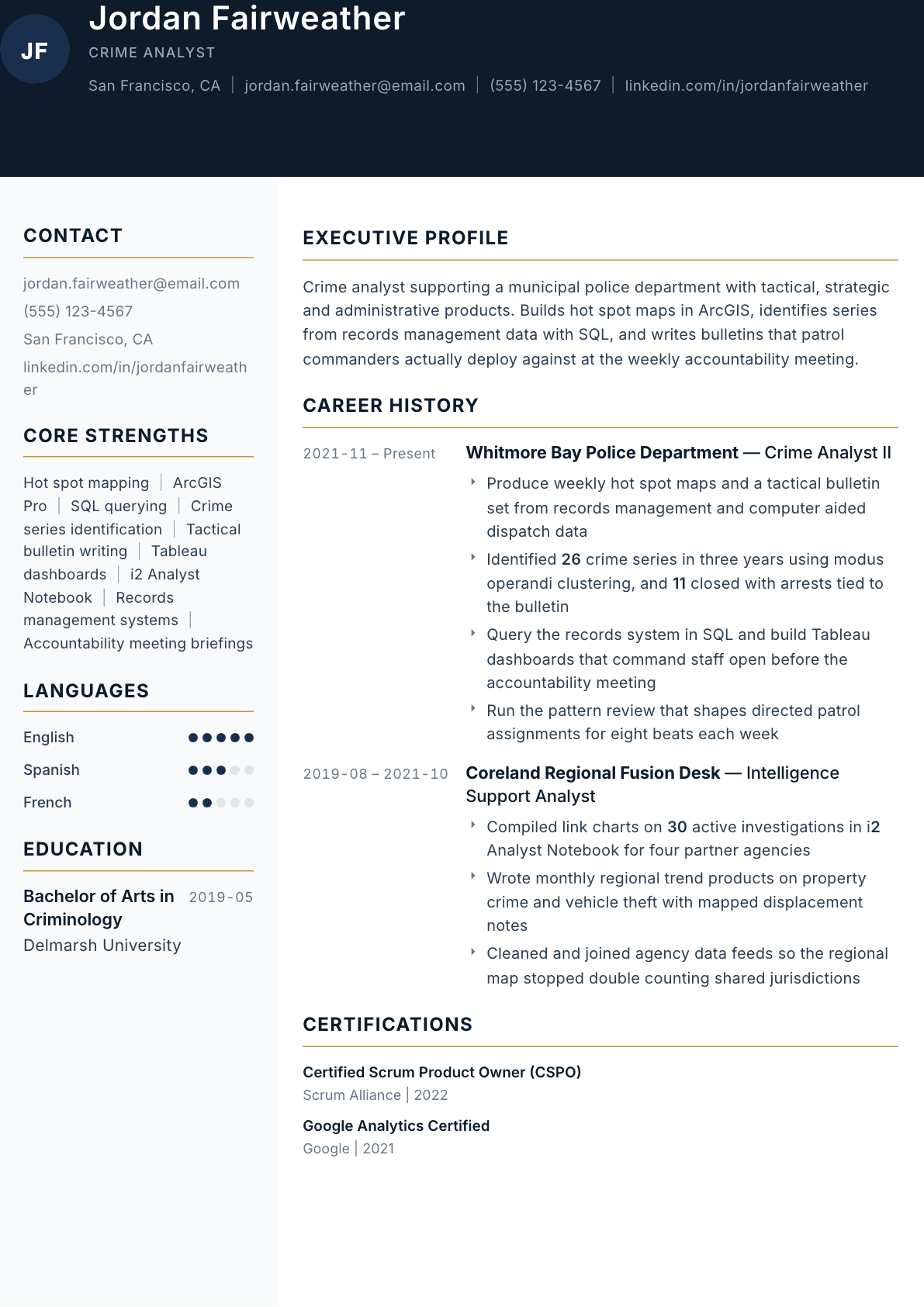
The same crime analyst content laid out in three CVBooster templates, so you can see what the finished document looks like before you write a word.
Example Crime Analyst summary
Crime analyst producing tactical bulletins, hot spot maps and strategic trend reports for a municipal police department. Queries the records management system directly in SQL, clusters modus operandi to name series before they run long, and builds the dashboards command staff open ahead of the weekly accountability meeting. Several identified series closed with arrests tied to the bulletin, and directed patrol assignments across eight beats are set from the pattern review.
Skills to list on a Crime Analyst resume
- Crime mapping and hot spot analysis
- ArcGIS Pro
- SQL and database querying
- Crime series and pattern identification
- Modus operandi clustering
- Tactical bulletin writing
- Strategic trend reporting
- Tableau and Power BI
- i2 Analyst Notebook
- Records management system extraction
- Computer aided dispatch data
- Statistical analysis in R or Python
- Command staff briefing
- Grant and annual reporting
What actually gets this resume read
- Split tactical, strategic and administrative products on the page, because departments hire for one of the three.
- Name the records management and dispatch systems you have queried, since every agency runs a different one.
- Give the number of series you have identified and how many closed with an arrest tied to your bulletin.
- Show your mapping and statistics stack by product name rather than writing that you are good with data.
- Put briefing experience on the resume, including standing up in front of command staff with your own numbers.
- Mention the grant reports, annual reports or council packets you have written, since those land on analysts.
How to write a crime analyst resume
A police captain hiring a crime analyst is not buying charts. He is buying a decision he can defend at the accountability meeting on Thursday: where the extra cars go, which series to run down first, and why last quarter looks the way it does. Your resume has to show that your products changed somebody deployment, not that you produced them.
The gap between analysts is usually the same. One writes that she prepared crime statistics and maps for the department. The other writes that she identified twenty six series in three years, eleven of which closed with arrests tied to the bulletin. Both did similar work. Only one of them proved it.
This guide covers the resume structure a police or sheriff agency reads, how to separate tactical from strategic products, three summaries across career stages, before and after bullets, and the questions analysts ask when moving between municipal agencies, fusion centers and private sector intelligence roles.
Format: one page, product types and data systems near the top
Reverse chronological, one page for most analysts and two once you have a decade or a long publication list. Under the summary, put a product line naming what you actually produce: tactical bulletins, hot spot maps, series alerts, strategic trend reports, annual and grant reporting, and command briefings. Agencies staff for a specific mix and they read for it.
Next to that, list the data systems by name. The records management system, the computer aided dispatch platform, the mapping software and the query language you write are the four things that decide how long onboarding takes. An analyst who has already worked in the agency stack is worth real money on day one.
- Product line under the summary: tactical, strategic and administrative outputs, with the cadence you produce each on.
- Data block: records management system, dispatch platform, mapping software, business intelligence tool and query language.
- Each job leads with agency size and coverage area, then the standing products you owned and who consumed them.
- Briefing line: the forums you present in, from shift briefing through accountability meetings and council packets.
Tactical work: series, patterns and the arrest that closed them
Series identification is the highest value thing a crime analyst does, so give it numbers. How many series have you named, on what offense types, and how many closed with an arrest tied to your bulletin. Add the linking basis: modus operandi clustering, temporal and spatial signature, vehicle description, or a suspect description repeated across reports.
Speed matters as much as accuracy here. If your bulletins go out inside a day of the linking report, say so, because a series that runs another week costs more victims. Where you have shortened that turnaround by changing how the data reaches you, that is a process improvement worth its own bullet.
Strategic products, mapping and getting the statistics right
Strategic work is where an agency gets judged in public, so accuracy is the currency. Describe your recurring products, who they go to, and any data quality work behind them: deduplicating reports, correcting geocoding failures, reconciling counts against national reporting rules, or fixing a feed that was double counting shared jurisdictions.
For mapping, name the software and the techniques rather than the output. Kernel density, repeat and near repeat analysis, risk terrain modeling, temporal heat maps and displacement checking are all specific and all readable to an analyst on the interview panel. Someone who writes that she created maps in mapping software tells the panel nothing they can test.
Briefing, credibility and the room where deployment is decided
Analysts who get promoted are the ones who can stand in front of command staff and defend a number. Put briefing experience on the page with the audience: shift briefings, weekly accountability meetings, executive staff, city council, or a multi agency task force. Say how often, because a monthly presenter and a weekly one are different animals.
Then show that your work is used. A directed patrol plan built from your pattern review, a resource request supported by your analysis, a grant awarded on a report you wrote, or a policy discussion your trend product started are all proof of consumption. Without one of those, a resume can describe a full workload and still read as decorative.
Skills and the vocabulary agency postings match on
Civil service postings recycle a narrow set of terms: crime analysis, intelligence led policing, hot spot, pattern and series identification, modus operandi, geographic information systems, statistical analysis, bulletin, briefing, records management. Mirror the exact language and evidence at least four terms inside your bullets with a count attached.
Add the technical differentiators. Writing your own queries rather than requesting extracts, automating a recurring report, building a dashboard that command opens without you, or handling a data feed join across agencies all separate an analyst who waits for data from one who goes and gets it. That difference is what fusion centers and larger agencies hire on.
Crime Analyst resume summary examples
First analyst post
Criminology graduate with an agency internship and eighteen months producing weekly property crime maps and monthly count reports for a municipal department. Writes queries against the records management system, builds hot spot maps in ArcGIS Pro, and completed a foundational crime analysis course in 2024.
Four years analyzing
Crime analyst producing weekly hot spot maps and a tactical bulletin set from records management and dispatch data. Identified 26 series in three years through modus operandi clustering, with 11 closing on arrests tied to the bulletin, and runs the pattern review that sets directed patrol for eight beats.
Lead or supervising analyst
Lead crime analyst supervising two analysts and owning the tactical, strategic and administrative product set for a mid sized agency. Rebuilt the geocoding pipeline, briefs command staff weekly, writes the annual report and grant narratives, and represents the department on a regional intelligence group.
Work experience bullets: before and after
Before: Prepared crime statistics and maps for the department.
After: Produced weekly hot spot maps and a tactical bulletin set from records management and dispatch data, feeding the directed patrol assignment for eight beats each week.
Naming the consumer and the decision your product feeds turns output into influence.
Before: Identified crime patterns and trends.
After: Identified 26 crime series in three years through modus operandi and temporal clustering, with 11 closing on arrests tied directly to the bulletin.
A series count paired with closures is the clearest measure of tactical analysis anyone can offer.
Before: Used databases to pull crime data.
After: Wrote SQL against the records management system to build recurring extracts, replacing a manual monthly pull that had taken two working days.
Owning the query and quantifying the time saved shows technical independence, not tool familiarity.
Before: Presented information at department meetings.
After: Briefed command staff weekly at the accountability meeting on beat level trends, defending the counts and the deployment recommendation in the room.
Audience, cadence and the defending detail prove credibility that a presentation claim cannot.
Before: Improved the accuracy of crime data.
After: Rebuilt the geocoding and deduplication step across four partner agency feeds so the regional map stopped double counting shared jurisdictions.
A specific data defect and the fix show the quiet work that makes every other product trustworthy.
Hard skills
- Crime mapping and hot spot analysis
- ArcGIS Pro and geographic information systems
- Pattern and series identification
- Modus operandi clustering
- Tactical bulletin writing
- Strategic and trend reporting
- SQL and database querying
- Tableau and Power BI dashboards
- Link analysis software
- Records management system extraction
- Computer aided dispatch data handling
- Statistical analysis in R or Python
- Grant and annual report writing
Soft skills
- Defending a number in front of command staff
- Writing a bulletin an officer reads at the start of a shift
- Saying what the data does not support
- Building trust with detectives who prefer their own instincts
- Turning a vague request into an answerable question
Certifications worth listing
- Certified Law Enforcement Analyst (CLEA) (International Association of Crime Analysts)
- Criminal Intelligence Certified Analyst (CICA) (International Association of Law Enforcement Intelligence Analysts)
Mistakes that cost crime analyst candidates the interview
- Describing products without naming who consumed them or what decision they fed.
- Leaving series identification unquantified when the count and the closures are the strongest evidence available.
- Writing that you used mapping software instead of naming the analytical techniques you applied.
- Omitting the records management and dispatch systems, which decide how fast you become useful.
- Skipping briefing experience, since standing in front of command staff is half the senior analyst job.
- Hiding data quality work, which is often the most valuable thing an analyst has done for an agency.
Crime Analyst resume questions
What is the difference between tactical and strategic crime analysis on a resume?
Tactical work names series and patterns fast enough to change this week deployment, while strategic work explains longer trends for planning and public reporting. Agencies hire for one emphasis, so label your products by type rather than mixing them into one undifferentiated list.
Do I need law enforcement experience to become a crime analyst?
No, and many analysts come from criminology, geography or data backgrounds instead. What you do need is fluency with agency data and a demonstrated ability to write a product an officer will act on, so an internship or a volunteer analysis project carries real weight on a first application.
Which software should a crime analyst list?
The mapping platform, the business intelligence tool, any link analysis package, and the query language you write yourself. Name the records management and dispatch systems too, because those vary by agency and prior exposure shortens onboarding more than any general tool skill.
How do I show that my analysis was actually used?
Attach a consequence to each major product: a directed patrol plan, an arrest tied to a bulletin, a resource request supported, a grant awarded, or a policy discussion started. One consequence per product is enough, and it changes how the whole page reads.
Can crime analysis experience transfer to the private sector?
Yes, particularly into corporate intelligence, retail crime analysis and risk teams that value pattern work and clear briefing. Translate the vocabulary carefully, keep the technical stack visible, and lead with the analysis method rather than the offense types, since those do not travel as well.
Related resume examples
- Intelligence Analyst Resume example
- Policy Analyst Resume example
- Police Detective Resume example
- Homeland Security Analyst Resume example
- Military Intelligence Analyst Resume example
- Federal Agent Resume example