Military Intelligence Analyst Resume Examples: free score
Write a Military Intelligence Analyst Resume for Cleared Work
By Mustafa Tarabya, founder of CVBooster · Published · Updated
Military intelligence analyst resume example covering clearance, all-source products and keywords for cleared analyst hiring.
Sample resumes for a military intelligence analyst
The same military intelligence analyst content laid out in three CVBooster templates, so you can see what the finished document looks like before you write a word.
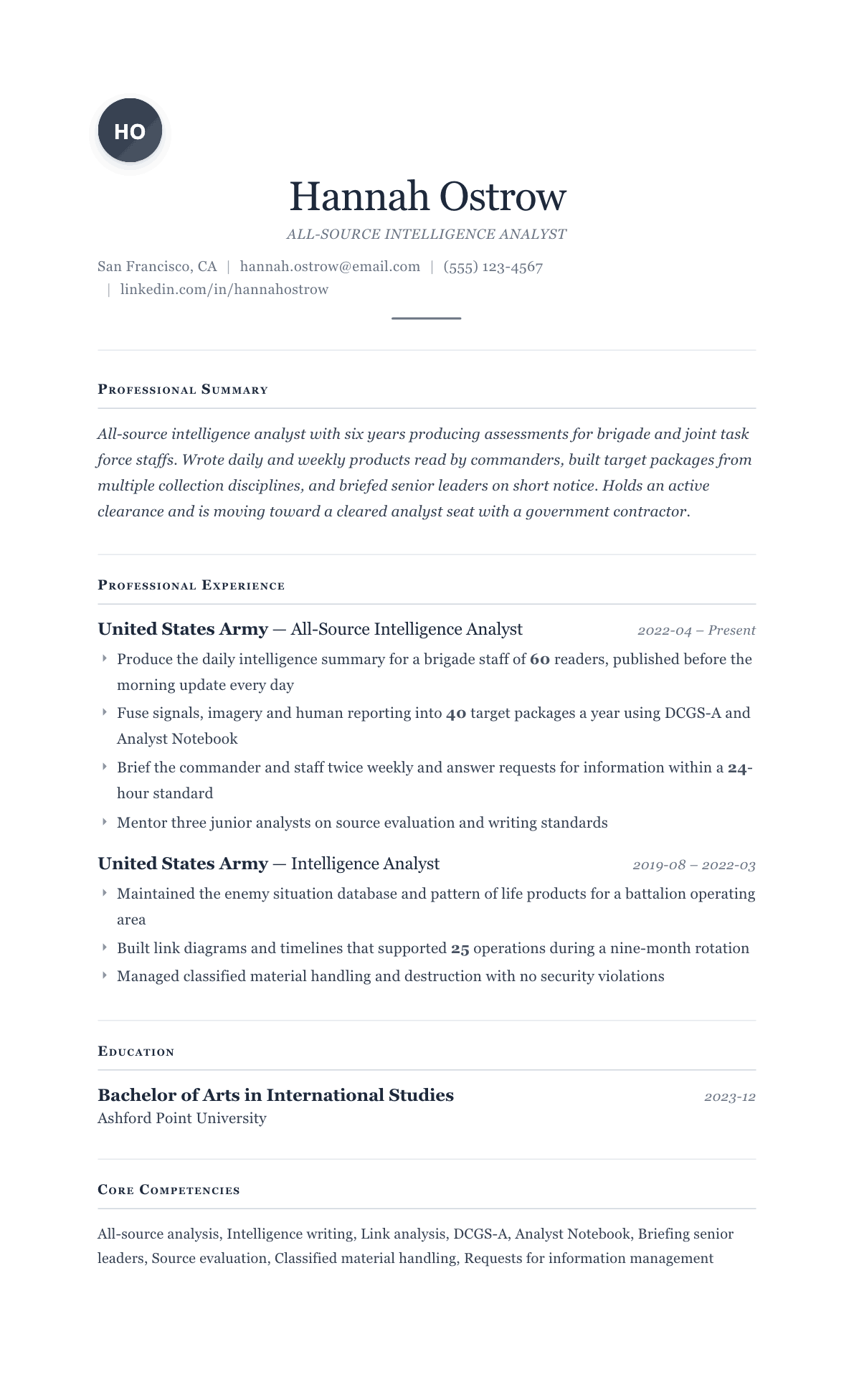
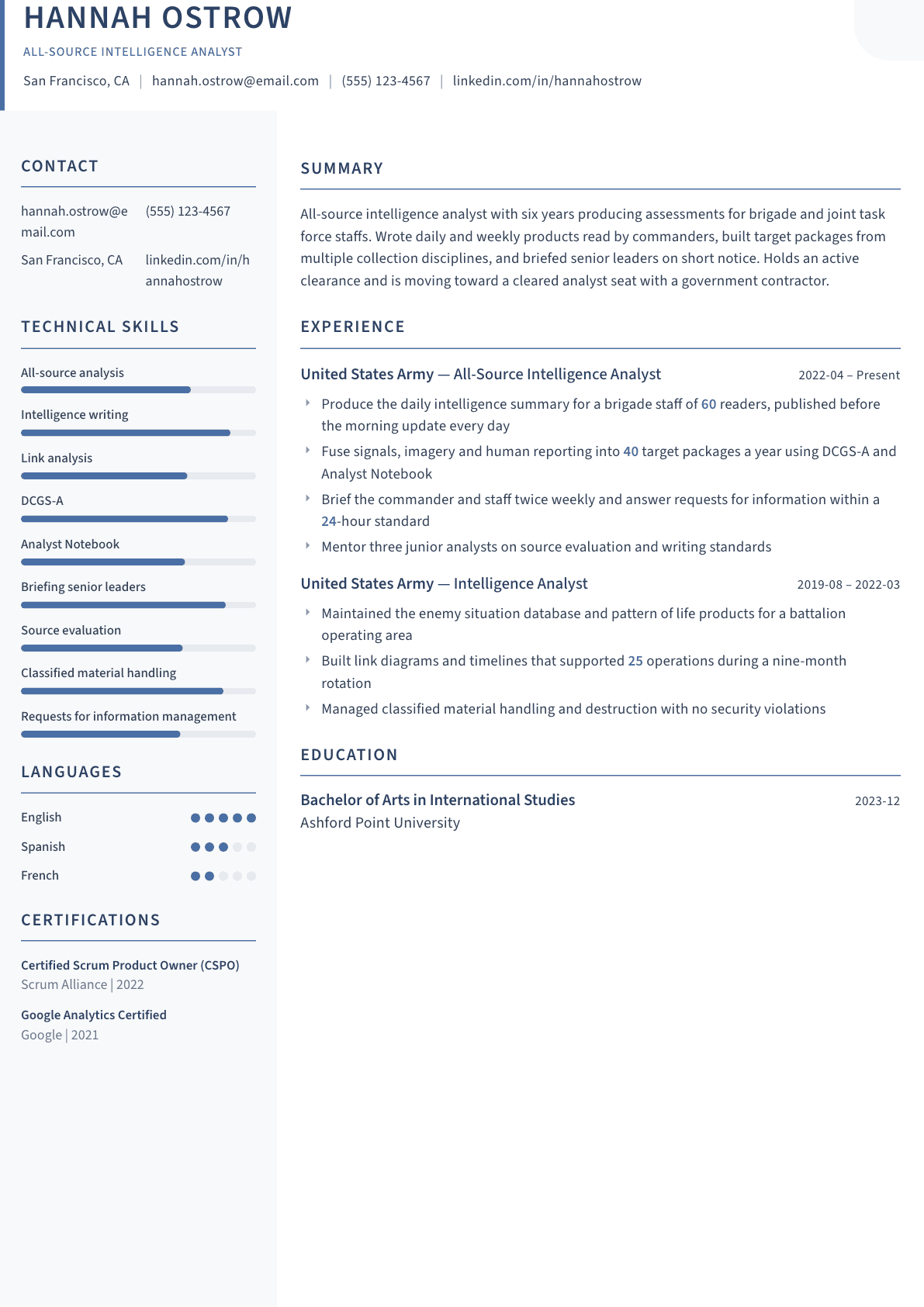
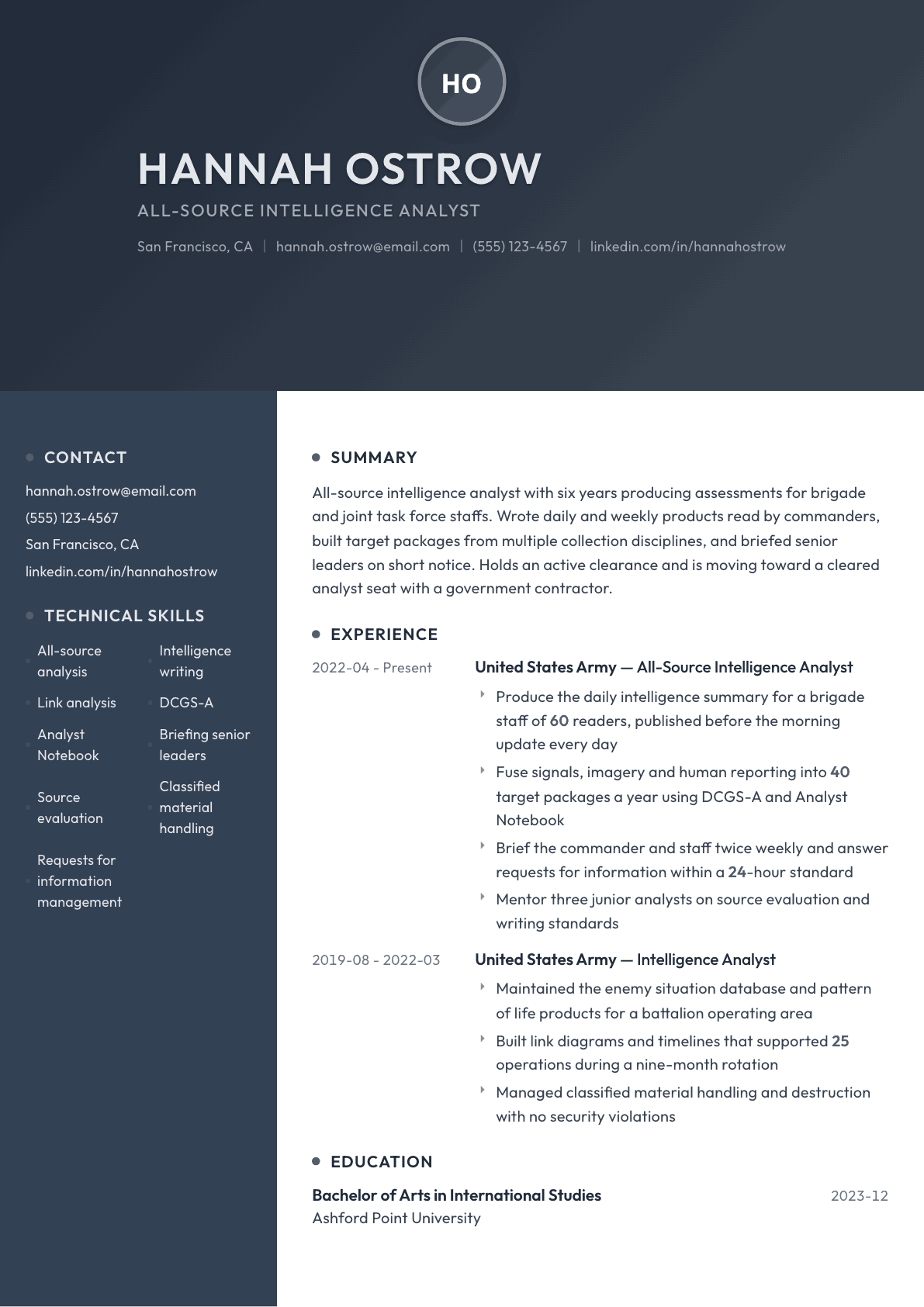
Example Military Intelligence Analyst summary
All-source intelligence analyst with six years producing assessments for brigade and joint staffs, holding an active clearance. Writes the daily intelligence summary for 60 readers, fuses signals, imagery and human reporting into about 40 target packages a year, and briefs the commander twice a week. Trains junior analysts on source evaluation and writing standards. Seeking a cleared all-source analyst position with a government contractor.
Skills to list on a Military Intelligence Analyst resume
- All-source intelligence analysis
- Intelligence report writing
- Target package development
- Link and network analysis
- Pattern of life analysis
- Geospatial analysis support
- Open source research
- Briefing and presentation
- Requests for information management
- Source reliability evaluation
- Classified information handling
- Database maintenance
- Analytic tradecraft standards
- Mentoring junior analysts
What actually gets this resume read
- State your clearance level, the granting decision date and whether a polygraph is on file, since cleared postings screen on it first.
- Name the analytic tools you have actually operated, because contractors match candidates to tool lists line by line.
- Count the products you wrote and who read them, so a hiring manager can judge writing volume and audience level.
- Describe briefing work by audience seniority and frequency rather than calling yourself an excellent communicator.
- Keep every line unclassified and generic about locations, and say on the resume that you have done so.
- Separate collection disciplines you worked with from ones you only read, because interviewers test that distinction.
How to write a military intelligence analyst resume
Cleared hiring runs on three filters, applied in order. Does the candidate hold the clearance at the level the contract requires. Have they used the specific tools named in the statement of work. Can they write. A military intelligence analyst resume that answers those three questions inside the first half of page one gets a call, and one that saves them for later usually does not.
The complication is that most of your best work cannot be described. You can name the discipline, the product type, the audience and the cadence, but not the subject. That constraint is normal and recruiters expect it, so the resume should show that you understand it: unclassified phrasing, generic geography, and a short line confirming the page has been written accordingly.
This guide covers the format cleared recruiters read fastest, how to describe analytic production without revealing anything, how to present tools and disciplines accurately, and the questions analysts ask when they are moving from a uniformed billet to a contractor seat.
Format: clearance, tools and production in the top third
One page for under eight years, two after that. Under the name goes the target title, then a clearance line stating the level, the status and the year of the last investigation, then the summary. A cleared recruiter is often filtering hundreds of files on that one line, and putting it below the fold costs you the match.
Follow the summary with a tools and systems block. Contractors build requirements directly from the statement of work, and they compare your list against theirs line by line. A tool you have used daily deserves naming even when it feels routine to you.
- Clearance line: level held, active or eligible, investigation year, and polygraph type if you have one.
- Tools block listing the analytic, geospatial and reporting systems you have operated, separated from ones you have only read output from.
- Assignment scope line: the staff or organization supported, the size of the readership, and the production cadence you met.
- A short statement that all content on the page is unclassified and written at the general level.
Describing production without describing the content
Analytic work is measurable in ways that do not touch the subject matter. Product type, frequency, audience seniority, readership size, turnaround standard against requests for information, and the number of assessments or packages produced in a year are all sayable and all useful.
Use the product names the industry uses: daily summaries, situation updates, target packages, link diagrams, pattern of life studies, threat assessments. A hiring manager matching a resume against a contract needs to see the deliverable, and the deliverable name carries no classified content.
Where an assessment mattered, describe the effect in generic terms: informed a commander decision, supported a planning cycle, changed a collection priority. Say what your product did without saying what it said.
Disciplines, tools and being precise about both
Separate what you produced from what you consumed. An all-source analyst fuses reporting from several disciplines but is not a signals analyst or an imagery analyst. Interviewers test that boundary quickly, and a resume that blurs it damages every other claim on the page.
The same rule applies to tools. List the systems you have operated with your own credentials and, if useful, a second short line for systems you have worked alongside. Contractors would rather see an honest short list than a long one that collapses in a technical screen.
If you built anything, say so. A database you maintained, a template you standardized, a workflow you introduced that shortened a request turnaround. Analysts rarely mention this work and it is what distinguishes a producer from a report writer.
Writing, briefing and the evidence you can offer
Writing quality is the hardest thing to prove on a resume and the most important skill in the job. Prove it structurally: give volume and cadence, say who edited your work and who read it, mention any role reviewing or editing the products of others, and then make the resume itself well written, because it is the writing sample.
Briefing deserves its own bullet with the audience level and the frequency. Briefing a commander twice weekly is a different claim from occasionally presenting at a staff meeting, and the seniority of the audience is what a contractor uses to judge whether you can face their customer.
Mentoring belongs here too. Analysts who trained junior analysts on source evaluation or writing standards are showing that they understand the craft well enough to teach it, which is exactly what a team lead posting is looking for.
Moving from uniform to a contractor seat
Contractor postings describe a seat on a specific customer site with specific tools and a specific product. Read them literally and mirror the vocabulary. Where the posting names a mission area you have not worked, do not claim it, and instead show adjacent experience and the speed with which you have picked up new accounts before.
Keep your clearance current and say so plainly, including the date it was last adjudicated. If it is inactive but within the reinstatement window, write that too. Silence about clearance status is read as a problem, and an accurate line is always better than an omission.
Add education and any analytic tradecraft training with the issuing school. Contractors are often required by the contract to document the qualifications of the people they place, so a credential with a named source is worth more than a description of your capability.
Military Intelligence Analyst resume summary examples
First assignment analyst
Intelligence analyst with three years supporting a battalion staff, maintaining the situation database and producing link diagrams and timelines that supported 25 operations during a nine-month rotation. Handled classified material with no security violations. Active clearance, seeking a junior all-source analyst seat with a government contractor.
Six years, brigade level
All-source intelligence analyst with six years producing assessments for brigade and joint staffs. Writes the daily summary for 60 readers, fuses signals, imagery and human reporting into about 40 target packages a year, briefs the commander twice weekly, and answers requests for information within a 24-hour standard.
Senior analyst and team lead
Senior intelligence analyst with twelve years across tactical and joint assignments, leading a six-analyst production cell and owning the review chain for every product leaving the section. Rebuilt the request for information workflow and cut average turnaround by half. Active clearance with a current investigation.
Work experience bullets: before and after
Before: Produced intelligence products in support of unit operations.
After: Produced the daily intelligence summary for a brigade staff of 60 readers, published before the morning update every duty day for two years.
Product name, readership size, deadline and duration describe the work fully without touching classified content.
Before: Used multiple intelligence disciplines to support targeting.
After: Fused signals, imagery and human reporting into about 40 target packages a year, building each in the analytic workstation and staffing it through the collection manager.
It names the disciplines fused, the output volume and the staffing path instead of gesturing at multi-source work.
Before: Briefed leadership on the current intelligence picture.
After: Briefed the commander and primary staff twice weekly, condensing the week of reporting into a five-minute update with a single recommendation.
Audience, frequency and product format prove briefing experience that a general statement about leadership cannot.
Before: Answered requests for information from higher and subordinate units.
After: Managed the request for information queue for the section, answering within a 24-hour standard and closing more than 300 requests without an overdue item.
A service standard and a completion record turn a routine duty into evidence of reliability under load.
Before: Trained junior analysts in the section.
After: Mentored three junior analysts on source reliability evaluation and product writing standards, reviewing their drafts until each could publish without edit.
It shows the tradecraft you can teach and the standard you held, which is what a team lead posting screens for.
Hard skills
- All-source analysis and fusion
- Intelligence report writing
- Target package development
- Link and network analysis
- Pattern of life analysis
- Open source research
- Geospatial product interpretation
- Requests for information management
- Source reliability evaluation
- Classified material handling and control
- Database maintenance and data quality
- Analytic tradecraft standards
Soft skills
- Saying what you do not know as clearly as what you do
- Defending an assessment without becoming attached to it
- Writing for a reader who has two minutes
- Working a queue that never empties
- Discretion that holds outside the workspace
Certifications worth listing
- CompTIA Security+ (CompTIA)
- GIAC Open Source Intelligence (GOSI) (Global Information Assurance Certification)
- Certified Fraud Examiner (Association of Certified Fraud Examiners)
Mistakes that cost military intelligence analyst candidates the interview
- Putting clearance status at the bottom of the page when it is the first filter applied to the file.
- Blurring the line between disciplines you produced in and disciplines you only consumed reporting from.
- Listing every system in the building instead of the ones you operated with your own credentials.
- Describing products by their subject rather than by type, cadence and audience.
- Submitting a resume with weak sentences for a job whose core deliverable is written analysis.
- Leaving out mentoring and workflow work, which is what separates a senior analyst from a productive junior one.
Military Intelligence Analyst resume questions
How do I write about classified work without disclosing anything?
Describe the shape rather than the subject: product type, audience, cadence, tool, volume and turnaround. Keep geography generic and never name an operation or a target set. Add one line confirming the resume is unclassified so the reader knows the omissions are deliberate.
What if my clearance has lapsed?
State the level you held, the year of the last adjudication, and whether you are within the reinstatement window. Many contractors will still consider you, particularly for a role with a long start runway, but only if the status is written plainly instead of left ambiguous.
How important is the tools list?
Very. Contract requirements are often written around named systems, and a recruiter matches your list against theirs before reading further. Keep it accurate, list what you have used yourself, and put the most commonly required systems first.
Should I apply directly to agencies or to contractors?
Both, with different documents. Federal applications follow their own long format with detailed duty descriptions, while contractor resumes stay short and mirror the statement of work. Reusing one for the other is the most common reason a strong analyst gets screened out.
Does an analyst resume need a degree?
Many cleared postings list one as a requirement, often with substitution allowed for years of experience. List the degree if you hold one, list the program and expected date if you are enrolled, and lean on experience plus a named tradecraft course if you have neither.
Related resume examples
- Intelligence Analyst Resume example
- Private Investigator Resume example
- Military Officer Resume example
- Veteran Resume example
- Military to Civilian Resume example
- Crime Analyst Resume example