State Trooper Resume Examples: free ATS score and gap list
Write a State Trooper Resume That Clears the Background Board
By Mustafa Tarabya, founder of CVBooster · Published · Updated
State trooper resume example, keyword list and writing guide covering patrol miles, crash reconstruction, DUI enforcement and academy credentials.
Sample resumes for a state trooper
The same state trooper content laid out in three CVBooster templates, so you can see what the finished document looks like before you write a word.
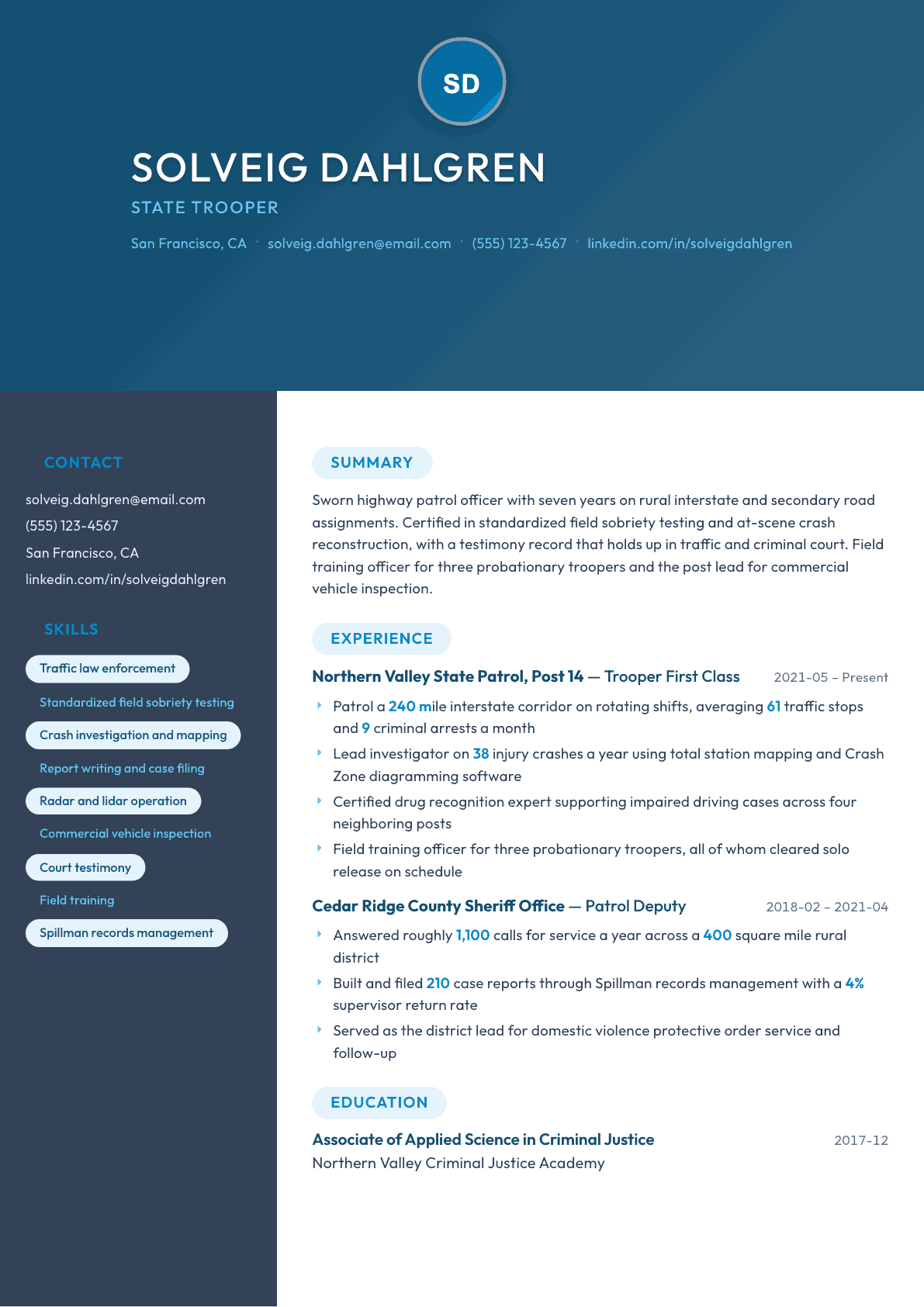
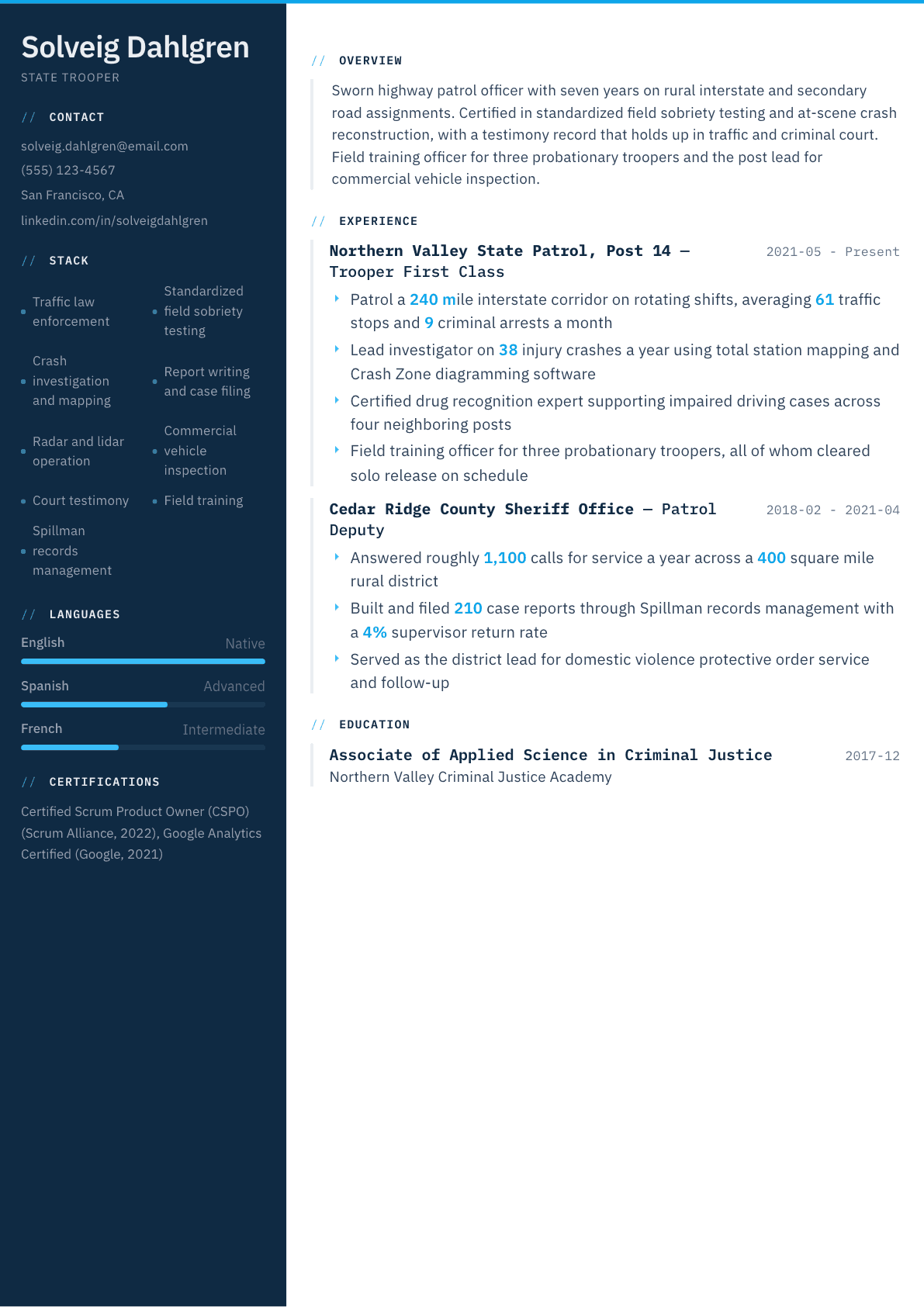
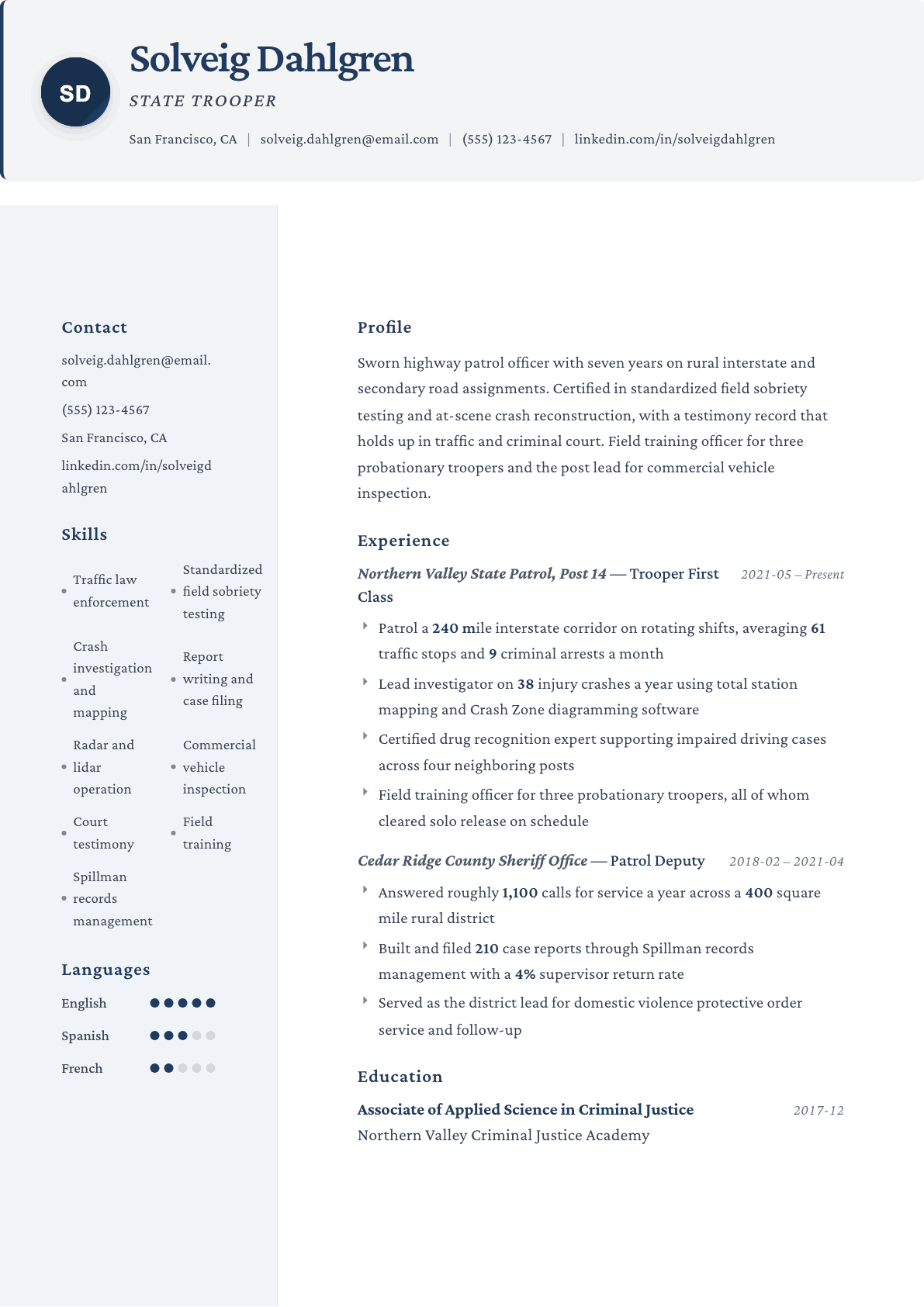
Example State Trooper summary
State trooper with seven years on interstate and rural patrol, certified as a drug recognition expert and in standardized field sobriety testing. Investigates injury crashes end to end using total station mapping, files cases that survive defense challenge, and trains probationary troopers through solo release. Seeking a criminal interdiction assignment with a specialized enforcement unit.
Skills to list on a State Trooper resume
- Highway patrol operations
- Traffic law and vehicle code
- Standardized field sobriety testing
- Drug recognition evaluation
- Crash scene investigation
- Total station and scene mapping
- Radar and lidar certification
- Commercial motor vehicle inspection
- Criminal interdiction
- Evidence collection and chain of custody
- Report writing
- Court and grand jury testimony
- Field training and mentoring
- Emergency vehicle operation
- Defensive tactics and firearms qualification
- Radio and dispatch procedure
What actually gets this resume read
- Name your academy, your commission date and your current post assignment before anything else on the page.
- Give patrol volume in real terms: corridor miles, stops per month, calls answered and arrests filed.
- List every enforcement certification separately, since a post commander staffs shifts around who holds what.
- Show your crash investigation depth, from at-scene diagrams up to reconstruction with mapping equipment.
- Mention court testimony volume and outcomes, because a prosecutor sees your reports long before a jury does.
- Include field training officer time, honor guard, dive team or any collateral duty you carried on top of patrol.
- Keep your driving and disciplinary history clean on the page and be ready to document every date in the background packet.
How to write a state trooper resume
A state trooper application is read by a background investigator before it is read by a commander. The investigator is checking whether every date, address and employer on your page can be verified against a paper trail, and whether anything you wrote will conflict with what a former supervisor says on the phone. Accuracy is the first quality your resume demonstrates.
The commander reads next, and he is staffing posts. He wants to know what corridor you can patrol alone at three in the morning, whether you can work a fatal crash without a supervisor standing over you, and how your reports look when a prosecutor opens them. A page that says you enforced traffic laws answers none of that.
This guide covers how to build the page for both readers: the format a background packet expects, how to write patrol volume, crash work and enforcement certifications, three summary versions by career stage, rewritten bullets, and the questions troopers ask when they apply laterally or move to a specialized unit.
Format: verifiable dates, academy credentials, no gaps
Reverse chronological, one page for under a decade of service and two after that. Every employment gap longer than a month gets accounted for somewhere on the page, because an unexplained gap becomes the first question in your background interview and the answer is always easier to give in writing than under fluorescent light.
Your commission details belong high on the page: the academy that trained you, your graduation date, the state that certified you, and your current certification status. A lateral applicant with an active certification is a much cheaper hire than a recruit, and the agency wants that fact confirmed before it reads anything else.
- Top block for a trooper: name, city and state, phone, email, current post assignment and years of sworn service.
- Certification block directly under the summary: academy, commission date, certifying state and current standing.
- Order the page as summary, certifications, sworn experience, training, education, then collateral duties.
- Recruit applicants with no sworn time move education, physical fitness results and any military service above experience.
Summary: post type, years, enforcement specialty
Three lines. Say how long you have been sworn, what kind of road you patrol, the enforcement specialty you carry, and one thing the post relies on you for. A trooper who works rural interstate at night is a different candidate from one assigned to an urban expressway with constant backup nearby, and the reader cannot tell those apart unless you say it.
If you are applying laterally from a municipal department, use the summary to bridge the gap. Municipal patrol builds call volume and people skills; highway patrol builds solo decision making across long distances. Name the part of your record that already looks like trooper work rather than leaving the panel to guess at the fit.
Experience: corridor, volume, and what you handled alone
Each assignment opens with the post, the geography and the shift. Give corridor miles, district size, population density and whether backup was minutes or a half hour away. Those facts frame every bullet that follows, and a commander reads them as a proxy for how much independence you have already exercised.
Then bullets on the work that separates troopers from other officers: traffic stops per month, impaired driving arrests, criminal interdiction on the highway, commercial vehicle inspections, and the crash work. Crash investigation deserves its own bullet with the level you work at, whether that is at-scene diagramming, total station mapping or full reconstruction with speed calculation.
Leave out the lines that describe police work generally. Patrolling assigned areas, responding to calls and maintaining public safety are true of every sworn applicant in the stack, and they cost you the space where an interdiction seizure or a fatal crash case should sit.
Certifications, court record and collateral duties
Group your enforcement certifications where they can be checked at a glance: field sobriety testing, drug recognition evaluation, radar and lidar, commercial vehicle inspection, breath instrument operation, any instructor ratings. A post commander builds the shift schedule around who holds which certification, so this block is closer to a staffing document than a list of achievements.
Court work belongs on the page too. Give a rough count of cases you have testified in and note if you have handled expert testimony on crash reconstruction or impairment. Then list collateral duties: field training officer, honor guard, dive or aviation support, recruiting, crisis negotiation. Agencies fill those slots from inside and hire with them in mind.
Skills and keywords a patrol agency filters on
Announcements for trooper positions recycle a compact vocabulary: patrol operations, traffic enforcement, impaired driving, crash investigation, interdiction, evidence handling, report writing, testimony, emergency vehicle operation. Use the exact term from the announcement once in your skills block and once inside a bullet where the work is visible, so both the screening system and the human reader find it.
Name your report writing platform and your in-car technology, since a lateral hire who already knows the records system saves the training unit weeks. Physical fitness results, firearms qualification standing and driving record status also belong on the page, briefly, because they are gate items the background investigator has to confirm anyway.
State Trooper resume summary examples
Recruit applicant
Criminal justice graduate and Army military police veteran applying to the state patrol academy. Four years of gate security, patrol and incident reporting on a large installation, current emergency medical technician certification, and a clean driving and disciplinary record ready for background verification.
Seven years sworn
State trooper with seven years on a rural interstate corridor, certified as a drug recognition expert and in standardized field sobriety testing. Averages 61 traffic stops a month, leads injury crash investigations using total station mapping, and has testified in 40 traffic and criminal cases without a suppression ruling.
Sergeant track
Trooper first class with twelve years across two posts, serving as field training officer, breath instrument operator and post lead for commercial vehicle inspection. Reconstructs fatal collisions, instructs impaired driving detection at the academy, and has supervised shift operations as acting sergeant for two seasons.
Work experience bullets: before and after
Before: Patrolled assigned areas and enforced traffic laws.
After: Patrolled a 240 mile interstate corridor on rotating midnight shifts with backup averaging 18 minutes out, making 61 stops and 9 criminal arrests a month.
Distance, shift and backup time show the independence the job actually demands.
Before: Investigated motor vehicle accidents.
After: Served as lead investigator on 38 injury crashes a year, mapping scenes with a total station and producing scale diagrams and speed calculations used at trial.
It names the level of crash work rather than leaving a commander to assume the lowest one.
Before: Made DUI arrests during patrol shifts.
After: Made 74 impaired driving arrests in a year as a certified drug recognition expert, completing twelve step evaluations for four neighboring posts on request.
The certification and the mutual aid work turn a common bullet into a specialty.
Before: Wrote reports and testified in court.
After: Filed 210 case reports through the state records system with a 4% supervisor return rate and testified in 40 traffic and criminal proceedings.
A return rate is the closest thing patrol work has to a quality score on writing.
Before: Helped train new troopers.
After: Served as field training officer for three probationary troopers, running the daily observation reports and releasing all three to solo patrol on schedule.
Naming the trainee count and the release outcome makes the training claim checkable.
Hard skills
- Highway patrol and area control
- Traffic and vehicle code enforcement
- Standardized field sobriety testing
- Drug recognition evaluation
- Crash scene investigation and mapping
- Speed measurement with radar and lidar
- Commercial motor vehicle inspection
- Criminal interdiction and vehicle search
- Evidence collection and chain of custody
- Case report writing
- Court and grand jury testimony
- Emergency vehicle operation
- Firearms and defensive tactics qualification
Soft skills
- Solo decision making with distant backup
- Calm control of roadside contacts
- Clear radio discipline under stress
- Credibility with prosecutors and defense counsel
- Mentoring probationary officers
Certifications worth listing
- Standardized Field Sobriety Testing (SFST) Practitioner (National Highway Traffic Safety Administration)
- Drug Recognition Expert (DRE) (International Association of Chiefs of Police)
- Emergency Medical Technician (EMT) (National Registry of Emergency Medical Technicians)
- Basic Life Support Provider (American Heart Association)
Mistakes that cost state trooper candidates the interview
- Rounding dates or employers rather than checking them, when a background investigator verifies every line against records.
- Describing patrol in generic terms instead of naming corridor miles, stop volume and the arrests you made alone.
- Burying enforcement certifications inside job bullets where a commander building a shift schedule will not see them.
- Ignoring crash investigation depth, which is the skill that separates highway patrol from most municipal policing.
- Leaving testimony off the page even though a prosecutor reads your reports more often than any supervisor does.
- Hiding an employment gap or a past discipline issue that the background packet will surface anyway.
State Trooper resume questions
How long should a state trooper resume be?
One page under about ten years of sworn service, two pages after that. Some agencies also want a separate personal history questionnaire that runs much longer, and that document, not the resume, is where the exhaustive address and reference history belongs.
I am applying from a municipal department. What changes?
Foreground the parts of your record that look like highway work: solo patrol on long shifts, traffic enforcement, impaired driving arrests, crash investigation and interstate corridor coverage. Call volume and community policing still count, but they are not what a patrol commander is staffing for.
Should I list my physical fitness test results?
Include them if they are recent and strong, since the fitness assessment is a gate every applicant has to clear. Give the test name and your scores in one short line rather than a table, and be certain the numbers match what you can repeat on test day.
How do I write military service on a trooper application?
Treat it as sworn adjacent experience. Name your specialty in plain language, give unit size and the security responsibilities you carried, note any military police or investigative work, and state your discharge character. Keep the paperwork ready because the background packet will ask for it.
What gets an otherwise strong applicant disqualified?
Inconsistencies between the resume, the personal history statement and what former employers report. Driving record problems, undisclosed discipline and vague dates all cause trouble that the underlying facts often would not. Write the page as if every line will be checked, because it will be.
Related resume examples
- Police Officer Resume example
- Sheriff Deputy Resume example
- Security Guard Resume example
- Police Detective Resume example
- Paramedic Resume example
- Crime Scene Investigator Resume example