Heavy Equipment Mechanic Resume Examples: free ATS score
Write a Heavy Equipment Mechanic Resume That Gets You in the Bay
By Mustafa Tarabya, founder of CVBooster · Published · Updated
Heavy equipment mechanic resume example, keyword list and writing guide covering hydraulics, diagnostics software, undercarriage and field service work.
Sample resumes for a heavy equipment mechanic
The same heavy equipment mechanic content laid out in three CVBooster templates, so you can see what the finished document looks like before you write a word.
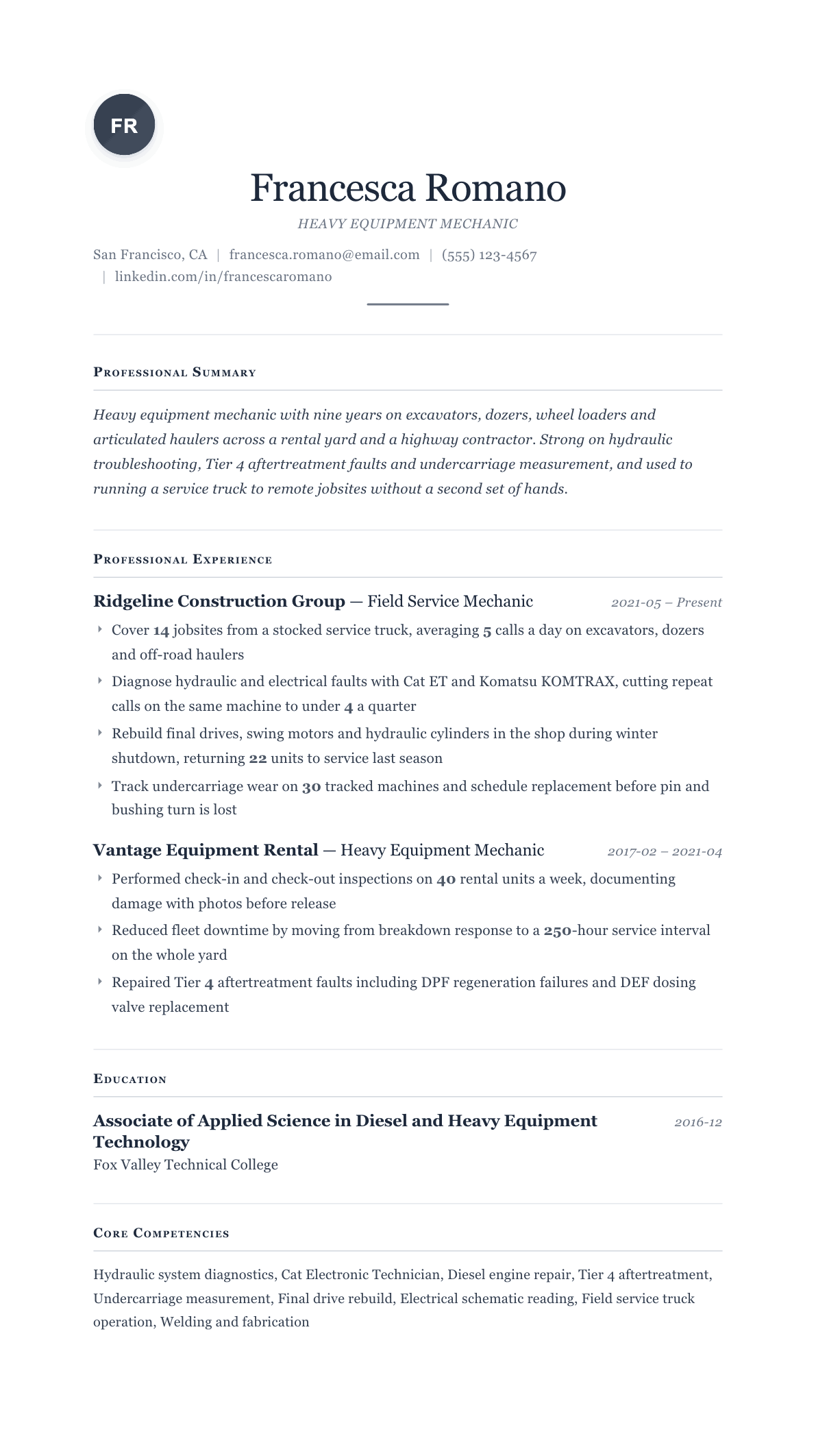
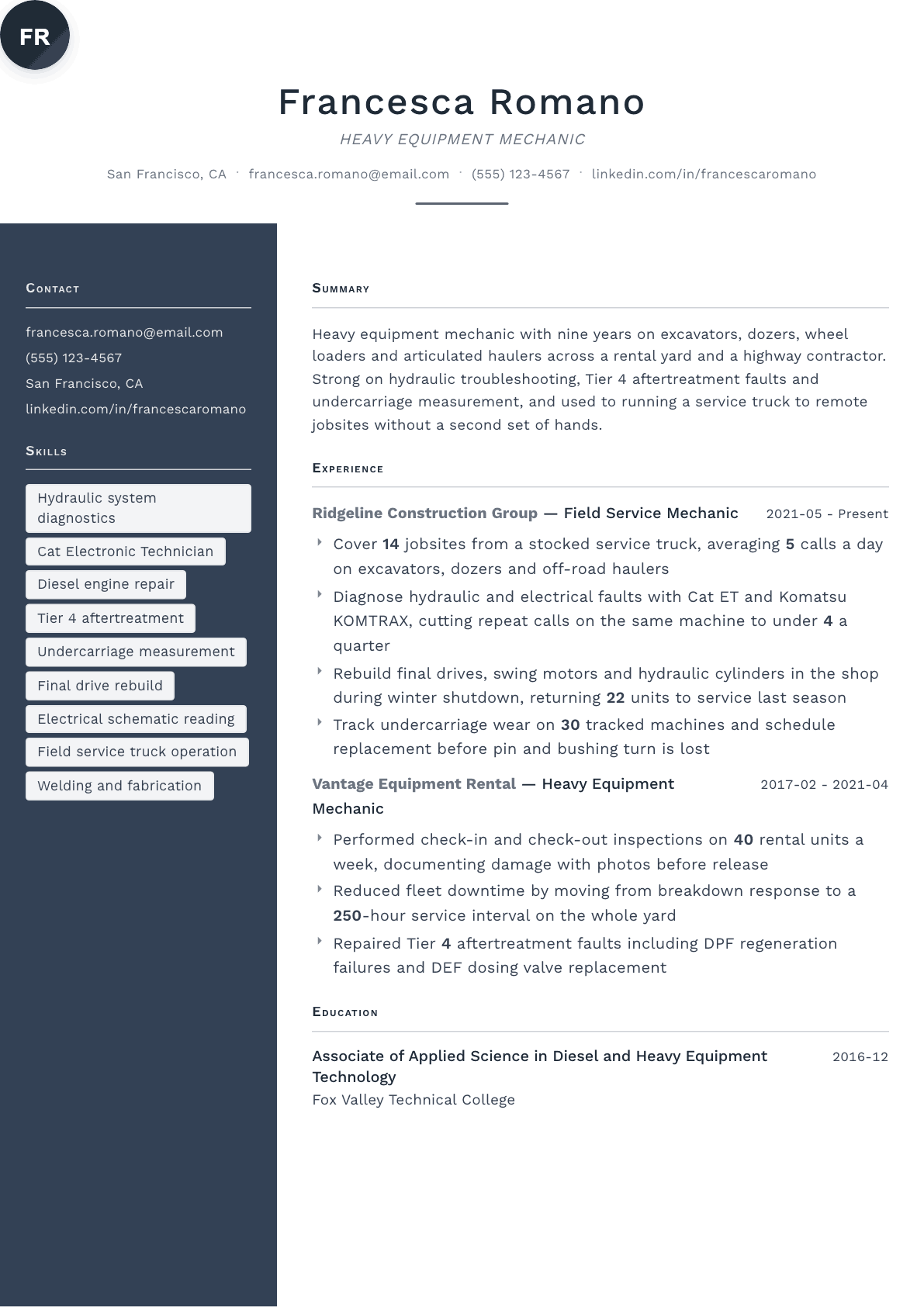
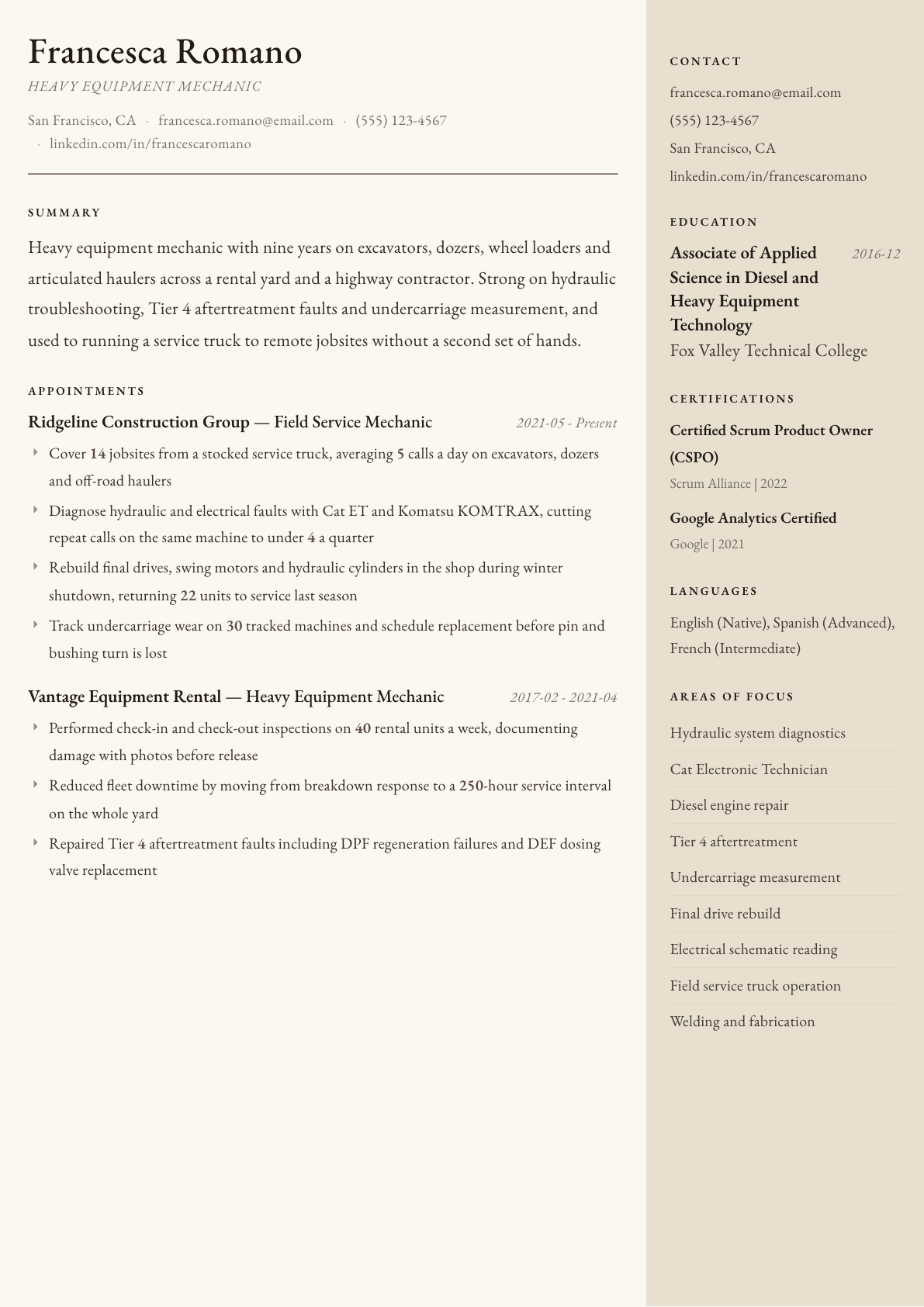
Example Heavy Equipment Mechanic summary
Heavy equipment mechanic with nine years across a rental yard and a highway contractor, covering excavators, dozers, wheel loaders and articulated haulers. Diagnoses hydraulic and electrical faults with Cat ET and manufacturer software rather than swapping parts, rebuilds final drives and cylinders in the shop, and runs a stocked service truck to remote jobsites alone. Comfortable on Tier 4 aftertreatment and undercarriage wear programs.
Skills to list on a Heavy Equipment Mechanic resume
- Hydraulic troubleshooting
- Hydraulic pump and cylinder rebuild
- Diesel engine overhaul
- Tier 4 and aftertreatment repair
- Cat Electronic Technician
- Komatsu and Deere diagnostic software
- Electrical schematic reading
- Undercarriage inspection and measurement
- Final drive and swing motor rebuild
- Powertrain and transmission repair
- Preventive maintenance scheduling
- MIG and stick welding
- Torch cutting and fabrication
- Field service and mobile repair
- Work order documentation
What actually gets this resume read
- Name the machine classes you have worked, because a dozer shop will not assume your loader time transfers.
- List the diagnostic software by name, since a shop foreman is buying a technician who can already plug in.
- Say whether you have run field service alone, because a service truck seat is a different hire from a bay.
- Put hydraulic and electrical troubleshooting above component swapping, which is the part any helper can learn.
- Give the fleet size and the machine count you carried so a manager can judge the load you are used to.
- Add your welding and torch work if you have it, since heavy repairs rarely stop at bolt-on parts.
How to write a heavy equipment mechanic resume
The person hiring a heavy equipment mechanic is usually a shop foreman or a fleet superintendent who has machines sitting idle on a jobsite while a contractor calls him twice a day. He is not reading your resume for polish. He is reading it to find out which machine classes you have opened up, whether you can find a hydraulic fault without a parts cannon, and whether you can be handed a service truck and trusted alone in the mud.
That means the two things most resumes bury need to be at the top: the equipment you have actually worked on, by class and by brand, and the diagnostic software you can already log into. A mechanic who lists Cat ET, Komatsu diagnostic tools and a John Deere service advisor account has told a foreman he does not need three weeks of tool training before his first work order.
This guide covers the sections a heavy equipment shop reads in order, with summaries for an apprentice, a settled shop technician and a lead field mechanic, before and after bullets that turn tasks into evidence, and the questions technicians ask when they move between rental, construction and mining work.
Format: equipment list high, credentials grouped, two pages allowed
Reverse chronological, and two pages is normal once you have a decade behind you, because equipment history is the substance of the resume and cutting it to fit a page removes the reason to call you. Keep it plain text with no columns so the fleet software that scans your file can read the machine names.
The block that goes near the top is the equipment and software list. A foreman scans it against the yard he has to cover, so break it into machine classes and brands rather than a single line saying construction equipment.
- Header: name, city and state, phone, email, and a line stating whether you hold a commercial driver license and any endorsements.
- Equipment block second: excavators, dozers, wheel loaders, articulated haulers, cranes, drills, with the brands under each.
- Software and tooling line: manufacturer diagnostic laptops, hydraulic test kits, laser alignment, undercarriage measuring gauges.
- Then experience, then credentials, then training and schooling, with welding processes named where you hold them.
Summary: machine classes, setting, and what you fix without help
Three lines. Name the years, the machine classes, the setting you have carried, whether shop, field or both, and one repair type you are known for. A foreman is triaging a stack of files, and the summary is where he decides whether to keep reading or move on.
Be specific about the setting because the three environments are genuinely different jobs. A rental yard mechanic sees breadth and check-in inspections. A construction fleet mechanic sees the same twenty machines aging under one operator group. A quarry or mine technician sees extreme duty cycles and planned component change-outs. Say which one you come from and which one you want.
Experience: the fleet, the fault, and how you found it
Open each job with the fleet you covered: how many machines, what classes, and whether you worked from a bay, a service truck or both. That single line tells a superintendent more about your capacity than any adjective.
Then write bullets that show diagnosis, not disassembly. Anyone can replace a hydraulic pump; the hire is the technician who proved the pump was the problem with flow and pressure readings before pulling it. Name the test, the tool and the reading you were chasing. Do the same for electrical faults: a wiring diagram, a voltage drop test and a corroded connector make a better bullet than replaced harness.
Include the planned side of the job too. Undercarriage wear tracking, oil sampling programs and service intervals are what separate a shop that fixes breakdowns from a shop that prevents them, and a foreman who is trying to build the second one will read those lines closely.
Field service: the part that decides the pay grade
If you have run a service truck, treat it as its own story. Say how many jobsites you covered, what you carried on the truck, how you handled parts you did not have, and how you kept a machine safe while working on it away from a shop. Cribbing, lockout, boom supports and pinned cylinders belong on the page because a jobsite injury is the fear behind every field service hire.
Customer contact matters here as well. A field mechanic talks to the operator and the site supervisor with no service advisor in between, so a bullet about explaining a repair decision to a contractor, or getting a machine limping safely to a laydown yard, shows judgment that a bay technician never has to prove.
Skills and keywords a heavy equipment shop filters on
Postings recycle a narrow vocabulary: hydraulics, powertrain, undercarriage, aftertreatment, electrical schematics, preventive maintenance, field service, welding and fabrication. Use the exact words from the advert once in your skills block and once inside a bullet where the work is visible, because a keyword with no story behind it is easy to spot in an interview.
Emissions work deserves its own mention. Aftertreatment faults, regeneration failures and dosing system repairs are the calls that eat a shop alive, and a technician who can handle them without sending the machine to a dealer is worth naming that skill plainly.
Heavy Equipment Mechanic resume summary examples
Apprentice or recent graduate
Diesel and heavy equipment graduate with two years of technical school and a summer working a rental yard, covering service intervals, hydraulic hose replacement and check-in inspections on excavators and skid steers. Trained on Cat ET and comfortable with schematics. Looking for a shop bay under a journeyman mechanic.
Five years in a shop
Heavy equipment mechanic with five years on a construction fleet of 60 machines, covering excavators, dozers and wheel loaders. Rebuilds hydraulic cylinders, final drives and swing motors in the shop, diagnoses Tier 4 aftertreatment faults, and runs the oil sampling program that moved the fleet onto planned component changes.
Lead field mechanic
Lead field mechanic with 12 years across rental, road building and quarry work, covering 14 active sites from a stocked service truck. Handles hydraulic and electrical diagnosis on machines other technicians have already parted at, mentors two apprentices, and writes the service schedules the shop plans its week around.
Work experience bullets: before and after
Before: Repaired hydraulic systems on construction equipment.
After: Traced a slow boom on a 30-ton excavator to an internally leaking main relief by running flow and pressure tests at the pump before any part came off the machine.
A named test and a named component show diagnosis, where the original bullet could describe a parts changer.
Before: Performed preventive maintenance on the fleet.
After: Moved 40 machines from breakdown response onto a 250-hour service interval with oil sampling at every visit, and used the sample trends to change three final drives before they failed on site.
The interval, the sampling and the caught failures turn routine maintenance into a measurable result.
Before: Worked on Tier 4 engines.
After: Resolved repeat regeneration failures on Tier 4 haulers by testing dosing pressure and replacing failed DEF injectors, cutting derated machines from four a month to under one.
Naming the fault path and the change in derates proves the emissions work rather than claiming exposure to it.
Before: Did field service calls.
After: Covered 14 active jobsites from a stocked service truck, averaging five calls a day, and completed most repairs on site by carrying common hoses, filters, sensors and connectors.
Site count, call volume and truck stocking tell a superintendent exactly what your day looks like.
Before: Checked undercarriage wear on machines.
After: Measured pin, bushing and idler wear on 30 tracked machines each quarter and scheduled turn or replacement while the components were still recoverable.
The measurement points and the timing decision show a wear program, not a walk-around glance.
Hard skills
- Hydraulic flow and pressure testing
- Hydraulic pump, motor and cylinder rebuild
- Diesel engine diagnosis and overhaul
- Tier 4 aftertreatment and DEF systems
- Cat Electronic Technician
- Komatsu and Deere diagnostic software
- Electrical schematic reading and voltage drop testing
- Undercarriage measurement and wear tracking
- Final drive and swing motor rebuild
- Powertrain, transmission and differential repair
- Oil sampling and trend analysis
- MIG and stick welding, torch cutting
- Air conditioning service on mobile equipment
- Field service truck operation and jobsite safety
Soft skills
- Working alone on a jobsite without a second opinion nearby
- Explaining a repair decision to an operator or site supervisor
- Staying methodical when a machine is holding up a crew
- Teaching an apprentice without taking the tool out of his hand
- Writing work orders another mechanic can pick up cold
Certifications worth listing
- Medium-Heavy Truck Technician (T Series) (National Institute for Automotive Service Excellence)
- Section 609 Motor Vehicle Air Conditioning Certification (United States Environmental Protection Agency)
- 30-Hour Construction Safety and Health (OSHA Outreach Training Program)
Mistakes that cost heavy equipment mechanic candidates the interview
- Writing heavy equipment as a single category instead of listing the machine classes and brands you have opened up.
- Leaving the diagnostic software off the page, which makes a foreman assume he is paying for tool training.
- Describing repairs as parts replaced rather than faults found, so nothing separates you from a helper with a wrench.
- Hiding field service experience inside a shop job when it is the thing that justifies the higher rate.
- Skipping welding and fabrication, since heavy repairs regularly need a bucket rebuilt or a cracked frame gusseted.
- Omitting the commercial driver license status when the job involves hauling machines or driving a service truck.
Heavy Equipment Mechanic resume questions
How long should a heavy equipment mechanic resume be?
Two pages once you have several years of machine history, because the equipment and software lists are the substance a foreman reads. One page is fine for an apprentice. What never helps is cutting the machine classes to save space.
Do I need ASE certification for heavy equipment work?
It is not required the way an EPA card is for refrigerant work, but the medium and heavy truck series carries weight with fleet shops and gives a hiring manager an outside check on your diesel and electrical knowledge. Manufacturer training courses count for just as much.
How do I move from truck or auto repair into heavy equipment?
Lead with hydraulics, diesel engines, electrical diagnosis and welding, since those transfer directly. Then name any equipment you have touched at all, including rental machines or farm gear, and say plainly that you are moving into equipment work rather than leaving the reader to guess.
Should I list every machine model I have worked on?
List classes and brands, then name specific models only where they show unusual depth, such as a large mining truck or a drill rig. A long model list reads like padding, while a clear class and brand grid lets a foreman match you to his yard in seconds.
What matters most for a field service position?
Evidence that you work safely and finish jobs alone. Say how many sites you covered, what you carried on the truck, how often you completed a repair on the first visit, and how you supported and locked out a machine before crawling under it.
Related resume examples
- Diesel Mechanic Resume example
- Maintenance Mechanic Resume example
- Fleet Mechanic Resume example
- Industrial Maintenance Technician Resume example
- Diesel Technician Resume example
- Medical Equipment Technician Resume example