Diplomat Resume Examples: free score, then the gap list
Build a Diplomat Resume That Opens Global Doors
By Mustafa Tarabya, founder of CVBooster · Published · Updated
Create a diplomat resume showcasing your international relations expertise, multilingual skills, and diplomatic negotiations experience.
Sample resumes for a diplomat
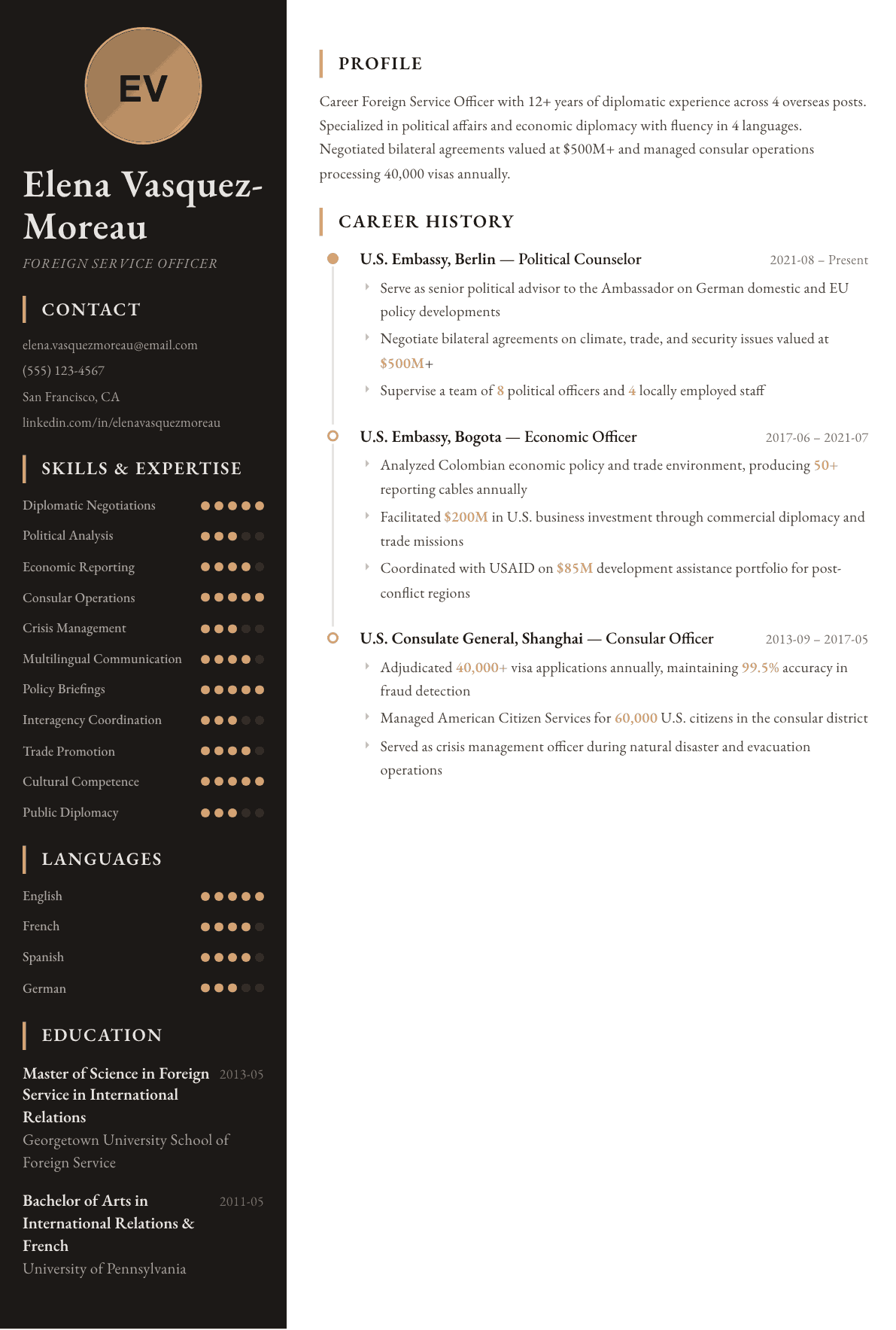
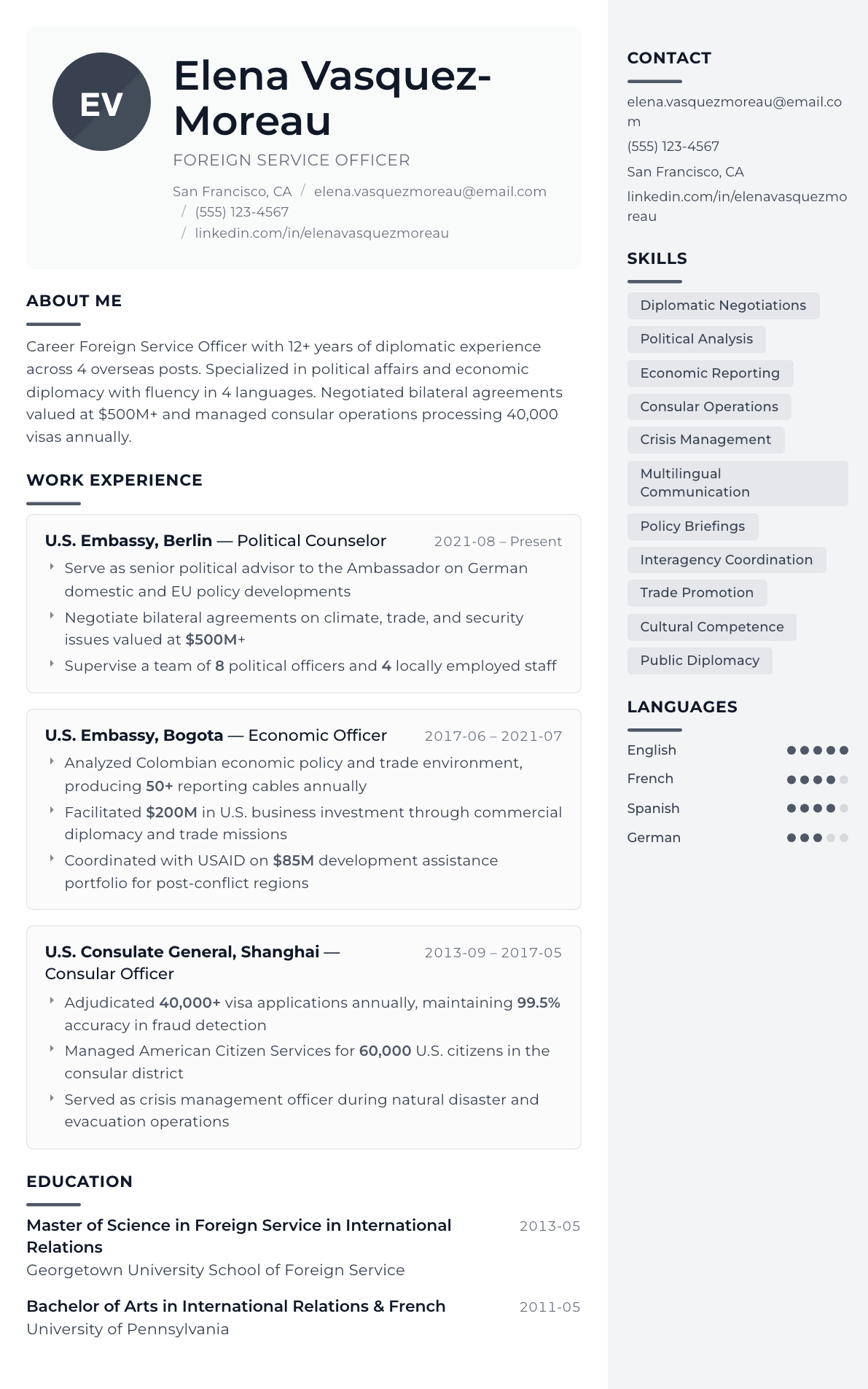
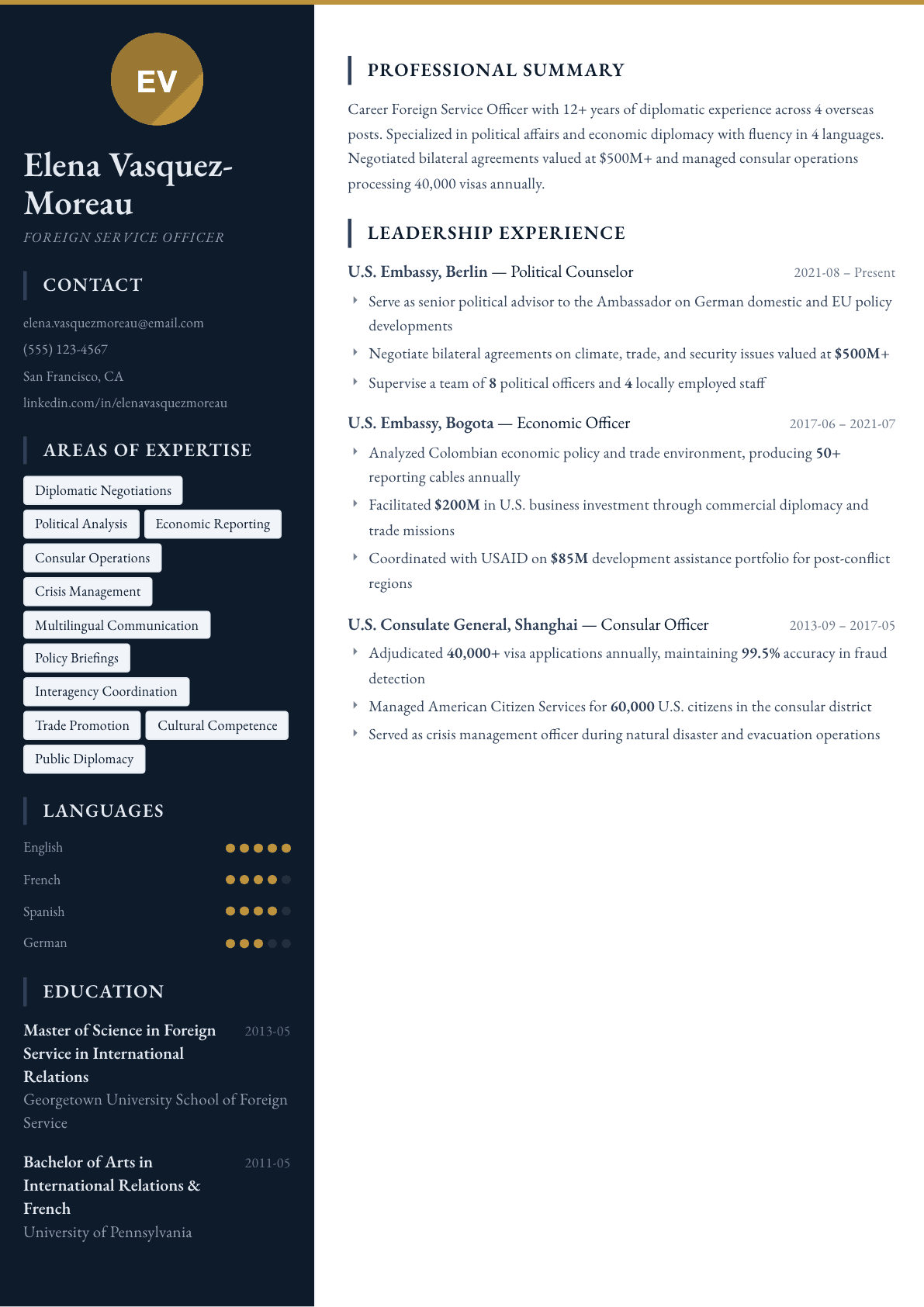
The same diplomat content laid out in three CVBooster templates, so you can see what the finished document looks like before you write a word.
Example Diplomat summary
Career Foreign Service Officer with 12 years of diplomatic experience across 4 overseas posts. Fluent in 4 languages with expertise in political affairs and economic diplomacy. Negotiated agreements valued at $500M+ and managed consular operations for 40,000+ visa applicants annually.
Skills to list on a Diplomat resume
- Diplomatic Negotiations
- Political Reporting
- Economic Analysis
- Consular Affairs
- Public Diplomacy
- Crisis Management
- Multilingual Communication
- Interagency Coordination
- Trade Promotion
- Development Assistance
- Policy Analysis
- Cultural Competence
- Program Management
- Media Relations
What actually gets this resume read
- Lead with your overseas posts and the regions/countries where you have served.
- Highlight language proficiency with FSI scores or equivalent (3/3, S-4/R-4) if applicable.
- Quantify diplomatic outcomes: agreements negotiated, investments facilitated, visas processed.
- Showcase your cone specialization: political, economic, consular, management, or public diplomacy.
- Include crisis management experience and security clearance level (Top Secret/SCI).
- Mention interagency coordination with DOD, USAID, Treasury, or intelligence community.
How to write a diplomat resume
A diplomat resume serves two very different readers, and most candidates write for only one of them. Inside the foreign affairs system, a panel wants tour history, cone, grade, language scores, clearance and the hard evidence behind the dimensions the service evaluates. Outside it, a corporate or think tank hiring manager wants to know what a political officer actually produced and why it should matter to her organization.
The failure mode is the same in both directions. Career diplomats write in institutional shorthand that only a colleague can decode, listing posts and section names with no outcome attached. Candidates entering the field write eloquently about international affairs without ever showing a negotiation they carried, a report they drafted or a citizen they helped in a crisis.
This guide covers how to lay out tours and cones so a panel can score them, how to write reporting and negotiation work as evidence, how to handle clearance and language proficiency accurately, and the questions officers ask when they leave the service for the private sector or return to it.
Format: tour based experience, longer than a private sector resume
If you are applying inside government, follow the federal convention: each tour gets the post, the section, the grade, the dates with months, hours per week and a supervisor reference, and the narrative can run several paragraphs. Length is expected because a rating panel needs the detail to score you against the announcement.
If you are applying outside government, cut hard to two pages and translate. A consular section chief becomes a manager of a high volume service operation with a named team size and adjudication volume. A political officer becomes an analyst whose written product reached decision makers. Keep the posts, drop the internal acronyms, and expand nothing that a reader outside the building cannot use.
- Header inside government: name, city, phone, email, clearance level and status, and citizenship.
- Order: summary, overseas and domestic assignments, language proficiency, clearance, education, awards.
- For private sector applications, replace the assignment list with a regions and functions block and move outcomes to the top of each entry.
Summary: cone, regions, languages, and the hardest thing you handled
Name the cone or functional track, the regions where you have served, the languages you work in with the actual proficiency levels, and one assignment that shows judgment under pressure. An evacuation, a bilateral negotiation, a high profile detention case, a visa fraud ring, a trade dispute, an election observation mission.
Candidates entering diplomacy from journalism, law, the military, development work or academia should name the crossing directly and lead with the transferable core: field reporting under constraint, contact building, cross cultural negotiation, security awareness, and writing for a decision maker rather than for a general audience.
Assignments: the portfolio, the counterpart, the outcome
Open each tour with the portfolio rather than the title. Bilateral security cooperation, human rights and labor reporting, energy and trade promotion, immigrant visa adjudication, management of a mission platform. Then say who your counterparts were at the host government level, because access is a diplomatic skill and hiring panels read it as one.
Attach outcomes. An agreement or memorandum concluded, a text negotiated line by line, a demarche delivered and the response secured, a bilateral working group established, an export contract facilitated, a detained citizen visited within the mandated window, a fraud referral that changed an adjudication standard. Reporting officers should say when a cable informed a specific policy decision, without disclosing anything classified.
Crisis work deserves its own bullets. Ordered departure, an authorized evacuation you helped run, a task force shift, an emergency action committee, a mass casualty consular response. Say how many citizens or staff were involved and what your role in the structure was.
Languages, clearance and interagency work: be exact
State language proficiency in the format your reader uses, with the speaking and reading scores separately, and say when the test was taken. An overclaimed language is discovered fast, and a diplomatic panel treats it as a judgment problem rather than a language problem. If a language is professionally useful but untested, describe it as working knowledge without a score.
Clearance should be stated as level and current status, including whether it is active, current or eligible for reinstatement, and whether a polygraph is included. Interagency experience is worth its own lines: coordination with defense attaches, development agencies, law enforcement liaison, treasury representatives and the intelligence community. Outside the government this reads as complex stakeholder management, which is exactly how you should describe it.
Keywords a foreign affairs screener scans for
Announcements and postings recycle a recognizable vocabulary: bilateral and multilateral engagement, demarche, reporting and analysis, public diplomacy, consular adjudication, visa fraud prevention, American citizen services, chief of mission authority, interagency coordination, host government liaison, protocol, and crisis management.
For a private sector move, translate the same record into market vocabulary: government affairs, regulatory engagement, market entry advisory, political risk assessment, stakeholder mapping, and international expansion support. Use the words of the posting you are answering, not the words of the institution you came from.
Diplomat resume summary examples
Entering the service
Attorney and former legislative aide seeking a foreign service political track appointment, with three years of country analysis on the Sahel and two field research deployments. Working proficiency in French with a tested 3 speaking and 3 reading score, plus a current Secret clearance from prior federal employment.
Second and third tours
Political officer with two overseas tours in Southeast Asia covering human rights reporting, security cooperation and election observation, plus a consular tour adjudicating roughly 40 thousand nonimmigrant applications. Tested 3 speaking and 3 reading in Thai. Top Secret clearance with SCI eligibility.
Section chief
Economic section chief with fifteen years across four posts in Latin America and Europe, leading a section of nine officers and eleven locally employed staff. Negotiated two bilateral memoranda, ran the mission trade promotion agenda and served as deputy on an emergency action committee during an ordered departure.
Work experience bullets: before and after
Before: Served as a political officer reporting on host country developments.
After: Covered a human rights and labor portfolio across two provinces, built a contact network spanning three opposition parties and four unions, and produced reporting that supported the annual country human rights report.
Portfolio, contact breadth and the product it fed give a panel something to score instead of a job title.
Before: Negotiated agreements with the host government.
After: Led the working level negotiation of a bilateral memorandum on customs cooperation across six rounds, coordinated positions with two domestic agencies, and delivered signature ready text ahead of the ministerial.
The rounds, the interagency coordination and the deadline show the mechanics of a negotiation you actually carried.
Before: Handled consular work including visas and citizen services.
After: Adjudicated high volume nonimmigrant cases at a post with a substantial daily interview load, supervised six locally employed staff, and referred a document vendor network that changed the section fraud screening standard.
Volume, supervision and a change that outlasted the tour turn routine consular duty into demonstrated judgment.
Before: Assisted during an embassy crisis.
After: Served on the emergency action committee during an ordered departure, ran the warden message cycle for the citizen community and coordinated onward travel for departing dependents with two partner missions.
The role inside the crisis structure and the specific tasks show what you did rather than that you were present.
Before: Promoted trade and investment opportunities.
After: Ran the mission commercial advocacy calendar, briefed 30 visiting firms on regulatory barriers, and supported two market entry cases that reached signed distribution agreements.
Named activities and a downstream commercial result make economic work legible to both a panel and a private employer.
Hard skills
- Bilateral and multilateral negotiation
- Political and economic reporting
- Demarche delivery and response tracking
- Consular adjudication and fraud prevention
- American citizen services and crisis response
- Public diplomacy and press engagement
- Interagency coordination
- Protocol and official visit management
- Country and political risk analysis
- Treaty and agreement drafting support
- Foreign language proficiency at tested levels
- Mission management and locally employed staff supervision
Soft skills
- Cross cultural judgment
- Discretion with sensitive information
- Contact building and access
- Composure under evacuation conditions
- Concise writing for decision makers
- Adaptability across postings
Mistakes that cost diplomat candidates the interview
- Listing tours by post and section with no portfolio or outcome, which forces the reader to guess what you did there.
- Overstating a language score, since a tested figure is verifiable and an inflated one reads as a judgment failure.
- Using internal acronyms in a private sector application, where the reader cannot decode a section name or a cable series.
- Leaving clearance status vague; say the level, whether it is active or eligible for reinstatement, and whether a polygraph is included.
- Writing about foreign policy views instead of foreign policy work, which turns the resume into an essay.
- Cutting a government application to one page, when a rating panel needs the detail the federal format asks for.
Diplomat resume questions
How do I write a diplomat resume for a private sector employer?
Translate every institutional term into a business function and cut the document to two pages. A political section becomes country risk analysis, consular management becomes high volume operations leadership, and demarche delivery becomes government affairs engagement with named ministries and results.
Should I list my cone on the resume?
Yes when applying inside the foreign affairs system, because it frames every tour that follows. Outside it, replace the cone with a plain description of the function, since a hiring manager in a company will not know what a management or public diplomacy cone means.
How do I show classified or sensitive work without disclosing it?
Describe the function, the scale and the audience rather than the content. You can say you produced analysis for senior policy makers, coordinated across agencies and supported a specific negotiation without naming sources, methods or the substance of any reporting.
What if I have never served overseas but want to enter the field?
Lead with the underlying skills the service tests: written analysis under deadline, cross cultural work, negotiation, crisis composure and language ability. Field research, military deployments, development postings and international legal work all provide evidence that a panel will recognize.
How should I present language ability without a formal test score?
Describe the functional level honestly, such as able to conduct meetings and read the local press, and note the setting where you used it. Avoid inventing a score, and consider taking a recognized proficiency test before applying so the claim carries a number a panel trusts.
Related resume examples
- Intelligence Analyst Resume example
- Policy Analyst Resume example
- Public Affairs Specialist Resume example
- Foreign Service Officer Resume example
- Public Information Officer Resume example
- City Manager Resume example