Job Coach Resume Examples: free ATS score and gap list
Write a Job Coach Resume That Shows Independence on the Worksite
By Mustafa Tarabya, founder of CVBooster · Published · Updated
Job coach resume sample with task analysis, fading plans and worksite training examples, plus keywords and a full writing guide.
Sample resumes for a job coach
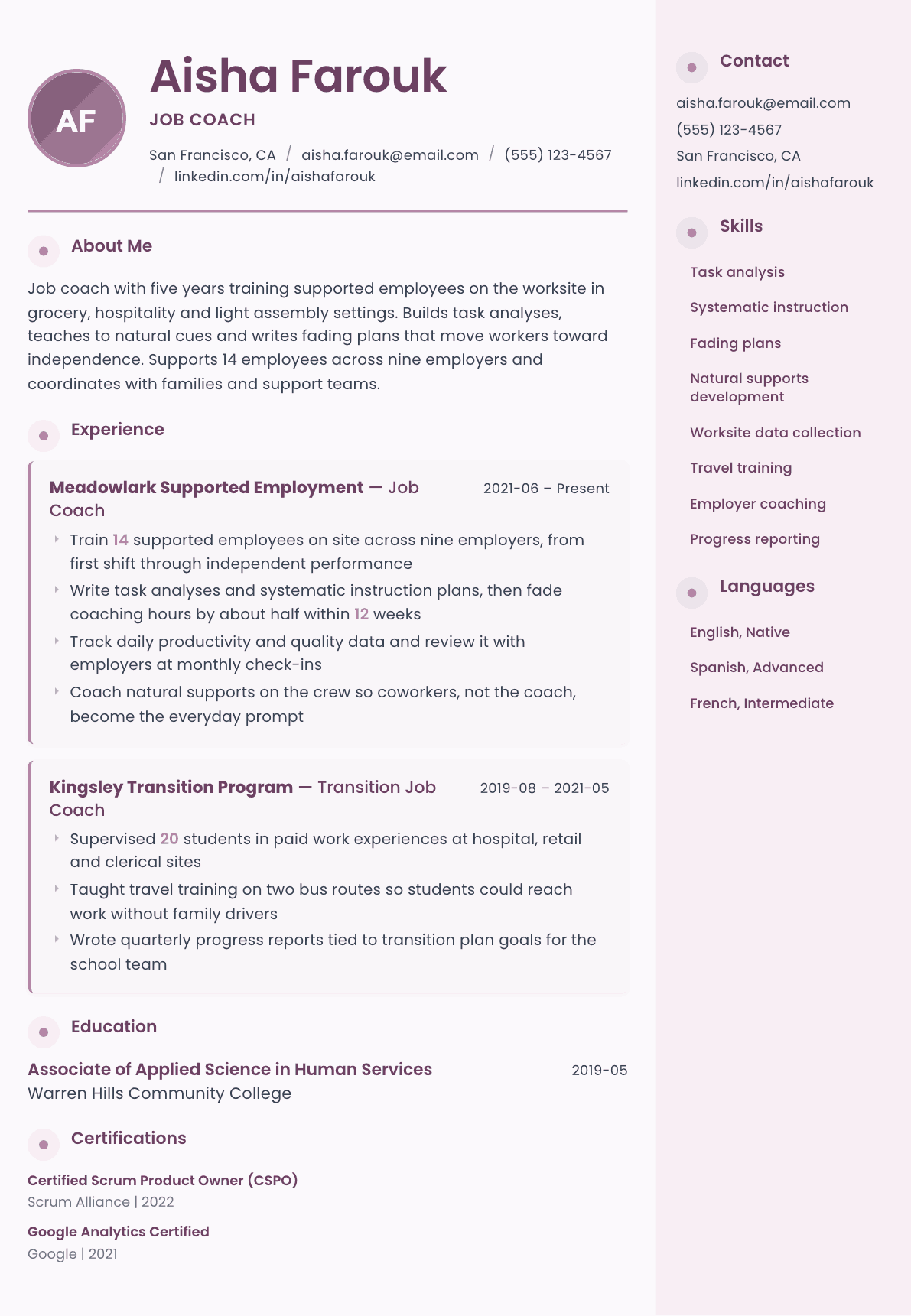
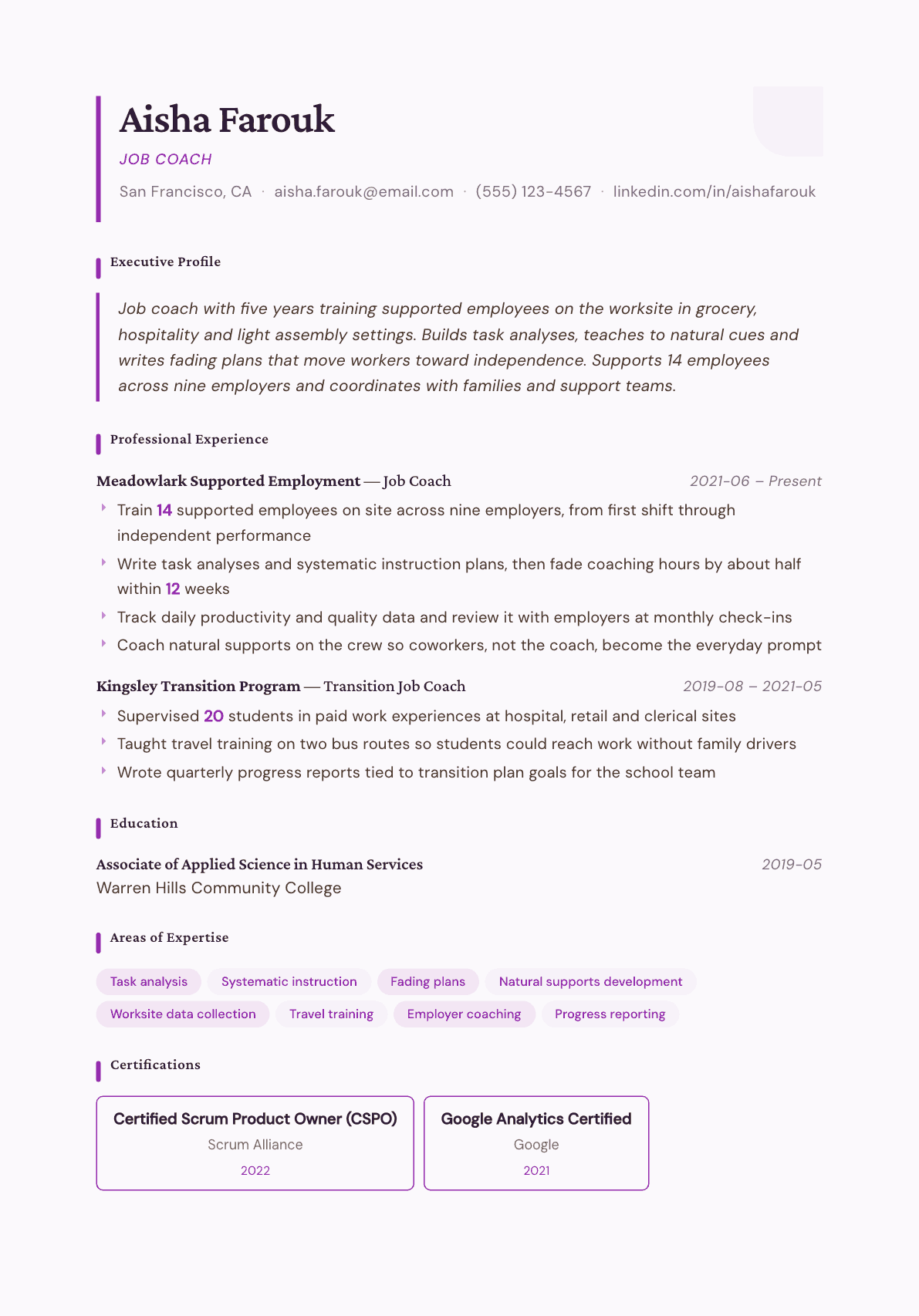
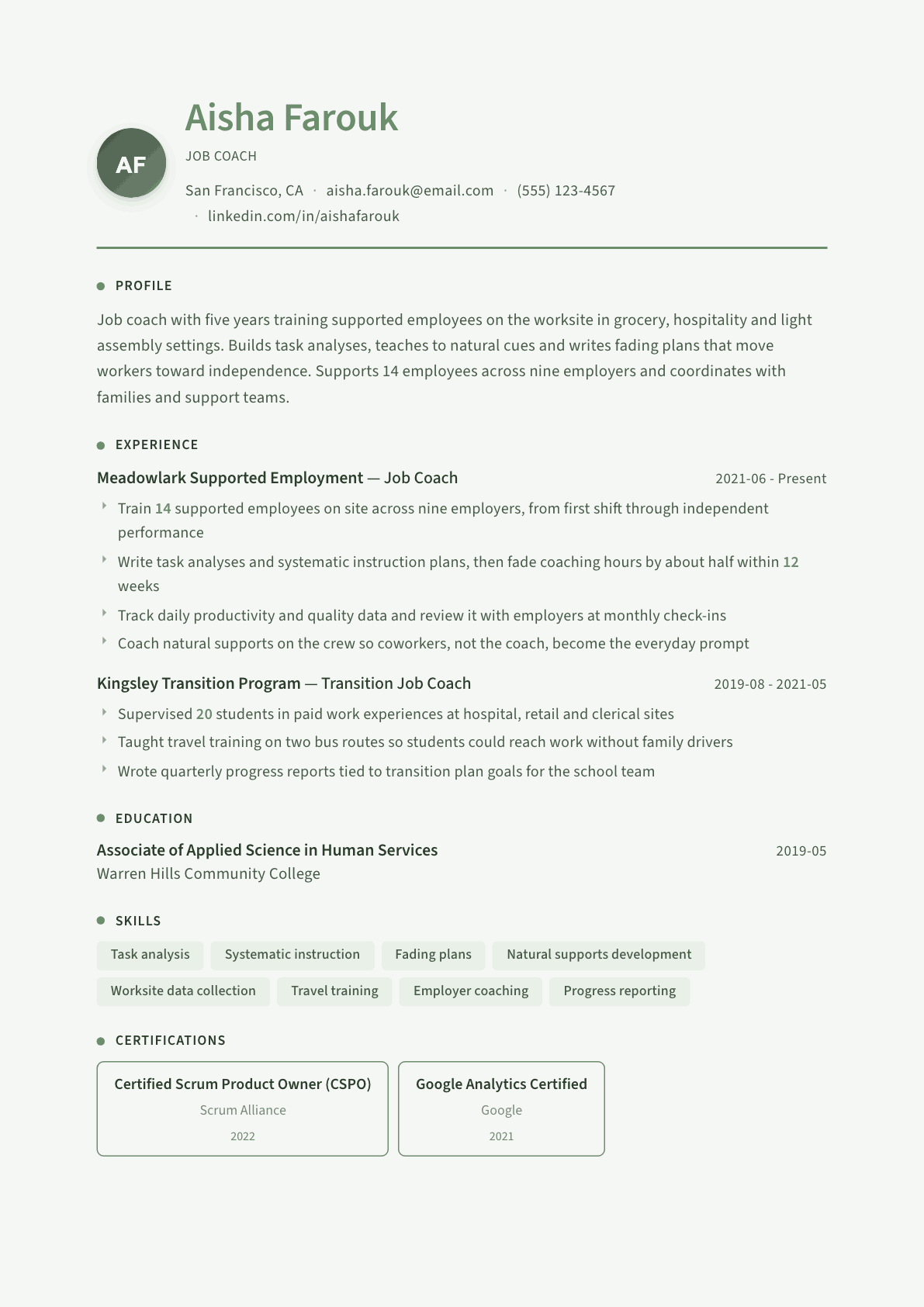
The same job coach content laid out in three CVBooster templates, so you can see what the finished document looks like before you write a word.
Example Job Coach summary
Job coach with five years training supported employees on site in grocery, hospitality and light assembly work. Builds task analyses, teaches through a prompting hierarchy and fades coaching hours as workers reach independent performance. Supports 14 employees across nine employers, develops natural supports on each crew and reports progress to families, schools and funders on schedule.
Skills to list on a Job Coach resume
- Job coaching
- Task analysis
- Systematic instruction
- Prompting hierarchy
- Fading and independence planning
- Natural supports development
- Worksite accommodation
- Behavior support strategies
- Productivity and quality data collection
- Travel training
- Employer and supervisor coaching
- Transition age youth support
- Person centered planning
- Progress reporting
What actually gets this resume read
- Describe how you fade support, because independence, not attendance at the worksite, is what this role is judged on.
- Name the industries you have coached in, since employers want a coach who knows their tasks and pace.
- Show systematic instruction: task analysis, prompting hierarchy and the data you collected on each shift.
- Include natural supports work, meaning how you handed the everyday prompting over to coworkers and supervisors.
- Add travel training and any driving or transport duties, because getting to work is half of many placements.
- Give reporting cadence to schools, families and funders, since documentation keeps supported employment funded.
How to write a job coach resume
A job coach is measured by disappearance. The point of standing next to a supported employee on the produce floor at six in the morning is to eventually not be there, with the worker still performing to the employer's standard. A resume that describes constant on-site presence without ever describing fading tells a supervisor you may be creating dependence instead of independence.
The second thing a supervisor looks for is teaching method. Anyone can help someone stock a shelf. A trained coach breaks the task into steps, chooses a prompting level, collects data on each shift, moves down the prompt hierarchy as accuracy improves, and hands the everyday cueing to a coworker who is already standing there. That sequence is the profession, and it is almost never on the page.
This guide shows how to write the worksite work with the specificity it deserves, with summaries for a new coach, an experienced one and a lead coach, before and after bullets, and the questions people ask when they move from direct support or education into supported employment.
Name the industries and the worksites, not just the agency
Employers hire coaches who understand their floor. Grocery, hospitality housekeeping, food preparation, light assembly, warehouse picking, janitorial, clerical and animal care all have distinct pace, safety rules and quality standards. List the settings you have coached in and the tasks you taught, because a supervisor placing you at a new site is thinking about which one you can walk into on day one.
Then give the shape of the assignment: how many supported employees you carry at once, across how many employers, and the hours you spend on site per worker per week. Add shift range, since supported employment often means early mornings, evenings and weekend coverage.
- Job line: agency, number of supported employees, number of employer sites, and the shift range you covered.
- List the job tasks you have taught, from register operation to pallet building and room turnover.
- Include driving duties if you transported workers or traveled between sites during a shift.
Systematic instruction is the skill you are hired for
Write the method plainly. Task analysis broken into teachable steps, a prompting hierarchy chosen deliberately, error correction handled without embarrassing the worker in front of coworkers, and reinforcement matched to what the person actually values. Naming these shows training rather than good intentions.
Then add the data. Percent accuracy per step, independent steps completed, productivity against the employer's rate, and quality checks. A coach who brings a data sheet to a monthly employer meeting changes the conversation from impressions to evidence, and supervisors hire for that habit.
Fading and natural supports: the part that proves you are good
Describe how support decreased over time. Hours on site in week one against week twelve, the point where you moved to intermittent check-ins, and the criteria you used to decide it was safe. A written fading plan with criteria beats any claim about independence.
Natural supports are the mechanism behind fading. Show how you taught a coworker to give the cue, set up a job aid the worker can read alone, adjusted the physical setup so the sequence is obvious, or trained a supervisor to give feedback in a way the worker can use. Coaching the workplace, not only the worker, is what makes the placement survive after your hours end.
Behavior support, safety and the difficult moments on site
Worksites bring situations that a classroom does not. A worker who becomes overwhelmed by noise during a rush, a customer who says something demeaning, a coworker who assumes the person cannot understand them, an equipment safety rule that must be followed exactly. Describe how you handled one of these with the response you used and how you protected the placement.
If you have implemented behavior support plans written by a clinician, say so and stay inside your role: implementing with fidelity, collecting data and reporting to the team. Add safety training, food handling, equipment certifications and any lifting or transfer training the setting required.
- Name the behavior support or de-escalation training you completed and the issuing organization.
- Include workplace safety credentials required by the industries you coached in.
- Describe how you preserved the worker's dignity in front of coworkers and customers.
Reporting, teams and the keywords supported employment postings use
Coaches sit between many parties: the employer, the family or guardian, the funding agency, the case manager and sometimes a school team. Say what you report, to whom and how often, including monthly service notes, quarterly progress reports against plan goals and billing documentation that has to match your hours on site.
Mirror the posting vocabulary: supported employment, systematic instruction, task analysis, prompting and fading, natural supports, competitive integrated employment, person centered planning, travel training and job retention. Each belongs in a bullet where it describes real work, not stacked in a list.
Job Coach resume summary examples
New job coach
Job coach with one year supporting 20 students in paid work experiences at hospital, retail and clerical sites through a school transition program. Teaches tasks with written step guides, taught travel training on two bus routes, and writes quarterly progress reports for the school team.
Four years on worksites
Job coach with four years training supported employees in grocery, hospitality and light assembly settings. Carries 14 workers across nine employers, writes task analyses and fading plans, and cuts coaching hours by about half within twelve weeks while productivity holds at the employer standard.
Lead job coach
Lead job coach with nine years in supported employment, mentoring seven coaches and holding the employer relationships across a regional portfolio. Standardized the agency data sheet and fading criteria, trains new coaches on systematic instruction, and represents the program at employer quarterly reviews.
Work experience bullets: before and after
Before: Supported clients at their jobs.
After: Trained 14 supported employees on site across nine employers in grocery, hospitality and light assembly, covering shifts from early morning stocking to evening room turnover.
Worker count, employer count, industries and shift range give a supervisor the exact scope you have carried.
Before: Taught clients how to do their job tasks.
After: Wrote task analyses for each position, taught with a least-to-most prompting hierarchy, and tracked independent steps on a data sheet reviewed every shift.
Naming the instruction method and the data collection shows trained practice instead of informal helping.
Before: Reduced support over time as clients improved.
After: Faded on-site coaching hours by about half within twelve weeks using written criteria on accuracy and rate, then moved to intermittent check-ins once the worker met the employer standard alone.
A fading plan with criteria and a timeline proves independence was engineered rather than hoped for.
Before: Built good relationships with coworkers and supervisors.
After: Trained coworkers on the crew to deliver the daily cue and coached supervisors on giving feedback the worker could act on, so prompting came from the team rather than from me.
Handing the prompt to natural supports is the mechanism that keeps a placement alive after coaching ends.
Before: Helped clients get to work.
After: Delivered travel training on two bus routes with fading escort, walked the transfer point until it was independent, and built a backup plan for missed connections.
Route specifics and a contingency plan show transportation solved as a taught skill rather than a ride provided.
Hard skills
- Systematic instruction
- Task analysis
- Prompting hierarchy and error correction
- Fading and independence planning
- Natural supports development
- Worksite data collection
- Productivity and quality measurement
- Job aid and visual support creation
- Behavior support plan implementation
- Travel training
- Workplace accommodation setup
- Progress reporting and service documentation
Soft skills
- Patience across repetition
- Reading a workplace culture quickly
- Dignity preserving correction
- Flexibility across shifts
- Employer rapport
- Family and guardian communication
Certifications worth listing
- Certified Employment Support Professional (CESP) (APSE, the Association of People Supporting Employment First)
- ACRE Basic Employment Services Certificate (Association of Community Rehabilitation Educators)
- Nonviolent Crisis Intervention (Crisis Prevention Institute)
- ServSafe Food Handler (National Restaurant Association)
Mistakes that cost job coach candidates the interview
- Describing hours spent on site as though presence were the outcome, when the funded outcome is the worker performing without you.
- Skipping the instruction method entirely, which leaves a supervisor unable to tell trained coaching from friendly company.
- Leaving out worksite data, the only evidence that a worker's accuracy or rate actually improved under your teaching.
- Never mentioning natural supports, which signals that every placement you built depends on an agency staff member staying forever.
- Writing about the disability rather than the job, when employers and supervisors are reading for task competence and safety.
- Omitting shift availability and driving, the logistics that determine whether a coach can cover a portfolio at all.
Job Coach resume questions
What is the difference between a job coach and an employment specialist?
An employment specialist develops employer relationships and secures the position. A job coach trains the person on the worksite after hire and fades support toward independence. Some agencies combine the roles, so read the posting for which half it emphasizes.
How do I show fading on a resume?
Give the starting and ending support hours, the timeframe, and the criteria you used to reduce them, such as accuracy on task steps or meeting the employer's rate. A written fading plan with criteria is the clearest evidence of trained coaching.
Do job coaches need a certification?
Not usually to be hired, though supported employment certificates strengthen an application and some funders prefer them. Industry credentials such as food handler cards and safety training also help, since they let you work certain sites immediately.
How do I move from direct support work into job coaching?
Reframe your experience around teaching and independence rather than assistance. Highlight any task instruction, data collection, community outing planning and travel training you have done, then add the industries you know from your own work history.
What should I avoid writing about the workers I support?
Avoid diagnoses, personal details and anything that reduces a person to their disability. Write about the tasks taught, the instruction method, the data collected and the independence reached, which is what employers and hiring supervisors are reading for.
Related resume examples
- Case Manager Resume example
- Social Worker Resume example
- Employment Specialist Resume example
- Vocational Rehabilitation Counselor Resume example
- Disability Support Worker Resume example
- Behavior Analyst Resume example