Youth Counselor Resume Examples: the lines they read
Youth Counselor Resume Guide With Examples and Keywords
By Mustafa Tarabya, founder of CVBooster · Published · Updated
Youth counselor resume example with behavior intervention bullets, treatment plan keywords, and a section by section guide for youth services hiring.
Sample resumes for a youth counselor
The same youth counselor content laid out in three CVBooster templates, so you can see what the finished document looks like before you write a word.
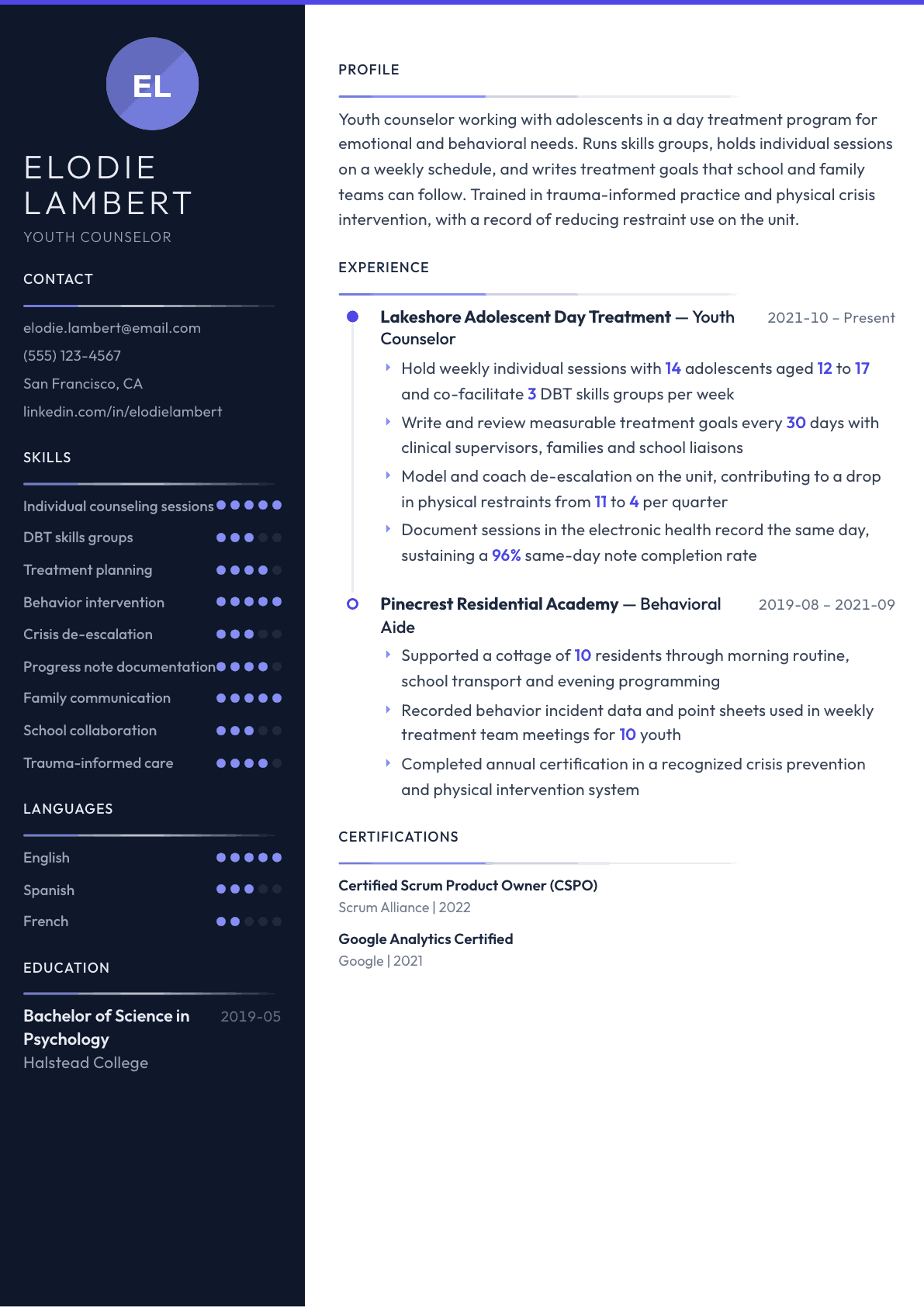
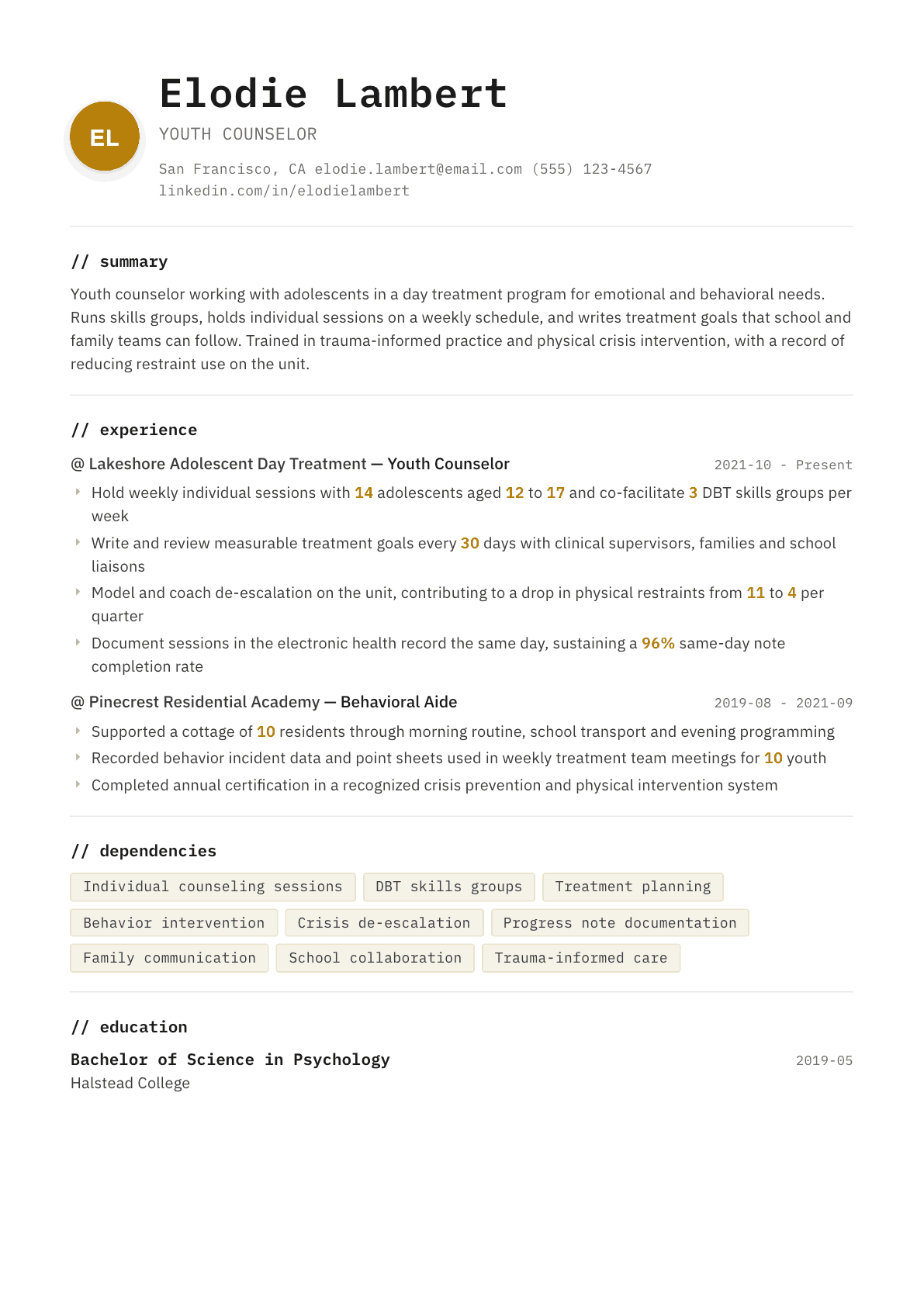
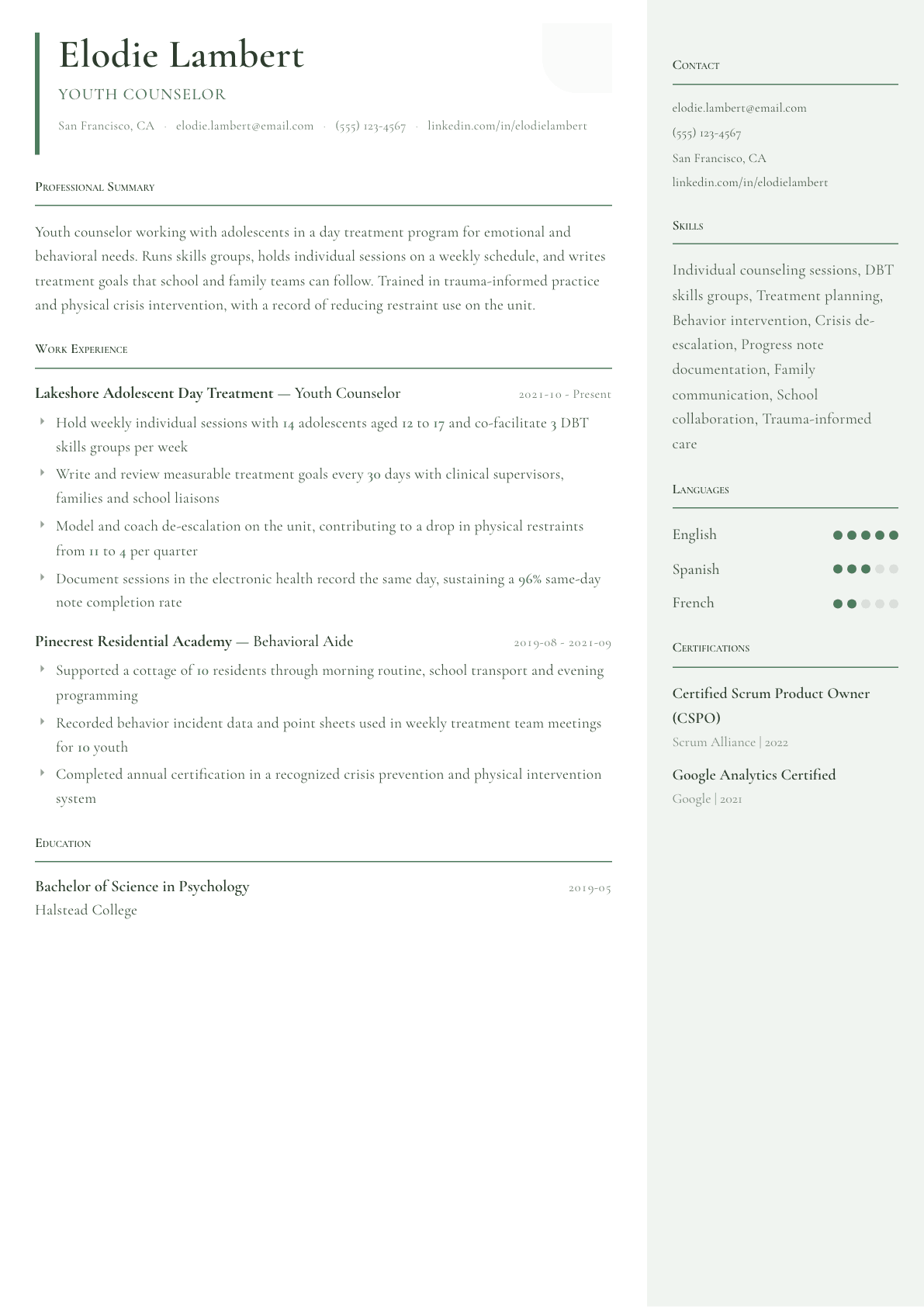
Example Youth Counselor summary
Youth counselor with five years supporting adolescents in day treatment and residential settings. Carries a weekly individual caseload of fourteen, co-facilitates DBT skills groups, and writes measurable thirty-day treatment goals with families and school teams. Certified in crisis prevention and known for coaching new staff through de-escalation rather than reaching for restraint.
Skills to list on a Youth Counselor resume
- Individual counseling
- Group facilitation
- DBT skills coaching
- Cognitive behavioral techniques
- Treatment plan writing
- Behavior intervention planning
- Crisis prevention and de-escalation
- Safety and risk screening
- Progress notes and charting
- Family engagement
- School and IEP collaboration
- Trauma-informed care
- Substance use awareness
- Case coordination
What actually gets this resume read
- Name the setting first: day treatment, residential, school-based and outpatient programs hire for different skills.
- Give the age range and the presenting needs you worked with, because a clinical director matches you to a unit.
- Show your group work and your individual caseload separately, with the frequency of each on the page.
- Reference the therapeutic model you were trained in, such as DBT skills or cognitive behavioral techniques.
- Include documentation timeliness, since late notes are the reason youth counselors fail chart audits.
- Add your crisis intervention certification with the issuing body and keep the renewal date current on the resume.
How to write a youth counselor resume
A youth counselor resume goes to a clinical director or program manager who has a specific hole to fill: a shift on a unit, a caseload in a day treatment classroom, or a school-based post. Her first question is which setting you have worked in, because a residential milieu, an outpatient office and a school office demand different reflexes from the same title. Her second question is whether your documentation is timely, since late notes stop billing and fail chart audits.
What sinks most applications is generic language about helping teenagers reach their potential. Adolescent programs are staffed by people who can hold a room when a fifteen year old escalates, run a skills group that adolescents do not walk out of, and write a treatment goal a school can act on. None of that is visible in a sentence about compassion.
This guide covers the sections in the order a clinical director reads them, three summaries across career stages, before-and-after bullets drawn from how applicants really describe unit work, and the questions youth counselors ask when they move between settings or toward licensure.
Format: setting labeled, credentials current, one page early on
Reverse chronological with a labeled setting on the first line of every job. Write day treatment, residential, school-based, intensive outpatient or wraparound explicitly. A program manager sorting a stack of applications is grouping them by setting before she reads anything else, and an unlabeled job gets sorted into the wrong pile or none at all.
Keep certifications visible near the top with the issuing body. Crisis prevention training, first aid and CPR are conditions of employment in most adolescent programs, and a resume that leaves them off implies they have expired.
- Header: name, city and state, phone, email, degree, license or license-eligible status.
- Order: summary, certifications, clinical and program experience, education, skills.
- State whether you are accruing supervised hours toward a counseling license and under whom.
Summary: population, age band, caseload, model
Lead with the population and the age range: adolescents in a locked residential setting, middle school students with emotional disability classifications, or teens with co-occurring substance use. Then give the shape of your week, meaning individual caseload, number of groups facilitated, and whether you carried on-call or overnight duty.
Close with the therapeutic model you were trained to use. Dialectical behavior therapy skills, cognitive behavioral techniques, collaborative problem solving and trauma-focused approaches are all trainable and verifiable. Saying you use a strengths-based approach communicates nothing because everyone writes it.
Experience: sessions, groups, goals, and behavior data
Split individual work from group work so the reader can count both. Give the individual caseload, the session frequency and the length. Give the number of groups per week, the curriculum they follow, and the typical group size. A director staffing a schedule is trying to see whether you fit into hers.
Then show the treatment planning cycle. Say who you write goals with, how often they are reviewed, and how the goals are measured. Adolescent treatment goals only work when the family and the school can act on them, so a bullet that shows you translated a clinical target into something a teacher could implement is worth more than a general planning claim.
Behavior data is the third piece. Programs track incidents, restraints, seclusions, elopements and time out of instruction, and they hire people who move those numbers in the right direction. If your unit reduced restraint use while you were coaching de-escalation, say so with the before and after figures and be ready to describe your actual contribution.
Crisis work: the part every interview will test
Write one bullet that shows you can hold a crisis without escalating it. Name the crisis prevention system you are certified in, describe your role in the response, and say what happened afterward: the debrief, the plan revision, the family call. Directors are wary of counselors who are proud of physical intervention and reassured by counselors who talk about the twenty minutes before it.
Risk screening belongs here too. Suicide and self-harm screening, safety planning with an adolescent and a caregiver, and the handoff to a higher level of care are core duties, and leaving them off makes a resume look like it came from a recreation role rather than a clinical one.
- Certification in a recognized crisis prevention and intervention system, with the issuing body named.
- Screening and safety planning with both the youth and the caregiver, and the escalation route.
- Post-incident work: debrief, plan revision, documentation inside the required window.
Documentation and keywords
Notes are the compliance backbone of an adolescent program. Say what you documented, in which record, and how fast. Same-day note completion rates and clean chart audits are the metrics a director actually reviews, and they belong on the page in that form.
The keyword layer is drawn from postings: adolescent counseling, milieu, treatment plan, behavior intervention plan, de-escalation, crisis prevention, trauma-informed care, family engagement, individualized education program collaboration, progress notes, level of care. Use the ones that are true, once in the skills block and once as evidence.
Youth Counselor resume summary examples
First clinical position
Psychology graduate with 2 years as a behavioral aide in an adolescent residential cottage, supporting 10 residents through daily routines and recording behavior data for weekly treatment teams. Certified in crisis prevention and first aid, seeking a youth counselor post in day treatment.
Five years with a caseload
Youth counselor in adolescent day treatment holding 14 individual clients aged 12 to 17 and co-facilitating 3 skills groups weekly. Writes 30-day measurable goals with families and school liaisons, maintains a 96% same-day note rate, and helped cut quarterly physical restraints from 11 to 4.
Lead counselor
Lead youth counselor overseeing 6 counselors across two adolescent units of 24 beds. Reviews treatment plans before submission, runs weekly de-escalation coaching, and rebuilt the shift handoff so incoming staff receive written risk updates on every resident before taking the floor.
Work experience bullets: before and after
Before: Provided counseling to at-risk youth.
After: Held weekly individual sessions with 14 adolescents aged 12 to 17 presenting with mood, trauma and school refusal concerns, in a day treatment program of 30 students.
Caseload, age band, presenting concerns and program size make an abstract claim into a job a director can staff.
Before: Led group therapy sessions.
After: Co-facilitated 3 dialectical behavior therapy skills groups each week for cohorts of 8, teaching distress tolerance and emotion regulation modules across 16-week cycles.
The model, the module names and the cycle length prove trained group work rather than supervised free time.
Before: Helped de-escalate difficult behaviors.
After: Coached staff and students through escalations using a certified crisis prevention approach, contributing to a drop in physical restraints from 11 to 4 per quarter over one year.
A measurable reduction shows de-escalation working, where the word alone shows only exposure to it.
Before: Wrote treatment plans for clients.
After: Wrote and revised measurable 30-day treatment goals with the youth, the caregiver and the school liaison present, then tracked progress against each goal at every supervision review.
Naming who is in the room and the review cadence shows planning that other people can actually act on.
Before: Kept up with paperwork requirements.
After: Completed progress notes in the electronic health record on the day of service at a 96% rate, clearing two consecutive chart audits with no returned documentation.
Same-day rates and audit outcomes are how clinical documentation is judged in a billing environment.
Hard skills
- Individual adolescent counseling
- Skills group facilitation
- Dialectical behavior therapy skills coaching
- Cognitive behavioral techniques
- Treatment plan writing and review
- Behavior intervention planning
- Crisis prevention and physical intervention certification
- Suicide and self-harm risk screening
- Safety planning with youth and caregivers
- Milieu and shift management
- Progress note documentation
- School and individualized education program collaboration
Soft skills
- Staying regulated while a teenager is not
- Consistency across a treatment team
- Honest feedback to adolescents without shaming
- Caregiver engagement under conflict
- Handoff communication between shifts
Certifications worth listing
- Child and Youth Care Professional (CYC-P) (Child and Youth Care Certification Board)
- Youth Mental Health First Aid (National Council for Mental Wellbeing)
- National Certified Counselor (NCC) (National Board for Certified Counselors)
Mistakes that cost youth counselor candidates the interview
- Leaving the setting unnamed so a director cannot tell residential shift work from an outpatient caseload.
- Merging groups and individual sessions into one vague duty line, which hides the shape of your week.
- Claiming de-escalation skill with no certification named and no change in restraint or incident data.
- Omitting documentation timeliness in a role where late notes stop billing and fail audits.
- Listing a therapeutic model you attended one workshop on, which collapses under a single interview question.
- Describing behavior management as control rather than teaching, which reads as a poor fit for a treatment program.
Youth Counselor resume questions
What license do I need to work as a youth counselor?
It depends on the setting. Residential and day treatment counselor posts often require a bachelor degree and program certifications, while roles delivering therapy usually require a counseling license or license-eligible status with supervision. State your degree, license status and supervisor arrangement plainly so nobody has to guess.
How do I describe restraint and physical intervention experience?
Name the certified system you trained in, describe your role in prevention and debriefing, and give any reduction in incident or restraint figures your unit achieved. Directors want counselors whose first instinct is de-escalation, so lead with prevention and keep physical intervention as the last item.
Can I move from a school-based role to residential work, or the other way?
Yes, but rewrite the resume for the destination. Residential hiring wants milieu skill, shift coverage and crisis response. School-based hiring wants classroom collaboration, individualized education program meetings and short structured sessions. Reorder your bullets so the closest experience appears first in each job.
How should I present supervised hours toward licensure?
Give total supervised hours, direct client contact hours and the supervision format separately, with the credential of the supervisor. Clinical directors read those numbers as a schedule, since they will inherit your supervision requirement if they hire you before you are fully licensed.
Is behavior data safe to include on a resume?
Program level figures are fine and expected: restraints per quarter, incidents per month, attendance or completion rates. Individual client information is never appropriate. Keep everything at the unit or caseload level and be ready to explain your personal contribution to any figure you claim.
Related resume examples
- Social Worker Resume example
- Case Manager Resume example
- Youth Worker Resume example
- Residential Counselor Resume example
- Psychotherapist Resume example
- Addiction Counselor Resume example