E-commerce Specialist Resume Examples: read this first
Write an E-commerce Specialist Resume That Shows Store Ownership
By Mustafa Tarabya, founder of CVBooster · Published · Updated
E-commerce specialist resume example with merchandising and conversion bullets, the platforms to name, ATS keywords, and a full writing guide.
Sample resumes for a e-commerce specialist
The same e-commerce specialist content laid out in three CVBooster templates, so you can see what the finished document looks like before you write a word.
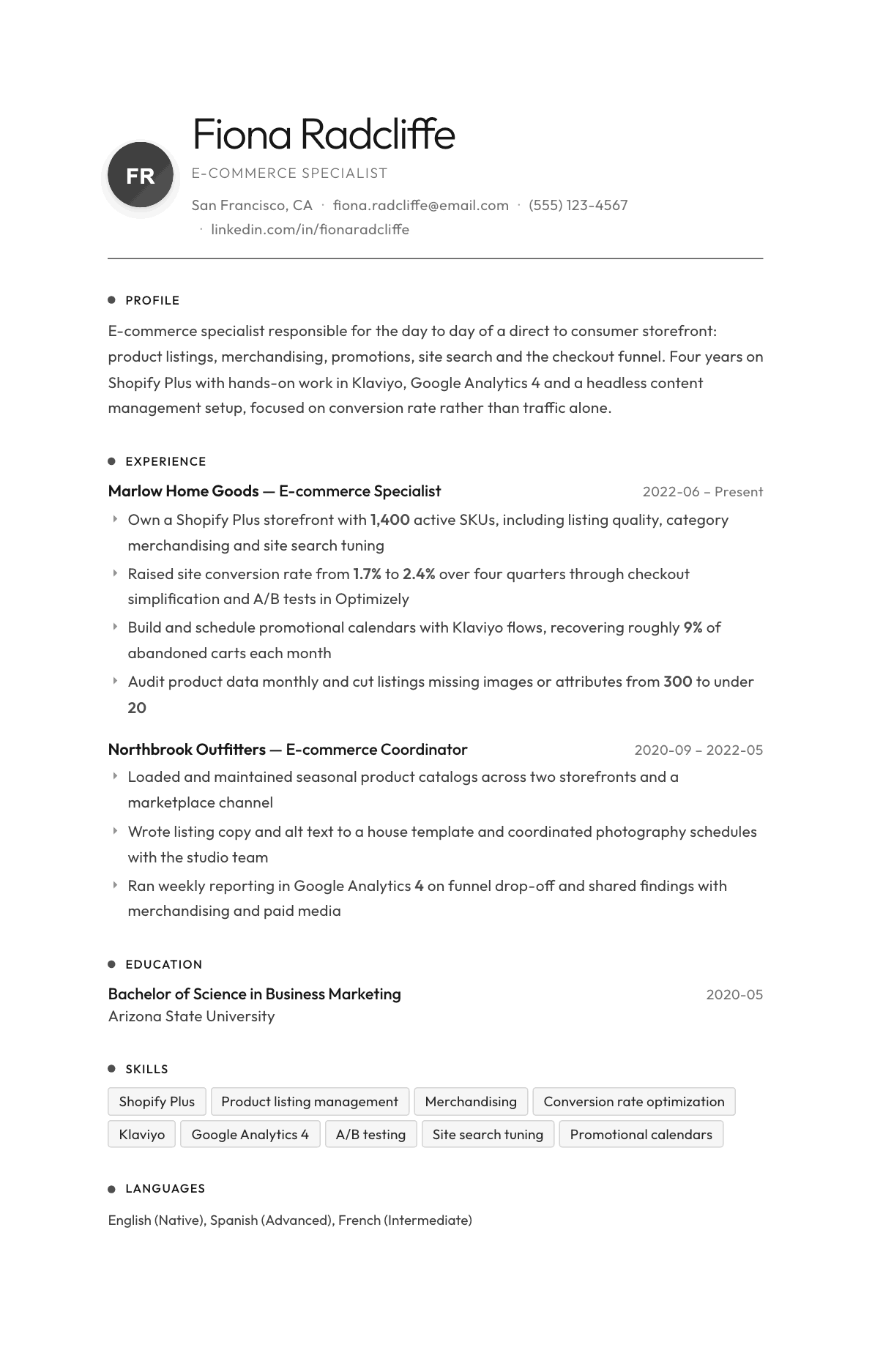
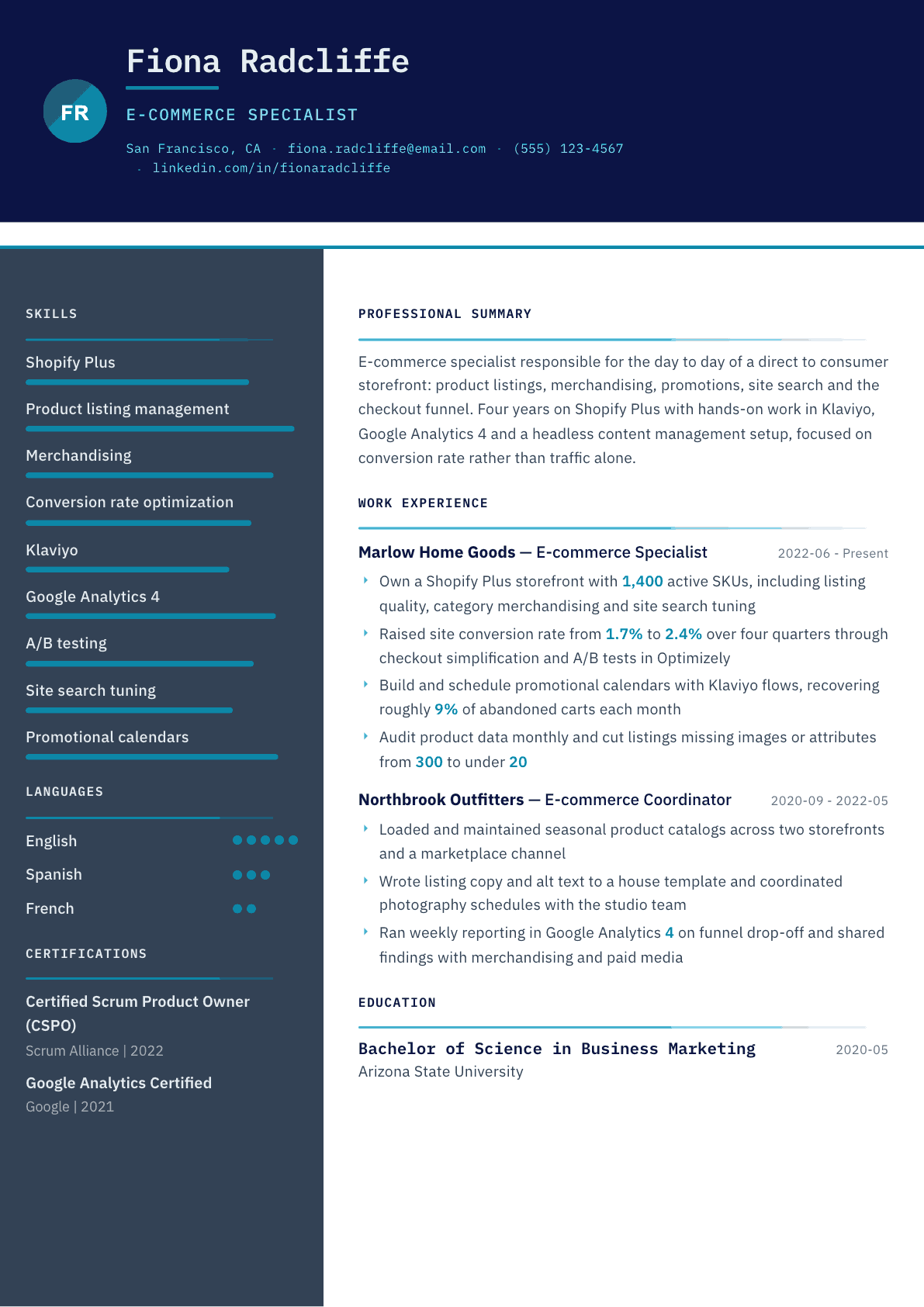
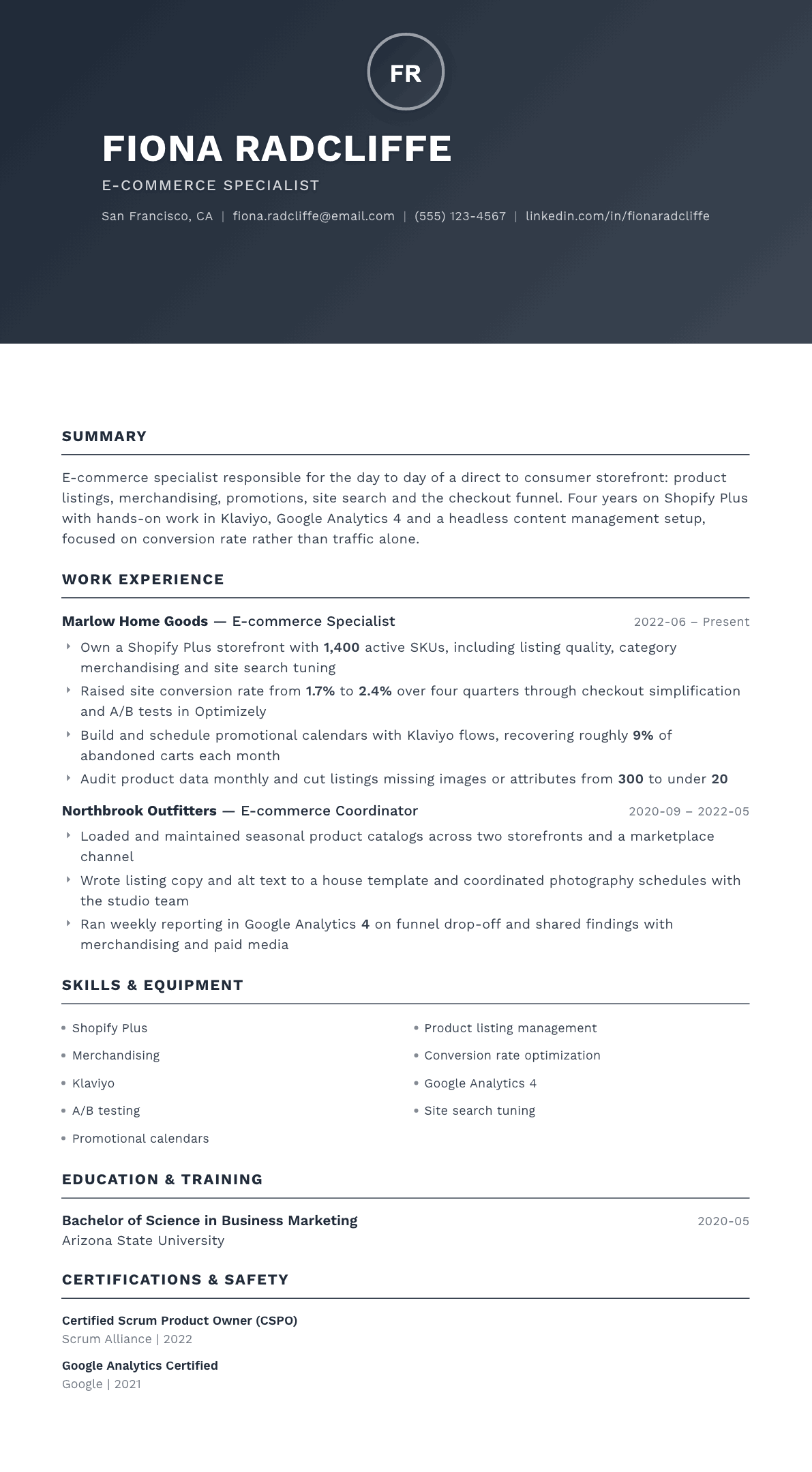
Example E-commerce Specialist summary
E-commerce specialist with four years running a direct to consumer Shopify Plus storefront holding roughly fourteen hundred active SKUs. Owns merchandising, promotions, site search and checkout, and lifted conversion rate from under two percent to nearly two and a half through structured testing. Works daily in Klaviyo and Google Analytics 4, and treats product data hygiene as a revenue task rather than an administrative one.
Skills to list on a E-commerce Specialist resume
- Shopify Plus
- Magento
- Product listing management
- Merchandising strategy
- Conversion rate optimization
- A/B testing
- Google Analytics 4
- Klaviyo
- Site search tuning
- Promotional planning
- Catalog data hygiene
- Checkout optimization
- Marketplace channels
- Product feed management
- Customer journey analysis
What actually gets this resume read
- Name the platform you actually administered, because Shopify, Magento and BigCommerce hiring pools barely overlap.
- Give the catalog size you managed in SKUs, since that number sets expectations for merchandising and data hygiene work.
- Report conversion rate and average order value rather than sessions, because store owners are judged on the funnel.
- Show the promotional calendar work: how far ahead you plan, who you coordinate with, and how launches get staged.
- Include the email and retention tool you used, since retention is usually stapled onto this role in smaller teams.
- Describe one product data cleanup with before and after numbers, because catalog hygiene is quietly half the job.
How to write a e-commerce specialist resume
The person hiring an e-commerce specialist owns a revenue number and needs someone who will treat the storefront as the product. She is scanning for three things: the platform you administered, how big the catalog was, and whether you can name a funnel metric you personally moved. Traffic claims do not help here, because traffic is usually somebody else budget. Conversion, order value and catalog quality are yours.
The role also sits in an awkward spot between merchandising, marketing and operations. In a small company you do all three. In a larger one you do a slice. A resume that never says which version you lived through forces the reader to guess, and guessing usually ends with a rejection rather than a phone screen.
This guide covers the section order that fits an e-commerce specialist resume, how to describe storefront ownership in a way merchandising leaders recognize, which platform and analytics names matter, and the questions people in this seat ask when they want the next level.
Format: one page, platform and catalog size in the first block
Reverse chronological, one page. Put a scope line under each employer giving the platform, the number of active items in the catalog, the channels the store sold through, and the order volume or revenue band if you can share it. Catalog size is the single most useful sizing fact in this field because it predicts how much data hygiene and merchandising work the job involved.
A short platform block near the top is worth more than a long skills list at the bottom. Store owners filter hard on platform, since a Shopify administrator and a Magento administrator solve different problems with different vocabularies.
- Header: name, city and state, phone, email, and a line naming your platform and store type.
- Scope line under each employer: platform, active items, sales channels, order volume band.
- Sections: summary, platforms and tools, experience, education.
- Marketplace and retail media work deserves its own bullet group if you did any.
Summary: the store you ran and the number you moved
Three lines: the platform, the catalog scale, the parts of the store you owned, and one funnel figure you changed. Conversion rate and average order value are the two numbers that make a merchandising leader keep reading, because they are the only ones fully inside your control.
Say whether the store was direct to consumer, business to business, or a hybrid selling through marketplaces as well. Pricing rules, account structures and catalog logic differ so much between those models that experience in one does not automatically read as experience in another.
Experience: merchandising, testing, and catalog hygiene
Split each job into three visible strands. Merchandising covers category structure, collection curation, site search tuning, cross-sell rules and promotional staging. Testing covers the experiments you ran on product pages, cart and checkout, with the tool and the result. Hygiene covers the product data work: missing attributes, image coverage, duplicate items, feed errors, and the audits that caught them.
The hygiene strand is where most candidates underplay themselves. Cleaning a catalog that had hundreds of items missing images or attributes is directly a revenue action, because unlisted attributes break filters and broken filters cost orders. Give the before and after count.
For promotions, describe the calendar rather than one campaign. How far ahead you planned, who approved pricing, how launches were staged, what happened at peak trading. Anyone who has run a fourth-quarter peak recognizes a resume written by someone who has also done it.
- Give conversion rate and average order value before and after, not session counts.
- Name the testing tool and one winning change with the mechanism behind it.
- Quantify catalog cleanup with an item count on both sides of the fix.
- Describe the promotional calendar cadence and who you coordinated with.
Platforms, analytics and the retention layer
Name the commerce platform and your administrator level on it, then the analytics stack you queried yourself: Google Analytics 4, a session replay tool, a testing tool, and any warehouse or dashboard layer. Store owners want somebody who checks the funnel without waiting for an analyst.
Retention tools usually land on this desk in smaller teams, so list the email and messaging platform you built flows in. Abandoned cart, browse abandonment, post-purchase and winback flows are concrete deliverables, and naming them shows you understand the store beyond the first order.
Keywords retailers filter on
Postings for this seat repeat a compact list: e-commerce, Shopify, Magento, BigCommerce, product listings, merchandising, conversion rate optimization, average order value, A/B testing, Google Analytics 4, product feed, marketplace, checkout, site search, catalog management. Use the ones that are true, attach a number where one exists, and skip the rest rather than padding a list nobody believes.
E-commerce Specialist resume summary examples
E-commerce coordinator
E-commerce coordinator maintaining seasonal catalogs across two storefronts and a marketplace channel. Writes listing copy and alt text to a house template, coordinates photography scheduling with the studio, and reports weekly on funnel drop-off in Google Analytics 4 for merchandising and paid media.
Four years in
E-commerce specialist owning a Shopify Plus storefront with 1,400 active items, responsible for listings, category merchandising, promotions and checkout. Raised site conversion rate from 1.7% to 2.4% over four quarters through checkout simplification and structured testing, and builds retention flows in Klaviyo.
E-commerce manager
E-commerce manager running a direct to consumer store and two marketplace channels with a combined 40M in annual online revenue. Leads a three-person team across merchandising and site operations, owns the trading calendar, and runs a monthly test roadmap against conversion and average order value targets.
Work experience bullets: before and after
Before: Managed the company online store and product listings.
After: Owned a Shopify Plus storefront with 1,400 active items, including listing quality, category merchandising, site search tuning and the promotional calendar.
Platform, catalog size and the named areas of ownership tell a merchandising lead exactly what the job was.
Before: Improved website conversion rate through optimization.
After: Raised site conversion rate from 1.7% to 2.4% across four quarters by cutting the checkout from four steps to two and testing product page layouts in Optimizely.
Before and after figures plus the actual change made turn a claim into an account of what you did.
Before: Cleaned up product data in the catalog.
After: Ran a monthly product data audit and reduced listings missing images or required attributes from more than three hundred to under twenty across the catalog.
Counts on both sides of the fix show the scale of the problem and prove the cleanup actually finished.
Before: Set up email campaigns for the store.
After: Built abandoned cart, browse abandonment and post-purchase flows in Klaviyo, recovering roughly 9% of abandoned carts each month.
Naming the specific flows and the recovery figure shows retention work rather than a newsletter send.
Before: Helped plan seasonal promotions.
After: Built the quarterly trading calendar with merchandising and finance, staged each promotion in a draft theme, and ran peak week with no unplanned price errors on the storefront.
The planning partners, the staging practice and the peak outcome demonstrate operational control of promotions.
Hard skills
- Shopify Plus administration
- Magento
- Product listing management
- Category merchandising
- Conversion rate optimization
- A/B testing
- Google Analytics 4
- Klaviyo
- Site search tuning
- Checkout optimization
- Product feed management
- Marketplace channel management
- Promotional calendar planning
- Catalog data auditing
Soft skills
- Commercial judgment
- Cross-team coordination
- Attention to data quality
- Calm during peak trading
- Clear reporting to non-specialists
- Prioritizing by revenue impact
Certifications worth listing
- Shopify Foundations Certification (Shopify)
- Google Analytics Certification (Google)
- Adobe Commerce Business Practitioner Professional (Adobe)
- Klaviyo Product Certification (Klaviyo)
Mistakes that cost e-commerce specialist candidates the interview
- Reporting sessions and traffic growth instead of conversion rate and order value, which are the numbers this seat owns.
- Leaving out the platform name, which is the first filter almost every retail employer applies.
- Omitting catalog size, so a reader cannot tell whether you managed forty items or forty thousand.
- Treating product data work as administrative filler when it is one of the clearest revenue levers you have.
- Describing tests without naming the change tested, the tool used, or whether the variant actually won.
- Blurring direct to consumer and business to business experience when the two models are merchandised differently.
E-commerce Specialist resume questions
Does an e-commerce specialist resume need Shopify specifically?
Only if the employer runs Shopify. Platform experience is the strongest filter in this field, so name what you administered and describe the transferable work clearly. Someone with deep Magento catalog experience is credible for a Shopify role if the merchandising logic is spelled out.
What metrics matter most on an e-commerce resume?
Conversion rate, average order value, revenue per session and repeat purchase rate. Those sit closest to the work you control. Traffic and impression numbers usually reflect the paid media budget rather than your merchandising decisions, so they carry less weight with a hiring manager.
How do I write this resume if I ran the store alone in a small company?
Say so directly and list the full span: catalog, promotions, email, customer service escalations, site content and reporting. Solo ownership is attractive to growing companies. Just be clear about scale so nobody expects enterprise process experience you never had.
Should I include marketplace and retail media experience?
Yes, in a separate bullet group. Selling through marketplaces involves different content rules, fee structures and advertising tools, and many employers are specifically hiring for that gap. Name the marketplaces and say whether you owned the listings, the advertising, or both.
How do I move from e-commerce specialist to e-commerce manager?
Show ownership of a plan rather than a queue of tasks. A trading calendar you built, a test roadmap with a target, a budget you controlled, or a junior colleague you directed all signal readiness. Managers are hired on planning and prioritization, not on execution volume.