Performance Marketing Manager Resume Examples: free score
Write a Performance Marketing Manager Resume That Proves Growth
By Mustafa Tarabya, founder of CVBooster · Published · Updated
A performance marketing manager resume focused on CAC, payback and channel scale, with a sample resume, recruiter keywords and a full writing guide.
Sample resumes for a performance marketing manager
The same performance marketing manager content laid out in three CVBooster templates, so you can see what the finished document looks like before you write a word.
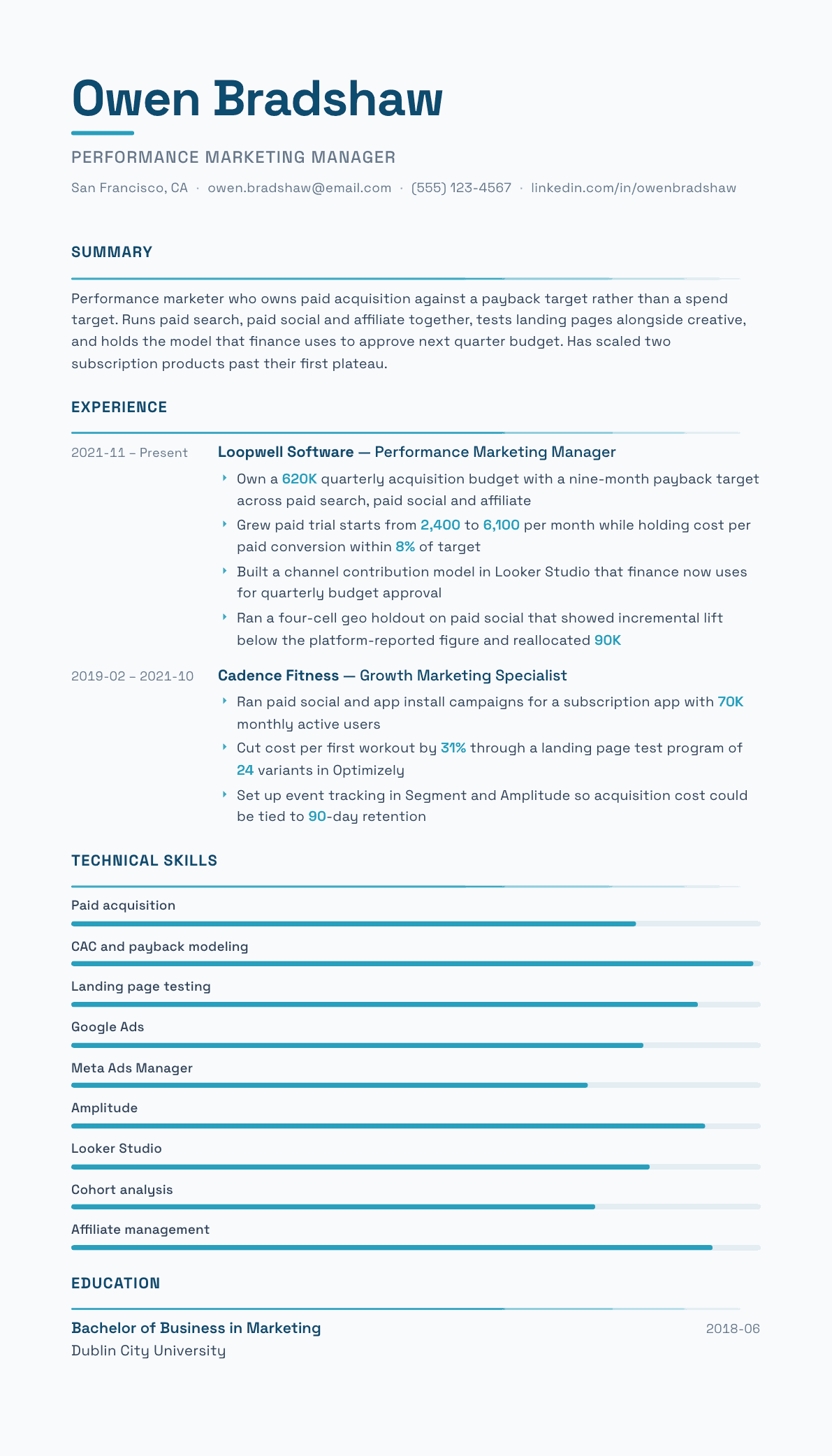
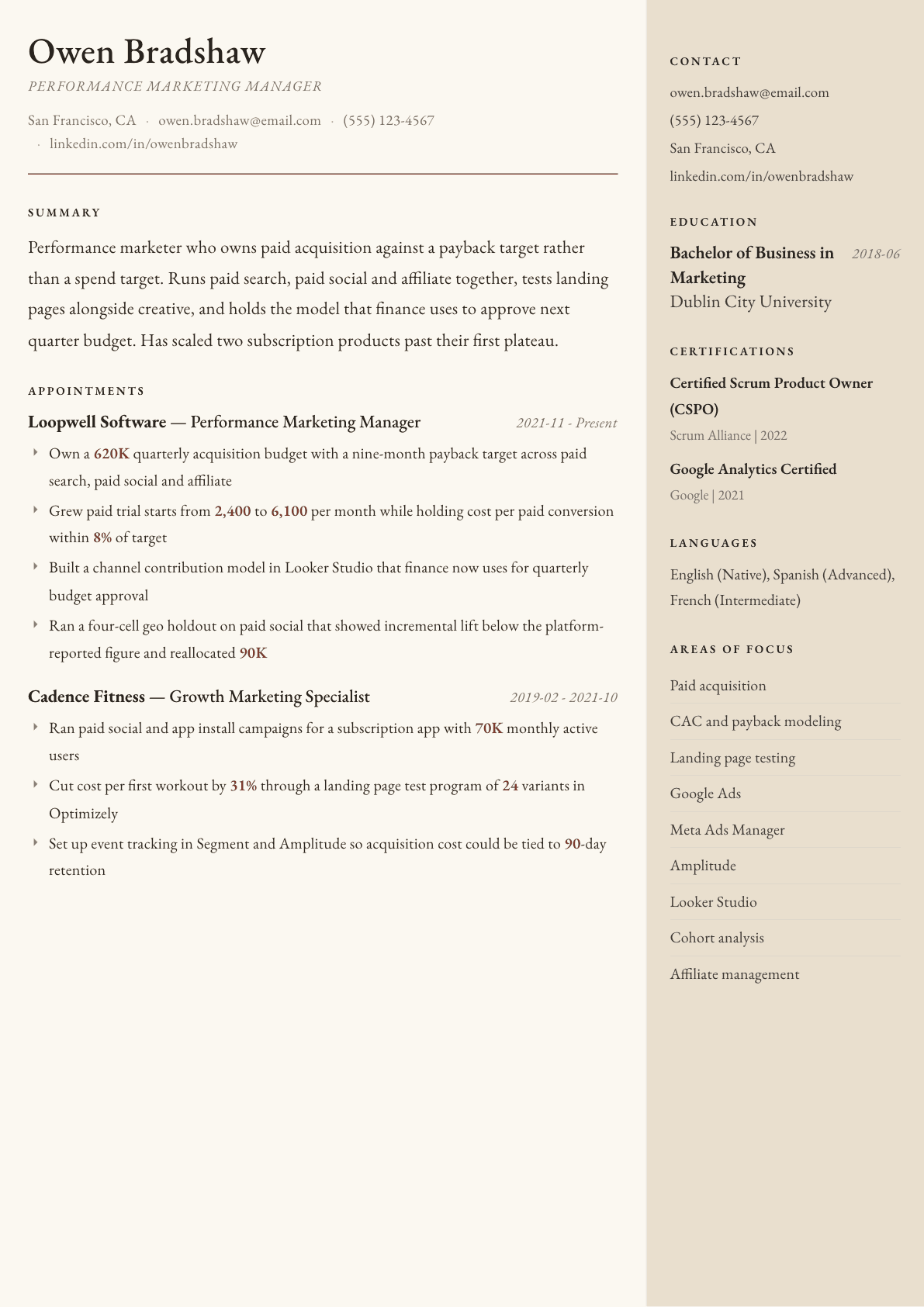
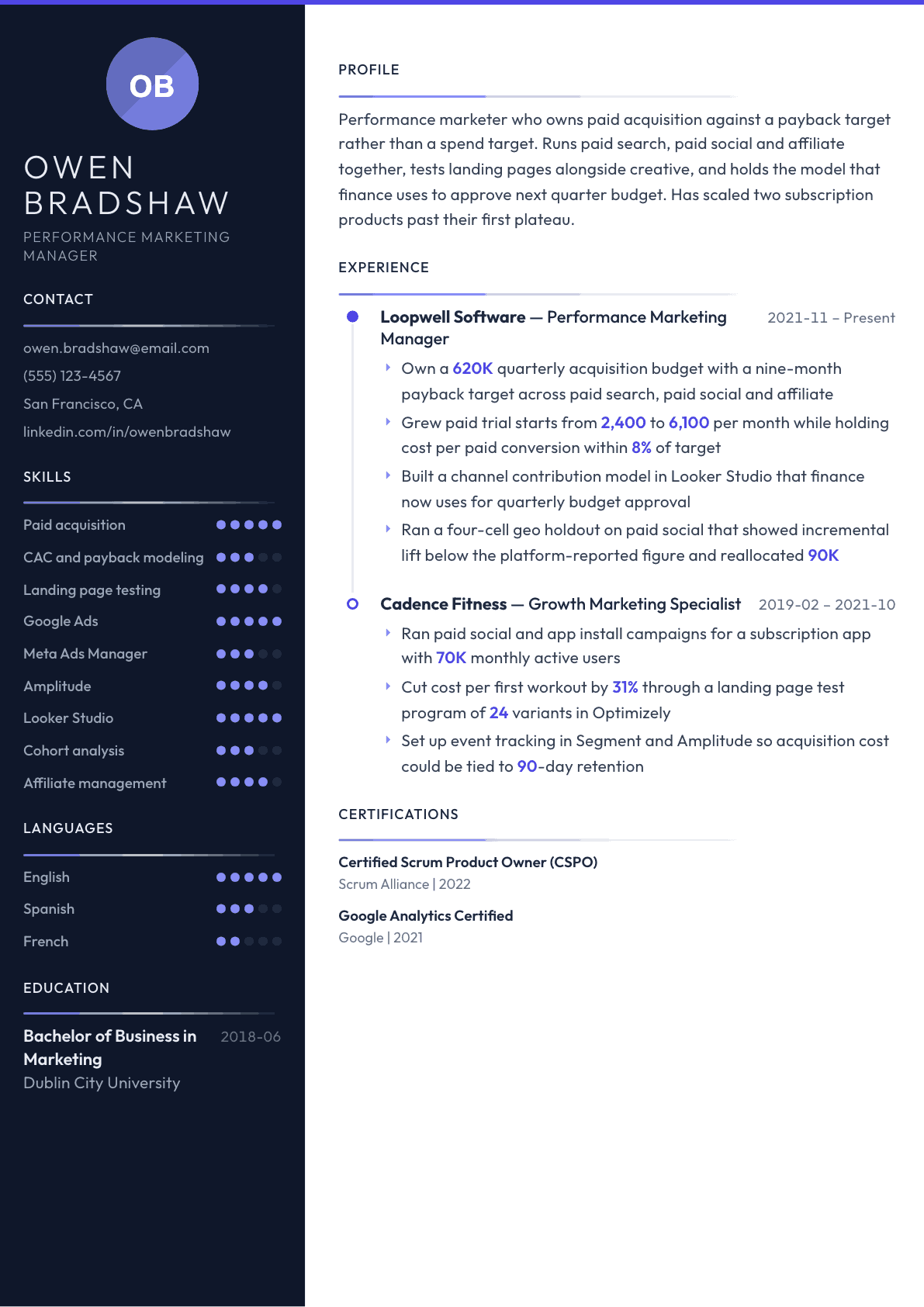
Example Performance Marketing Manager summary
Performance marketing manager with seven years owning paid acquisition against payback targets for subscription and ecommerce businesses. Grew paid trial starts from 2,400 to 6,100 a month at Loopwell Software while holding cost per paid conversion within 8% of plan. Builds the channel contribution model finance approves budget from, and tests incrementality with geo holdouts before scaling a channel further.
Skills to list on a Performance Marketing Manager resume
- Paid acquisition
- Customer acquisition cost
- Payback modeling
- Google Ads
- Meta Ads Manager
- Apple Search Ads
- Conversion rate optimization
- A/B testing
- Cohort analysis
- Amplitude
- Segment
- Looker Studio
- Affiliate marketing
- Marketing mix modeling
- Landing page strategy
What actually gets this resume read
- Anchor every result to a business metric such as payback period, contribution margin or qualified pipeline, not clicks.
- Show the range of scale you have worked at, since scaling a small account and defending a large one are different jobs.
- Include the experiment you got wrong and what the holdout taught you, because senior interviewers ask about measurement honesty.
- Name the analytics stack you built or inherited, from event tracking through to the dashboard leadership reads.
- Separate the channels you personally operated from the ones you briefed to an agency, so nobody is surprised in the interview.
- Mention the business model you know best, since ecommerce, subscription and lead generation economics reward different tactics.
How to write a performance marketing manager resume
Performance marketing manager is a title that covers two different jobs, and the resume has to declare which one you do. In some companies it means running paid channels well. In others it means owning the number: acquisition volume against a cost and payback target, with the channel mix as your choice rather than your brief. Hiring managers screen for the second version and are disappointed by resumes that describe the first.
What proves the second version is unit economics. A performance marketer who can name their target payback window, explain how contribution margin was calculated, and show what happened when a channel stopped clearing that bar has a very short list of competitors. One who reports clicks, impressions and platform conversions does not.
Below is the section order that fits this role, how to write acquisition numbers so they survive scrutiny, three summaries pitched at different stages, before and after bullets, and the questions that come up in every performance marketing interview.
Lead with the number you owned
The first line under your name should say what you were accountable for and at what scale. "Owned a 620K quarterly acquisition budget against a nine-month payback target" is a complete answer to the screening question. Save the channel list for the skills block.
If your accountability was volume rather than efficiency, say that instead. Trial starts, qualified leads, first orders, installs that reached day-seven retention: name the metric your bonus or your weekly review was tied to. Being precise about what you were measured on is more persuasive than claiming ownership of everything.
- Header: name, title, city, phone, email, and a link if you keep a portfolio of experiments or dashboards.
- Section order: summary, experience, growth stack, skills, education, certifications.
- One page under seven years. Beyond that a second page is fine if it carries team and budget scope, not more channels.
Experience: the business model comes before the channels
State the business model at the top of each job, because it determines everything a reader will assume about your work. Subscription with a monthly plan, ecommerce with a repeat cycle, marketplace with two sides, business software with a sales-assisted funnel: each rewards a different channel mix, a different payback tolerance and a different definition of a conversion.
Then write bullets that move from a decision to a business outcome. Growing trial starts is a channel result. Growing trial starts while holding cost per paid conversion within target is a business result, and it tells the reader you were watching what happened after the click.
Reserve one bullet per job for the analytics work. Performance marketers who set up event tracking, defined the conversion schema, or built the model finance uses are hired ahead of those who only consumed a dashboard someone else built.
Experiments: show the design, not just the win
Testing is the core craft of the role, so describe at least one experiment with its structure visible: what you tested, the cells, the duration, the metric, and what you did with the answer. A landing page program of twenty-four variants with a stated primary metric reads as a discipline. "Ran A/B tests to improve conversion" reads as a phrase.
Include a test that changed your mind. A holdout showing a channel was less incremental than the platform reported, followed by a reallocation, is worth more than three successes, because it demonstrates that your numbers are measured rather than collected.
- Name the testing surface: ad creative, landing page, offer, onboarding flow, or the pricing page.
- Give the sample or duration so the reader can judge whether the result was real.
- State the primary metric before the result, since a test with a metric chosen afterward is not a test.
- Say what changed as a consequence: budget moved, a page shipped to all traffic, a channel paused.
The growth stack: name every layer
A performance marketing stack has four layers and the resume should show all of them. Buying platforms such as Google Ads, Meta Ads Manager, Apple Search Ads and affiliate networks. Measurement such as GA4, a mobile measurement partner, server-side tagging and a warehouse. Product analytics such as Amplitude, Mixpanel or Heap, where retention actually lives. Experimentation such as Optimizely, VWO or an in-house framework.
Add SQL if you have it, and be honest about the level. Reading and adapting queries is common and worth stating. Writing your own cohort analysis against a warehouse table is uncommon and worth stating loudly, because it removes your dependence on an analyst.
Keywords hiring teams search on
Postings for this role repeat a compact vocabulary: performance marketing, paid acquisition, customer acquisition cost, payback period, return on ad spend, conversion rate optimization, incrementality, cohort analysis, marketing mix modeling, growth marketing and the platform names. Use the posting's own phrasing once in the summary and once in a bullet.
Watch the abbreviations. Write customer acquisition cost in full the first time with the short form in brackets, and do the same for conversion rate optimization, because some applicant tracking systems treat the two forms as unrelated terms.
Performance Marketing Manager resume summary examples
Growth marketer, two years
Growth marketer with two years on paid social and app install campaigns for a subscription app with 70K monthly active users. Ran a landing page program of 24 variants that cut cost per first workout by 31%, and set up event tracking so acquisition cost could be tied to 90-day retention.
Owning the acquisition number
Performance marketing manager accountable for a 620K quarterly budget against a nine-month payback target. Grew paid trial starts from 2,400 to 6,100 a month while keeping cost per paid conversion within 8% of plan, and built the channel contribution model finance uses for budget approval.
Head of growth
Growth lead with ten years scaling subscription and marketplace businesses, now running a team of six across paid, lifecycle and web. Introduced geo holdout testing and a marketing mix model that reset channel allocation, and reduced blended payback from fourteen months to nine at higher volume.
Work experience bullets: before and after
Before: Grew paid acquisition significantly year over year.
After: Grew paid trial starts from 2,400 to 6,100 a month over four quarters while holding cost per paid conversion within 8% of the plan target.
Two absolute numbers plus the efficiency constraint show growth that was not bought by loosening the target.
Before: Built dashboards to report on marketing performance.
After: Built a channel contribution model in Looker Studio, joining ad spend to warehouse revenue, that finance now uses for quarterly budget approval.
Naming the data join and the audience turns a reporting task into evidence that leadership trusted your numbers.
Before: Ran A/B tests to improve landing page conversion.
After: Ran a 24-variant landing page program in Optimizely against a single primary metric, cutting cost per first workout by 31% across paid social traffic.
Variant count, tool, primary metric and the traffic source make the result checkable rather than decorative.
Before: Used data to decide where to spend budget.
After: Ran a four-cell geo holdout on paid social, measured incremental lift below the platform-reported figure, and moved 90K a quarter into search and affiliate.
The test design and the reallocation prove a real measurement practice instead of a claim to be data-led.
Before: Improved retention through better targeting.
After: Segmented acquisition cost by 90-day retention cohort in Amplitude, then paused the two audiences whose retained users cost more than twice the blended average.
Connecting acquisition spend to a retention cohort is the specific analysis that separates growth from media buying.
Hard skills
- Paid acquisition across search and social
- Customer acquisition cost and payback modeling
- Cohort and retention analysis
- Conversion rate optimization
- Experiment design and statistical significance
- GA4 and server-side tagging
- Amplitude or Mixpanel
- Segment event tracking
- Looker Studio and SQL
- Apple Search Ads and mobile measurement partners
- Affiliate and partnership channels
- Marketing mix modeling
- Landing page and funnel strategy
Soft skills
- Translating channel data into business terms
- Working with product and engineering
- Prioritizing a testing roadmap
- Defending a budget request
- Intellectual honesty about results
- Cross-functional forecasting
Certifications worth listing
- Google Ads Search Certification (Google Skillshop)
- Google Analytics Certification (Google Skillshop)
- Meta Certified Media Buying Professional (Meta Blueprint)
- HubSpot Marketing Software Certification (HubSpot Academy)
Mistakes that cost performance marketing manager candidates the interview
- Describing channel activity without ever naming the business metric you were accountable for.
- Reporting platform-attributed conversions as company results, which a senior interviewer will unpick immediately.
- Omitting the business model, so the reader cannot tell whether your experience transfers to their funnel.
- Listing testing as a skill with no experiment described in enough detail to be believed.
- Claiming ownership of a full-funnel program when you ran one channel inside somebody else's plan.
- Filling the page with tool logos while leaving out the analysis you personally ran.
- Skipping the failure, which is the fastest way to show measurement maturity and almost nobody includes it.
Performance Marketing Manager resume questions
What is the difference between a performance marketing manager and a paid media manager?
Paid media roles center on buying and optimizing channels well. Performance marketing roles add accountability for the business outcome: acquisition volume at a cost and payback target, with channel mix as your decision. Many postings blur the two, so read the metrics section closely.
How do I write this resume if I never had access to revenue data?
Report the deepest metric you could see and say where the line stopped. Qualified leads, activated accounts or first orders are all credible. Explaining that revenue sat with finance is honest and far better than inventing a return figure you cannot defend.
Does a performance marketing resume need SQL?
It is not required, but it changes how you are read. Candidates who can query a warehouse for cohort or channel analysis are treated as self-sufficient. If you only read and adapt existing queries, say exactly that rather than listing SQL as a headline skill.
How should I present results from a very small budget?
State the budget plainly and lead with the decisions rather than the scale. A small account run with clean experiment design and honest measurement reads well to a hiring manager, who can teach scale far more easily than judgment.
Should I include experiments that failed?
Include at least one, framed by what it changed. A holdout that showed a channel was less incremental than reported, followed by a budget reallocation, demonstrates the exact discipline these teams hire for and very few candidates put it on the page.