Digital Marketing Specialist Resume Examples: free score
Write a Digital Marketing Specialist Resume That Passes the Filter
By Mustafa Tarabya, founder of CVBooster · Published · Updated
A digital marketing specialist resume example with channel metrics, platform keywords, ATS friendly skills, and a complete writing guide.
Sample resumes for a digital marketing specialist
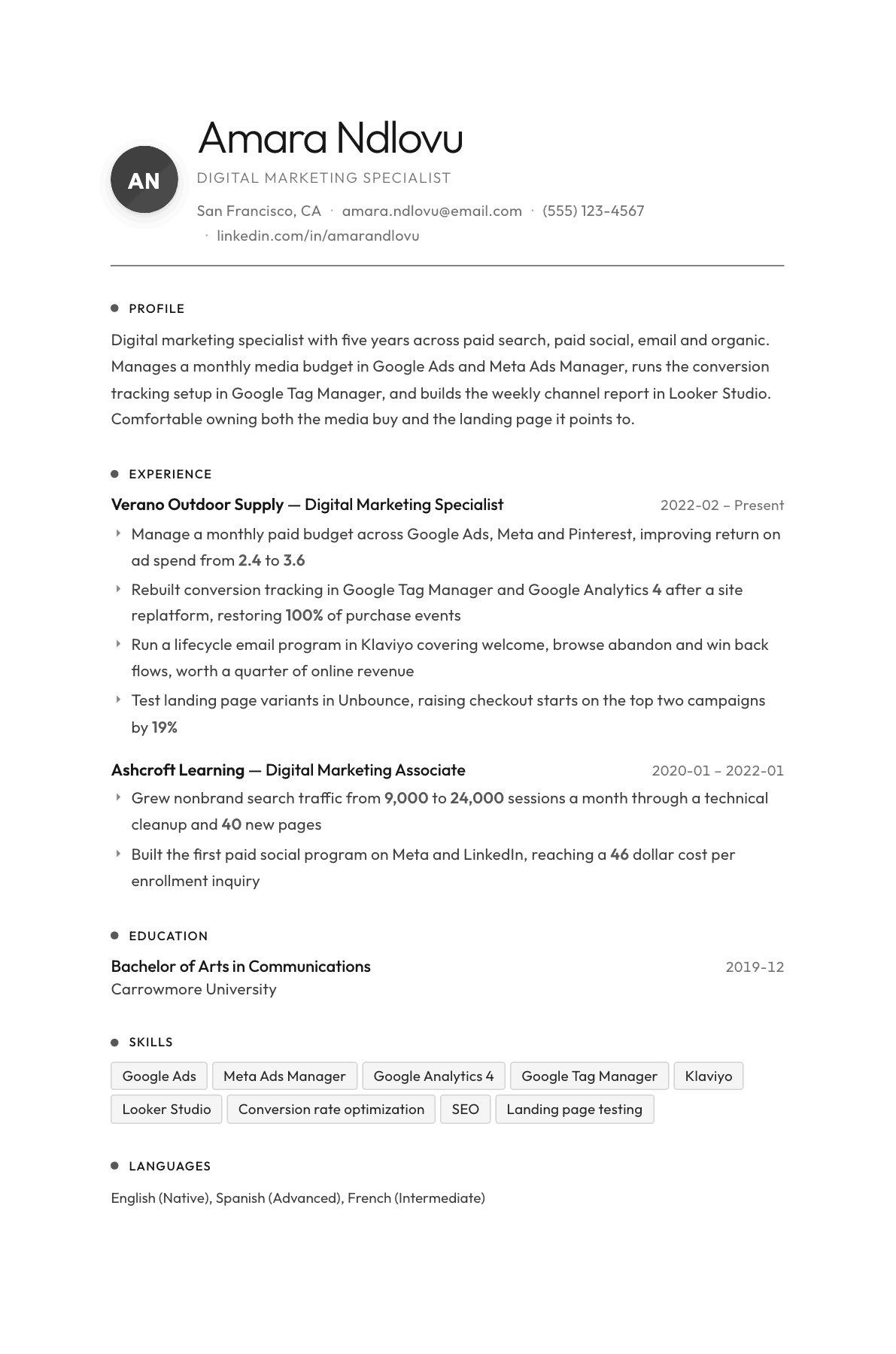
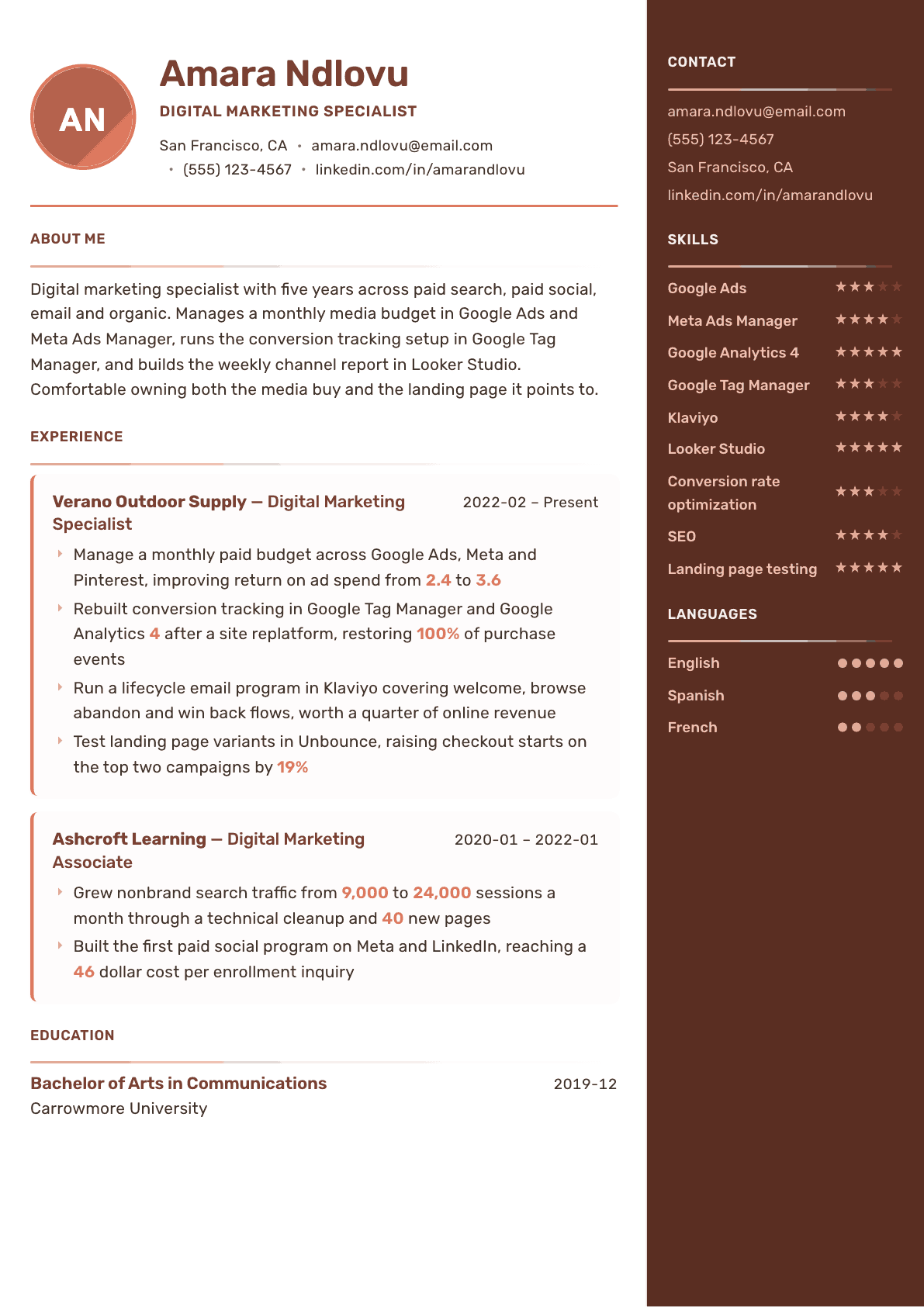
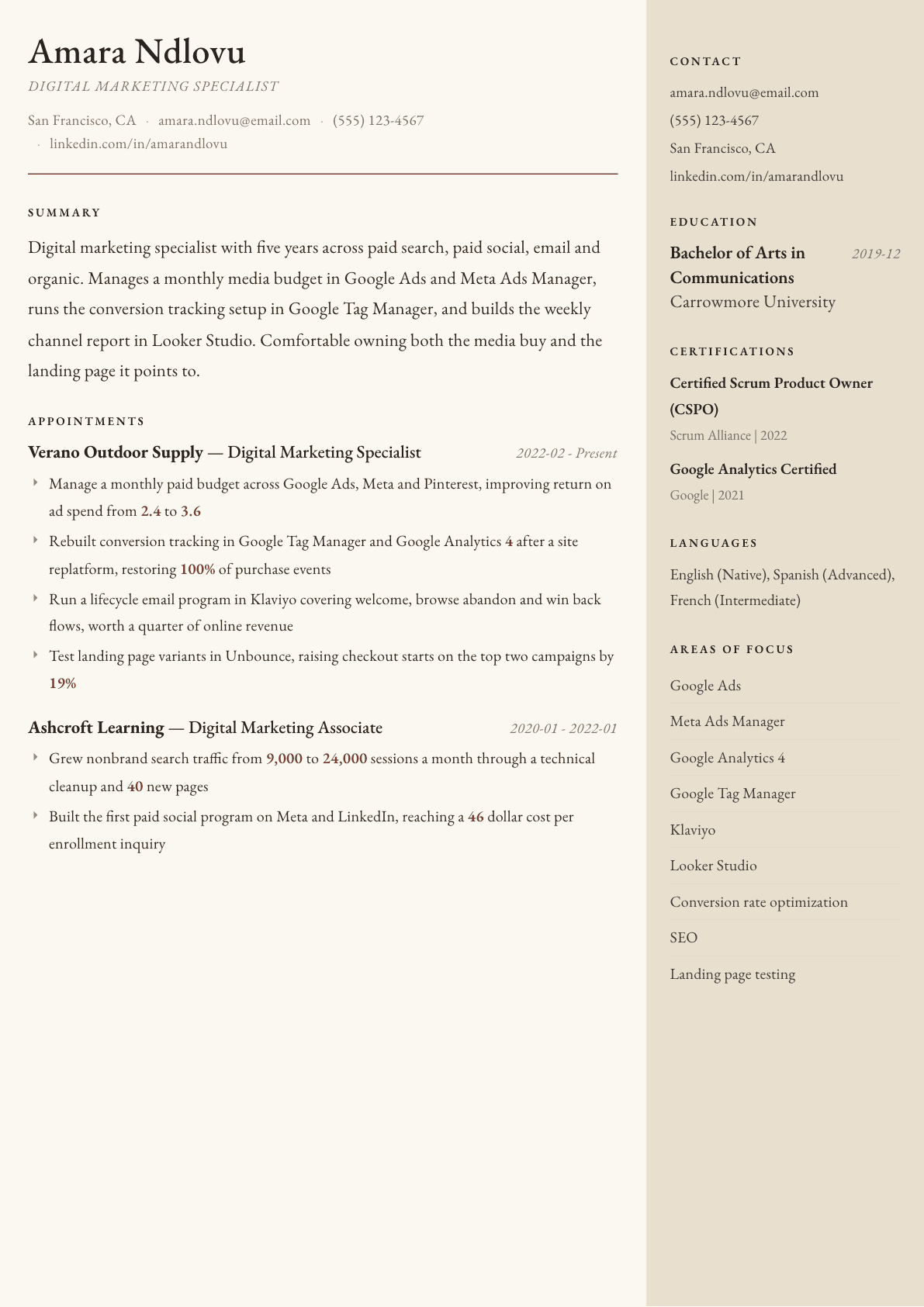
The same digital marketing specialist content laid out in three CVBooster templates, so you can see what the finished document looks like before you write a word.
Example Digital Marketing Specialist summary
Digital marketing specialist with five years across paid search, paid social, lifecycle email and organic search for consumer brands. Manages a monthly media budget in Google Ads and Meta, owns conversion tracking in Google Tag Manager, and reports channel results in Looker Studio. Raised return on ad spend from 2.4 to 3.6 while rebuilding a lifecycle email program that now drives a quarter of online revenue.
Skills to list on a Digital Marketing Specialist resume
- Paid search
- Paid social
- Google Ads
- Meta Ads Manager
- Google Analytics 4
- Google Tag Manager
- Conversion rate optimization
- Email marketing
- Klaviyo
- SEO
- Looker Studio
- Landing page testing
- Audience targeting
- Return on ad spend analysis
- Marketing reporting
What actually gets this resume read
- Lead with the channels you personally run, because digital marketing specialist is a title that covers six different jobs.
- Give budget scale in a range or a monthly figure so a hiring manager knows whether you have handled their spend level.
- Prove the measurement side: tag manager work, conversion tracking fixes and reporting builds separate you from button pushers.
- Pair a media metric with a business metric, such as return on ad spend alongside revenue or qualified inquiries.
- Name the analytics stack explicitly, since Google Analytics 4 and Tag Manager appear in most postings as required keywords.
- Show one test you designed and what you concluded, including a test that failed and what you stopped doing because of it.
How to write a digital marketing specialist resume
Digital marketing specialist is a title that hides at least six different jobs. At one company it means running the paid accounts. At another it means email and lifecycle. At a third it means the website, the blog and the analytics. The person screening resumes knows exactly which version she needs, and the first job of your resume is to tell her within two lines whether you are that person.
The second thing a digital hiring manager checks is measurement. Anyone can run ads; far fewer candidates can prove the conversions were tracked correctly, explain what a tag manager container holds, or say what happened to reporting after a site replatform. Measurement literacy is the line between a specialist who is trusted with budget and one who is supervised on it.
This guide covers the layout that survives an applicant tracking screen, how to write channel bullets that pair a media metric with a business metric, three summaries by career stage, before and after bullets, and the questions people ask when they move between agency and in house digital roles.
Format: one page with a channel and stack block up top
Single column, one page, reverse chronological. Under the summary, add two compact blocks: channels you run and the platform stack you run them in. Digital postings are keyword dense, and putting the platform names in a scannable block gets you past both the parser and the ten second human skim.
Group the stack rather than listing it flat: advertising platforms, analytics and tagging, lifecycle and email, content and testing, reporting. Grouping tells the reader you understand how the pieces connect, which a random list never does.
- Header: name, title, city and state, phone, email, professional profile link.
- Sections: summary, channels, platform stack, experience, education, certifications.
- Do not use icons or rating bars for tools; nobody believes a four out of five in an ad platform.
Summary: which channels are yours and at what spend level
Three lines. Years in digital, the channels you personally run, the budget scale you have handled, the measurement stack, and one result that pairs efficiency with revenue. Budget scale matters because managing a small monthly spend and a large one require different habits, and a manager screens for the gap.
If you are a genuine generalist across paid, organic, email and web, say so plainly and then rank the channels by depth. Claiming equal expertise in everything reads as claiming none.
Experience: media metric plus business metric, every time
Digital bullets go wrong in two ways: they report platform metrics with no business meaning, or they claim revenue with no mechanism. Fix both by pairing them. Return on ad spend alongside the revenue it produced, cost per acquisition alongside the volume at that cost, click through rate alongside the conversion rate it fed.
Include the account structure work, because that is where digital specialists earn their efficiency. Campaign segmentation, negative keyword hygiene, audience layering, feed quality, exclusion lists, and the budget pacing routine you follow. These are the details a paid media lead uses to tell an operator from a dashboard watcher.
Give one bullet to measurement engineering. A conversion tracking rebuild, a tag manager migration, a consent mode implementation, offline conversion imports, or a dashboard that replaced manual reporting. This is the bullet that most competing resumes will not have.
- Name each advertising platform separately, since postings list them as distinct requirements.
- Say whether the account was ecommerce, lead generation or subscription; the metrics differ completely.
- Include one test with a conclusion, including the tests that told you to stop something.
Organic, email and web work belong here too
Most digital specialist seats include at least one non paid channel. Write the organic work with the same rigor: pages published, technical issues fixed, sessions before and after, and the tool you diagnosed with. Write the lifecycle work with flow names, segments and the share of revenue those flows carry.
Website work is worth a line even when you did not build the site. Landing page tests, form changes, page speed fixes and navigation experiments all connect directly to the media you buy, and a specialist who owns both sides of the click is more valuable than one who hands traffic to somebody else's page.
Certifications and keywords the screen expects
Platform credentials are cheap to earn and easy to verify, which makes their absence noticeable. The Google Ads certifications, the Google Analytics certification, the Meta media buying credentials and the Microsoft Advertising certification are the ones hiring teams see most often. List the issuer beside each.
Recurring posting phrases include paid search, paid social, conversion rate optimization, marketing automation, search engine optimization, tag management, audience targeting and attribution. Each should appear once in a block and once inside a bullet that proves it.
Digital Marketing Specialist resume summary examples
Two years in
Digital marketing associate with two years across paid social and organic search for an education company. Built the first Meta and LinkedIn program to a 46 dollar cost per inquiry, and grew nonbrand search sessions from nine thousand to twenty four thousand a month through a technical cleanup and forty new pages.
Five years, full funnel
Digital marketing specialist running paid search, paid social, lifecycle email and organic for a consumer brand. Owns a monthly media budget, the tag manager container and the weekly channel dashboard. Improved return on ad spend from 2.4 to 3.6 while rebuilding a lifecycle program that now drives a quarter of online revenue.
Senior specialist
Senior digital marketing specialist owning acquisition across four paid platforms and the measurement stack behind them, including server side tagging and offline conversion imports. Sets the quarterly test roadmap, mentors one associate, and reports blended acquisition cost and contribution margin to the leadership team each month.
Work experience bullets: before and after
Before: Managed Google Ads and Facebook campaigns.
After: Managed a monthly paid budget across Google Ads, Meta and Pinterest for a home and outdoor retailer, improving return on ad spend from 2.4 to 3.6 while holding total spend steady.
The platform list, the account type and a before and after efficiency figure make the scope legible.
Before: Fixed website tracking issues.
After: Rebuilt conversion tracking in Google Tag Manager and Google Analytics 4 after a site replatform, restoring purchase and lead events within a week and reconciling revenue against the order system.
Naming the systems, the trigger event and the reconciliation step demonstrates real measurement ownership.
Before: Improved landing page performance.
After: Tested headline, form length and social proof variants in Unbounce across the two highest spend campaigns, raising checkout starts by 19% and retiring the long form version entirely.
A named tool, the variables tested and a decision that followed show a testing process rather than a tweak.
Before: Ran email marketing for the brand.
After: Built welcome, browse abandonment and win back flows in Klaviyo with segment rules by purchase history, together accounting for roughly a quarter of online revenue.
The flow names, the segmentation logic and the revenue share turn a channel mention into a program.
Before: Grew organic traffic to the site.
After: Grew nonbrand organic sessions from nine thousand to twenty four thousand a month by fixing duplicate title tags and thin category pages, then publishing forty new pages against researched question terms.
Traffic growth is only convincing when the diagnosis and the specific work behind it are named.
Hard skills
- Paid search
- Paid social
- Google Ads
- Meta Ads Manager
- Google Analytics 4
- Google Tag Manager
- Conversion rate optimization
- Lifecycle email
- Klaviyo
- Search engine optimization
- Looker Studio
- Attribution and reporting
Soft skills
- Evidence over intuition
- Budget discipline
- Clear reporting to non specialists
- Patience with measurement detail
- Rapid diagnosis under pressure
Certifications worth listing
- Google Ads Search Certification (Google Skillshop)
- Google Ads Measurement Certification (Google Skillshop)
- Google Analytics Certification (Google Skillshop)
- Meta Certified Media Buying Professional (Meta)
- Microsoft Advertising Certified Professional (Microsoft)
Mistakes that cost digital marketing specialist candidates the interview
- Claiming every digital channel at equal depth, which tells a hiring manager you have owned none of them.
- Reporting impressions, clicks and reach with no cost or conversion figure attached to them.
- Omitting budget scale, so the reader cannot tell whether you have handled the spend the role carries.
- Skipping measurement work entirely, which is the fastest way to be read as a dashboard watcher.
- Listing the analytics platform without ever showing what you built or fixed inside it.
- Copying agency deliverable language into an in house application where the reader wants business outcomes.
- Attributing a company revenue jump to your channel without naming the mechanism that connected them.
Digital Marketing Specialist resume questions
What should a digital marketing specialist resume lead with?
The channels you personally run and the budget scale you have handled. Those two facts decide whether the rest of the resume gets read, because the same job title covers paid media, lifecycle, organic and web roles at different companies.
How do I show budget responsibility without sharing confidential figures?
Use a range or a monthly order of magnitude rather than an exact annual number. Saying you manage a mid five figure monthly budget across three platforms gives the reader the scale she needs without disclosing anything a former employer would object to.
Do I need to know Google Tag Manager for a digital marketing role?
For most in house seats, yes, at least well enough to add a tag, build a trigger and debug why a conversion stopped firing. Measurement work is the part of the job that cannot be outsourced quickly, and it separates candidates in interviews.
Should I split paid and organic results into separate sections?
Keep them inside each job rather than splitting the resume by channel, but order the bullets so your strongest channel comes first in every role. A channel split section breaks the timeline and makes tenure hard to follow.
How do I write this resume when I am moving from agency to in house?
Convert client deliverables into commercial results and name the industries and account sizes you handled. Add one bullet about working with a client's internal team, because in house hiring managers worry that agency candidates have never navigated a stakeholder who outranks them.