Growth Marketing Manager Resume Examples: free ATS score
Build a Growth Marketing Manager Resume Around Experiments
By Mustafa Tarabya, founder of CVBooster · Published · Updated
Growth marketing manager resume example with experiment and retention bullets, the analytics stack to list, keywords, and a writing guide.
Sample resumes for a growth marketing manager
The same growth marketing manager content laid out in three CVBooster templates, so you can see what the finished document looks like before you write a word.
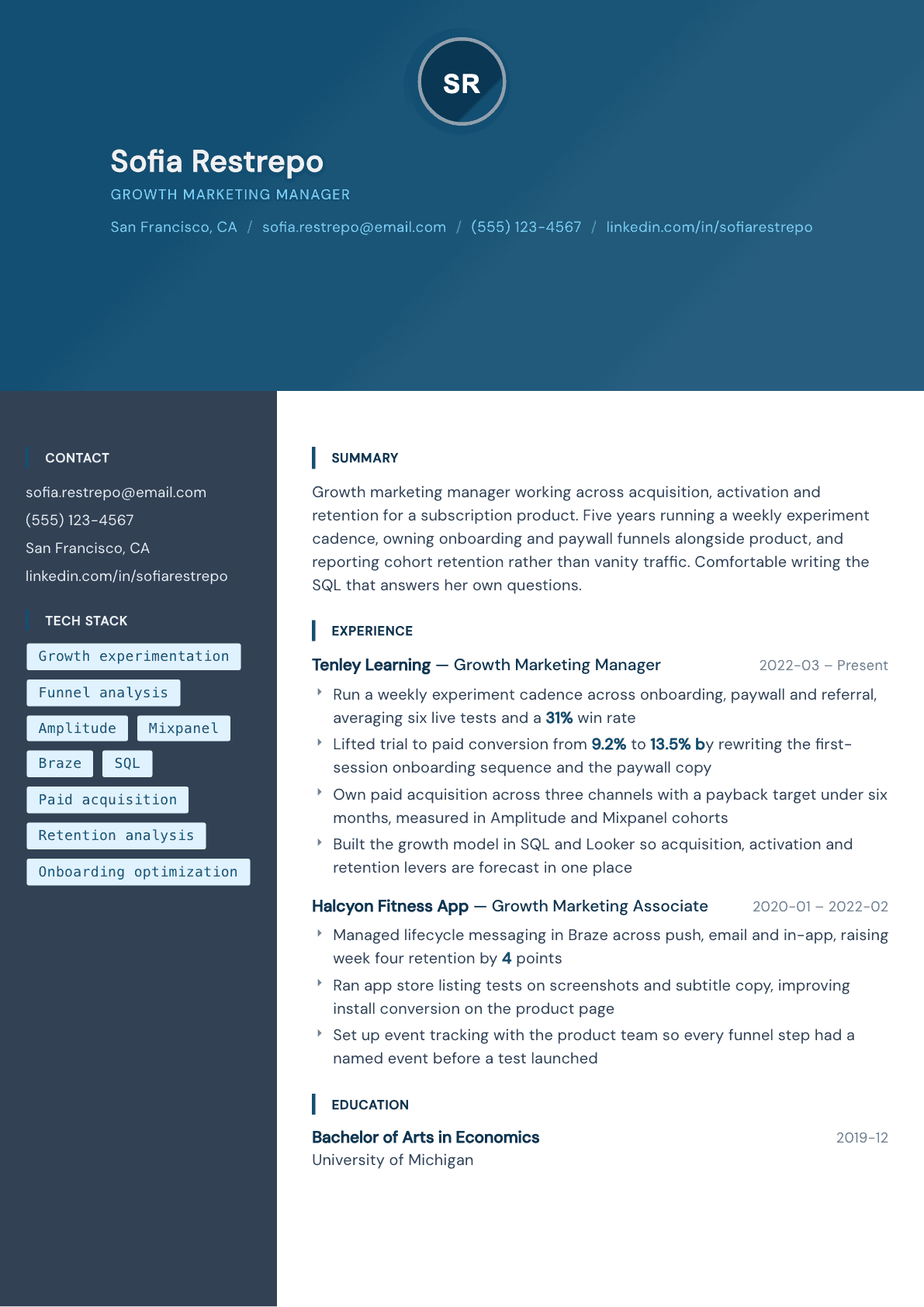
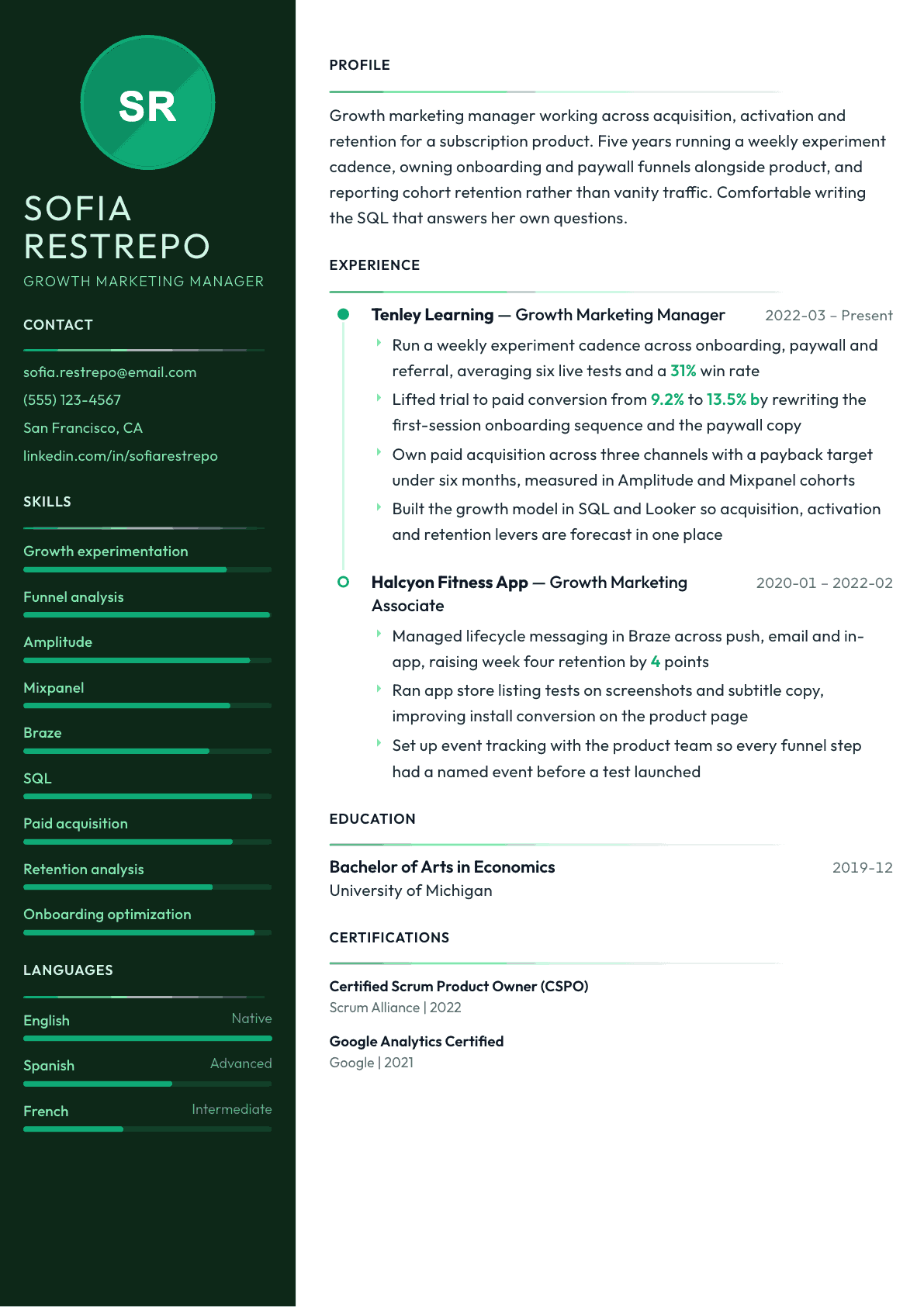
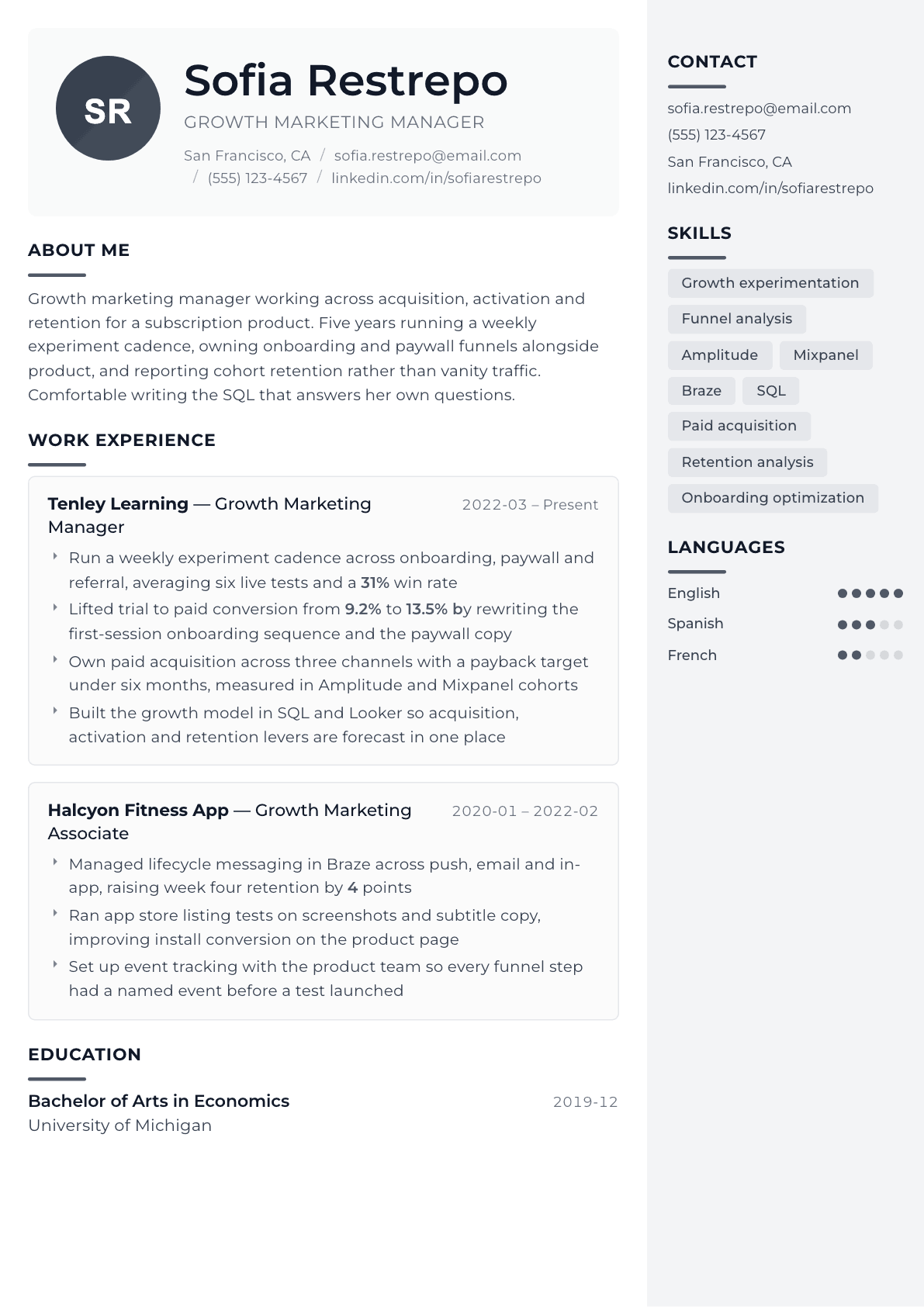
Example Growth Marketing Manager summary
Growth marketing manager with five years on subscription products, running a weekly experiment cadence across onboarding, paywall and referral funnels. Lifted trial to paid conversion by several points through onboarding and copy rewrites, and owns paid acquisition against a payback target. Analyzes cohorts in Amplitude and writes her own SQL, so recommendations arrive with the query behind them rather than a hunch.
Skills to list on a Growth Marketing Manager resume
- Growth experimentation
- A/B testing
- Funnel analysis
- Cohort retention analysis
- Amplitude
- Mixpanel
- SQL
- Looker
- Braze
- Paid acquisition
- Onboarding optimization
- Referral programs
- Lifecycle messaging
- Payback period analysis
- Landing page optimization
What actually gets this resume read
- Report your experiment cadence and win rate, because growth teams hire for testing volume and honest measurement.
- Show retention, not only acquisition, since a growth manager who only buys traffic is really a paid media manager.
- Name the product analytics tool you queried yourself, such as Amplitude, Mixpanel or a warehouse you wrote SQL against.
- Give one funnel metric you moved with the before and after figure, and say what the winning change actually was.
- Say whether the growth was self serve, sales assisted or app based, because the playbooks are not interchangeable.
- Mention how you worked with product and engineering, since most growth wins need a code change, not a campaign.
How to write a growth marketing manager resume
Growth marketing manager is one of the least standardized titles in marketing. At one company it means paid acquisition with a bigger budget. At another it means working inside the product on onboarding and paywalls with an engineer beside you. The hiring manager reading your resume already knows which version she needs, so your first job is to make clear which version you have actually done.
The second thing she is testing is whether your numbers are real. Growth teams live around experiments, and anyone who has run them knows that most tests lose. A resume where every initiative succeeded reads as either selective memory or borrowed credit. Experiment volume, win rate and one honest loss do more for credibility than another rounded-up conversion claim.
This guide covers how to frame the funnel you owned, how to write experiment bullets that hold up under questioning, which analytics and lifecycle tools to name, and the questions growth marketers ask when their resume is not converting into interviews.
Format: one page, funnel scope stated before anything else
Reverse chronological and tight. Under each employer put a scope line naming the product type, the business model, the funnel stages you owned, and the budget or team attached. Acquisition, activation, retention and referral are the four stages, and saying which ones were yours prevents the most common mismatch in growth hiring.
Add an experiments block or a consistent bullet pattern that shows cadence. A growth manager who ran a weekly testing rhythm across a year is a different candidate from one who ran a redesign, and the reader cannot tell those apart from campaign descriptions alone.
- Scope line: product type, business model, funnel stages owned, budget or team.
- State the experiment cadence and the win rate somewhere on the page.
- Keep a tools block that separates analytics from lifecycle messaging.
- Show whether you worked with engineers, since product-side growth requires it.
Summary: model, funnel, cadence, one metric moved
Say the business model first: subscription, marketplace, self serve software, transactional commerce. Then the funnel stages you owned, then the testing cadence, then one metric you moved with the before and after. Four facts, three lines, and the reader knows whether to keep going.
Avoid describing yourself as data driven. Everyone applying for this role says it. Naming the analytics tool you query yourself, and whether you write SQL, proves the same point without spending a line on a claim nobody can check.
Experience: experiments, funnel movement, and the loss you learned from
Write experiment bullets in a consistent shape: the hypothesis, the change, the measurement, the result. A bullet that says tested new onboarding flow is worth nothing. A bullet that says a shortened first session with a single setup step raised activation, measured on a cohort basis, tells a hiring manager how you think.
Retention deserves at least one bullet in every job, because it is the stage that separates growth marketing from paid acquisition. Cohort retention at a named interval, churn reduction, resurrection campaigns, or the point in the customer journey where drop-off concentrated and what you did about it.
Include one experiment that failed and what it changed in your approach. It is the single most credible thing you can put on a growth resume, and it gives the interviewer a natural question that plays to your strength rather than exposing a gap.
- Use one consistent structure for every experiment bullet.
- Report cohort figures rather than aggregate averages where you can.
- Name the funnel step, not just the campaign, for each result.
- Include the engineering or product partnership behind any in-product change.
Tools: analytics you query, lifecycle you build, channels you buy
Split the tools into three groups. Product analytics such as Amplitude, Mixpanel or a warehouse with SQL and a dashboard layer. Lifecycle messaging such as Braze, Iterable or Customer.io. Acquisition platforms and the attribution tool used to measure them. That structure maps exactly onto how growth teams divide work.
State your own depth honestly. Writing your own queries, reading a dashboard somebody built, and briefing an analyst are three different levels. Growth interviews almost always include a metrics conversation, so an accurate claim here saves an awkward screen later.
Keywords growth teams filter on
Growth postings recycle a specific vocabulary: growth marketing, experimentation, A/B testing, activation, retention, cohort analysis, funnel optimization, onboarding, paywall, referral, lifecycle marketing, payback period, customer acquisition cost, Amplitude, Mixpanel, Braze, SQL. Use the ones that describe work you did, and put each next to a number or a mechanism so the claim survives a second reading.
Growth Marketing Manager resume summary examples
Growth marketing associate
Growth marketing associate managing lifecycle messaging in Braze across push, email and in-app for a subscription fitness product. Raised week four retention by four points, ran app store listing tests on screenshots and subtitle copy, and set up named funnel events with the product team before each test.
Five years in
Growth marketing manager running a weekly experiment cadence across onboarding, paywall and referral for a subscription product, averaging six live tests and a 31% win rate. Lifted trial to paid conversion from 9.2% to 13.5%, and owns paid acquisition against a payback target under six months.
Head of growth
Head of growth leading a five-person team of marketers, an analyst and a growth engineer on a subscription product. Owns the growth model end to end, sets the quarterly experiment roadmap with product leadership, and rebuilt the acquisition mix around payback rather than volume after a channel review.
Work experience bullets: before and after
Before: Ran A/B tests to improve conversion on the website.
After: Ran a weekly experiment cadence across onboarding, paywall and referral surfaces, averaging six live tests at a time with a 31% win rate over the year.
Cadence, surface area and an honest win rate show a testing practice instead of a handful of experiments.
Before: Improved trial conversion for the subscription product.
After: Lifted trial to paid conversion from 9.2% to 13.5% by rewriting the first-session onboarding sequence and moving the paywall after the first completed lesson.
The before and after figures plus the two specific changes let a reader judge whether the result is plausible.
Before: Managed paid acquisition channels within budget.
After: Owned paid acquisition across three channels against a payback target under six months, measured on Amplitude cohorts rather than platform-reported conversions.
A payback target and an independent measurement source signal discipline that platform numbers alone do not.
Before: Worked on retention and lifecycle messaging.
After: Rebuilt the first thirty days of lifecycle messaging in Braze around three activation milestones and raised week four retention by four points on subsequent cohorts.
The structure of the rebuild and a cohort-based result make retention work concrete instead of decorative.
Before: Collaborated with the product team on growth initiatives.
After: Paired with a product engineer on a two-week cycle to instrument every funnel step, so each test launched with named events and a defined success metric before any traffic ran.
Describing the working method with engineering proves in-product growth work rather than campaign adjacency.
Hard skills
- Growth experimentation
- A/B and multivariate testing
- Funnel analysis
- Cohort retention analysis
- Amplitude
- Mixpanel
- SQL
- Looker
- Braze
- Paid acquisition
- Onboarding optimization
- Referral program design
- Payback and acquisition cost modeling
- Landing page optimization
Soft skills
- Hypothesis thinking
- Comfort with negative results
- Working alongside engineers
- Prioritizing by expected value
- Concise written updates
- Curiosity about user behavior
Certifications worth listing
- Google Analytics Certification (Google)
- Meta Certified Digital Marketing Associate (Meta)
Mistakes that cost growth marketing manager candidates the interview
- Presenting paid acquisition work as growth marketing without any activation or retention evidence.
- Reporting only wins, which makes an experienced experimenter look like someone who ran three tests.
- Using aggregate averages where cohort figures exist, since averages hide the behavior growth teams care about.
- Claiming analytics depth you cannot defend when the interview includes a metrics conversation.
- Describing tests without the hypothesis, so the reader cannot tell whether you were guessing.
- Omitting the engineering partnership on in-product changes, which leaves ownership ambiguous.
Growth Marketing Manager resume questions
What separates a growth marketing manager from a digital marketing manager?
Scope beyond acquisition. A growth marketing manager owns activation and retention as well as traffic, usually works inside the product with engineering, and is measured on funnel movement and payback rather than campaign performance and cost per click.
Do I need SQL for a growth marketing role?
For most product-led teams, yes at a working level. You do not need warehouse engineering skills, but you should be able to write a cohort query without waiting for an analyst. If you cannot yet, say what you can do in your analytics tool and be straightforward about the gap.
How do I show growth results when the product was pre-launch or very small?
Report the absolute numbers and the mechanism rather than the ratios. On tiny bases a large improvement means little, and experienced readers know it. Describing what you built, how you measured it and what you learned is far more persuasive than a triple-digit improvement on ten users.
Should I list every experiment I ran?
No. Show the cadence, the win rate and three or four experiments that moved a real metric or changed the roadmap. A long catalog of tests reads as busywork, while a short set with clear reasoning shows how you prioritize scarce engineering time.
Is growth marketing experience from consumer apps relevant to business software?
The method transfers and the motion does not. Experiment design, cohort analysis and lifecycle work apply everywhere. Buying committees, sales handoffs and long consideration cycles do not exist in consumer apps, so name that difference yourself before an interviewer raises it.