Elevator Mechanic Resume Examples: the lines they read
Write an Elevator Mechanic Resume That Survives a Code Reading
By Mustafa Tarabya, founder of CVBooster · Published · Updated
Elevator mechanic resume example with traction, hydraulic and code keywords, plus a guide to writing testing, callback rates and license details.
Sample resumes for a elevator mechanic
The same elevator mechanic content laid out in three CVBooster templates, so you can see what the finished document looks like before you write a word.
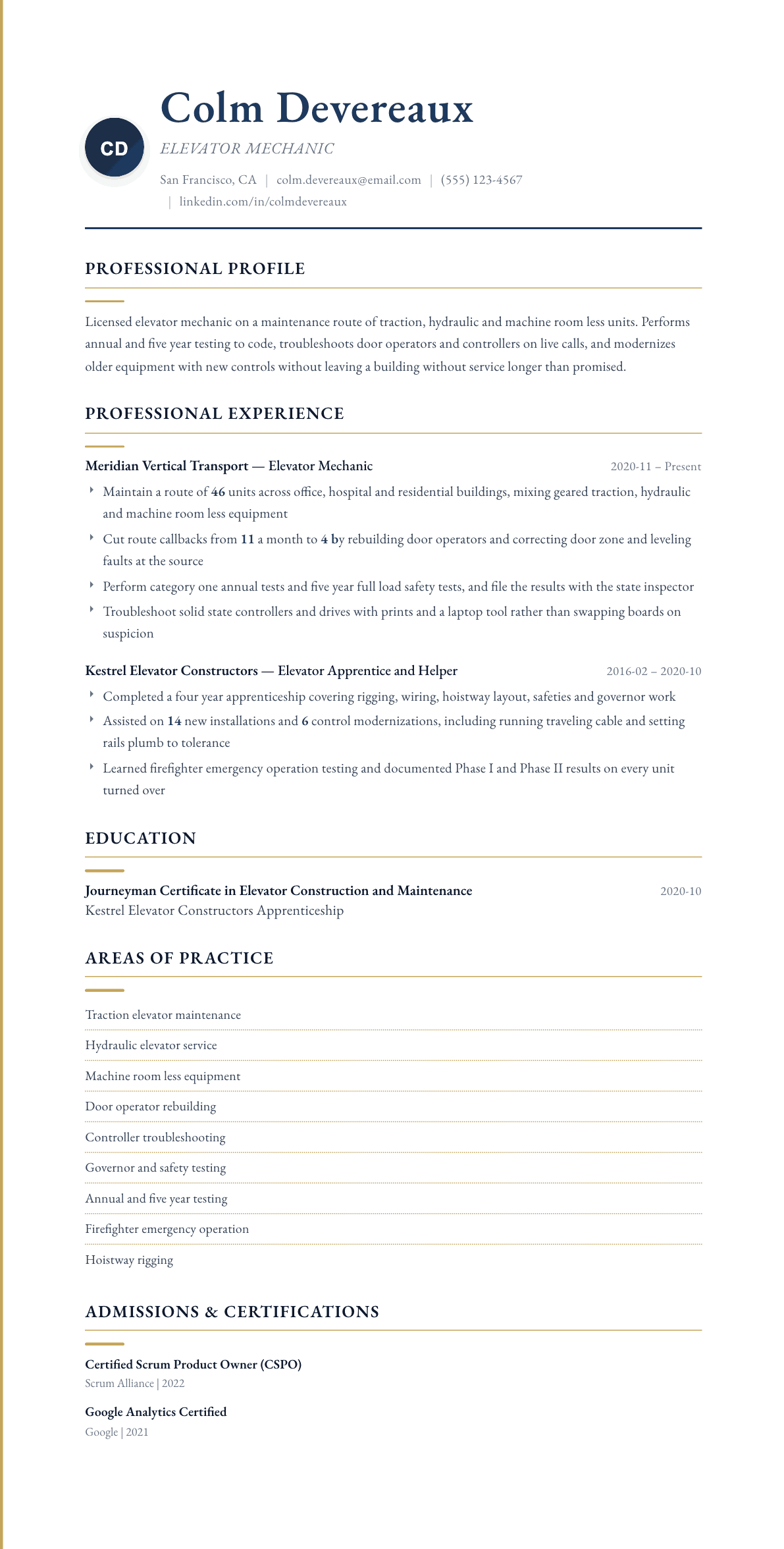
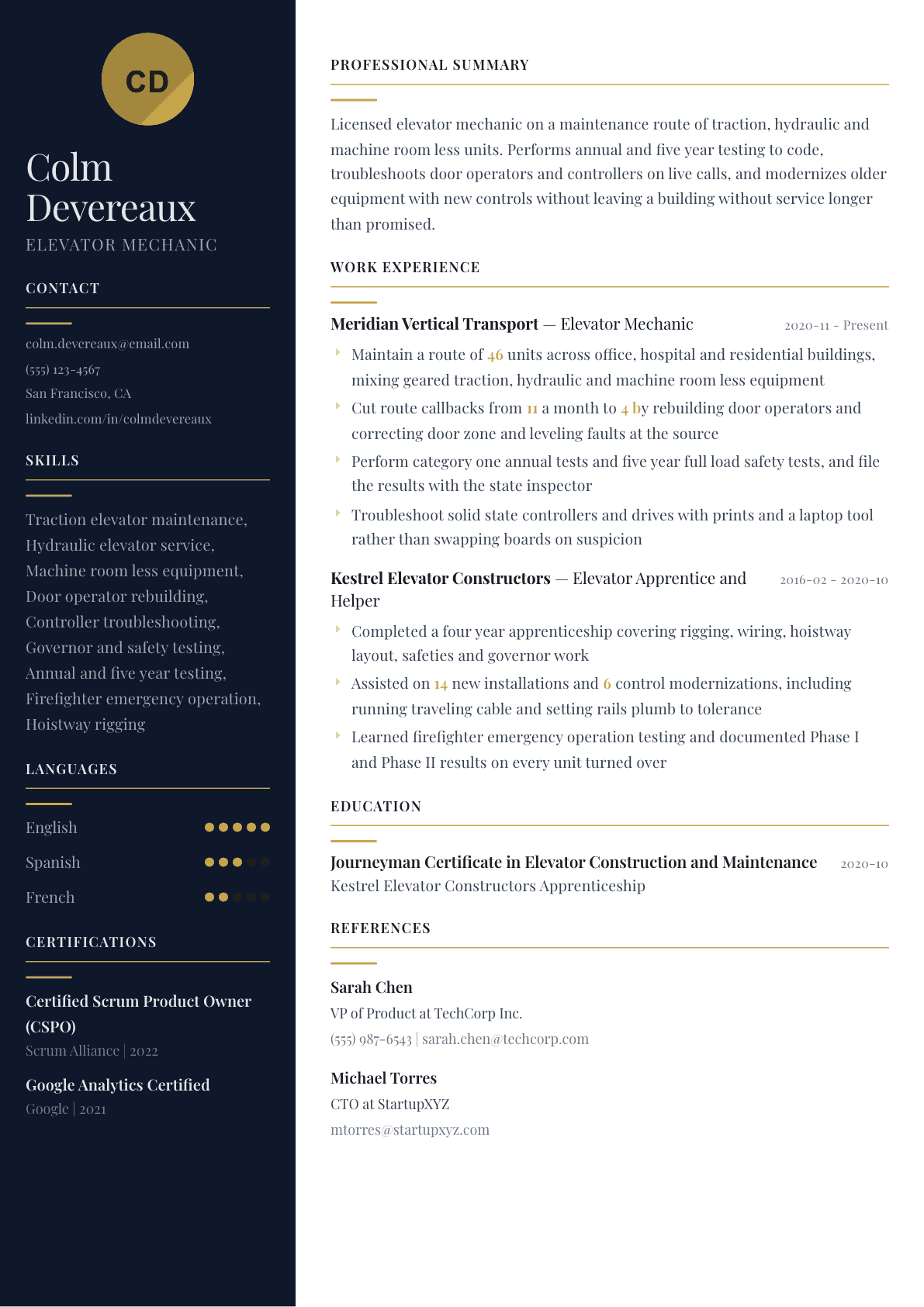
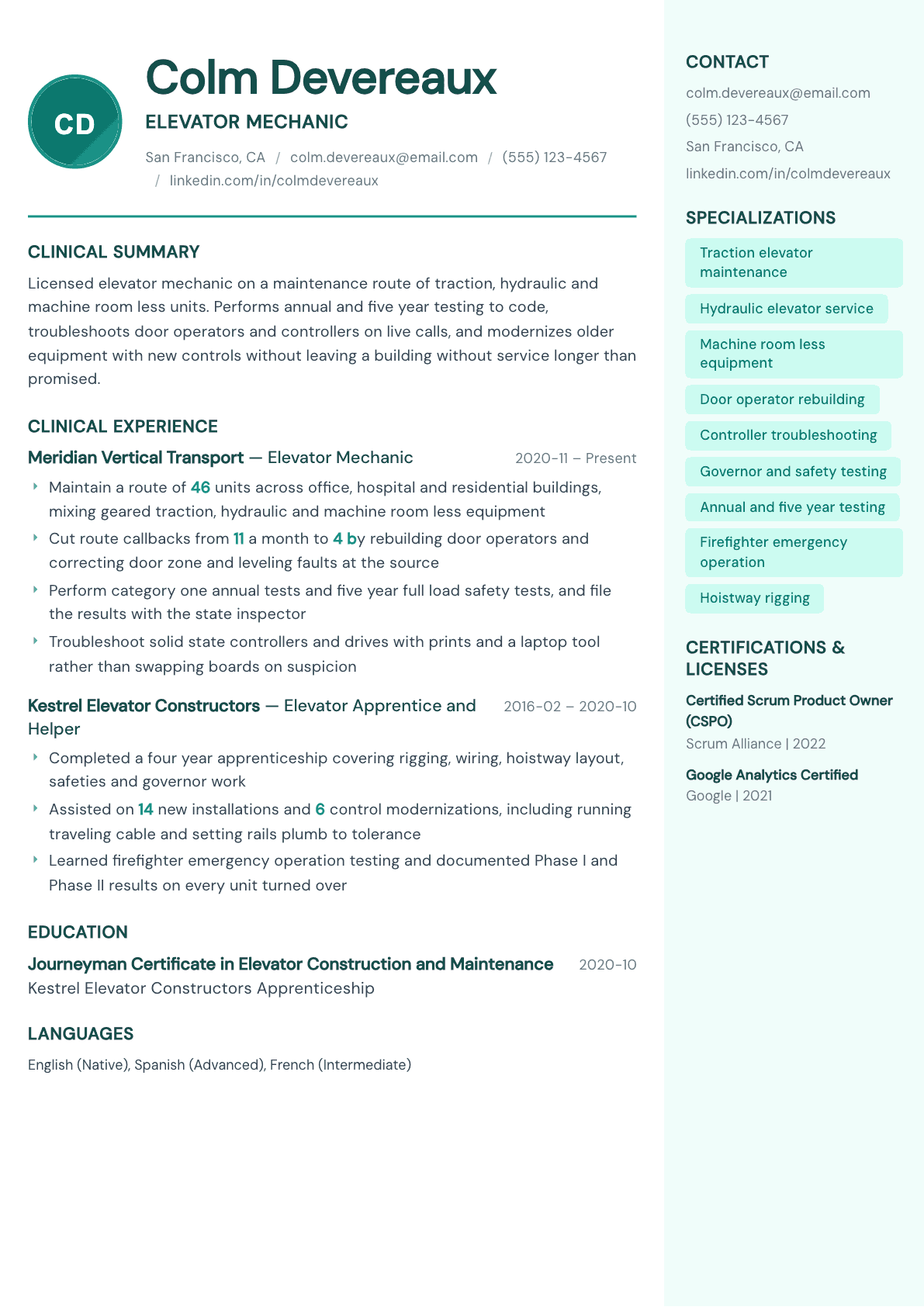
Example Elevator Mechanic summary
Licensed elevator mechanic with nine years across construction, modernization and route maintenance on traction, hydraulic and machine room less equipment. Runs annual category testing and five year full load safety tests, troubleshoots solid state controllers from prints instead of swapping boards, and rebuilds door operators to remove the callbacks they generate. Holds a route of more than forty units in mixed occupancies and keeps monthly callbacks low.
Skills to list on a Elevator Mechanic resume
- Geared and gearless traction
- Hydraulic jack and valve service
- Machine room less systems
- Escalator step and handrail work
- Door operator and gate switch repair
- Leveling and door zone adjustment
- Solid state controller troubleshooting
- Drive and encoder setup
- Governor and car safety testing
- Annual category testing
- Five year full load testing
- Firefighter emergency operation
- Hoistway layout and rigging
- Traveling cable and wiring
- Control modernization
- Route maintenance planning
What actually gets this resume read
- Put your state elevator mechanic license and its expiration on the first block, because it gates the whole hire.
- Split your equipment experience by type: geared and gearless traction, hydraulic, machine room less and escalators.
- Give your route size in units and the callback rate you carry, since that pair describes the job better than adjectives.
- Show code testing you have run yourself, including annual category tests and five year full load safety tests.
- Name the controller families you troubleshoot with prints, and say whether you have done control modernizations.
- Add your union status, apprenticeship hours and any inspector qualification, all of which change what work you may sign.
How to write a elevator mechanic resume
Elevator hiring is unusual because the license decides almost everything. A service manager can admire a resume all afternoon and still be unable to use the person, because the state requires a licensed mechanic to perform and sign the work. So the license, its state and its status belong in the first block, and everything else is the argument for why you should be the licensed mechanic they choose.
After that, the manager is buying two things: a route that stops generating callbacks, and testing that survives an inspector. Callbacks are the operating cost of a maintenance portfolio and they come overwhelmingly from doors. Testing is the compliance cost and it comes with dates that cannot slip. A resume that speaks to both is speaking directly to the person who signs the offer.
This guide covers how to present license and apprenticeship, how to describe equipment without listing every manufacturer alive, how to write testing and modernization work, three summaries across the trade, before and after bullets, and the questions mechanics ask when moving between construction, service and inspection.
Format: license, apprenticeship, equipment types, then history
One page for a mechanic, two if you have both a construction and a service record worth showing. Open with the license block: the state, the number, the expiration and any additional state you are licensed or reciprocal in. Add union status and the apprenticeship program you completed, because in this trade that record is how experience is verified.
Follow with an equipment block sorted by type rather than by brand: geared traction, gearless traction, hydraulic, machine room less, escalators and moving walks, dumbwaiters and material lifts. A service manager mentally maps your block onto the equipment in the portfolio, and a brand list without types makes that mapping harder rather than easier.
- License block: state, license number, expiration, reciprocity and any inspector qualification held.
- Apprenticeship line: the program, the hours completed and the year of topping out.
- Equipment block by type, with a note on the controller generations you can troubleshoot from prints.
- Work type line: new construction, modernization, route maintenance, repair crew or on call service.
Summary: license, route size, callback rate, testing you own
Four lines. State the license, the size of the route you carry in units, the callback rate you hold, and the testing you perform and sign yourself. Those four facts describe the value of a maintenance mechanic more precisely than any description of duties could.
Mention the building types too. A hospital route with critical care access requirements is a different job from a residential portfolio, and a mechanic who has managed shutdowns in a facility that cannot lose an elevator has learned scheduling skills that a service manager will pay for.
Experience: route, callbacks, and the fault you stopped repeating
Give the route size and mix for every maintenance role. Units, building types and equipment types. Then give the callback figure and the period, because a monthly callback count is the number a branch reviews and a mechanic who improved theirs has a story worth reading.
The most convincing bullet is a recurring fault eliminated. Doors cause the majority of callbacks, and a mechanic who rebuilt operators, corrected door zone and leveling, adjusted gate switches and cleaned and aligned detectors, then watched the callbacks stop, has demonstrated the exact competence the job is about. Say what the fault was, what you changed and what happened after.
Repair and modernization bullets need scope. A control modernization means new controllers, drives, wiring, fixtures and often door equipment, with the car out of service for a defined period. Give the number of units, the type of change and how long the building was without service, because that last figure is what the customer remembers.
Testing, code and the inspector relationship
Compliance testing is a large part of what a licensed mechanic is paid for. Say plainly which tests you run: annual category testing, five year full load safety testing with weights, governor tripping and overspeed checks, buffer tests, and firefighter emergency operation in both phases. Add whether you file results with the authority and how you track due dates across a route.
Working with an inspector is a skill and it belongs on the page. A mechanic who prepares the unit, has the paperwork ready, knows which code edition the building was permitted under and can discuss a finding without arguing gets units back in service faster. Service managers notice which of their mechanics generate calm inspections and which generate letters.
- List test types you perform and sign yourself, separate from tests you have only assisted on.
- Note how you track due dates across a route so a compliance date never arrives unplanned.
- Mention any experience with code upgrades required after an inspection finding.
- Say whether you hold or are pursuing an inspector qualification, since it changes your career path.
Troubleshooting method and the keywords that matter
Controller work is where mechanics separate. Describe the method: reading prints, following the safety string, checking signals in sequence and confirming a theory before parts are ordered. Board swapping on suspicion is expensive and every service manager has paid for it, so a mechanic who describes a disciplined approach stands out immediately.
Terms that recur in postings include elevator mechanic, traction, hydraulic, machine room less, escalator, door operator, leveling, door zone, controller, drive, governor, car safety, annual category testing, five year full load test, firefighter emergency operation, modernization and callback reduction. Use the ones that match your record and let the rest go.
Elevator Mechanic resume summary examples
Apprentice, final year
Fourth year elevator apprentice with 6800 hours across new installation and modernization, covering rail setting, wiring, traveling cable, door equipment and safety adjustment. Assisted on 14 installs and 6 control modernizations and documented firefighter emergency operation testing on units turned over. Preparing for the mechanic license exam.
Route mechanic
Licensed elevator mechanic carrying a route of 46 units across office, hospital and residential buildings on traction, hydraulic and machine room less equipment. Cut route callbacks from 11 a month to 4 by rebuilding door operators and correcting leveling faults, and performs annual and five year testing with results filed.
Adjuster and lead mechanic
Elevator mechanic with 15 years across construction, modernization and service. Adjusts traction systems for ride quality and door timing, leads control modernizations from demolition through turnover, troubleshoots solid state controllers from prints, and mentors apprentices through safety, governor and leveling work.
Work experience bullets: before and after
Before: Maintained elevators in commercial buildings.
After: Maintained a route of 46 units across office towers, a hospital and residential buildings, mixing geared traction, hydraulic and machine room less equipment on a monthly maintenance schedule.
Unit count, building mix and equipment types let a service manager match you to an actual portfolio.
Before: Reduced the number of service calls on my route.
After: Cut route callbacks from 11 a month to 4 over two quarters by rebuilding door operators, correcting door zone and leveling faults, and replacing worn gate switches rather than adjusting around them.
It names the metric, the period and the specific mechanical causes, which is how callbacks actually fall.
Before: Performed required elevator tests.
After: Performed category one annual tests and five year full load safety tests with weights, verified governor tripping speed and buffer condition, and filed results with the state inspector on schedule.
Naming the tests and the filing shows compliance work you own rather than tasks you helped someone else with.
Before: Fixed control problems on elevators.
After: Troubleshot solid state controllers and drives using prints and a laptop tool, tracing the safety string in sequence and confirming the fault before ordering parts instead of swapping boards on suspicion.
The method is the point, because board swapping is the expensive habit every service branch is trying to end.
Before: Worked on elevator modernizations.
After: Completed control modernizations on 6 units, replacing controllers, drives, wiring and fixtures, adjusting door equipment afterward, and returning each car to service inside the window promised to the building.
Unit count, scope of replacement and the schedule promise show ownership from demolition through turnover.
Hard skills
- Geared and gearless traction maintenance
- Hydraulic jack, valve and packing service
- Machine room less equipment
- Escalator step, chain and handrail work
- Door operator rebuilding and adjustment
- Door zone and leveling correction
- Gate switch and detector alignment
- Solid state controller troubleshooting
- Drive and encoder setup
- Governor and car safety testing
- Annual category testing
- Five year full load safety testing
- Firefighter emergency operation testing
- Hoistway layout, rails and rigging
- Control modernization
Soft skills
- Keeping a building informed while a car is out of service
- Working an inspection without turning a finding into an argument
- Planning shutdowns around a hospital or hotel schedule
- Staying methodical on a controller fault at the end of a shift
- Teaching an apprentice why the adjustment matters
Certifications worth listing
- Certified Elevator Technician (CET) (National Association of Elevator Contractors)
- Certified Accessibility and Private Residence Lift Technician (CAT) (National Association of Elevator Contractors)
- Qualified Elevator Inspector (QEI) (NAESA International)
- Elevator Industry Apprenticeship Completion (National Elevator Industry Educational Program)
Mistakes that cost elevator mechanic candidates the interview
- Burying the state license when it is the single fact that decides whether you can be hired at all.
- Listing manufacturers instead of equipment types, which makes it harder to map you onto a portfolio.
- Omitting the callback figure, the number that describes a maintenance mechanic better than any adjective.
- Claiming testing experience without separating tests you sign from tests you have only assisted on.
- Describing controller work as troubleshooting electrical faults with no mention of prints or the safety string.
- Leaving out apprenticeship hours and program, which is how this trade verifies that experience is real.
Elevator Mechanic resume questions
How important is the state license on an elevator resume?
It is the first filter. In licensed states nobody can perform or sign the work without it, so a strong resume without a license goes to a helper conversation instead of a mechanic one. Put the state, number and expiration where they cannot be missed.
Should I list every elevator brand I have worked on?
List equipment types first and controller generations second, then mention brands briefly if your record is concentrated in a few. A service manager cares whether you can troubleshoot a solid state controller from prints, not whether you have seen a particular nameplate.
How do I move from construction to a service route?
Emphasize adjustment, door work and testing rather than installation volume. Service is judged on callbacks, and the construction skills that transfer are the ones that touch ride quality, door timing and safety adjustment. Say directly that route work is the goal.
What if my callback numbers were never tracked?
Use what you can defend instead. Route size, the recurring faults you eliminated, the units that stopped generating night calls, and the buildings that renewed. A manager will accept a described improvement when the mechanical detail behind it is convincing.
Is an inspector qualification worth pursuing?
It opens a different career track and it makes you more useful on a maintenance route because you understand what a finding will be before it is written. Mention it on the resume even while in progress, with the stage you have reached.
Related resume examples
- Elevator Technician Resume example
- Maintenance Technician Resume example
- Industrial Maintenance Technician Resume example
- Instrument Technician Resume example
- Generator Technician Resume example
- Cable Technician Resume example