Industrial Maintenance Technician Resume Examples: free
An Industrial Maintenance Technician Resume That Proves Troubleshooting
By Mustafa Tarabya, founder of CVBooster · Published · Updated
Industrial maintenance technician resume example with PLC, VFD, hydraulics and electrical keywords, plus a guide to writing downtime results.
Sample resumes for a industrial maintenance technician
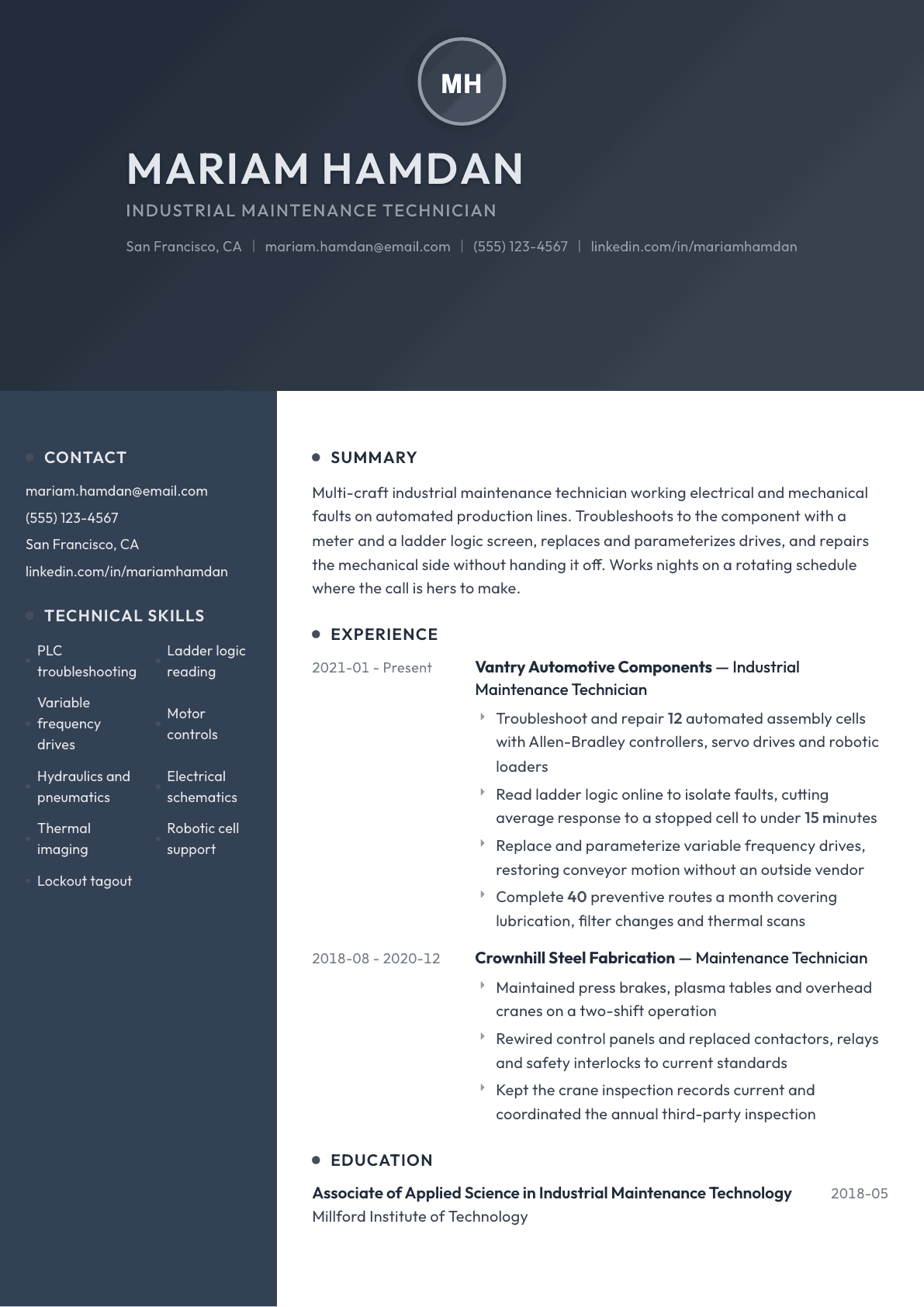
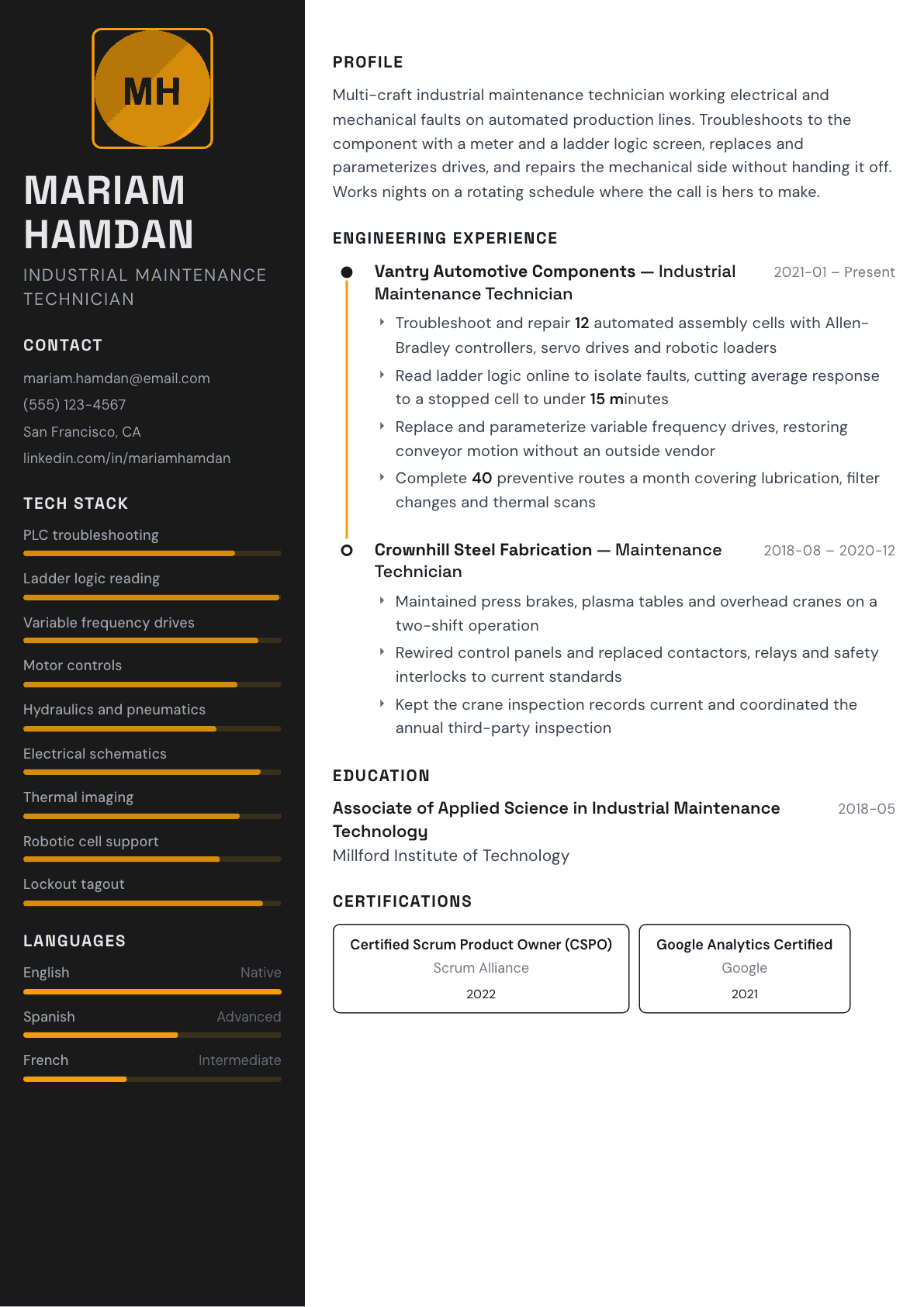
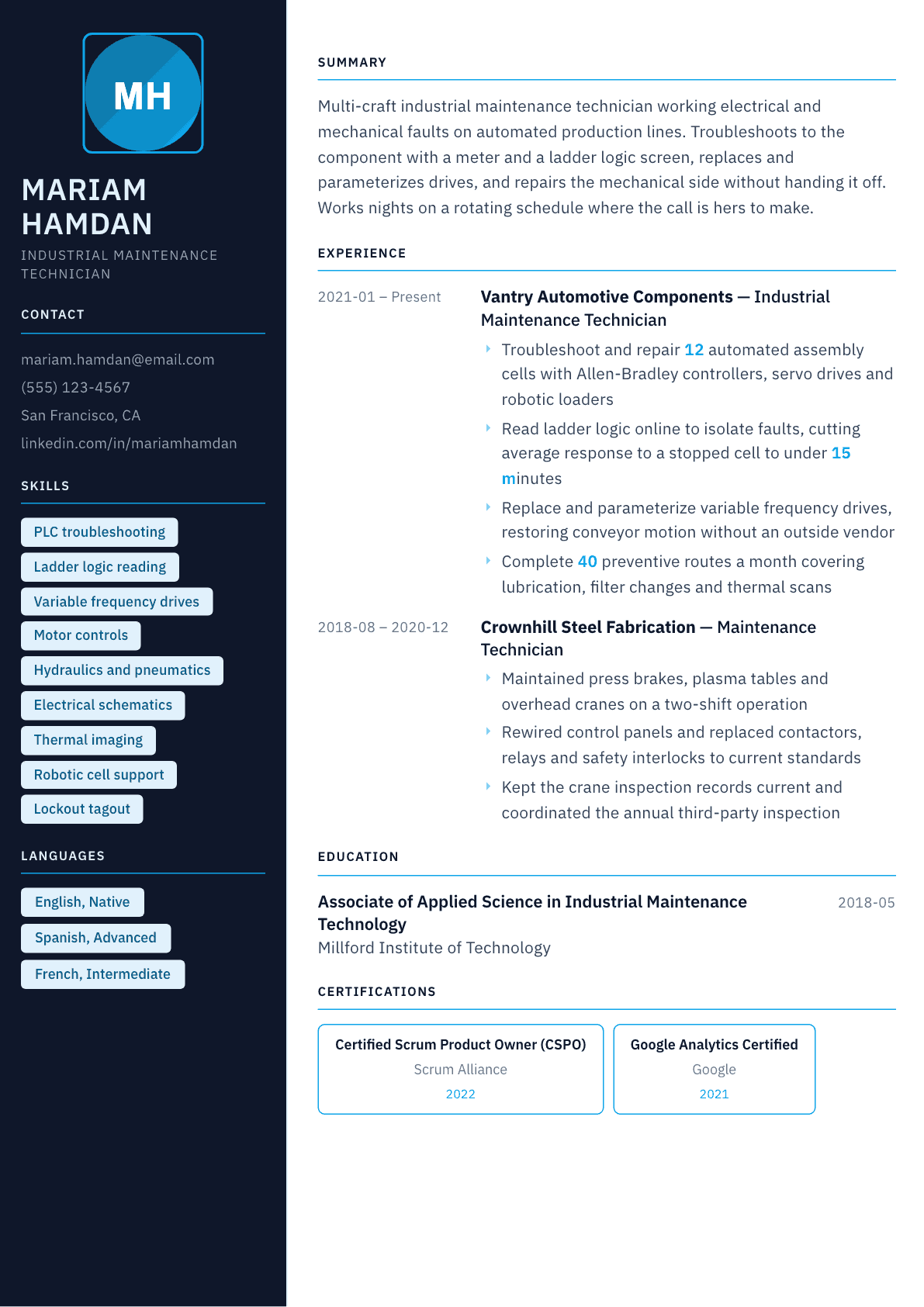
The same industrial maintenance technician content laid out in three CVBooster templates, so you can see what the finished document looks like before you write a word.
Example Industrial Maintenance Technician summary
Multi-craft industrial maintenance technician with five years on automated assembly and fabrication equipment, troubleshooting electrical and mechanical faults to the component. Works online in ladder logic to isolate stopped cells, replaces and parameterizes variable frequency drives, and repairs hydraulics, bearings and drives without handing the job across. Runs a full preventive route every month and documents every repair in the maintenance system.
Skills to list on a Industrial Maintenance Technician resume
- PLC fault isolation
- Ladder logic and HMI screens
- Variable frequency drive setup
- Motor control centers
- Three phase electrical troubleshooting
- Electrical and control schematics
- Hydraulic and pneumatic systems
- Servo and robotic cell support
- Sensor and safety interlock repair
- Thermal imaging and vibration checks
- Precision alignment and bearings
- Preventive maintenance routes
- Lockout tagout and arc flash awareness
- CMMS documentation
What actually gets this resume read
- State whether you are multi-craft or single trade, because that word decides which postings you match.
- Name the controller families you troubleshoot on, from Allen-Bradley to Siemens, and say what you do with them.
- Separate reading ladder logic from writing it, since inflating that claim is caught in the first interview.
- Give a response or repair time on a stopped line, which is the number a plant judges technicians by.
- List drive and motor control work in detail, including parameterization and fault code diagnosis.
- Show the mechanical half of the job too, or a hiring plant will assume you only chase electrical faults.
- Include your shift history, because plants hiring for nights want to see you have already worked them.
How to write a industrial maintenance technician resume
Plants hire industrial maintenance technicians to shorten the gap between a stopped machine and a running one. The maintenance supervisor screening your resume has a specific worry: most applicants are strong on one side of the trade and thin on the other. They can chase a bearing but not a fault code, or they can read a drive fault but stall the moment the guard comes off.
So the first job of this resume is to place you honestly on that spectrum. Multi-craft, electrically led, mechanically led, or controls-capable. Say it plainly in the summary, then prove it in the bullets with the controller families, the drive work, the diagnostic path and the mechanical repairs you complete alone. A technician who is clear about his shape gets more calls than one who claims everything.
This guide covers the layout a plant expects, how to write troubleshooting so it reads as diagnosis rather than parts swapping, how to handle controls claims without overreaching, the credentials worth listing, and the questions technicians ask when moving between industries or onto nights.
Format: one page, craft statement first, equipment and controls blocks under it
One page, reverse chronological. The line under your name should state your craft mix in a few words, because the supervisor reading it will sort you into a pile on that basis alone. Follow it with two compact blocks: the equipment you maintain and the control platforms you troubleshoot on.
Do not scatter electrical work through the job bullets and hope it adds up. A plant hiring for a controls-capable technician is filtering for named platforms, and a technician who mentions a drive in one bullet and a sensor in another looks weaker on paper than he is in the shop.
- Craft line: multi-craft, electrical maintenance, mechanical maintenance, or controls technician.
- Equipment block: assembly cells, presses, conveyors, robots, packaging equipment, cranes, compressors.
- Controls block: controller families, HMI platforms, drive families, network types you have worked on.
- Electrical block: voltages worked, motor control centers, panel wiring, instrumentation.
- Safety block: lockout tagout, arc flash training, confined space, elevated work.
Summary: craft mix, equipment, response, shift
Three lines that answer four questions. What craft mix you bring, what automation you keep running, how fast a stopped cell comes back with you on it, and what shift you work. Shift is not a small detail: plants filling a night seat read past every day-shift candidate no matter how good the technical content is.
Response time is the number that carries most weight, so give it honestly and attach it to a class of fault. A technician who says most stopped cells are back inside fifteen minutes when the fault is on the machine, and longer when the failure is a supplied part, sounds credible where a flat average does not.
Experience: the diagnostic path, not the parts list
The strongest bullets on this resume describe how you find things. Where you start, what you check next, and what tool tells you the answer. Reading a fault on the HMI, going online in the controller to watch the rung, checking the sensor at the terminal with a meter, then confirming mechanically. That sequence proves training in a way that a list of components never will.
Cover drives properly. Replacing a variable frequency drive is common work, but parameterizing it, copying settings across, and diagnosing a fault code rather than swapping until it clears are the parts that mark a real technician. Say which of those you do.
Then keep the mechanical half visible. Bearings, couplings, chain and belt drives, gearboxes, pneumatic cylinders and hydraulic circuits still cause most of the stops. A technician whose page is entirely electrical makes a supervisor wonder who fixes the actual machine.
- Number of cells, lines or machines covered, and whether you are alone on shift.
- A diagnostic path written as steps, from fault indication to confirmed root cause.
- Drive work: replacement, parameterization, fault code diagnosis, and backup of settings.
- Mechanical repairs completed alone, with the components involved.
- Preventive route volume per month, including lubrication, filters and thermal scans.
Controls claims, written so they survive the interview
There is a wide gap between reading ladder logic online and writing or modifying a program. Both are valuable, and only one of them is common. Write exactly what you do: monitor rungs to isolate a fault, force an output during testing, edit a timer value under supervision, or develop and download logic changes. Vague wording here gets found out inside ten minutes of a technical phone screen.
The same discipline applies to networks and instrumentation. If you have replaced a node on an industrial network and set its address, say that. If you have configured and calibrated transmitters, say that separately. Precision on this block is what moves a technician from the general pile to the shortlist for a controls-heavy seat.
Skills and keywords an industrial maintenance posting screens on
Adverts recycle a tight vocabulary: PLC troubleshooting, variable frequency drives, motor controls, three phase, hydraulics, pneumatics, conveyors, preventive maintenance, root cause, lockout tagout, multi-craft. Use the wording the advert uses in your blocks, then show each one at work in a bullet.
Add the documentation habit. Plants that run a maintenance system live or die on whether technicians write real notes, so a line about recording the fault, the cause and the parts used against the asset is more valuable than another component name.
Industrial Maintenance Technician resume summary examples
Recent graduate
Industrial maintenance technology graduate with a two-year degree covering motor controls, ladder logic, hydraulics and precision mechanics, plus a summer on a packaging floor. Comfortable with a meter, a print and a torque wrench. Available for nights and seeking a first multi-craft seat on automated equipment.
Five years in
Multi-craft industrial maintenance technician covering 12 automated assembly cells with programmable controllers, servo drives and robotic loaders. Works online in ladder logic to isolate faults, returning most stopped cells in under 15 minutes, replaces and parameterizes drives without a vendor, and completes 40 preventive routes a month.
Senior technician
Senior industrial maintenance technician and night shift point of contact for a continuous plant, holding the call on whether a line runs or stops. Diagnoses controls, drives and mechanical faults across presses, conveyors and robotic cells, and has trained six technicians on fault isolation using the machine prints.
Work experience bullets: before and after
Before: Troubleshot equipment problems on the production floor.
After: Isolated faults on 12 automated assembly cells by reading the HMI alarm, going online in the controller to watch the rung, then confirming the input at the sensor terminal with a meter.
A written diagnostic path shows how you think, which is what a supervisor cannot test from a component list.
Before: Replaced variable frequency drives when they failed.
After: Replaced and parameterized variable frequency drives on conveyor and pump motors, restoring motion the same shift and saving a vendor callout on each unit.
Parameterizing rather than swapping is the part that distinguishes a technician from a parts changer.
Before: Reduced downtime on the production lines.
After: Brought average response on a stopped cell under 15 minutes by building a laminated fault card at each cell listing the sensors, their addresses and their normal states.
The result comes with a tool you created, so the improvement is clearly yours rather than the plant's.
Before: Performed preventive maintenance tasks.
After: Completed 40 preventive routes a month covering lubrication, filter changes, belt tension and thermal scans on panels, flagging two overheating connections before they failed.
Route volume with a specific catch proves preventive work found problems instead of just closing tickets.
Before: Worked on electrical panels and controls.
After: Rewired control panels and replaced contactors, relays and safety interlocks to current standards, testing each interlock circuit before returning the machine to production.
Naming the components and the verification step turns a broad claim into a checkable practice.
Hard skills
- PLC fault isolation and online monitoring
- HMI alarm interpretation
- Variable frequency drive setup and diagnosis
- Motor control centers and starters
- Three phase electrical troubleshooting
- Electrical and control schematic reading
- Sensors, proximity switches and safety interlocks
- Hydraulic and pneumatic circuits
- Servo and robotic cell support
- Bearings, couplings and drive alignment
- Thermal imaging and vibration checks
- Preventive maintenance routes
- Lockout tagout and arc flash awareness
Soft skills
- Working alone on nights and owning the call
- Keeping a production lead informed without losing focus
- Resisting the urge to swap parts before diagnosing
- Handing over a partial repair clearly at shift change
- Learning a new machine from its prints rather than waiting for training
Certifications worth listing
- Certified Maintenance and Reliability Technician (CMRT) (Society for Maintenance and Reliability Professionals)
- Certified Production Technician (Manufacturing Skill Standards Council)
- OSHA 30-Hour General Industry (Occupational Safety and Health Administration)
Mistakes that cost industrial maintenance technician candidates the interview
- Leaving your craft mix unstated, so a supervisor cannot tell whether you lean electrical or mechanical.
- Implying you program controllers when the honest description is monitoring logic to isolate a fault.
- Listing components without ever describing how you move from a symptom to a confirmed cause.
- Dropping the mechanical half of the trade, which is where most production stops actually originate.
- Omitting shift history when the open seat is nights and the plant is filtering for exactly that.
- Writing preventive maintenance as a duty with no route volume and nothing it ever caught.
Industrial Maintenance Technician resume questions
Do I need PLC programming skills to get an industrial maintenance job?
Not for most seats. Plants want technicians who can go online, read the logic and find the failed input or output, and they keep programming with engineering. Say what you genuinely do, because overstating it is caught quickly in a technical screen.
How do I get into industrial maintenance from a general maintenance background?
Lead with the electrical and mechanical fundamentals you already have, then add any automated equipment you have touched. A two-year industrial maintenance degree or a manufacturing skills credential closes the gap fastest and gives the resume a clear entry point.
Should I mention that I work nights?
Yes, prominently. Night and weekend coverage is one of the hardest parts of staffing a maintenance department, so a technician who has already worked those hours and says so plainly moves up the list before the technical review even starts.
How much detail should I give about machines under a confidentiality agreement?
Describe equipment by type, function and scale rather than by product or customer. Saying you maintained robotic loading cells on an assembly line conveys everything a hiring plant needs without naming a part, a program or a client.
What certifications actually help for this role?
A recognized maintenance and reliability technician credential and a manufacturing skills certification both clear screening filters. Beyond those, safety training such as an extended general industry course and arc flash awareness carries real weight with plants that audit their contractors.
Related resume examples
- Maintenance Technician Resume example
- Electrical Technician Resume example
- Maintenance Mechanic Resume example
- Production Technician Resume example
- Elevator Technician Resume example
- Facilities Technician Resume example