Social Services Assistant Resume Examples: free score
Write a Social Services Assistant Resume That Opens the Door
By Mustafa Tarabya, founder of CVBooster · Published · Updated
A social services assistant resume guide with intake keywords, referral tracking examples, and a sample built for entry into human services work.
Sample resumes for a social services assistant
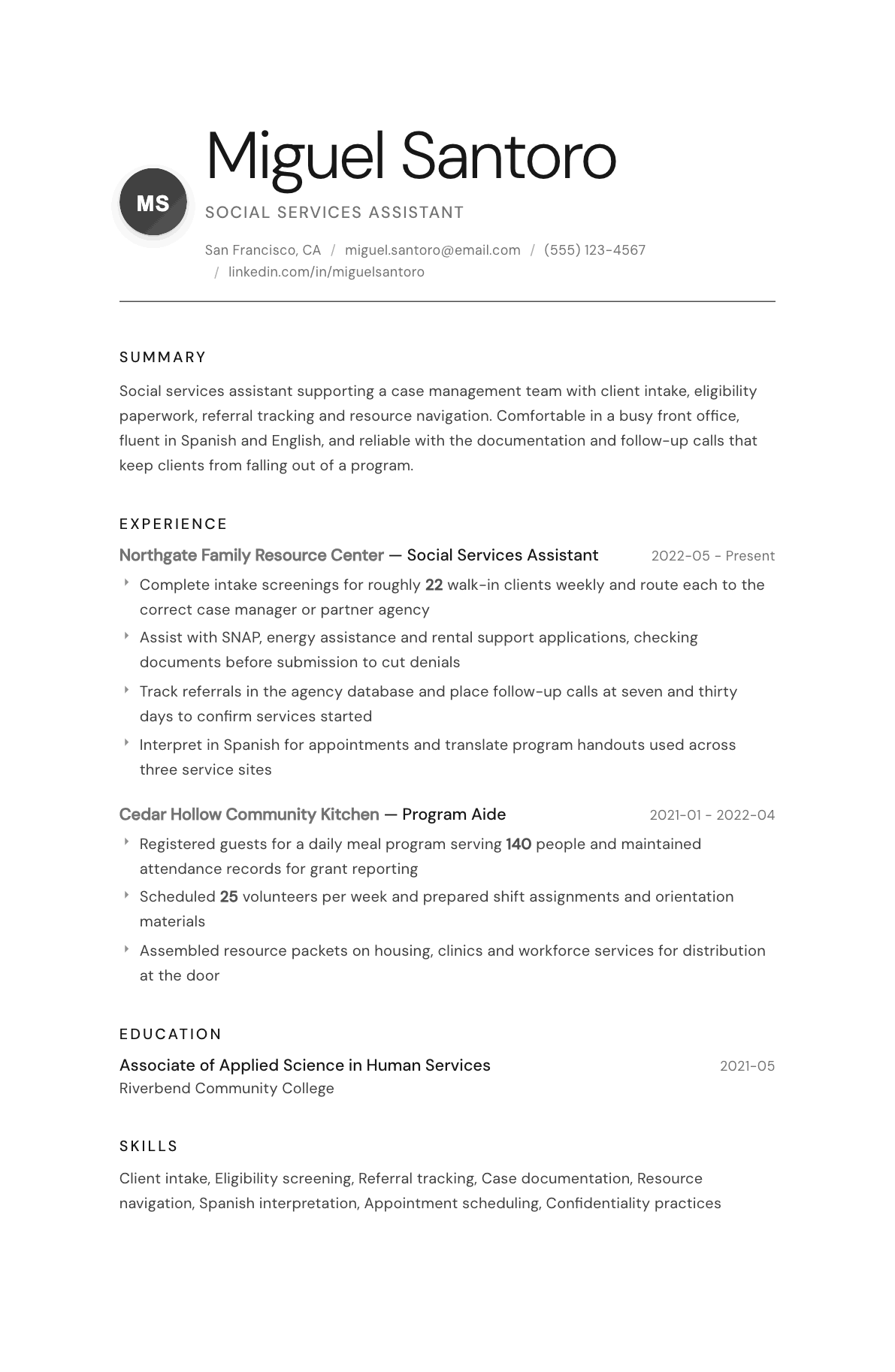
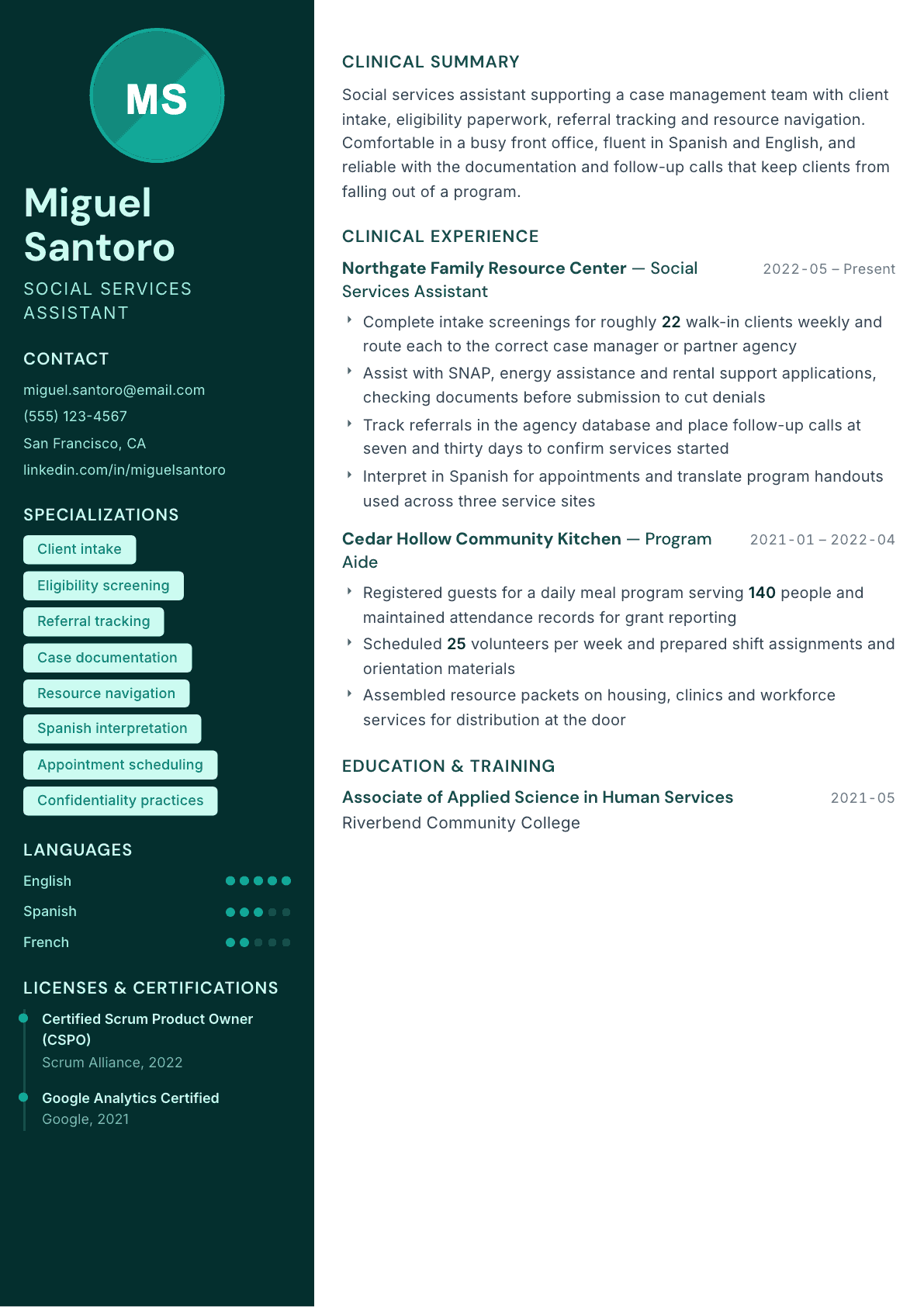
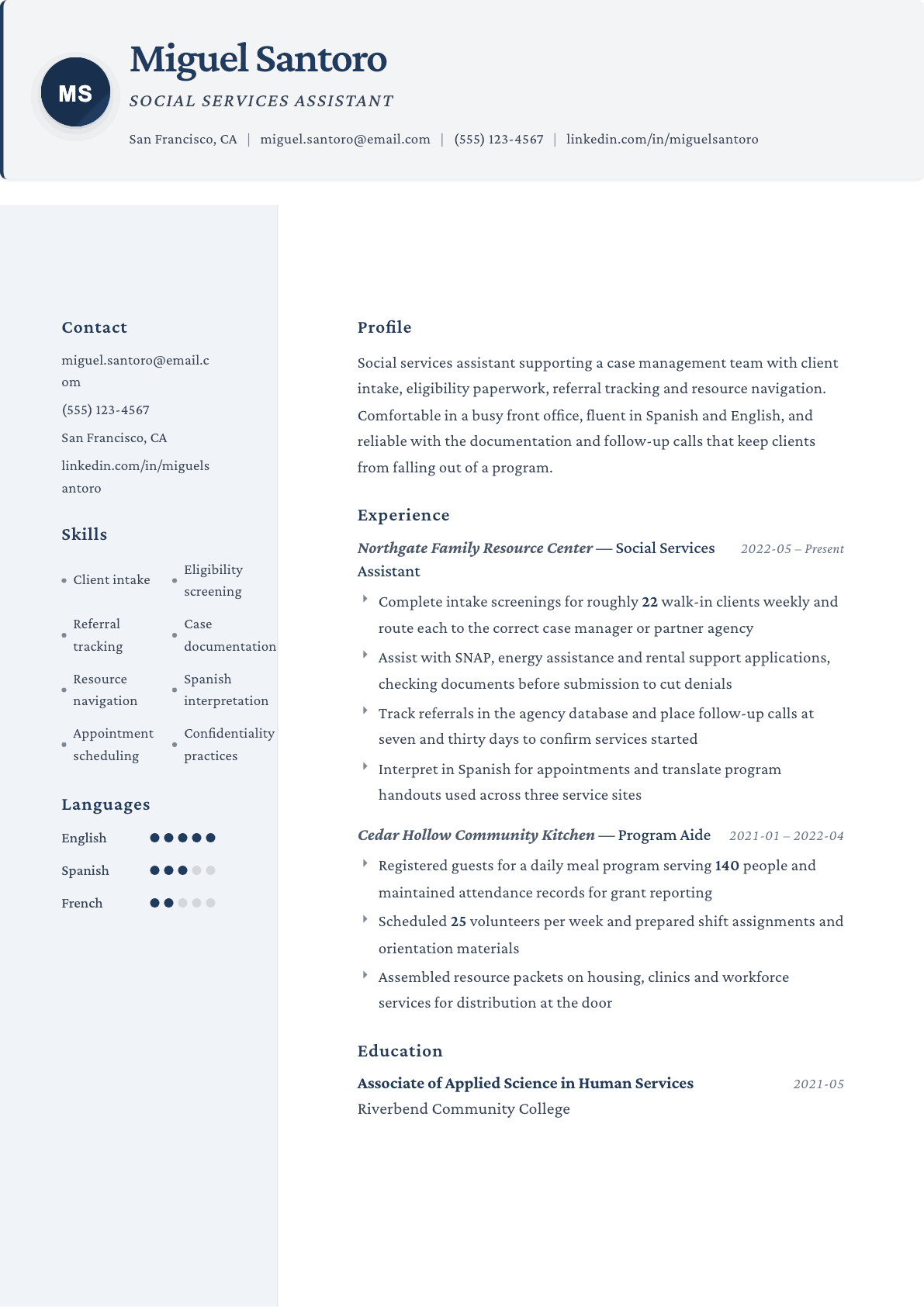
The same social services assistant content laid out in three CVBooster templates, so you can see what the finished document looks like before you write a word.
Example Social Services Assistant summary
Social services assistant with three years supporting a community case management team through intake screening, benefits paperwork and referral follow-up. Bilingual in Spanish and English, accurate with case documentation, and steady in a walk-in setting where clients arrive in crisis. Familiar with food, energy and rental assistance programs and the documents each requires. Seeking a human services role with a path toward case management.
Skills to list on a Social Services Assistant resume
- Client intake and screening
- Benefits eligibility support
- Referral tracking and follow-up
- Case note documentation
- Resource navigation
- Crisis de-escalation basics
- Confidentiality and HIPAA awareness
- Appointment scheduling
- Data entry and reporting
- Community outreach
- Bilingual interpretation
- Program record keeping
- Front desk coverage
- Volunteer coordination
What actually gets this resume read
- Show volume in the front office: intakes completed weekly, calls handled, and applications assisted with.
- Name the benefit programs you helped clients apply for, because those program names are searched directly.
- Include the case management database you used and any reporting you prepared from it.
- List a second language and whether you interpreted formally, since agencies weigh that heavily.
- Describe follow-up practice rather than duties, because closing the loop is what supervisors are hiring for.
- Mention volunteer or internship hours in human services if your paid history is short, with the setting named.
How to write a social services assistant resume
A social services assistant resume is usually read by a program supervisor who is trying to fill a position that has been open too long, in an office where the phone does not stop. They are hiring for reliability first and warmth second. Will this person show up at eight, complete the intake form correctly, notice when a client is in crisis, and not go quiet when a case manager is out sick.
That makes the resume different from a clinical one. Nobody expects a treatment plan. They expect accuracy on paperwork, follow-through on phone calls, judgment about when to hand a situation upward, and enough steadiness to work a waiting room where people arrive angry, exhausted or frightened. The way to prove that is with volume and specifics, not with adjectives about being a people person.
This guide covers how to structure the page when your experience is short, how to describe intake and referral work in numbers, which trainings genuinely help, three summaries for different starting points, and rewritten bullets that turn an entry-level history into a credible human services application.
Format: one page, front-loaded with what you can do on day one
One page, reverse-chronological, no exceptions at this level. Under the summary put a short capability line: intake screening, benefits application support, referral tracking, database entry and any language you speak. A supervisor scanning twenty files is looking for the four or five tasks they can hand over immediately.
If your paid history is thin, do not pad it with responsibilities you were never given. Add a separate block for volunteer work, practicum hours or a community role and treat it as real experience with dates, hours and duties. Human services supervisors read volunteer sections seriously because that is how most of them started.
- Header: name, city and state, phone, email, languages spoken.
- Order: summary, skills, experience, volunteer or field experience, education, trainings.
- State schedule availability and reliable transportation, since outreach and home visit support come up often.
Summary: the tasks you own and the office you can hold
Three sentences. Name the setting you have worked in, the tasks you carried independently, the volume you handled, and any language beyond English. An assistant who completed intake screenings for around twenty-two walk-in clients weekly and routed each to the right case manager has said something no adjective could.
If you are coming from retail, food service or a call center, translate rather than apologize. High-volume customer contact, cash and record accuracy, de-escalation with upset people and shift reliability are exactly the base skills the job needs, and naming them that way is honest.
Experience: intake volume, paperwork accuracy, follow-up
Write bullets around the three things this role is judged on. First, intake and screening: how many clients you saw or called, what you screened for, and how you decided where to route them. Second, paperwork: which benefit applications you helped with, what documents you verified, and whether that verification reduced denials or returns. Third, follow-up: the calls you made after a referral, at what intervals, and what percentage of clients you could confirm had started services.
Add the office backbone work that keeps a program running: scheduling, file maintenance, data entry into a case management system, preparing reports for a grant deadline, and stocking or assembling resource materials. Supervisors know this work is invisible until nobody does it.
Where you have language skills, treat interpretation as a real duty and describe it. Interpreting in appointments, translating handouts, and taking calls in a second language are distinct contributions that many agencies are actively short of.
- Give weekly or monthly client volume for intake, calls and appointments.
- Name the benefit programs you supported applications for.
- Describe your follow-up rhythm and what you did when a client could not be reached.
- Name the database or case management system you entered data into.
Boundaries and confidentiality: the thing supervisors worry about
The most common reason a new assistant creates a problem is not incompetence, it is boundary drift: giving advice outside the role, sharing information with a family member who asked nicely, or trying to solve a crisis alone rather than pulling in a case manager. A short bullet showing that you know where your role ends is genuinely reassuring.
Say how you handled confidentiality in a shared space: verifying identity before releasing information, keeping files off the counter, and escalating disclosures that required a mandated report. Concrete practice beats writing that you maintained confidentiality.
Keywords agency postings use for this role
Postings recycle a small set: intake, screening, eligibility, referral, resource navigation, case notes, data entry, client records, community outreach, confidentiality, mandated reporting, de-escalation and bilingual. Use them in your skills block and attach the important ones to real work in a bullet.
Include the benefit program names too, because a supervisor searching a candidate pool will search for the exact programs their office administers.
Social Services Assistant resume summary examples
First human services job
Human services graduate with a practicum at a family resource center completing intake forms, assembling resource packets and making follow-up calls under supervision. Two years of customer-facing retail experience with a strong attendance record. Bilingual in Spanish and English. Seeking a social services assistant position in a community agency.
Three years in the office
Social services assistant supporting a five-person case management team with intake screening for around 22 walk-in clients weekly, benefit application preparation and referral tracking. Interprets in Spanish for appointments and maintains the agency referral database. Known for catching missing verification documents before an application is submitted.
Lead assistant
Lead social services assistant coordinating front office operations for a multi-site agency, training two newer assistants and preparing monthly service counts for three grant reports. Six years of intake, benefits navigation and referral follow-up experience. Rebuilt the intake form to capture the data the funder actually requested.
Work experience bullets: before and after
Before: Greeted clients and answered questions at the front desk.
After: Completed intake screenings for roughly 22 walk-in clients weekly, identified the presenting need, and routed each person to the correct case manager or partner agency the same day.
Volume, the screening decision and the same-day routing show a working process rather than desk coverage.
Before: Helped clients fill out forms for assistance programs.
After: Assisted with food benefit, energy assistance and rental support applications, verifying identification, income and residency documents before submission to cut avoidable denials.
Named programs and the verification step explain why the help mattered instead of describing form filling.
Before: Made follow-up calls to clients.
After: Tracked referrals in the agency database and called clients at seven and thirty days to confirm services had started, logging outcomes for the monthly program report.
A defined follow-up interval plus reporting turns a phone task into the loop closure supervisors are missing.
Before: Spoke Spanish with clients who needed it.
After: Interpreted in Spanish for intake appointments and case manager meetings and translated program handouts used across three service sites.
Naming the settings and the translation work makes language a documented contribution rather than a personal attribute.
Before: Entered client information into the computer.
After: Maintained client records in the case management system with same-day entry, and prepared quarterly service counts used in two grant reports.
Entry timeliness and the reporting use show the data mattered downstream, which is what an auditor checks.
Hard skills
- Client intake and screening
- Benefits eligibility support
- Document verification
- Referral tracking and follow-up
- Case note and record documentation
- Case management database entry
- Appointment scheduling
- Community resource navigation
- Program reporting and service counts
- Confidentiality and privacy practice
- Mandated reporting basics
- Bilingual interpretation
- Front office operations
- Volunteer scheduling support
Soft skills
- Steadiness in a busy waiting room
- De-escalation with upset clients
- Attention to detail on paperwork
- Knowing when to escalate
- Nonjudgmental listening
- Dependable attendance
Certifications worth listing
- Mental Health First Aid (National Council for Mental Wellbeing)
- Basic Life Support (BLS) (American Heart Association)
- Certified Community Health Worker (State department of health)
Mistakes that cost social services assistant candidates the interview
- Writing a duties list copied from the job posting, which tells a supervisor nothing about what you personally handled.
- Leaving out volume entirely, so a role serving five clients a week looks the same as one serving fifty.
- Hiding volunteer or practicum hours at the bottom, when that is often the only human services experience on the page.
- Claiming case management responsibilities you did not hold, which unravels in the first interview question about caseload.
- Skipping the language skill or burying it, when bilingual staff are the hardest position for many agencies to fill.
- Ignoring reliability evidence such as attendance or tenure, which is the single trait supervisors are most worried about.
Social Services Assistant resume questions
Can I get a social services assistant job without a degree?
Often yes. Many agencies accept a high school diploma with relevant experience, and some prefer an associate degree in human services. Volunteer hours, a community health worker training or lived experience with the population you would serve all strengthen an application without a degree.
How do I make retail or restaurant experience count?
Translate it into the skills the role uses: high-volume customer contact, accurate record keeping, calming upset people, working under time pressure and reliable attendance. Give numbers where you have them. That framing is honest and reads as directly relevant rather than as filler.
What is the difference between a social services assistant and a case manager?
An assistant supports the process: intake, paperwork, scheduling, data entry and follow-up calls. A case manager carries a caseload and owns assessment, service planning and outcomes. Do not blur the two on your resume, because supervisors ask directly about which responsibilities were yours.
Should I mention my own experience with the services the agency provides?
Only if you are comfortable and it is relevant to the role, such as a peer support position where it is an asset. Keep it brief and framed around what it lets you do for clients. You are never obligated to disclose personal history on a resume.
How do I show I am ready to move into case management?
Point to the parts of your work closest to it: screening decisions you made, resource plans you built, clients you followed over time, and any coursework toward a human services or social work degree. Then say in your summary that you are seeking a role with a path to case management.
Related resume examples
- Case Manager Resume example
- Outreach Coordinator Resume example
- Caseworker Resume example
- Community Health Worker Resume example
- Family Support Worker Resume example
- Refugee Resettlement Caseworker Resume example