Embedded Systems Engineer Resume Examples: free score
Program Your Career with an Embedded Systems Engineer Resume
By Mustafa Tarabya, founder of CVBooster · Published · Updated
Create an embedded systems engineer resume showcasing your firmware development and hardware-software integration expertise.
Sample resumes for a embedded systems engineer
The same embedded systems engineer content laid out in three CVBooster templates, so you can see what the finished document looks like before you write a word.
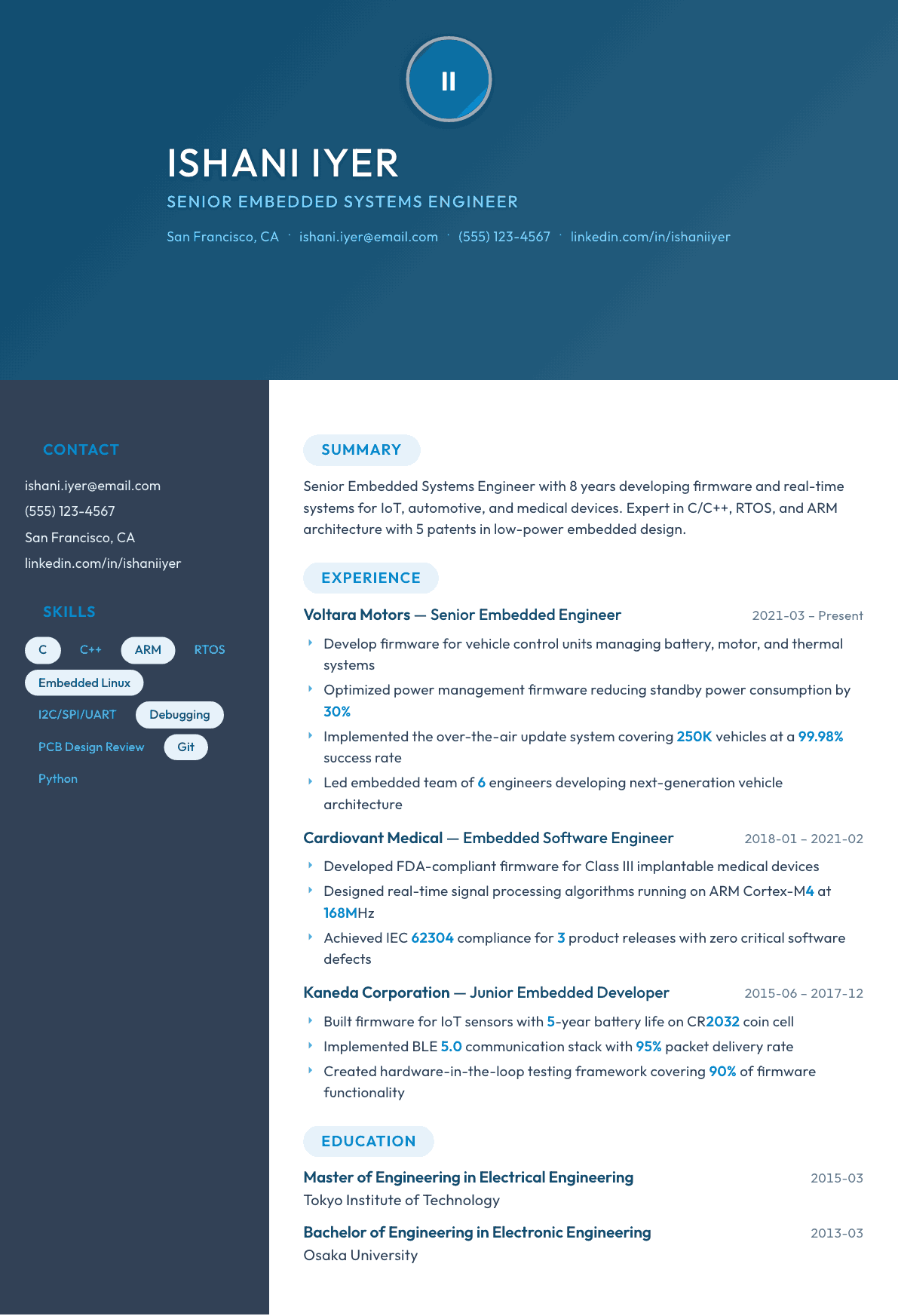
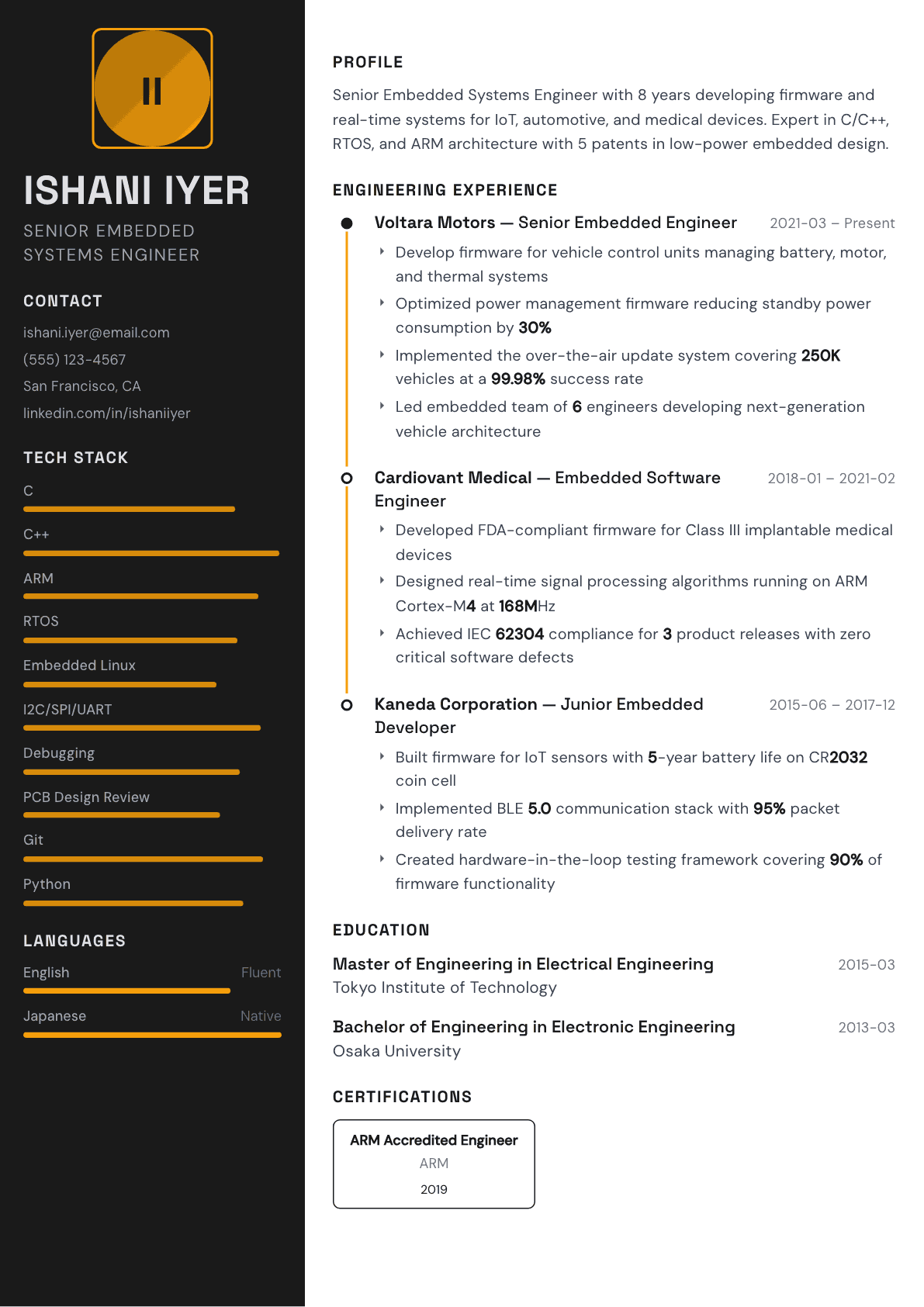
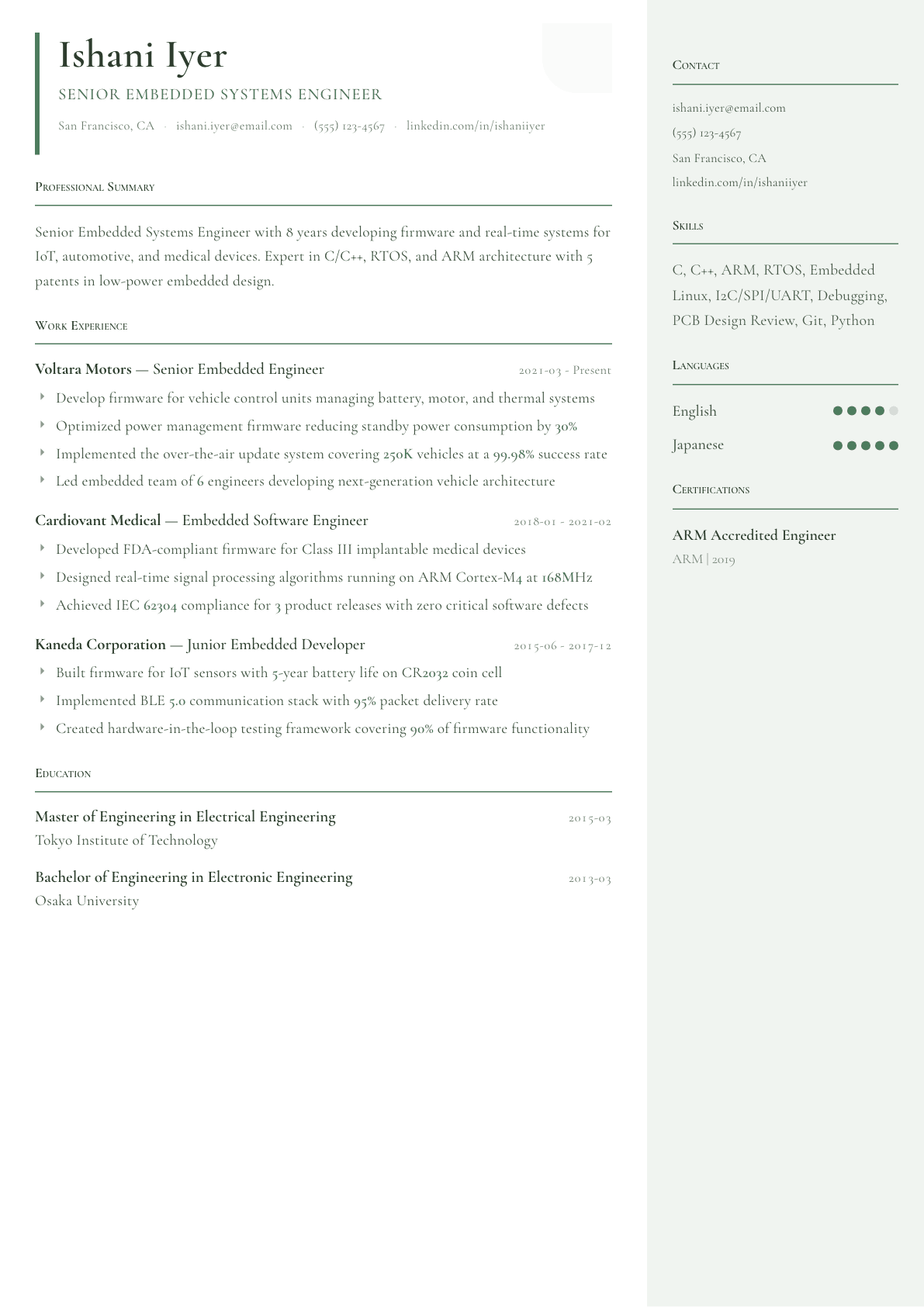
Example Embedded Systems Engineer summary
Senior Embedded Systems Engineer with 8 years developing firmware for automotive and medical devices. Expert in C/C++, ARM architecture, and RTOS with 5 patents in low-power design.
Skills to list on a Embedded Systems Engineer resume
- C
- C++
- ARM Cortex
- RTOS
- Embedded Linux
- I2C
- SPI
- UART
- CAN
- BLE
- PCB Review
- JTAG/SWD
- Python
- Git
What actually gets this resume read
- Highlight specific microcontroller families and architectures.
- Include protocol expertise (I2C, SPI, UART, CAN, BLE).
- Show compliance experience (IEC 62304, ISO 26262, DO-178C).
- Quantify power optimization and performance improvements.
- Mention any patents or hardware design collaboration.
How to write a embedded systems engineer resume
An embedded systems engineer resume is read by a firmware lead who wants to know one thing above all: has your code run on hardware that went out of the building and stayed working. Firmware cannot be hot-fixed the way a web service can, the device may be in a vehicle or a patient, and field updates are expensive or impossible. That reality shapes what belongs on the page.
The details that carry weight are the ones a firmware lead can picture: the microcontroller family, the real-time operating system or the bare-metal loop, the peripherals and buses, the power budget, the tools you debug with, and whether the product went through a safety or regulatory process. Generic software language does not survive contact with this reader.
This guide covers each section as an embedded hiring team reads it, with three summaries at recognizable levels, before-and-after bullets that replace vague firmware claims with hardware-level evidence, and the questions engineers ask when moving in from application software or from electrical engineering.
Format: one to two pages, silicon named under every job
Reverse chronological, single column, one to two pages depending on years. The line that matters most is the environment line under each job title: the processor family and core, the operating system or scheduling model, the toolchain, the memory available and the product the firmware went into.
A reader can calibrate you instantly from that line. Writing firmware for an ARM Cortex-M0 with 32 KB of flash and no operating system is a different discipline from writing an application on an embedded Linux system on a chip, and both are legitimate.
- Header: name, title, location, email, GitHub, and patents if you hold any.
- Order: summary, technical skills, experience, selected products, patents and publications, education.
- Under each job: core and family, RTOS or bare metal, toolchain and debugger, memory constraints, product type.
Summary: the silicon, the domain, and the constraint you engineer against
Three lines. Name the processor families you work in, the operating system model, the industry, and the hardest constraint you have designed against: power in a coin-cell device, hard real-time deadlines in a motor controller, memory in a cost-reduced part, or certification evidence in a medical or automotive program.
Constraint is the fastest way to communicate seniority in embedded work. An engineer who says they took a sensor node to a multi-year battery life on a coin cell has said more than a paragraph of framework names.
Experience: bring-up, drivers, integration, and field behavior
Cover the arc. Bring-up bullets describe first silicon or first board: clock and power configuration, boot from a new flash part, getting a serial console alive, and the schematic issues you found before the hardware team did. That work is highly valued because it needs both domains.
Driver and protocol bullets name the buses and the difficulty: an I2C sensor with a broken datasheet, a SPI display with tight timing, a CAN stack in a vehicle network, a Bluetooth Low Energy profile with connection interval tuning for power. Say what you measured with, since a logic analyzer or an oscilloscope capture is the proof an embedded engineer works from.
Then the parts that separate mid from senior: the update mechanism with a rollback path and image verification, the watchdog and fault handler strategy, the logging you can extract from a returned unit, and what you found in the field. A field failure diagnosed from a fault log is one of the strongest bullets available in this discipline.
Testing and safety: the evidence trail regulated products need
Say how firmware is tested when the target is not a laptop. Unit tests on the host with hardware abstraction mocked, hardware-in-the-loop rigs, automated regression on a rack of real boards, power profiling and long-duration soak tests. An engineer who has built a test rig has built the thing that makes releases possible.
Where the product is regulated, name the standard and your actual role in it: requirements traceability, design records, static analysis against a coding standard such as MISRA C, unit-level coverage evidence, or the hazard analysis you contributed to. Be precise about whether you produced the evidence or supported someone who did.
Skills: language, silicon, protocols, tools
Four groups. Languages: C first, then C++ with the subset you use, plus Python for test and tooling. Silicon and platforms: the microcontroller families, the real-time operating systems, embedded Linux and the build system if you use one. Protocols: I2C, SPI, UART, CAN, USB, Bluetooth Low Energy, Ethernet and any industrial bus.
Then tools, which are underweighted on most resumes and carry real signal here: the compiler toolchain, the debugger and trace probe, the oscilloscope and logic analyzer, the power analyzer, static analysis, and the version control and continuous integration setup you built firmware in.
Embedded Systems Engineer resume summary examples
Graduate or first firmware role
Electronics graduate with a capstone on a battery-powered sensor node. Wrote bare-metal C on an ARM Cortex-M4, brought up I2C and SPI sensor drivers verified with a logic analyzer, and cut average current draw 40% by moving the main loop to interrupt-driven sleep.
Five years in firmware
Embedded systems engineer with 5 years on ARM Cortex-M devices running FreeRTOS in industrial sensing products. Owns the Bluetooth Low Energy stack integration and the over-the-air update path with signed images and rollback, and built the hardware-in-the-loop rig used for release testing.
Lead or principal engineer
Principal embedded systems engineer with 12 years across automotive and medical devices. Led firmware for a motor control unit under ISO 26262 process, owned the CAN application layer and fault handling, and mentors 5 engineers on real-time design and static analysis discipline.
Work experience bullets: before and after
Before: Developed firmware in C for embedded devices.
After: Wrote the application firmware in C for an ARM Cortex-M4 running FreeRTOS in 256 KB of flash, covering the sensor sampling task, the Bluetooth Low Energy link and the fault handler that captures a stack trace to external flash.
Core, operating system, memory ceiling and the specific subsystems tell a firmware lead exactly what you have built.
Before: Optimized power consumption on a battery device.
After: Cut average current from 310 microamps to 46 by moving the sampling loop to a low-power timer with DMA transfers, gating unused peripheral clocks and raising the advertising interval, verified on a power analyzer over a 72-hour run.
Measured before and after figures with named techniques and instrumentation make a power claim verifiable.
Before: Debugged hardware and software issues.
After: Traced an intermittent I2C bus lockup to a clock stretch the sensor performed beyond the driver timeout, confirmed it on a logic analyzer capture, and fixed it with a bus recovery routine plus a timeout aligned to the datasheet worst case.
The root cause, the instrument and the fix show real hardware debugging instead of a generic troubleshooting claim.
Before: Implemented firmware updates for our products.
After: Built the over-the-air update path with a dual-bank layout, signature verification before the image is marked valid, and an automatic rollback if the application fails to confirm within two boots, tested through 500 interrupted update cycles.
A described failure-safe design plus interrupted update testing is what stops a fleet from being bricked.
Before: Worked with the hardware team on new board designs.
After: Reviewed 4 board revisions before release: flagged a missing pull-up on the boot select line, requested test points on the debug interface, and validated the power sequencing against the processor requirements during bring-up.
Specific review findings prove genuine hardware and software collaboration rather than attendance at meetings.
Hard skills
- Embedded C
- C++ for constrained targets
- ARM Cortex-M and Cortex-A
- FreeRTOS and Zephyr
- Embedded Linux and device drivers
- I2C, SPI, UART and CAN
- Bluetooth Low Energy
- USB device firmware
- Bootloaders and over-the-air update
- Low-power design and power profiling
- JTAG and SWD debugging
- Oscilloscope and logic analyzer use
- Static analysis and MISRA C
- Hardware-in-the-loop test automation
Soft skills
- Reading a schematic and a datasheet critically
- Working with hardware engineers
- Patience with intermittent faults
- Documenting design decisions for audits
- Estimating under hardware uncertainty
- Explaining firmware limits to product teams
Certifications worth listing
- Certified LabVIEW Associate Developer (NI)
- Professional Engineer (PE) License (NCEES and state licensing boards)
Mistakes that cost embedded systems engineer candidates the interview
- Leaving out the processor family and memory constraints, which is the first thing a firmware lead looks for.
- Describing firmware in application software language, so the reader cannot tell whether you have ever met an interrupt.
- Claiming low-power work with no current figures or measurement method behind it.
- Omitting the debugging tools, when instrument fluency is a large part of what the role is hired for.
- Skipping the update and recovery mechanism on connected products, which is the risk a manager worries about most.
- Listing a safety standard without saying what you personally produced under it.
- Presenting only simulation or evaluation board work when the posting is for a product that has to survive the field.
Embedded Systems Engineer resume questions
How much hardware knowledge should an embedded systems engineer show?
Enough to be useful in bring-up and debugging: reading schematics, understanding power sequencing and signal integrity basics, and using an oscilloscope and logic analyzer. You are not applying as a hardware designer, but a firmware engineer who cannot probe a bus is limited.
Do I need C++ or is C enough for embedded roles?
C remains the core language and many products are entirely C. C++ appears in larger codebases and on more capable parts, usually with a restricted subset. List C first with depth, then C++ with the features you actually use in constrained code.
How do I show embedded experience if my products are confidential?
Describe the class of device, the processor, the constraints and the technical problems without naming the product or customer. Add a personal hardware project on a development board so the reviewer has something concrete they can look at.
Are patents worth listing on an embedded systems resume?
Yes if they are granted or published, with the number and a short title in a dedicated block. They signal original work in a field where much of the output is confidential, but keep the block short and never let it push the experience section off page one.
How do I move from application software into embedded systems?
Start with the parts of your background that transfer: C, concurrency, memory discipline and debugging. Then build real evidence on hardware, including a driver written from a datasheet, a bootloader, or a project running under a real-time operating system on a development board.
Related resume examples
- Firmware Engineer Resume example
- Robotics Engineer Resume example
- Electrical Engineer Resume example
- Computer Engineer Resume example
- Rust Developer Resume example
- Computer Science Student Resume example