Computer Engineer Resume Examples: the lines they read
Write a Computer Engineer Resume That Bridges Hardware and Software
By Mustafa Tarabya, founder of CVBooster · Published · Updated
A computer engineer resume example spanning embedded firmware, digital design and verification, with keywords and a section by section guide.
Sample resumes for a computer engineer
The same computer engineer content laid out in three CVBooster templates, so you can see what the finished document looks like before you write a word.
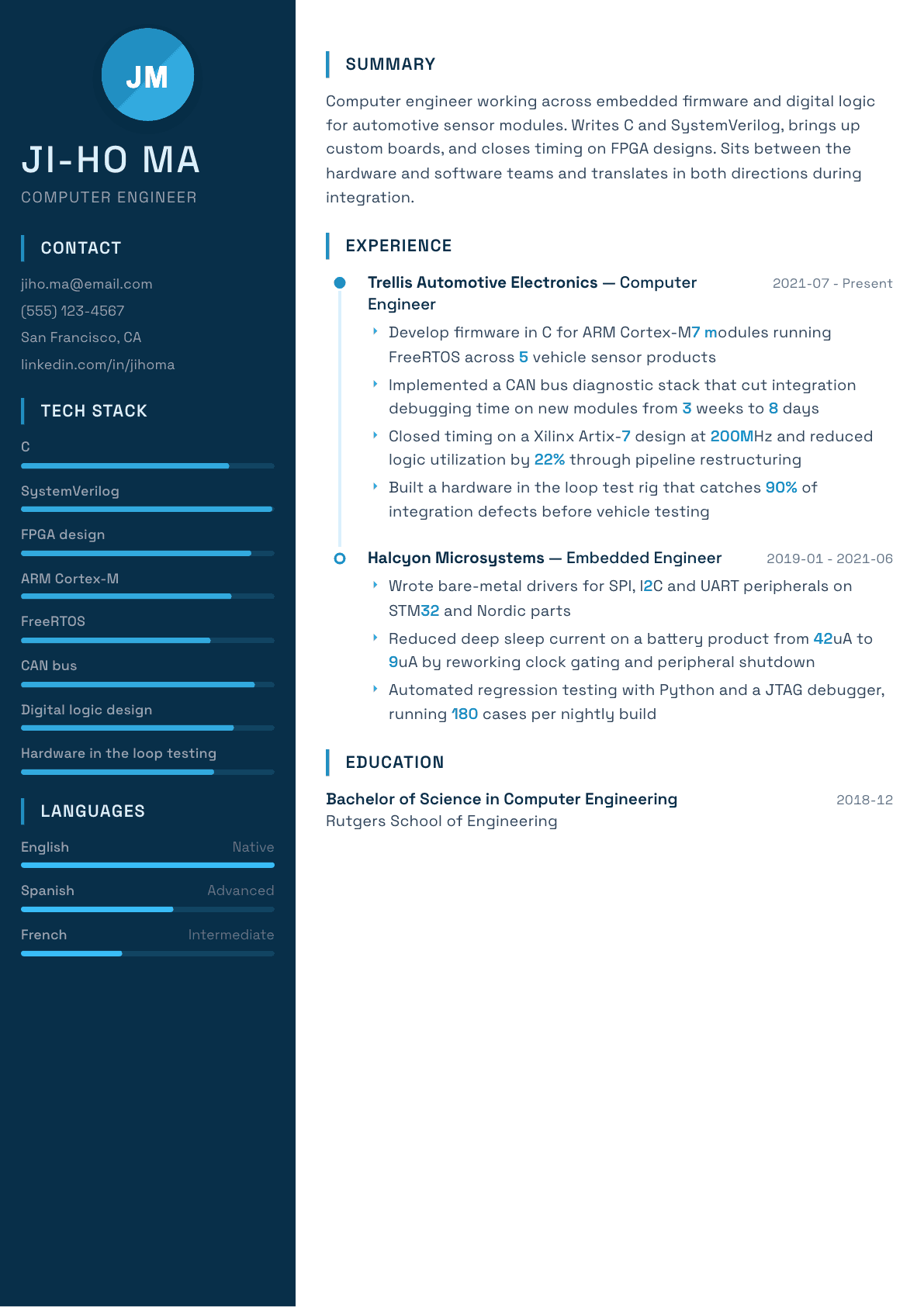
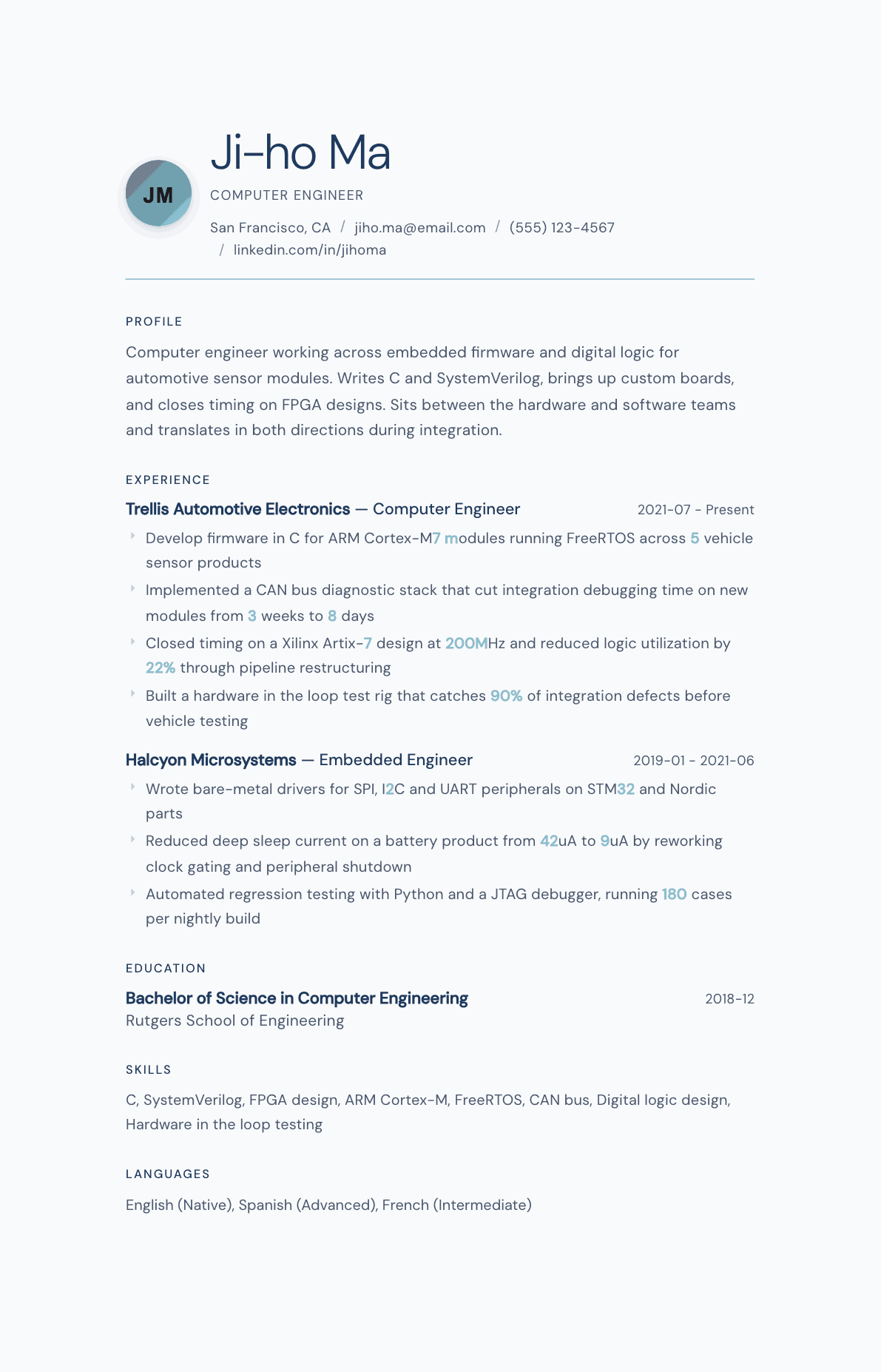
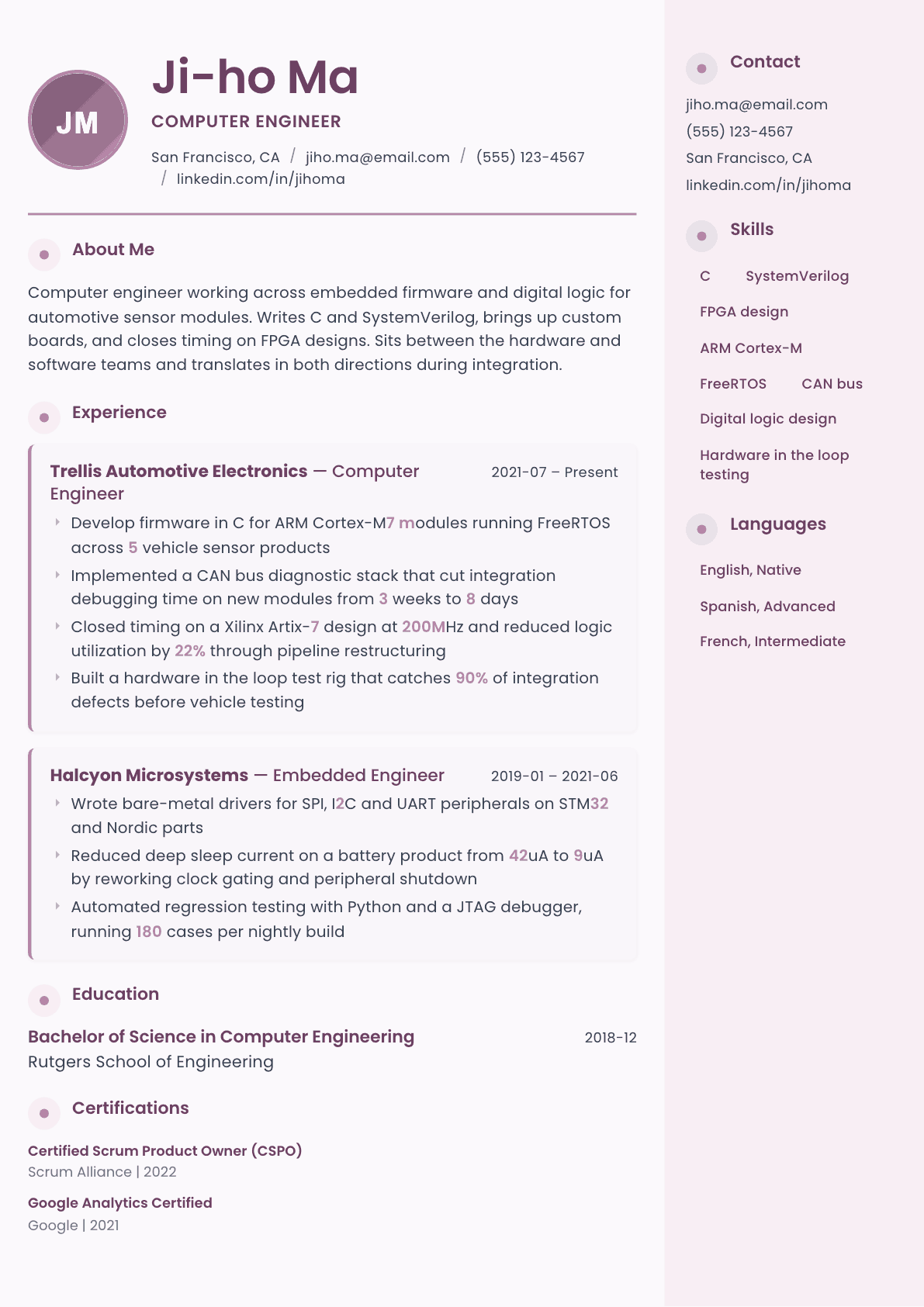
Example Computer Engineer summary
Computer engineer with six years across embedded firmware and FPGA design for automotive sensor modules. Writes C on ARM Cortex-M under FreeRTOS, closes timing on Artix-7 designs, and owns the hardware in the loop rig used by both teams. Cut deep sleep current from 42uA to 9uA and reduced module integration time from three weeks to eight days. Seeking an embedded systems role in robotics or automotive.
Skills to list on a Computer Engineer resume
- C
- C++
- SystemVerilog
- VHDL
- FPGA design
- Digital logic design
- ARM Cortex-M
- FreeRTOS
- Embedded Linux
- CAN bus
- SPI and I2C
- Computer architecture
- Timing closure
- Hardware in the loop testing
- JTAG debugging
- Python automation
What actually gets this resume read
- Decide which side you are selling, embedded software or digital design, and put that experience first on the page.
- Name the processor families and toolchains you have used, because those are the exact strings a recruiter searches.
- Quantify low-level wins that only a computer engineer can claim, such as current draw, clock frequency or logic utilization.
- Show integration work, since the value of this role is often bridging a firmware team and a hardware team.
- Include your test infrastructure work: hardware in the loop rigs and automated regression suites carry real weight.
- Keep the coursework section only while you are early, then replace it with projects that shipped on real hardware.
How to write a computer engineer resume
Computer engineer is the most ambiguous title in technical hiring. It is claimed by people writing firmware on microcontrollers, people closing timing on field programmable gate arrays, people designing processor subsystems, and people who studied computer engineering and now write web services. The reviewer opening your resume has a specific opening in mind and about twenty seconds to decide whether you match it. Your first job is to remove the ambiguity in the top third of the page.
Once she knows which side of the hardware and software boundary you live on, she reads for the evidence that only exists in this field: processor families you have written against, real time operating systems, bus protocols, timing closure, power measurement, and the debug tools you reach for when a device hangs and no console is attached. Those specifics are also what an interviewer will use to build the technical screen, so writing them precisely is both honest and strategic.
This guide covers the format, how to write a summary that positions you, experience bullets that carry low-level credibility, the skills grouping to use, and the questions computer engineers ask when preparing this document.
Format: single column, technical profile block, one page early
Reverse chronological, single column, one page until you have roughly seven years of work. Directly under your name write three short lines: the domain you work in, the processor and device families, and the languages. That block does the positioning work that a title alone cannot, and it is the part a hiring engineer rereads before the interview.
Keep the project section for as long as it is stronger than your employment history, which for many computer engineers means the first three or four years. A well described personal project on real hardware beats a vague professional bullet, especially for embedded roles.
- Header: name, title, city, phone, email, GitHub.
- Order: technical profile, skills, experience, projects, education, certifications.
- Under each job, a scope line: product type, your layer of the stack, and who you integrated with.
Summary: pick a side, then prove you can cross it
Three lines. State the domain first: embedded firmware, digital design and verification, system on chip integration, or hardware and software integration. Then name the platforms and the languages. Then, if it is true, add the crossing point, because the value of a computer engineer is often that she can debug across a boundary two specialists both point at.
Avoid describing yourself as a generalist. In this field it reads as unformed rather than versatile. Say instead that you write firmware in C on ARM Cortex-M parts and close timing on small field programmable gate array designs, which is specific, checkable, and describes exactly the same flexibility.
Experience: platforms, protocols, and measurements only you could have made
Every bullet should carry something a web developer could not write. Name the processor family and the toolchain. Name the real time operating system, if any, and the scheduling problem you solved with it. Name the buses: controller area network, serial peripheral interface, inter-integrated circuit, universal asynchronous receiver transmitter, or a memory-mapped fabric. These are not decoration; they are how a lead judges depth.
Quantify at the level this job works in. Microamps in deep sleep, clock frequency at which timing closed, logic utilization on the target device, interrupt latency, boot time, memory footprint in kilobytes, and defect counts caught by an automated rig. These numbers are unusual on a resume and immediately credible, because nobody invents a current draw figure.
Integration deserves its own bullet. A large part of a computer engineer's daily value is standing between the hardware team and the software team when a fault has no obvious owner. Describe a case where you found it: a signal captured on a logic analyzer, a race condition in an interrupt handler, a marginal timing path that only failed hot, a bus arbitration issue under load.
Test infrastructure is the most underused content in this field. A hardware in the loop rig, an automated regression suite driven through a debug probe, or a nightly build that flashes real boards will separate you from candidates whose testing story ends at the simulator. Say what it covers and what it catches.
- Name processor family, toolchain and real time operating system in the bullets, not only the skills list.
- Give at least two low-level measurements with before and after values.
- One integration or cross-boundary debug bullet.
- One bullet on automated hardware testing if you have built any.
Skills: group by layer so the reviewer can place you instantly
Use four groups. Languages and hardware description languages: C, C plus plus, Python for tooling, SystemVerilog or VHDL if you write them. Platforms: the microcontroller families, the field programmable gate array vendors, embedded Linux if relevant. Protocols and interfaces: the buses, the wireless stacks, the automotive or industrial protocols. Tools: the integrated development environments, debug probes, logic analyzers, simulators and version control.
Do not put SystemVerilog beside C without indicating which one you actually work in daily. Digital verification and firmware are separate hiring pipelines, and a list that implies equal fluency in both invites a screen that tests the weaker one.
Keywords these postings are built from
Computer engineering job descriptions repeat: embedded C, ARM Cortex, real time operating system, FreeRTOS, bare metal, device drivers, controller area network, serial peripheral interface, inter-integrated circuit, field programmable gate array, SystemVerilog, VHDL, timing closure, computer architecture, JTAG, oscilloscope, logic analyzer, embedded Linux and hardware in the loop. Use the ones that are true inside real sentences, and keep the vendor names, since teams filter on them.
Computer Engineer resume summary examples
New graduate
Computer engineering graduate with coursework in computer architecture, digital design and operating systems, plus two hardware projects: a bare metal STM32 data logger and a four stage pipelined processor implemented in SystemVerilog on an Artix board. Seeking an entry level embedded software or digital design position.
Five years embedded
Computer engineer with five years writing C firmware on ARM Cortex-M parts under FreeRTOS for automotive sensor modules, plus field programmable gate array work in SystemVerilog. Cut deep sleep current from 42uA to 9uA, closed timing at 200MHz, and built the hardware in the loop rig now used across the team.
Systems lead
Senior computer engineer owning the firmware and logic architecture for a family of industrial control modules. Defines the boot and update path, the bus topology and the verification strategy, reviews all driver code, and leads the integration effort between the hardware, firmware and application teams through every product release.
Work experience bullets: before and after
Before: Wrote firmware for embedded devices.
After: Developed C firmware on ARM Cortex-M7 modules running FreeRTOS across five vehicle sensor products, owning the driver layer and the over the air update path.
Processor family, operating system, product count and layer ownership together establish real embedded depth.
Before: Reduced power consumption on a battery product.
After: Cut deep sleep current from 42uA to 9uA by reworking clock gating, shutting down unused peripherals and moving the sensor poll to a low power timer.
A current measurement with three named techniques is unfakeable and instantly credible to an embedded lead.
Before: Worked on FPGA designs.
After: Closed timing on an Artix-7 design at 200MHz and reduced logic utilization by 22% by restructuring the pipeline and sharing a multiplier across two data paths.
Timing frequency, utilization and the restructuring technique show digital design capability rather than exposure.
Before: Debugged integration issues with the hardware team.
After: Traced intermittent module resets to a bus arbitration conflict under load using a logic analyzer capture, then reworked the interrupt priority scheme to eliminate the stall.
The fault, the instrument and the fix describe an engineer who solves problems across the hardware boundary.
Before: Set up automated testing.
After: Built a hardware in the loop rig running one hundred and eighty regression cases nightly against real boards through a JTAG probe, catching most integration defects before vehicle testing.
A concrete rig, a case count and the defect stage it protects prove ownership of test infrastructure.
Hard skills
- Embedded C and C plus plus
- ARM Cortex-M development
- FreeRTOS and bare metal firmware
- Device driver development
- SystemVerilog and VHDL
- FPGA design and timing closure
- Digital logic and computer architecture
- CAN, SPI, I2C and UART
- Embedded Linux
- JTAG debugging and logic analyzers
- Hardware in the loop testing
- Python test automation
Soft skills
- Cross-team debugging
- Technical documentation for hardware and software readers
- Design review discipline
- Root cause persistence
- Prioritizing under integration deadlines
Certifications worth listing
- Certified LabVIEW Associate Developer (NI)
- Certified SOLIDWORKS Associate in Electrical (Dassault Systemes)
- AWS Certified Solutions Architect Associate (Amazon Web Services)
Mistakes that cost computer engineer candidates the interview
- Leaving the title to do the positioning, so a reviewer cannot tell a firmware engineer from a verification engineer.
- Listing every language ever touched, which dilutes the two or three you would want to be interviewed on.
- Writing software-style bullets about features and sprints with no processor, bus or measurement anywhere.
- Claiming equal fluency in firmware and hardware description languages when one is clearly your daily work.
- Omitting debug tooling, when the ability to find a fault with a logic analyzer is central to the job.
- Keeping a coursework block on the page years after real hardware work should have replaced it.
Computer Engineer resume questions
Is a computer engineer resume different from a software engineer resume?
Yes. A software engineer resume centers on systems, languages and delivery. A computer engineer resume has to carry hardware context: processors, buses, timing, power and debug instruments. Without those specifics a reviewer will read it as an ordinary software application and route it accordingly.
Should I apply to both embedded and FPGA roles with one resume?
Keep two versions. The ordering and the top profile block change: firmware roles want C, real time operating systems and drivers first, while digital design roles want hardware description languages, verification and timing closure first. The underlying content stays the same, only the emphasis moves.
What projects impress hiring managers for computer engineering jobs?
Anything that ran on real hardware and had a measurable result. A custom board you designed and programmed, a processor implemented on a development board, a driver you wrote from a datasheet, or a power optimization you measured. Simulation-only work is weaker than something that physically ran.
How do I list computer architecture coursework without sounding junior?
Convert it into a project. Rather than naming the course, describe the pipelined processor you built, the cache policy you implemented, or the instruction set extension you added, along with the board or simulator it ran on and what you measured afterward.
Do computer engineers need certifications?
Very rarely. Hiring in this field runs on demonstrated hardware work, projects and technical screens rather than credentials. A vendor training certificate can help slightly when you are switching platform families, but it will never substitute for a bullet showing a device you brought to life.
Related resume examples
- Electrical Engineer Resume example
- Embedded Systems Engineer Resume example
- Hardware Engineer Resume example
- Firmware Engineer Resume example
- Computer Science Student Resume example
- Rust Developer Resume example