Firmware Engineer Resume Examples: the lines they read
Program a Firmware Engineer Resume That Boots Up Interviews
By Mustafa Tarabya, founder of CVBooster · Published · Updated
Create a specialized firmware engineer resume highlighting embedded C/C++, RTOS development, and hardware-software integration expertise.
Sample resumes for a firmware engineer
The same firmware engineer content laid out in three CVBooster templates, so you can see what the finished document looks like before you write a word.
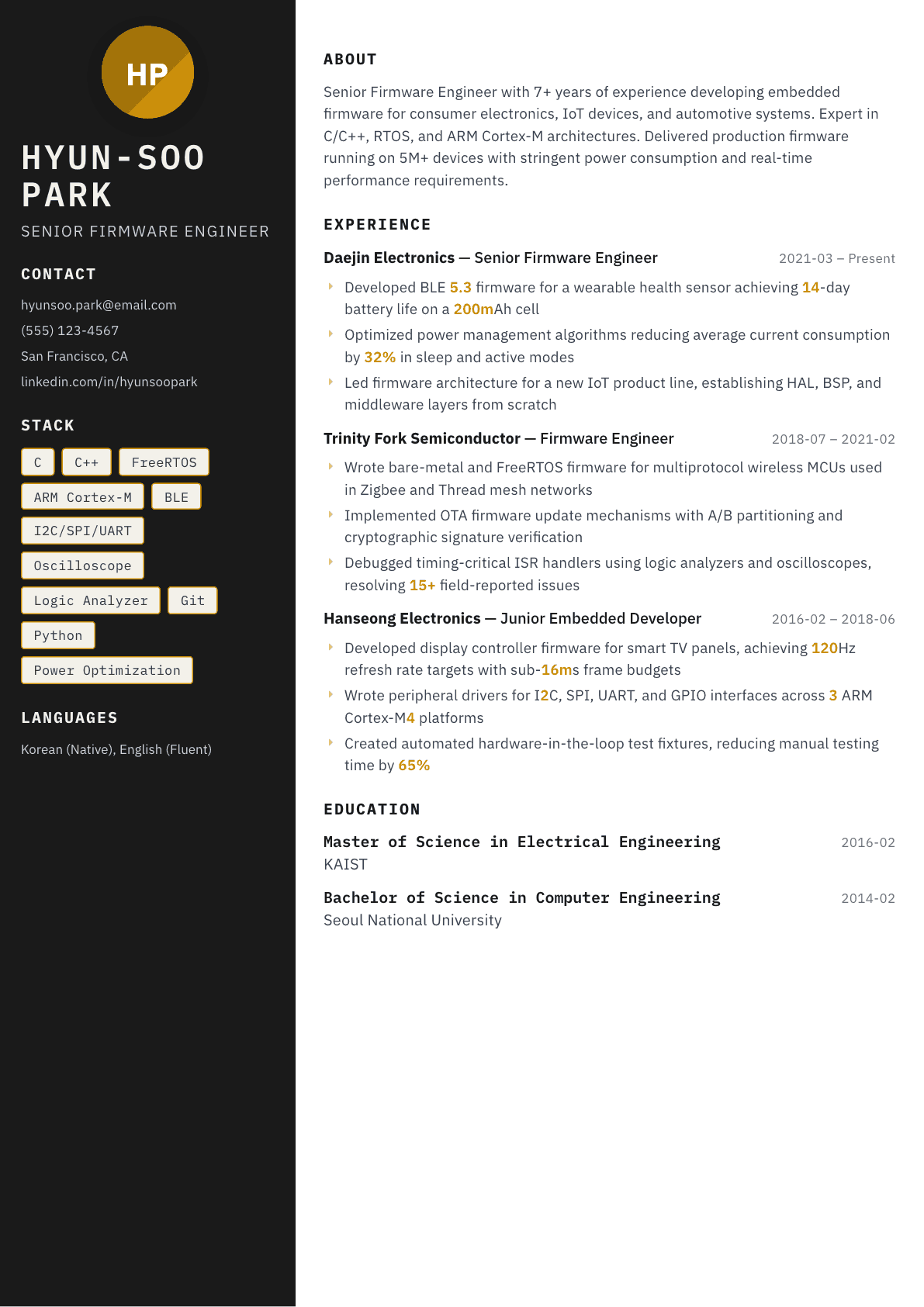
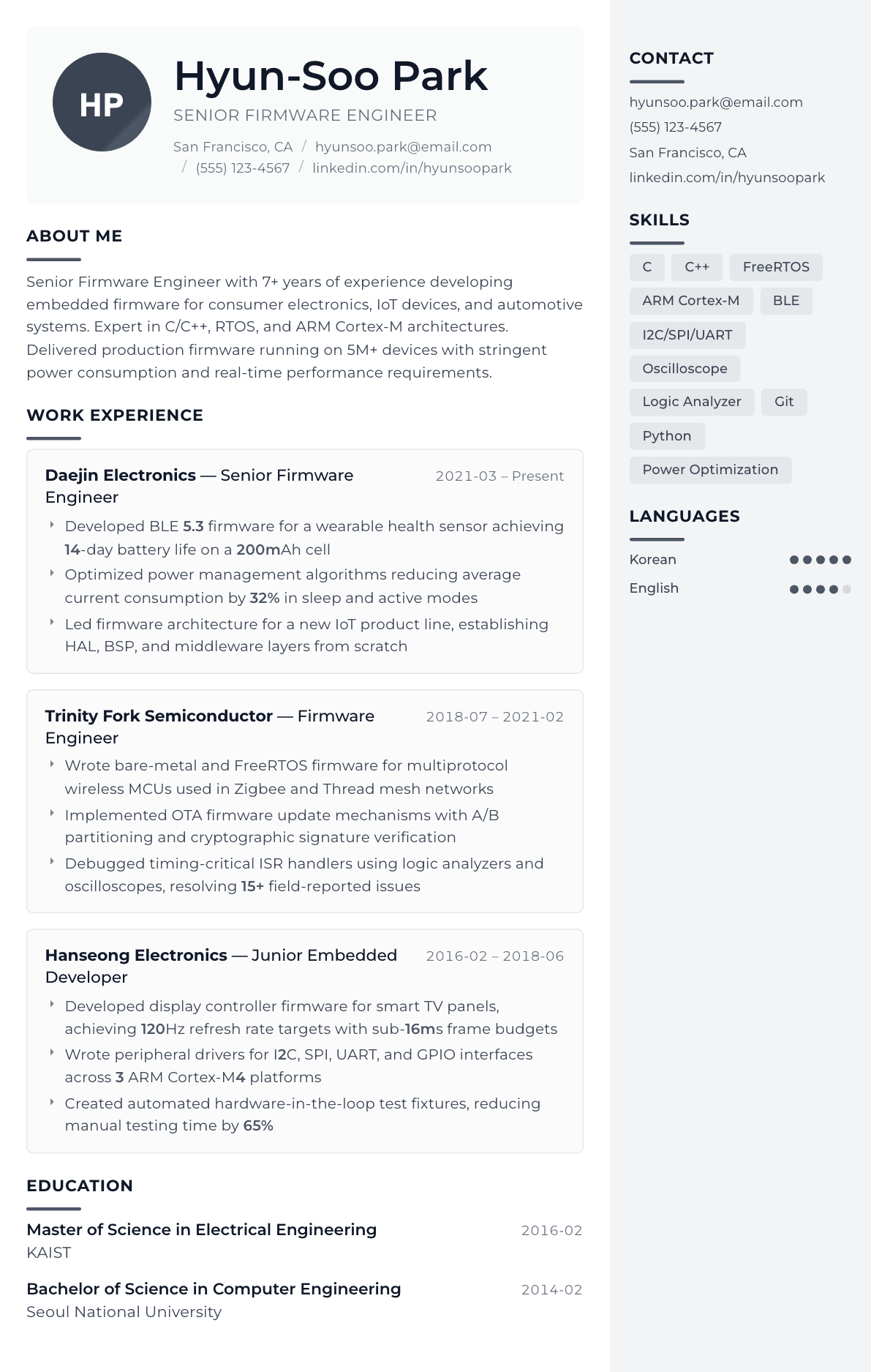
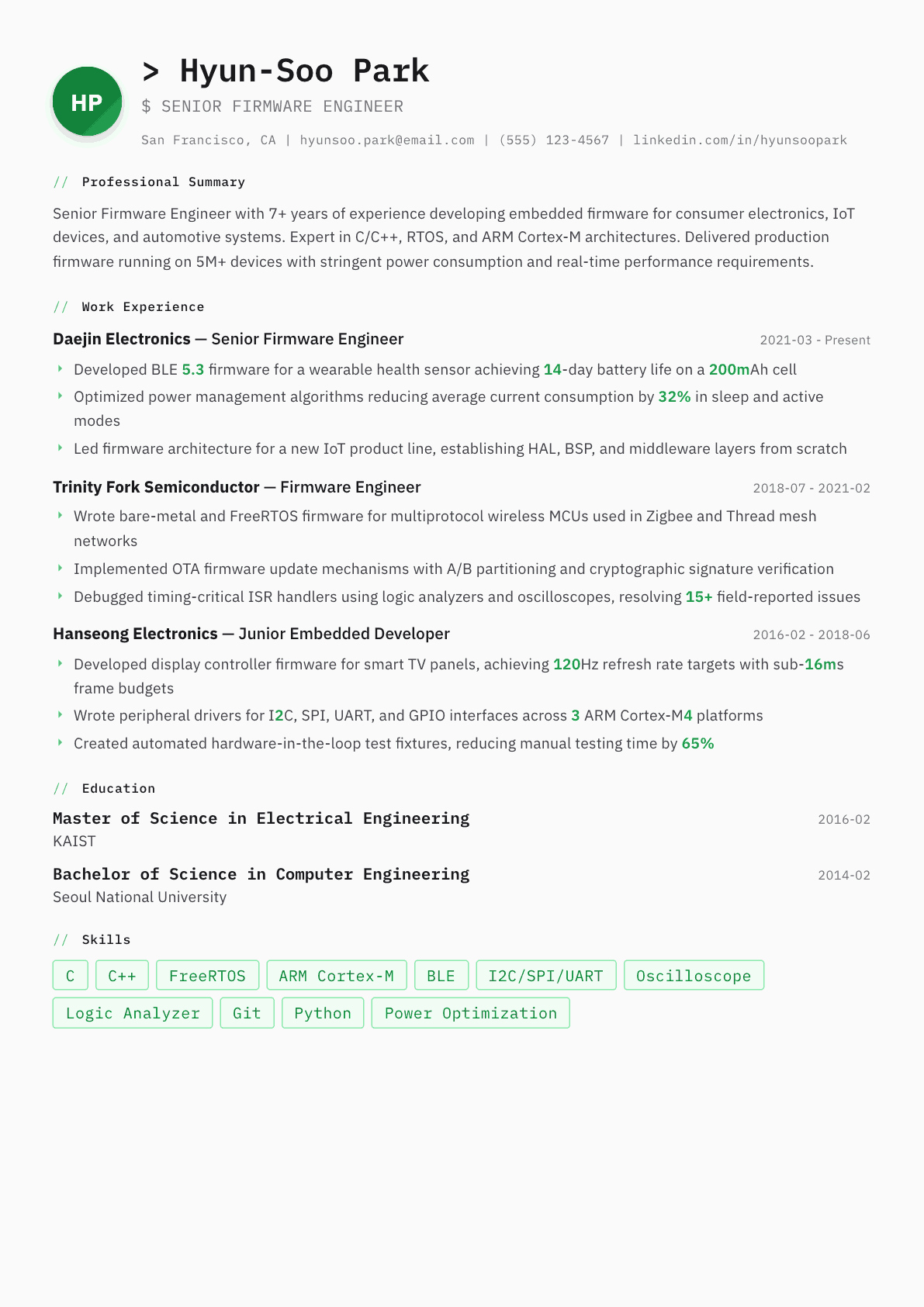
Example Firmware Engineer summary
Firmware Engineer with 7 years of experience developing embedded software for consumer electronics and IoT devices running on 5M+ units. Expert in C/C++, FreeRTOS, and ARM Cortex-M architectures. Delivered BLE-enabled wearable firmware achieving 14-day battery life through advanced power optimization techniques.
Skills to list on a Firmware Engineer resume
- C
- C++
- FreeRTOS
- Zephyr
- ARM Cortex-M
- BLE
- I2C/SPI/UART
- JTAG
- Oscilloscope
- Python
- Power Management
- OTA Updates
What actually gets this resume read
- Specify processor architectures you have worked with: ARM Cortex-M/A/R, RISC-V, AVR, PIC, or MIPS.
- Highlight RTOS experience: FreeRTOS, Zephyr, ThreadX, or VxWorks with specific use cases.
- Quantify hardware constraints: memory budgets, power consumption targets, and real-time deadlines.
- Include communication protocol expertise: BLE, Zigbee, Thread, Wi-Fi, I2C, SPI, UART, CAN, or USB.
- Mention debugging tools and methodologies: JTAG, oscilloscopes, logic analyzers, and HIL testing.
How to write a firmware engineer resume
A firmware engineer resume is screened by a hiring manager who owns a specific board. Before she reads a word of prose she is looking for three facts: which processor families you have written for, which real-time operating system or bare-metal environment you worked in, and whether your code went into a product that reached customers. If those three are missing from the top third of the page, the resume goes into the maybe pile and usually stays there.
The trap in this field is writing like an application developer. Firmware work is judged on constraints: flash and RAM budgets, interrupt latency, current draw in sleep mode, boot time, and whether the device survives a power cut mid-update. A resume that lists languages and frameworks without ever naming a constraint reads as though the candidate has only worked on evaluation boards.
This guide covers the section order embedded managers expect, how to describe silicon and toolchains without turning the page into a parts list, summary examples for three career stages, and rewritten bullets that show the difference between describing a task and describing an engineering decision.
Format: one page early, two pages once you have multiple silicon families
Reverse chronological, plain single column, no icons. Embedded teams often run resumes through an applicant tracking system before a human sees them, and a two-column layout scrambles the order of your part numbers and dates.
Directly under the header, put a short technical profile block: processor architectures, RTOS, languages, protocols, and lab instruments. A firmware manager scans that block first and uses it to decide whether to read the experience section at all.
- Header: name, city, phone, email, and a link to a repository or a project page if the code is public.
- Order: profile block, experience, projects, education, then certifications if you hold any.
- New graduates put a capstone or robotics project above experience and describe the board, the sensors and the code they personally wrote.
Name the silicon, the toolchain and the environment
Say the architecture and the vendor family, not just the word microcontroller. ARM Cortex-M4, ESP32, STM32F4, PIC24, RISC-V and Nordic nRF52 each imply a different toolchain and a different debugging culture, and a manager hiring for one of them is scanning for it by name.
Then say the environment. Bare metal, FreeRTOS, Zephyr, ThreadX, an automotive AUTOSAR stack and embedded Linux with a custom kernel driver are different jobs. Add the build and debug chain that goes with it: GCC arm-none-eabi, IAR, Keil MDK, SEGGER J-Link, OpenOCD, JTAG or SWD, and whether you used a logic analyzer or an oscilloscope to find the bug.
Experience: write the constraint, not the task
Every strong firmware bullet contains a number that was hard to hit. Battery life on a stated cell capacity, average current in microamps, interrupt latency in microseconds, flash footprint in kilobytes, boot time, sensor sampling rate, or the number of units the firmware went out on. These are the numbers a manager can compare across candidates.
Give each role the product context in one line: the device, the market, and the volume. Consumer wearables, industrial sensors, medical devices under a design control process, and automotive electronic control units all demand different documentation and test discipline, and the reader wants to know which discipline you have lived under.
Include the boring, high-value work. Over-the-air update paths with A and B partitions, secure boot and signature verification, bootloader recovery, hardware bring-up on a first spin board, and hardware in the loop test rigs are the tasks teams struggle to staff.
Peripherals, protocols and the driver layer
List the buses you have driven at register level: I2C, SPI, UART, CAN, USB, QSPI, I2S, PWM and DMA. Then the wireless stacks if you have them: BLE, Zigbee, Thread, LoRaWAN, Wi-Fi, Matter. Saying you wrote a driver is stronger than saying you used a peripheral, so make the distinction explicit where it is true.
If you have worked with a hardware abstraction layer, a board support package, or a vendor software development kit, name it, and say whether you consumed one or built one. Building the layer that the rest of the team codes against is a seniority signal and most candidates bury it.
Keywords the screener searches on
Embedded job descriptions repeat a predictable vocabulary: embedded C, RTOS, device drivers, bootloader, low power design, schematic reading, datasheet, board bring-up, unit test, and the exact part numbers of the target. Mirror the posting language once in the profile block and once inside a bullet where it is attached to real work. Never paste a keyword block at the bottom of the page; a firmware lead reads the resume minutes after the software does and can tell the difference.
Firmware Engineer resume summary examples
New graduate
Computer engineering graduate with embedded C on STM32 and Nordic nRF52 boards, plus a capstone that ran a BLE sensor node on FreeRTOS for 30 days on a coin cell. Comfortable with SWD debugging, logic analyzers and reading a datasheet before writing a driver.
Four years in
Firmware engineer with four years on ARM Cortex-M consumer devices, writing bare-metal and FreeRTOS code for wearables that went out on more than eight hundred thousand units. Owns the I2C and SPI driver layer, the over-the-air update path, and the hardware in the loop test rig.
Lead firmware engineer
Senior firmware engineer with nine years across industrial and automotive electronics, leading board bring-up on four first-spin designs and owning the secure boot and update architecture. Runs code review for a team of five and works directly with hardware on schematic review before layout is frozen.
Work experience bullets: before and after
Before: Developed firmware for embedded devices using C.
After: Wrote bare-metal C for an STM32F4 industrial gateway, holding the control loop inside a 500 microsecond deadline while keeping the image under 128KB of flash.
The part, the deadline and the flash budget turn a generic claim into evidence you can hold a real-time constraint.
Before: Worked on power optimization.
After: Cut average current from 40 to 12 microamps by moving the sensor loop to a low power timer and shutting down the radio between advertising intervals, extending field life to 14 months on a 220mAh cell.
Two current figures and the mechanism behind them let a reviewer judge the engineering, not just the outcome.
Before: Implemented OTA updates.
After: Built an over-the-air update path with A and B flash partitions, a signature check before the swap, and rollback on a failed boot, which removed field returns caused by interrupted updates.
Naming the partition scheme and the failure it prevents shows you designed for the power cut rather than the happy path.
Before: Debugged hardware issues.
After: Traced an intermittent I2C bus lockup to a missing clock stretch timeout using a logic analyzer and SWD trace, then rewrote the driver recovery routine that had caused 15 field returns.
The instrument, the root cause and the fix show a debugging method instead of a claim about debugging.
Before: Helped with testing.
After: Built a hardware in the loop rig with a relay board and a Python harness that flashed every nightly build onto three target boards and ran the peripheral suite before the team arrived.
The rig, the harness and the cadence describe infrastructure the next team can inherit.
Hard skills
- Embedded C and C++
- ARM Cortex-M architecture
- FreeRTOS and Zephyr
- Bare-metal driver development
- I2C, SPI, UART, CAN
- USB and DMA
- BLE and Zigbee stacks
- Bootloaders and secure boot
- Low power design
- JTAG and SWD debugging
- Oscilloscope and logic analyzer
- Schematic and datasheet reading
- Python test automation
- Git and continuous integration
Soft skills
- Working with hardware engineers
- Root cause discipline
- Writing for the next maintainer
- Design review
- Patience with intermittent faults
- Scope judgment under a tape-out date
Mistakes that cost firmware engineer candidates the interview
- Listing C and C++ without ever naming a processor family, which leaves the reader unable to tell an eight-bit hobby project from production automotive work.
- Describing peripherals you configured with a vendor tool as drivers you wrote, a claim that collapses in the first technical interview.
- Leaving out the constraint. Firmware without a memory, timing or current figure reads like application code that happened to run on a board.
- Hiding the bring-up work. Being the person who woke a first-spin board is one of the strongest signals on the page and it is often a footnote.
- Using a designer template with columns and icons, which scrambles part numbers and dates in the parsers embedded recruiters use.
- Writing one resume for consumer wearables and safety-critical automotive roles, when the second wants documentation, traceability and test evidence in the bullets.
Firmware Engineer resume questions
Do I need to list every microcontroller I have touched?
No. List the families where you wrote production code and could answer questions about the reference manual. A long list of parts you only flashed a demo onto weakens the ones that matter, and an interviewer will pick the weakest entry to ask about.
Should a firmware engineer resume include hardware skills?
Yes, if they are real. Reading schematics, probing with an oscilloscope, soldering rework and bringing up a new board are all valued because they reduce how often the firmware engineer has to wait for a hardware engineer to be free.
How do I show firmware work when the code is confidential?
Describe the constraint and the result rather than the implementation. You can say you held an interrupt path under a stated latency on a named architecture without disclosing a customer, a product name or any protected design detail.
Is embedded Linux experience the same as firmware experience?
Hiring managers treat them as neighboring but distinct. Kernel modules, device tree work and Yocto builds belong on the resume, but say so plainly rather than letting a reader assume you also have bare-metal and RTOS experience if you do not.
What projects help when I have no firmware job yet?
One deep project beats five shallow ones. Take a board, write the drivers yourself instead of pulling a library, measure the current draw, and describe the bugs you found and how you found them. That narrative reads like the job.
Related resume examples
- Embedded Systems Engineer Resume example
- Hardware Engineer Resume example
- iOS Developer Resume example
- Computer Engineer Resume example
- Field Service Technician Resume example
- Cloud Engineer Resume example