Rust Developer Resume Examples: the lines they read
Forge a Rust Developer Resume Built for Safety and Speed
By Mustafa Tarabya, founder of CVBooster · Published · Updated
Design a compelling Rust developer resume showcasing systems programming, memory safety expertise, and high-performance application development.
Sample resumes for a rust developer
The same rust developer content laid out in three CVBooster templates, so you can see what the finished document looks like before you write a word.
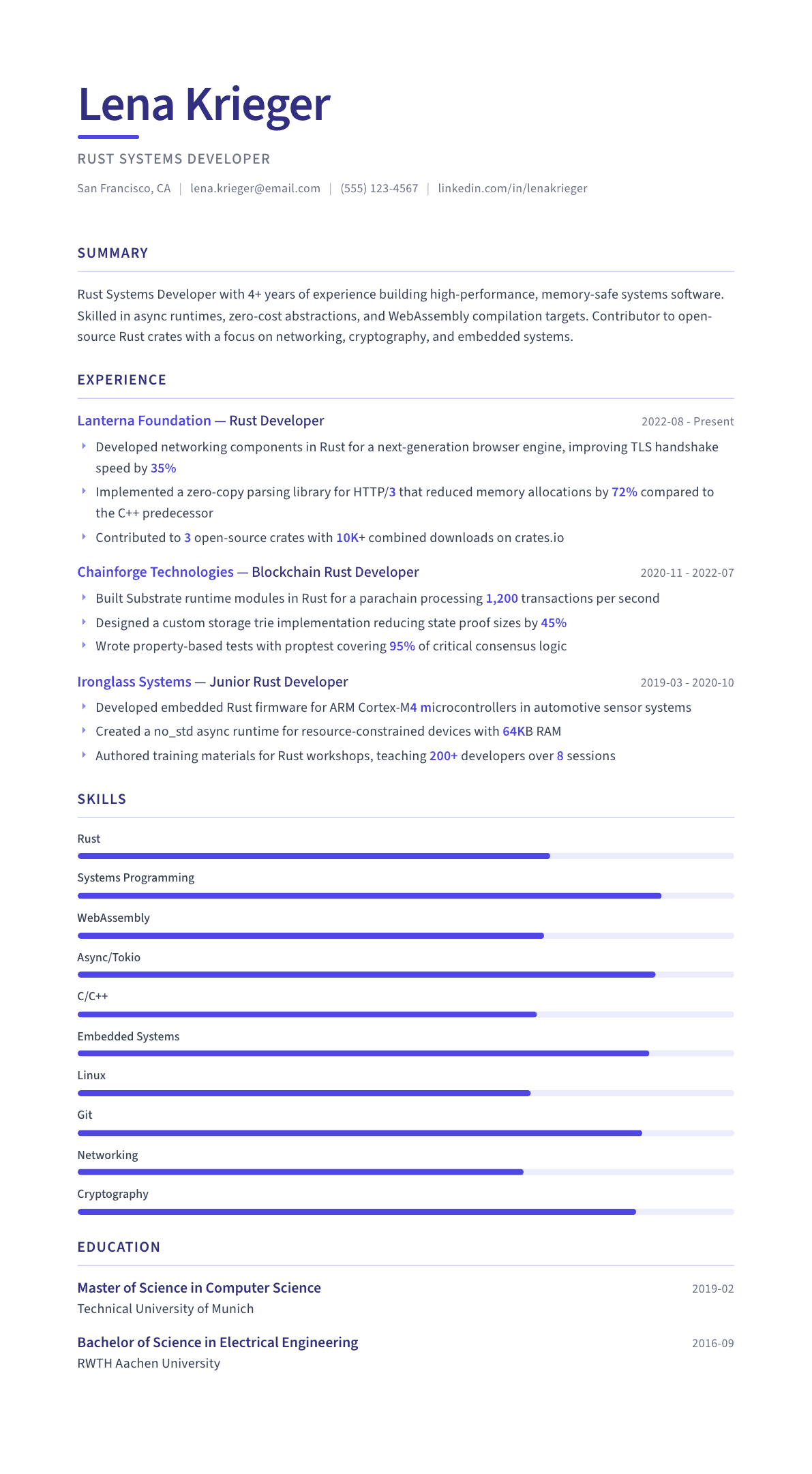
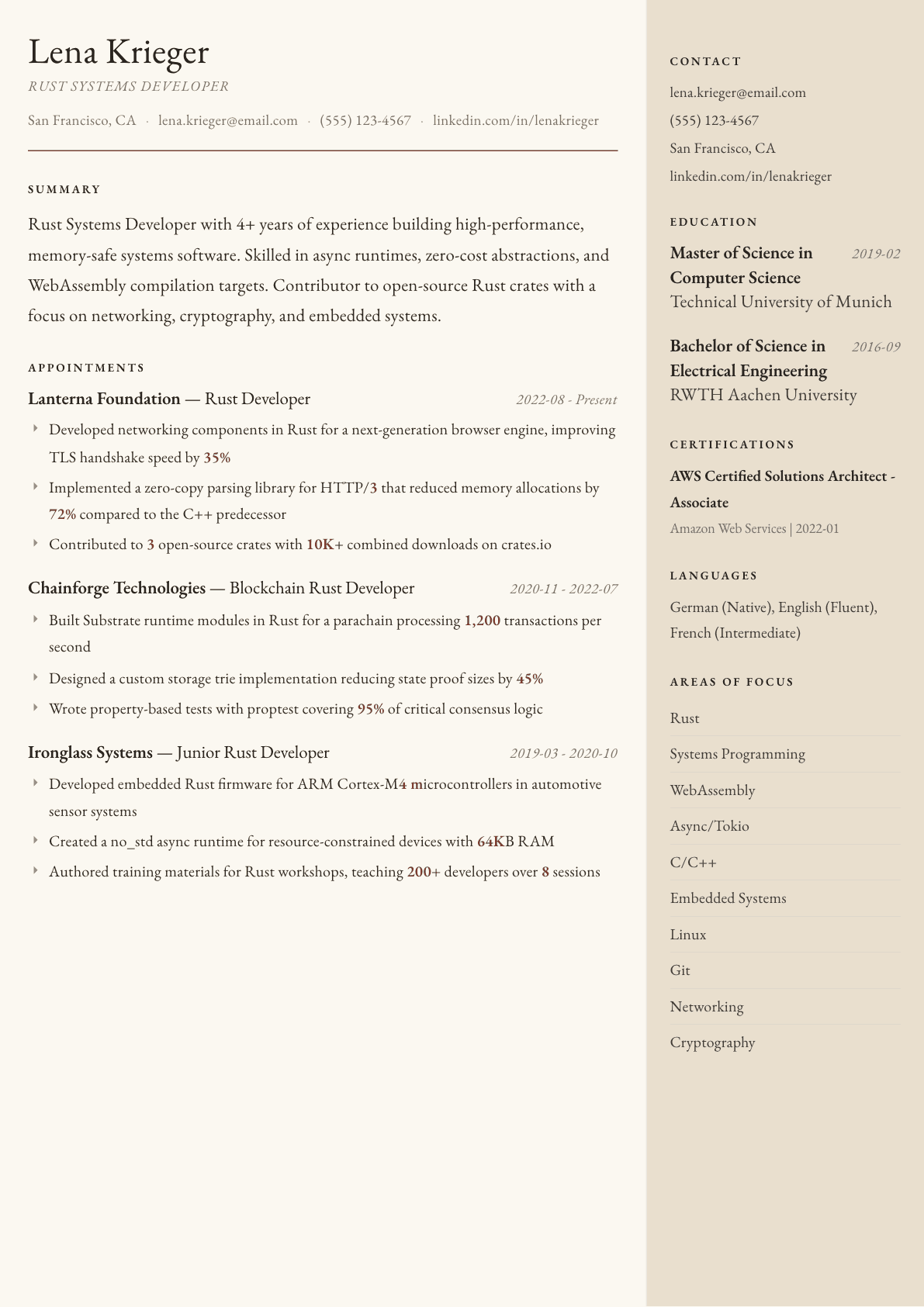
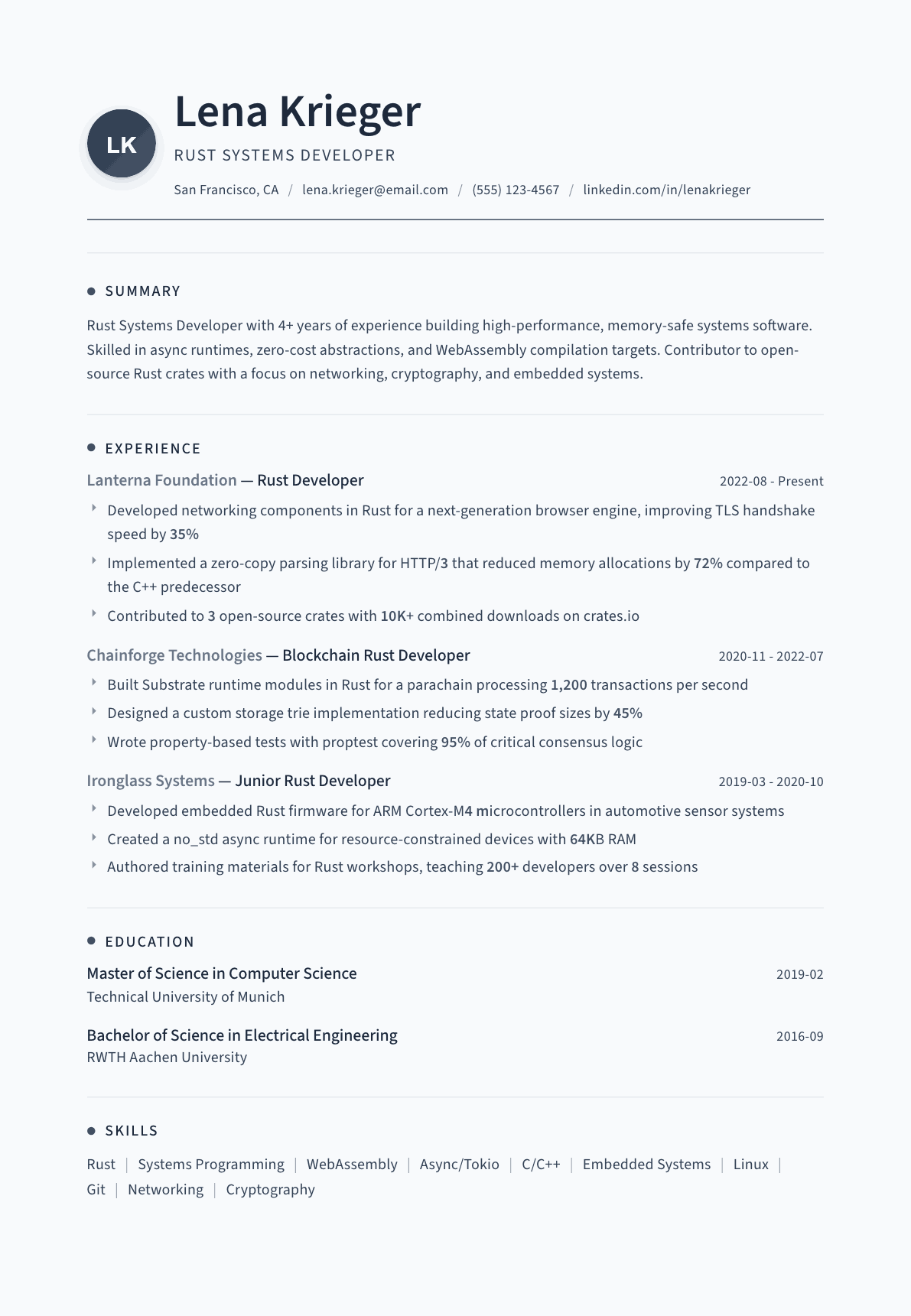
Example Rust Developer summary
Rust Developer with 4 years of experience building memory-safe, high-performance systems software. Expert in async runtimes, zero-copy parsing, and WebAssembly compilation. Open-source contributor with crates downloaded 10K+ times, plus embedded no_std and Substrate runtime work. Looking for a systems role where performance and memory safety both matter.
Skills to list on a Rust Developer resume
- Rust
- Systems Programming
- WebAssembly
- Tokio
- Async Programming
- C/C++
- Embedded Systems
- Linux
- Networking
- Cryptography
- LLVM
- Cargo
What actually gets this resume read
- Emphasize memory safety expertise: ownership, borrowing, lifetimes, and zero-cost abstractions.
- Showcase async programming experience with Tokio, async-std, or custom runtimes.
- Highlight performance metrics: throughput gains, memory reduction, and latency improvements over C/C++ alternatives.
- Include open-source contributions with crates.io download counts or GitHub stars.
- Mention WebAssembly, embedded (no_std), or blockchain experience as these are high-demand Rust niches.
How to write a rust developer resume
Rust roles are rarer than roles in other systems languages, and the people hiring for them are usually strong Rust programmers themselves. That means your resume gets read by someone who will notice whether your claims fit together. If you say you write async services, the reader expects to see a runtime named, an idea of how you handle backpressure, and some sign that you have fought with lifetimes across an await point. Vague enthusiasm about memory safety does the opposite of what candidates hope.
The other thing that makes this field unusual is how much of the evaluation happens outside your resume. Rust is written largely in the open. A crate you publish, an issue you diagnosed in a dependency, or a merged pull request in a widely used library is inspectable evidence, and a hiring manager will look. One good public artifact can outweigh a whole page of description.
This guide covers how to name your Rust niche, how to write performance claims that hold up against a reader who profiles for a living, how to present unsafe code and foreign function interfaces honestly, and how to make a transition from C, C++ or another language look deliberate.
Format: niche first, then evidence anyone can open
Reverse-chronological, one page unless you have a long systems career behind you. Directly under the summary, name your niche: async network services, embedded and no_std firmware, WebAssembly, blockchain runtimes, data infrastructure, command line tooling, or bindings that let another language call into Rust. Rust roles cluster into these groups and rarely overlap much.
Give public work its own short section: crate names, download or dependent counts if they are meaningful, and one line on what each does. Keep it factual. A crate with modest use described accurately reads better than a crate presented as if the ecosystem depends on it.
- Header: name, title, city, email, and a repository profile, since it will be opened.
- Order: summary, niche and public work, experience, technical skills, education.
- Say which async runtime you use, most often Tokio, and whether you have written runtime-agnostic code.
- For embedded work name the target: a Cortex-M part, RISC-V, or a specific board and HAL crate.
Summary: the systems problem you solve, not the language you like
A weak Rust summary talks about memory safety and zero-cost abstractions in general terms, which every Rust job description already says. A strong one names the problem class you solve: a network protocol implementation, a low latency data path, firmware on a constrained device, a parser handling untrusted input, or a component replacing a C library inside a larger system.
Say what you replaced or interoperate with. Rust is almost always introduced next to something older, so experience with the boundary, calling into C through a foreign function interface, exposing a stable C API, or embedding Rust inside a Python or Node project, is a large part of what teams are hiring for.
Experience: ownership, concurrency, and the parts that are actually hard
Write bullets that show you have hit the real difficulties. Designing an API where lifetimes do not leak into every caller, choosing between a borrow and an owned copy on a hot path, using interior mutability deliberately, structuring shared state with Arc and a lock versus message passing through channels, and handling cancellation safety in async code. These are the topics that come up in a Rust interview, so meeting them on the page is a strong signal.
Error handling deserves a mention because it separates library authors from application writers. A typed error enum with thiserror for a library, anyhow at the application boundary, and a clear statement of what your code does on invariant violation rather than panicking through a request path.
If you have written unsafe code, describe the invariant you upheld and how you checked it: Miri, sanitizers, fuzzing with cargo-fuzz, property tests with proptest, or a documented safety comment on each block. Unsafe used carelessly is the single fastest way to lose a Rust interviewer, and unsafe used carefully is a mark of seniority.
Performance claims: measured, compared, and reproducible
Rust attracts performance claims, and a reader will test them. Always name the baseline you compared against, the workload, the hardware class and the measurement tool. Criterion for microbenchmarks, flamegraphs from perf, heaptrack or a custom allocator counter for memory, and a load generator for throughput.
Prefer allocation counts, tail latency and memory footprint over vague speed multipliers. A statement that a parser dropped from a heap allocation per field to zero copy borrowing from the input buffer is checkable and impressive. A statement that a rewrite made things faster is neither.
- The baseline: the previous implementation, its language, and the workload used for both.
- Latency at the tail rather than the average, plus throughput at a stated concurrency.
- Memory: peak resident size, allocation count, or binary size for embedded targets.
- Method: Criterion, perf and flamegraphs, or hardware instrumentation for firmware.
Skills: separate the language from the domain
Split into language and tooling, async and concurrency, domain, and interoperability. Language and tooling covers Cargo workspaces, feature flags, clippy, rustfmt, macros both declarative and procedural, and cross compilation. Async covers Tokio, futures, channels, and the traits you have implemented by hand. Domain covers networking, cryptography, embedded, WebAssembly or data engines.
Interoperability deserves its own line because so many Rust jobs are integration jobs. Foreign function interfaces in both directions, bindgen and cbindgen, PyO3 for Python extensions, wasm-bindgen for browser targets, and any protocol or serialization work with serde, protobuf or a custom binary format.
Rust Developer resume summary examples
First Rust role
Systems programmer moving into Rust after three years of C++, with two published crates: a zero-copy log parser and a small command line tool with 4,000 downloads. Comfortable with ownership, Tokio, serde and cargo-fuzz, and looking for a backend or infrastructure team writing Rust.
Four years in
Rust developer with four years building async network services on Tokio, currently owning a proxy handling 40k requests per second. Replaced a C++ HTTP parser with a zero-copy implementation that cut allocations per request from 14 to zero, verified with Criterion and Miri.
Senior systems engineer
Senior Rust engineer with eight years in systems programming, six in Rust. Designed a storage engine with a custom async runtime abstraction, maintains three crates used across four internal teams, and reviews all unsafe code for a group of twelve engineers.
Work experience bullets: before and after
Before: Wrote high-performance code in Rust.
After: Rewrote the HTTP/3 frame parser as a zero-copy implementation borrowing from the receive buffer, cutting allocations per request from 14 to zero and the ninety-ninth percentile parse time from 180us to 22us against the previous C++ version.
A named subsystem, the technique, the baseline language and tail latency give a reader something they can verify.
Before: Used async Rust with Tokio.
After: Built a Tokio service handling 40k concurrent connections with bounded channels for backpressure, cancellation-safe request handling and graceful shutdown that drains in-flight work before exit.
Backpressure, cancellation safety and shutdown are the async problems that only appear in production code.
Before: Wrote embedded firmware in Rust.
After: Developed no_std firmware for a Cortex-M4 sensor node using RTIC, fitting the application and buffers into 64KB of RAM and holding average current low enough for a coin cell to last a full season.
The target, the framework and the hard resource ceiling show constraint-driven engineering rather than a language preference.
Before: Used unsafe code where needed for performance.
After: Wrote three unsafe blocks for an aligned ring buffer, each with a documented safety invariant, covered by proptest cases and validated under Miri and address sanitizer in continuous integration.
Documented invariants plus tooling turn unsafe from a red flag into evidence of discipline.
Before: Contributed to open source Rust projects.
After: Diagnosed and fixed a soundness bug in the borrow handling of a widely used serialization crate, added a regression test and a minimal reproduction, with the fix released in the next patch version.
A specific bug class and a merged, released fix is inspectable evidence rather than a claim of involvement.
Hard skills
- Rust ownership, borrowing and lifetimes
- Async Rust and Tokio
- Traits and generics, including trait objects
- Macros: declarative and procedural
- Cargo workspaces and feature flags
- no_std and embedded Rust
- WebAssembly and wasm-bindgen
- Foreign function interface with C and C++
- PyO3 and language bindings
- serde and binary serialization
- Criterion benchmarking and flamegraph profiling
- cargo-fuzz, proptest and Miri
- Cross compilation and toolchain management
- Systems networking and protocol implementation
Soft skills
- API design that does not leak complexity to callers
- Reviewing unsafe code carefully
- Explaining borrow checker constraints to newcomers
- Patience with long compile and iteration cycles
- Writing documentation and examples for library users
Mistakes that cost rust developer candidates the interview
- Writing about memory safety in the abstract, repeating the language marketing instead of describing your own engineering.
- Claiming a performance win with no baseline, workload or measurement tool, in front of a reader who profiles for a living.
- Mentioning unsafe code without saying how the invariants were checked, which reads as a hazard rather than an achievement.
- Listing a crate you published without saying what it does or how much it is used.
- Presenting a rewrite from another language as automatically better, when the interesting part is what the rewrite changed structurally.
- Failing to name the niche, so a firmware team and a backend team both read you as the wrong candidate.
Rust Developer resume questions
How do I get a Rust job without professional Rust experience?
Publish something real and small: a crate that solves one problem well, with documentation, tests and a benchmark. Then contribute a fix to a library you use, with a reproduction and a test. Hiring managers in this community read code, so two inspectable artifacts do more than any amount of resume language.
Should I list unsafe code experience on a Rust resume?
Yes, if you used it responsibly. State why safe Rust could not express the operation, what invariant you upheld, and how you verified it with Miri, sanitizers, fuzzing or property tests. Handled that way it is a seniority signal. Mentioned casually it costs you the interview.
Does C or C++ experience help when applying for Rust roles?
A great deal. Most Rust roles sit next to existing native code, and teams need someone who can read the C++ being replaced, work across a foreign function interface and reason about memory layout. Keep that experience on the page and frame it as the systems background your Rust work builds on.
Which Rust niche should I target?
Pick the one your background supports. Backend and infrastructure work suits people from server languages, embedded suits firmware engineers, WebAssembly suits frontend and graphics people, and data engines suit anyone with database internals experience. Targeting all of them at once produces a resume that convinces none of them.
Are there recognized Rust certifications?
There is no industry-standard Rust certification the way there is for cloud platforms or networking, so nothing is expected on your page. Training courses can be listed under education if they are substantial, but public code, benchmarks and a clear account of a hard problem you solved are what actually get evaluated.
Related resume examples
- Embedded Systems Engineer Resume example
- Blockchain Developer Resume example
- Software Engineer Resume example
- Computer Engineer Resume example
- Golang Developer Resume example
- Game Developer Resume example