Robotics Engineer Resume Examples: the lines they read
Assemble a Robotics Engineer Resume That Moves Recruiters
By Mustafa Tarabya, founder of CVBooster · Published · Updated
Build a robotics engineer resume showcasing motion planning, ROS, and mechatronics expertise with detailed project examples and technical depth.
Sample resumes for a robotics engineer
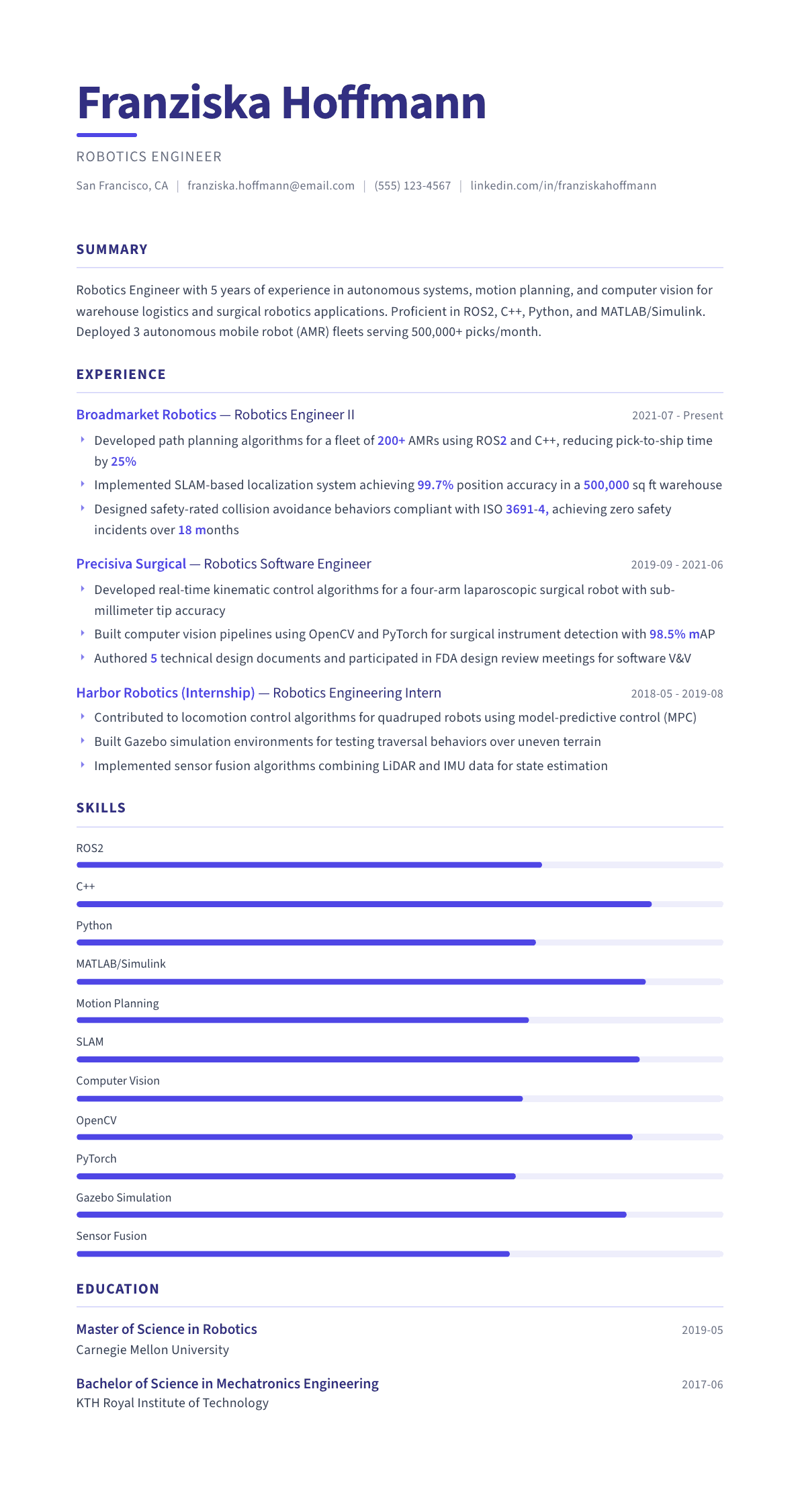
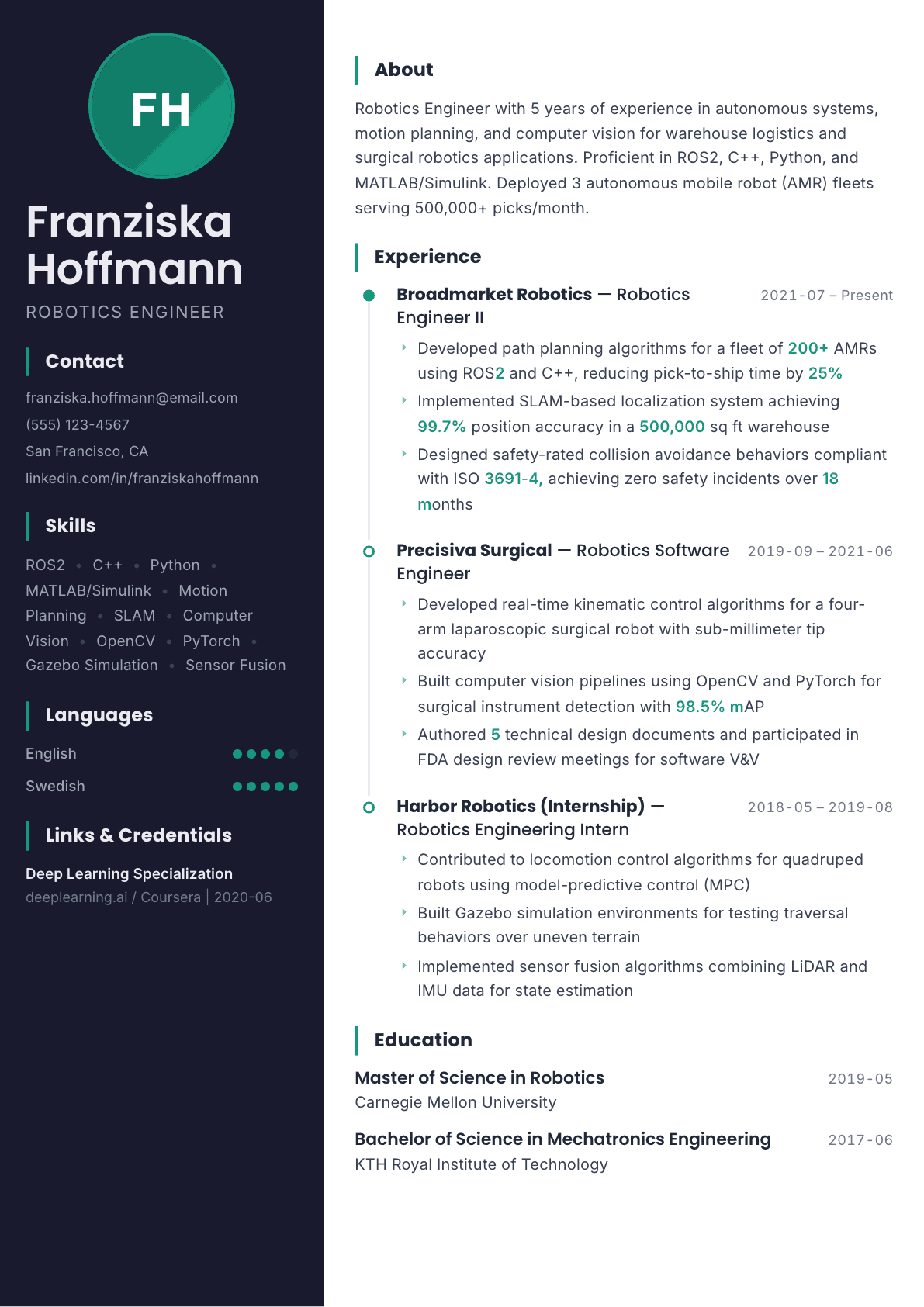
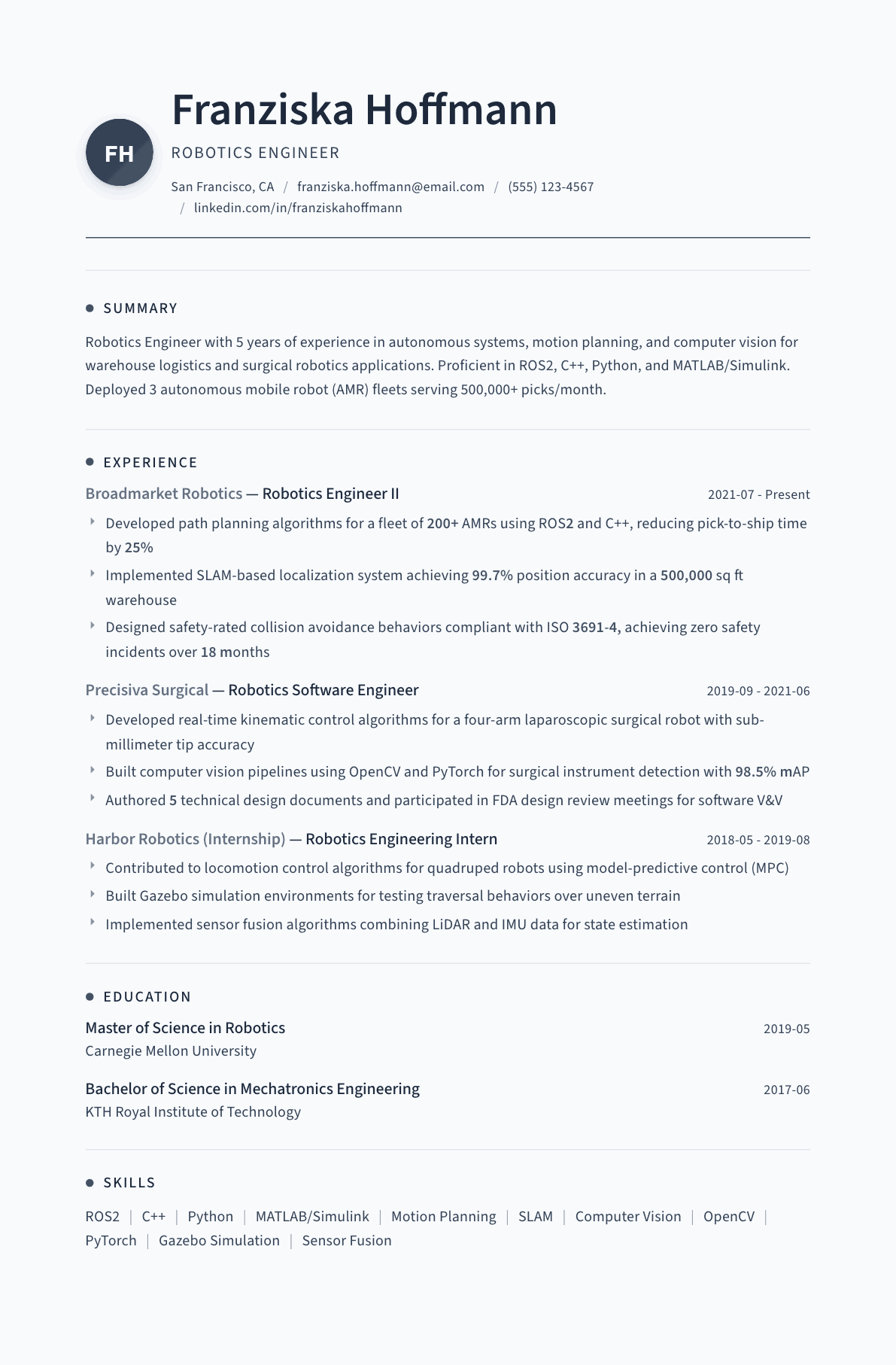
The same robotics engineer content laid out in three CVBooster templates, so you can see what the finished document looks like before you write a word.
Example Robotics Engineer summary
Robotics Engineer with 5 years of experience in autonomous systems, motion planning, and computer vision. Expert in ROS2, C++, and Python with deployments across warehouse logistics and surgical robotics. Deployed AMR fleets serving 500,000+ picks/month with 99.7% localization accuracy and zero safety incidents.
Skills to list on a Robotics Engineer resume
- ROS / ROS2
- C++
- Python
- MATLAB / Simulink
- Motion Planning
- SLAM
- Computer Vision
- Sensor Fusion
- OpenCV
- PyTorch / TensorFlow
- Gazebo Simulation
- Embedded Systems
- Kinematic Control
- PID Tuning
- ISO 10218 Safety
What actually gets this resume read
- Highlight robotics frameworks and tools: ROS/ROS2, Gazebo, MoveIt, RVIZ, Isaac Sim.
- Include programming languages: C++, Python, MATLAB, and real-time OS experience.
- Specify domains: autonomous vehicles, surgical robotics, warehouse automation, industrial cobots.
- Quantify system performance: accuracy, throughput, fleet size, uptime, safety records.
- Mention perception and AI skills: computer vision, SLAM, sensor fusion, reinforcement learning.
- Reference safety standards: ISO 10218, ISO/TS 15066, ISO 3691-4 for robot safety.
How to write a robotics engineer resume
Robotics is a systems discipline, and robotics teams hire for a slice of it. A perception engineer, a motion planning engineer, a controls engineer, a mechanical designer and an integrator all answer to the same job title, and the hiring manager has exactly one of those slots open. A resume that says robotics without saying which layer of the stack you own reads as a generalist to a team that needs a specialist.
The second thing a robotics manager checks is whether your code has ever run on hardware. Simulation results are cheap, and everyone has a demonstration video. Evidence that you have taken a system through calibration, integration, field failures and a real deployment is what separates candidates in an interview loop that will include a whiteboard session on kinematics or state estimation.
This guide covers how to declare your layer of the stack, how to write bullets that show hardware reality, the safety standards industrial employers expect you to know, summaries at three career stages, and how to present projects when your experience is mostly academic.
Declare your layer and your domain
The summary should answer two questions in one sentence: which part of the stack you work on, and what kind of robot. Perception, state estimation, planning, controls, manipulation, mechanical design, firmware and systems integration are the layers. Mobile robots, industrial arms, surgical systems, drones, agricultural machines and warehouse automation are the domains.
Domain matters more than candidates expect. Safety expectations, duty cycles, regulatory burden and failure consequences differ enormously between a warehouse robot and a surgical arm, so a manager reads the domain as a proxy for the engineering rigor you are used to.
- Header: name, city and state, phone, email, and a code repository link if it holds real work.
- Order: summary, technical skills grouped by layer, experience, projects, education.
- Name the middleware and the language: the robot operating system version, C++ standard, Python, and any real-time framework.
Show that it ran on hardware
Write bullets that make the physical system visible. Name the platform, the sensors, the actuators and the compute. A line that says a planner was validated in simulation and then deployed to a fleet of physical units in a warehouse tells a manager far more than an algorithm description, because the second half is the part that usually goes wrong.
Include the work that only happens with real robots: sensor calibration and extrinsics, time synchronization, latency budgets, thermal and power constraints, field failure triage from logs, and the regression testing that keeps a fleet stable through a software update. These details are how an experienced engineer recognizes another one.
Give the outcome in robotics units: cycle time, throughput, path length, localization error, mean time between interventions, pick success rate, or the number of units in the field running your code.
Safety, standards and integration
Industrial and medical robotics employers expect awareness of the functional safety framework their product must meet: the industrial robot safety standards, the technical specification for collaborative operation, safety-rated monitored stop and speed and separation monitoring, risk assessment, and the safety-rated hardware such as light curtains, scanners and dual-channel emergency stops.
If you have worked with plant equipment, name the integration surface too: programmable logic controllers, fieldbus protocols, teach pendants and the vendor programming environments for the arms you have commissioned. Integration experience is scarce and highly paid, so it should never be buried in a duties paragraph.
Skills: group by layer so a reviewer can scan
A flat alphabetical list wastes the most valuable block on the page. Group instead: languages and tooling, perception, estimation and localization, planning and control, simulation, and hardware. A reviewer looking for a motion planning hire should be able to find the planning group in two seconds.
Inside each group, name specifics rather than categories. Extended and unscented Kalman filters, factor graph optimization, sampling-based and optimization-based planners, model predictive control, inverse kinematics solvers, point cloud registration and learned perception models are all searchable and all meaningful.
Projects, competitions and academic work
For an early-career robotics engineer, the projects section is the resume. Give each project the platform, your specific role, the technical approach, and the result on real hardware. A competition entry with a documented failure and the fix is more persuasive than a polished description of a system that never left the bench.
Link a repository only if the code is readable and the readme explains what the system does. Robotics interviewers do open repositories, and a neglected one that fails to build costs more than it earns.
Robotics Engineer resume summary examples
New graduate
Robotics engineer with a master's in robotics and two years of project work on autonomous ground vehicles, covering lidar-based localization, path planning and sensor calibration. Comfortable in C++ and Python with the robot operating system, and deployed a navigation stack on a physical differential-drive platform.
Five years in
Robotics engineer with 5 years on mobile manipulation for warehouse automation, owning the motion planning and collision avoidance layer for a fleet of 120 units. Writes production C++, runs hardware-in-the-loop regression tests, and triages field failures from onboard logs.
Staff robotics engineer
Staff robotics engineer with 11 years across industrial arms and surgical systems, leading a team of 5 through architecture, controls and safety certification. Owns the real-time control stack, the risk assessment process for collaborative operation, and the calibration procedure used in manufacturing.
Work experience bullets: before and after
Before: Developed motion planning algorithms for robots.
After: Implemented a sampling-based planner with trajectory smoothing in C++ for a 7-axis arm, cutting average cycle time from 12 to 9 seconds and holding it across a 6-week validation run on the production cell.
Algorithm class, kinematic detail and a measured cycle-time change on real picks show the work reached production.
Before: Worked with ROS on a mobile robot project.
After: Built the navigation stack on the robot operating system for a differential-drive platform, integrating lidar odometry with wheel encoders and holding localization error under 5 centimeters across a mapped facility.
Sensor fusion detail and an accuracy figure prove a working system rather than tutorial familiarity.
Before: Responsible for robot safety compliance.
After: Ran the risk assessment for a collaborative cell, defined speed and separation monitoring zones, and specified the safety-rated scanner configuration that passed third-party review on the first submission.
Naming the safety function and the review outcome shows real standards work rather than awareness of a document.
Before: Debugged issues with robot hardware in the field.
After: Traced intermittent arm faults to a timing mismatch between the fieldbus cycle and the controller loop by replaying onboard logs, and released a fix that removed the fault across 60 deployed units.
The diagnostic method and fleet-wide result demonstrate systems debugging, which is the rarest robotics skill.
Before: Wrote simulation code for testing.
After: Built a Gazebo test suite covering 30 failure scenarios and wired it into continuous integration, catching planner regressions before they reached hardware on 4 separate releases.
The scenario count and the caught regressions turn simulation from a demonstration into engineering infrastructure.
Hard skills
- C++ for real-time systems
- Python
- Robot Operating System and ROS 2
- Motion planning and trajectory optimization
- Forward and inverse kinematics
- State estimation and Kalman filtering
- SLAM and localization
- Computer vision and point cloud processing
- Control systems and model predictive control
- Sensor calibration and time synchronization
- Gazebo and physics simulation
- Embedded firmware and CAN bus
- Hardware-in-the-loop testing
- Robot safety standards and risk assessment
Soft skills
- Debugging across hardware and software boundaries
- Working with mechanical and electrical engineers
- Documenting calibration and test procedures
- Judgment on simulation versus field validation
- Explaining failures to non-engineers
Certifications worth listing
- Certified SolidWorks Professional (CSWP) (Dassault Systemes)
- Certified LabVIEW Associate Developer (NI)
- Professional Engineer (PE), Electrical and Computer (State engineering licensing boards, via NCEES examinations)
Mistakes that cost robotics engineer candidates the interview
- Saying robotics without naming the layer of the stack, which leaves a specialist hiring manager unable to place you.
- Presenting only simulation results, when the interview loop is built to find out whether you have shipped code to hardware.
- Listing frameworks and libraries with no bullet showing a system you integrated end to end.
- Omitting the domain, so the reader cannot judge the safety and reliability standard you are used to working under.
- Linking a repository that does not build or explain itself, which is checked more often in robotics than in most fields.
- Ignoring safety standards on an industrial application, where risk assessment work is part of the job description.
Robotics Engineer resume questions
How do I write a robotics engineer resume with only academic projects?
Make the projects section the body of the resume. For each one give the platform, your role, the technical approach and what happened on real hardware. Include the failures you diagnosed, since debugging a physical system is the capability employers cannot verify from coursework.
Should I list both C++ and Python?
Yes, and say what you use each for. Production robotics runtime code is usually C++ while tooling, analysis and prototyping sit in Python. Naming the split shows you understand where real-time constraints apply rather than treating the languages as interchangeable.
Do robotics employers care about publications?
Research groups and perception teams do, especially for planning, estimation and learning roles. Product teams care more about deployed systems. List up to three relevant papers and put the deployment evidence first unless you are applying to a research organization.
How much mechanical and electrical detail should a software-focused robotics engineer include?
Enough to show you can work across the boundary: the actuators, sensors and compute you have integrated, the bus protocols you have debugged, and any hardware bring-up you supported. Robotics teams value engineers who can read a schematic even when they do not draw one.
Is a video or portfolio link worth adding?
A short link is fine when the footage shows a real robot doing the thing you describe. Keep it to one link, host it where it will still resolve in a year, and never rely on it to carry information the resume text should already contain.
Related resume examples
- Automation Engineer Resume example
- Aerospace Engineer Resume example
- Mechanical Engineer Resume example
- Mechatronics Engineer Resume example
- Chemical Engineer Resume example
- Controls Engineer Resume example