Engineering Manager Resume Examples: what gets the call
Engineering Manager Resume and Curriculum Vitae Examples
By Mustafa Tarabya, founder of CVBooster · Published · Updated
Engineering manager resume and curriculum vitae examples with team scope wording, delivery metrics, a full two page sample and the keywords hiring panels look for.
Sample resumes for a engineering manager
The same engineering manager content laid out in three CVBooster templates, so you can see what the finished document looks like before you write a word.
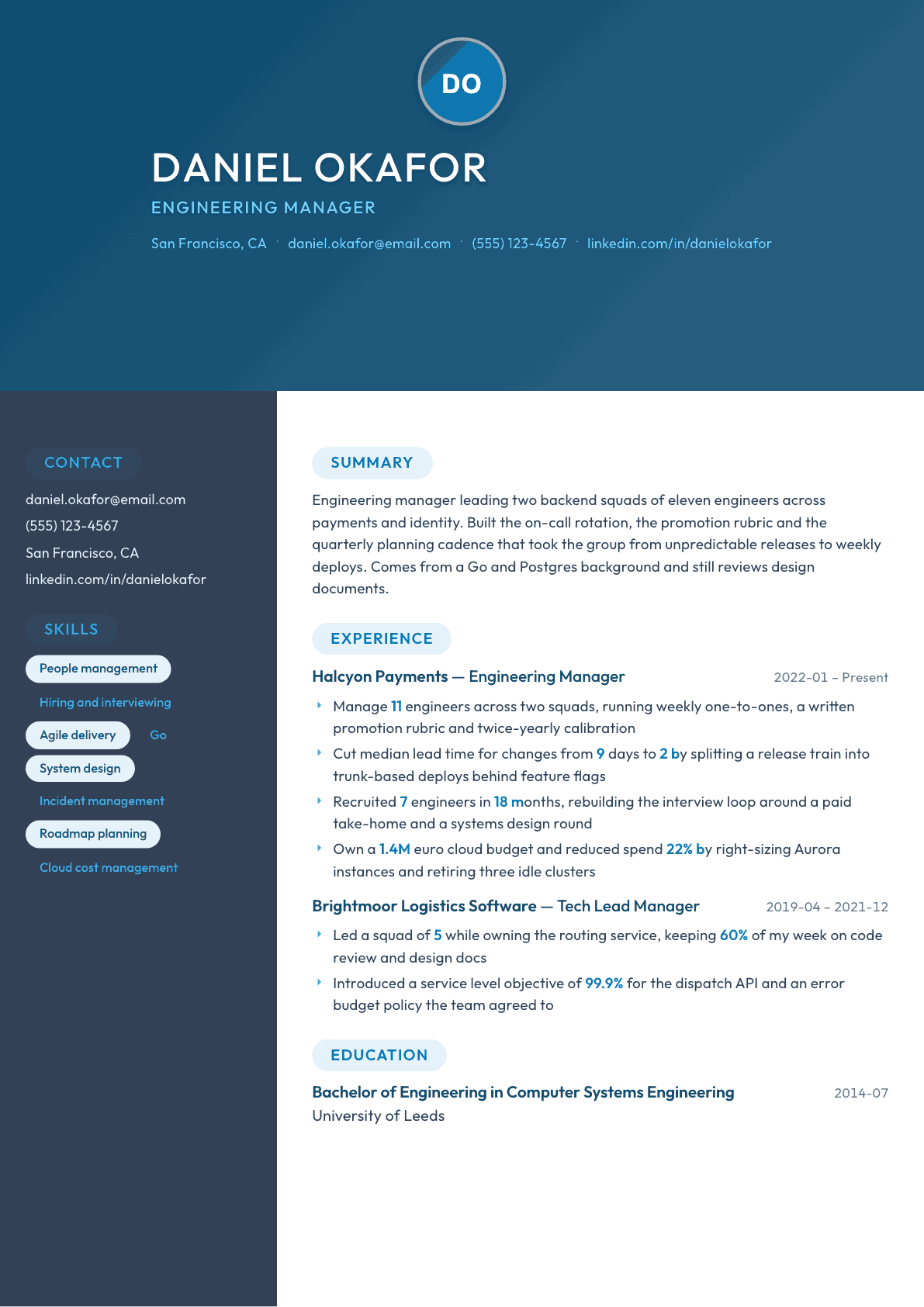
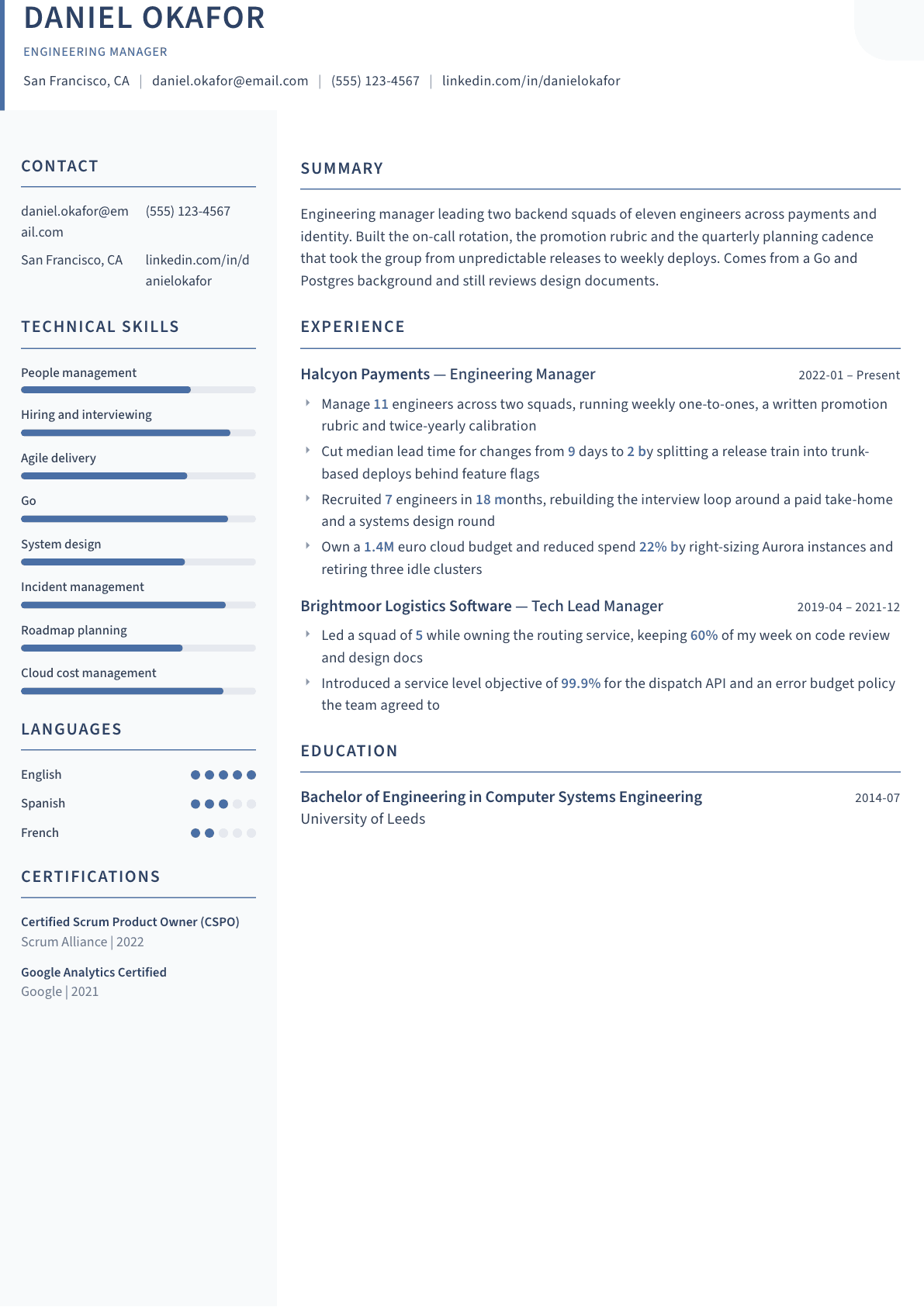
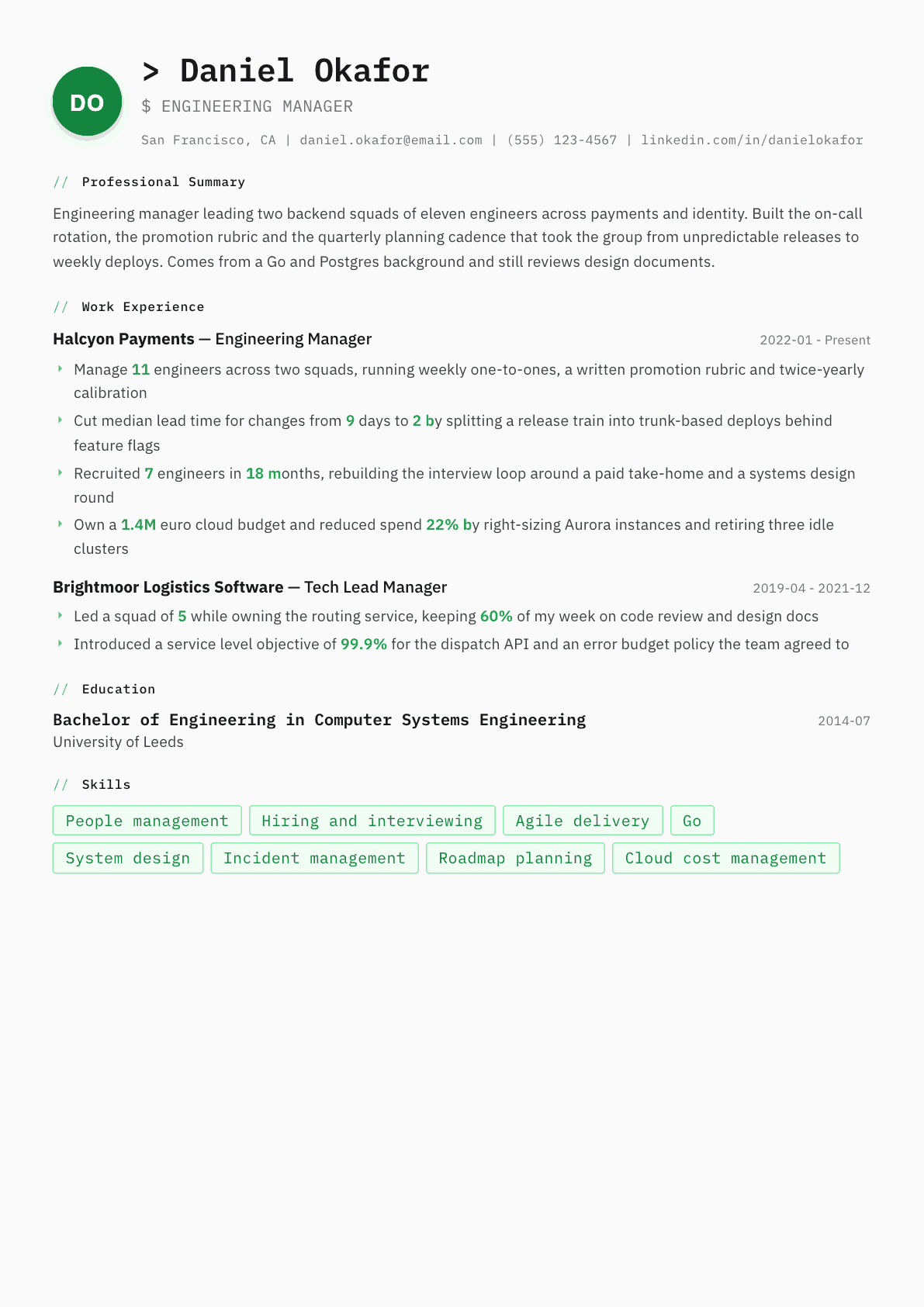
Example Engineering Manager summary
Engineering manager with eight years in backend and platform teams, the last four leading groups of eight to twelve engineers. Rebuilt a release process around trunk-based development and feature flags, took deploys from fortnightly to daily, and hired seven engineers through a redesigned interview loop. Comfortable owning a cloud budget, an on-call rotation and a promotion rubric at the same time.
Skills to list on a Engineering Manager resume
- People management
- Performance reviews
- Technical hiring
- Roadmap planning
- Agile and Scrum
- System design review
- Incident response
- Service level objectives
- Budget ownership
- Cross-functional partnership
- Coaching and mentoring
- Delivery metrics
- Org design
- Stakeholder communication
What actually gets this resume read
- Open every job with the team size, the number of squads and the systems your group owned end to end.
- Show delivery health with real engineering measures such as lead time, deploy frequency and change failure rate.
- Give hiring and retention their own bullets: offers accepted, loop redesign, attrition you kept low and why.
- Keep one line of hands-on credibility per role so a panel knows which stack you can still reason about.
- Separate the people work from the technical work so a reader can see how your week was actually split.
- Name the planning cadence you ran, whether quarterly objectives, six-week cycles or continuous roadmap review.
How to write a engineering manager resume
An engineering manager resume is read by a director who has a specific gap to fill, and the gap is almost never generic. She is hiring for a group that is missing delivery discipline, or missing a hiring engine, or missing someone who can hold a platform team together while the product side pulls at it. The first thing she looks for is the shape of the teams you have run: how many engineers, in how many squads, owning what systems.
The mistake that sinks most of these resumes is writing about the team as if you were still an individual contributor. Bullets that say you built a service and shipped features tell a director you can do the job below the one you applied for. Bullets that say you took a group of nine through a reorganization, kept attrition low, and doubled deploy frequency tell her what you do with a team once you have one.
This guide covers when an engineering manager curriculum vitae and a resume are the same document, the section order a director expects, how to size your scope honestly, which delivery numbers are safe to claim, and how to keep enough technical credibility on the page that a staff engineer on the panel takes you seriously.
Engineering manager curriculum vitae or resume: two pages, scope before story
A posting that asks for a curriculum vitae for an engineering manager role in a US company wants the same document as one that asks for a resume. The long academic CV, with publications, grants and teaching, is only expected for research labs and university posts. International employers and recruiters outside the US use CV for everything, so send the two page version below under either name and save the file as your name plus engineering manager CV or resume, matching the word in the posting.
Reverse chronological, two pages once you have managed for more than a couple of years. Under each job title, put one short scope line before the bullets: team size, number of squads, the systems owned, and who you reported to. That line does more work than any summary sentence, because it lets a reader place you instantly against the role they are filling.
Keep a compact technical block near the bottom rather than the top. You are not being screened on language keywords the way an individual contributor is, but a panel wants to know which stack you can reason about when a design review goes sideways.
- Header: name, city, phone, email, and a link to a public profile or a written piece on leadership if you have one.
- Order: summary, experience with a scope line per role, education, technical background, and selected talks or writing.
- First-time managers keep one earlier senior engineer role in full detail and compress everything before it.
Summary: team size, domain, and the problem you are good at
Four lines at most. Say how long you have managed, the largest group you have run, the domain, and the specific management problem you are known for solving. Turning around a team with a reliability problem, standing up a new group from nothing, and running a mature platform organization are three different jobs, and a director is hiring for one of them.
If you are moving from tech lead to full manager, say that plainly and name the parts you already own: one-to-ones, performance input, hiring loops. Directors hire first-time managers deliberately, but only when the resume shows the boundary honestly rather than blurring it.
Experience: split the people work from the delivery work
Give each role four to six bullets and make sure at least two are about people. Hiring, performance management, promotions, coaching someone through a hard quarter, and moving a struggling engineer to a better fit are the parts of the job nobody else on the resume pile writes about, which is exactly why they land.
Then the delivery bullets. Use the measures engineering leaders actually track: lead time for changes, deploy frequency, change failure rate, time to restore, and whether the team hit its committed scope. These are recognized across the industry and a panel can question you about them, which is a sign that they are real.
Add one bullet per role about a decision that cost you something. Killing a project, moving a team off a technology you had championed, or telling a stakeholder a date was not real. Directors read that as judgment, and judgment is what the interview is going to probe.
A panel will ask what you last built and how deeply you read design documents. Put a short line in each role that answers it: reviewing architecture proposals, sitting in the on-call rotation as the escalation point, writing the postmortem template, or contributing to a specific internal library. Be accurate about how hands-on you are, because a manager who overstates coding time gets caught in the first technical conversation.
Hiring and retention deserve their own bullets
Say how many engineers you hired, over what period, and what you changed about the process. A rebuilt interview loop, a scorecard, a paid take-home replacing a whiteboard round, or a sourcing partnership with a bootcamp are all concrete. Add the retention side: how long people stayed, how many were promoted under you, and how many internal transfers you supported rather than blocked.
Avoid claiming a company-wide attrition figure you cannot source. Keep it to your group, phrase it as your own record, and be ready to explain the departures you did have.
Keywords a screener and an applicant tracking system look for
Management postings repeat a narrow vocabulary: people management, one-to-ones, performance reviews, career development, hiring, cross-functional partnership, roadmap, quarterly planning, on-call, incident management, service level objectives, and budget. Use the phrasing from the posting once in the summary and once inside a bullet where it is demonstrated. A block of leadership adjectives at the bottom of the page helps nobody and reads as filler.
Engineering management resume example, start to finish
An engineering management resume is easiest to get right when you can see a whole one, so here is a complete sample for a manager of two squads applying for a senior engineering manager role. The person and companies are invented; copy the order and the scope lines. A first time manager keeps the same structure and puts the earlier senior engineer role in full under the current one.
Header and summary: Priya Nair, Engineering Manager, Austin. Engineering manager with five years leading backend squads in payments, currently running two squads of eleven engineers. Known for fixing delivery on teams that have lost the trust of product, and for building hiring loops that hold their bar.
- Current role, Engineering Manager, Corvel Payments, three years. Scope line: two squads, eleven engineers, owning the card processing and ledger services, reporting to the director of engineering.
- Took the group from fortnightly releases to daily deploys behind feature flags, with the change failure rate held flat, by moving both squads to trunk based development.
- Hired six engineers through a rebuilt loop with a paid take home and a systems design round; promoted two engineers to senior and supported one transfer into the platform team.
- Killed a ledger rewrite that had run two quarters over plan and replaced it with three targeted fixes, which closed the reliability incidents the rewrite was meant to solve.
- Previous role, Senior Software Engineer and Tech Lead, Hallmark Retail Tech, four years: led a team of five on checkout; ran one to ones and the interview loop in the final year.
- Technical background: Go, Java, PostgreSQL, Kafka, AWS; architecture review for the payments group; escalation point on the on-call rotation.
- Education: BS in Computer Science. Selected writing: an internal guide on running blameless postmortems, adopted across the engineering organization.
Engineering Manager resume summary examples
First management role
Tech lead moving into full people management, currently responsible for one-to-ones, performance input and the hiring loop for a five-person backend team while still owning the payments service architecture. Ran the last two quarterly plans and cut the team backlog of production defects from 40 to 6.
Four years managing
Engineering manager with four years leading squads of six to eleven in payments and identity. Rebuilt the release process around trunk-based development, taking deploys from fortnightly to daily, hired seven engineers through a redesigned loop, and kept the group intact through a company reorganization.
Managing managers
Senior engineering manager running three squads and two reporting managers, twenty-four engineers total, across a platform group. Owns the hiring plan, the promotion calibration and a cloud budget, and drove a reliability program that took the change failure rate on the core API from 22% to under 5%.
Work experience bullets: before and after
Before: Managed a team of engineers and delivered projects on time.
After: Managed 11 engineers across two squads owning payments and identity, delivering four of the last five quarterly commitments in full and renegotiating the fifth before the deadline rather than after.
The team shape, the ownership and an honest record of commitments give a director something she can question and verify.
Before: Improved the team development process.
After: Replaced a two-week release train with trunk-based development behind feature flags, cutting median lead time for changes from 9 days to 2 while holding the change failure rate flat.
Naming the practice and using recognized delivery measures turns a vague claim into an argument another manager can evaluate.
Before: Responsible for hiring new engineers.
After: Hired 7 engineers in 18 months after rebuilding the loop around a paid take-home and a systems design round, raising the offer acceptance rate and cutting time from first screen to offer to 12 days.
Volume plus a specific process change shows you built a hiring engine instead of sitting on a panel.
Before: Supported career growth for my reports.
After: Wrote the team promotion rubric and ran twice-yearly calibration with peer managers, supporting three promotions to senior and one internal transfer into infrastructure at the engineer's request.
Artifacts and outcomes prove career work happened, where the word support proves only that you meant well.
Before: Worked with product and design stakeholders.
After: Ran a joint weekly planning session with product and design that replaced separate roadmaps, which ended a recurring pattern of features arriving without the backend contract agreed.
The reader learns what the collaboration changed rather than that meetings took place.
Before: Reduced cloud costs.
After: Cut the group cloud bill by 22% in two quarters by right-sizing database instances, retiring three idle clusters and adding a monthly cost review to the team ritual.
The method and the cadence explain how the saving holds, which is the part a director actually cares about.
Hard skills
- Team and org design
- Technical hiring and interview loop design
- Performance management and calibration
- Quarterly and roadmap planning
- Delivery metrics such as lead time and deploy frequency
- Incident management and postmortems
- Service level objectives and error budgets
- Architecture review
- Cloud budget ownership
- Agile and Scrum practice
- Capacity planning
- Vendor and tool selection
Soft skills
- Coaching and feedback
- Difficult conversations
- Stakeholder negotiation
- Written communication
- Conflict resolution
- Decision making under pressure
Certifications worth listing
- Project Management Professional (PMP) (Project Management Institute)
- Certified ScrumMaster (CSM) (Scrum Alliance)
- Professional Scrum Master (PSM I) (Scrum.org)
Mistakes that cost engineering manager candidates the interview
- Writing individual contributor bullets under a manager title, so the reader cannot tell what changed when you were promoted.
- Leaving team size and squad count off the page, which forces a recruiter to guess your scope and usually guess low.
- Claiming company-level results that a single manager could not own, such as a revenue figure for the whole product line.
- Listing every technology you have ever touched, which makes a management resume read like a senior engineer resume.
- Skipping hiring and performance work entirely, when those are the two duties that separate the role from a tech lead.
- Using invented productivity percentages with no method behind them, which the first interview question will unpick.
- Hiding a reorganization or a team that was disbanded, when explaining it plainly reads as maturity.
Engineering Manager resume questions
What does an engineering management resume example look like?
Two pages with a scope line under each job title, a four line summary naming team size and the problem you are good at, then four to six bullets per role split between people work and delivery. A short technical block sits near the end. The engineering management resume sample on this page shows the full order.
How technical should an engineering manager resume be?
Technical enough that a staff engineer on the panel respects it. Keep one line per role showing design review, on-call escalation or a real contribution, and a short stack block at the end. Do not pad it with every framework you have ever seen.
What metrics belong on an engineering manager resume?
Delivery measures your team genuinely owned: lead time for changes, deploy frequency, change failure rate, time to restore service, defect backlog and commitment hit rate. Add hiring counts and promotions. Avoid company revenue numbers you did not control.
Is an engineering manager curriculum vitae different from a resume?
Not for an industry job in the US. A posting that asks for a curriculum vitae wants the same two page document with scope lines, people results and delivery measures. A long academic CV with publications is only for research labs and universities. If you have managed a small team, give its exact size and the systems it owned.
Should a first-time manager apply with a tech lead resume?
Yes, if you reframe it. Lead with the management duties you already carry such as one-to-ones, performance input, hiring loops and planning, then keep the technical ownership as supporting evidence. State plainly that you are moving into a full people management role.
Related resume examples
- Software Engineer Resume example
- IT Project Manager Resume example
- Technical Lead Resume example
- Technical Program Manager Resume example
- Scrum Master Resume example
- CTO Resume example