Technical Lead Resume Examples: the lines they read
Build a Technical Lead Resume That Proves Architectural Ownership
By Mustafa Tarabya, founder of CVBooster · Published · Updated
Technical lead resume examples, wording for architecture and mentoring work, ATS keywords and a step by step guide to every section.
Sample resumes for a technical lead
The same technical lead content laid out in three CVBooster templates, so you can see what the finished document looks like before you write a word.
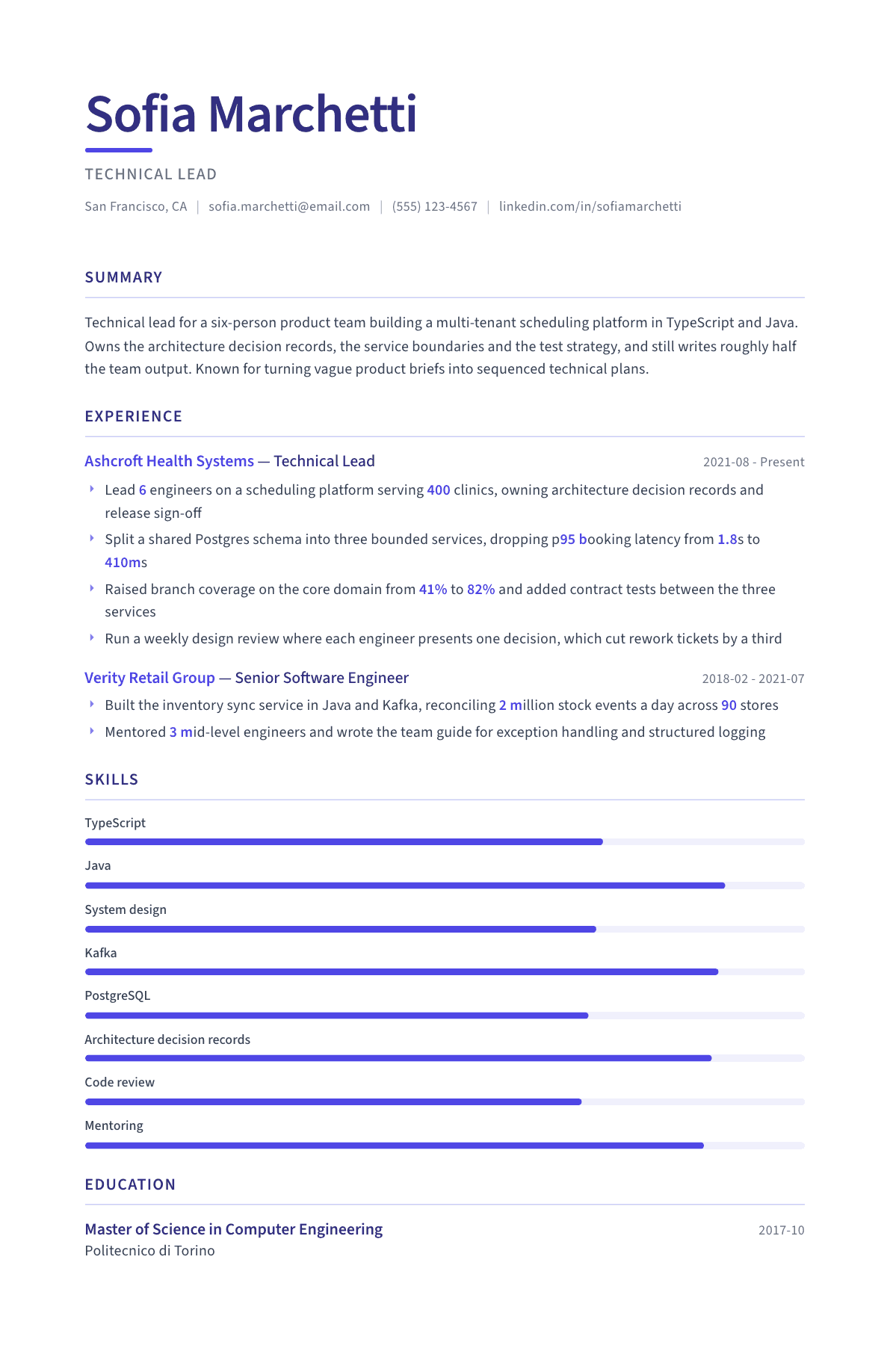
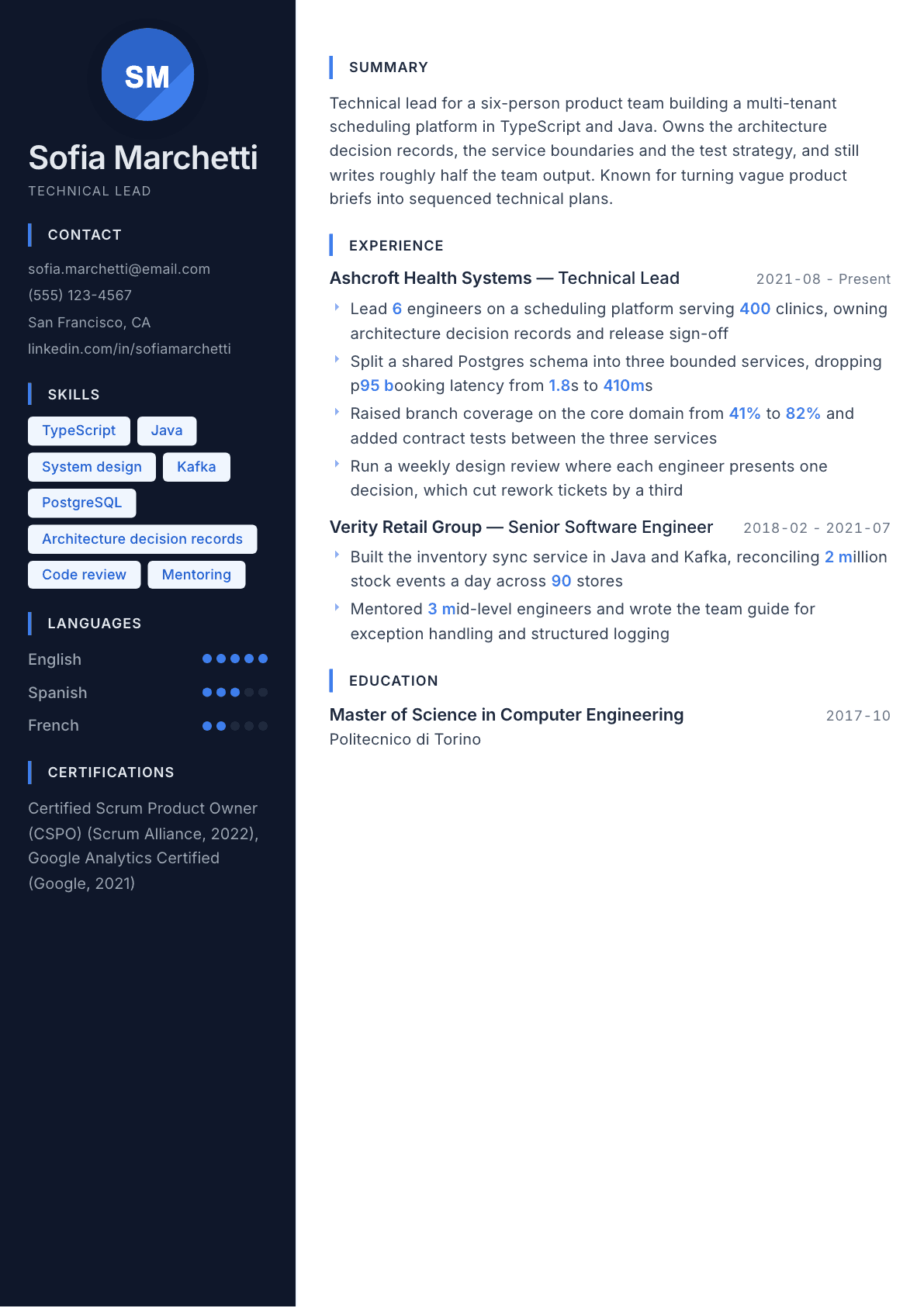
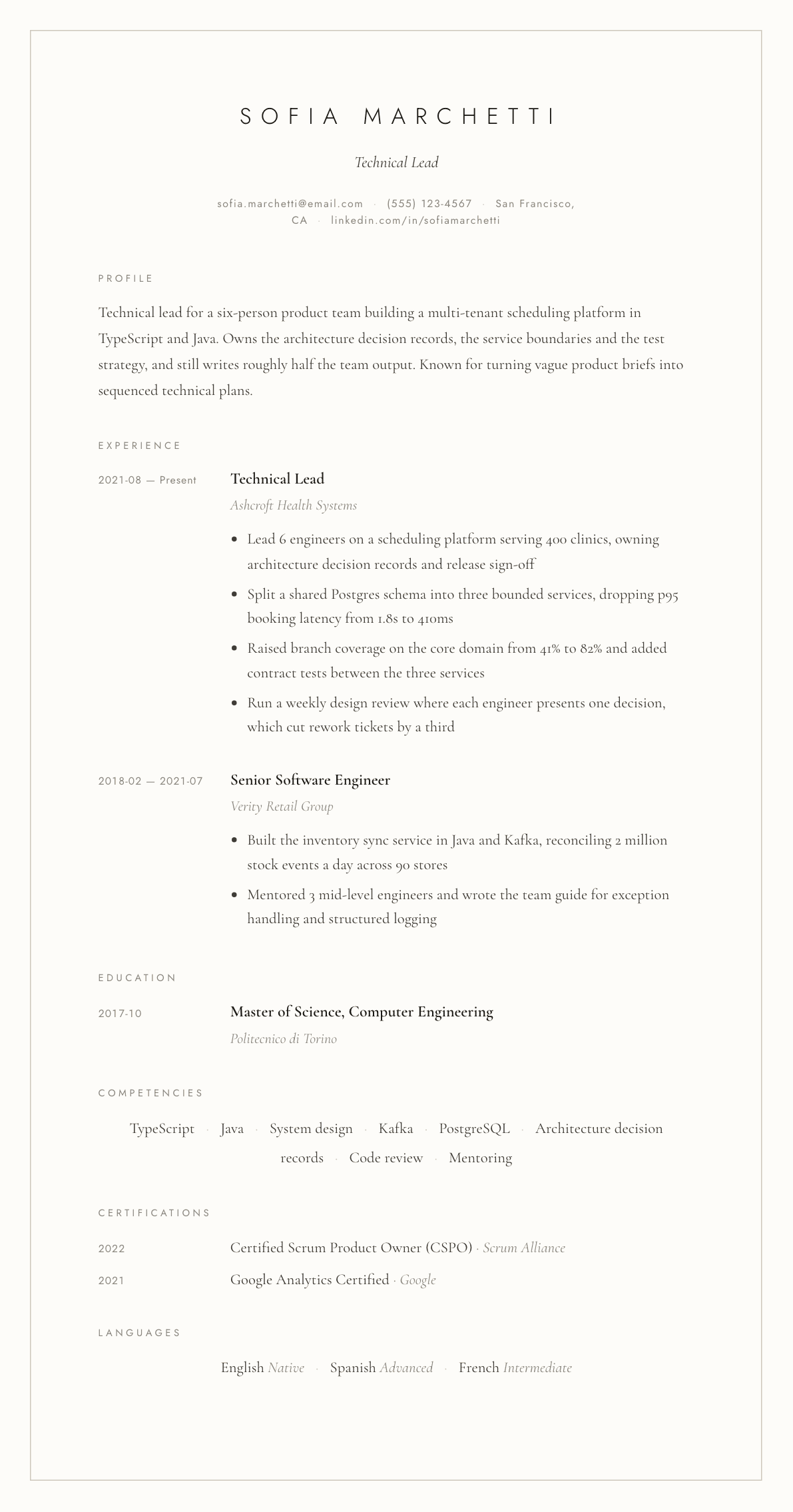
Example Technical Lead summary
Technical lead with nine years in product engineering and four leading teams of five to eight. Owns architecture decisions, breaks large product briefs into sequenced technical plans, and still contributes a meaningful share of the code. Recently split a shared database into bounded services and cut booking latency to under half a second while raising domain test coverage past eighty percent.
Skills to list on a Technical Lead resume
- System design
- Architecture decision records
- Code review
- Technical mentoring
- API design
- Distributed systems
- Test strategy
- Refactoring and migration
- CI and CD pipelines
- Observability
- Estimation and sequencing
- Stakeholder translation
- Java
- TypeScript
What actually gets this resume read
- State how many engineers you led and whether the role was hands-on, because lead means different things per company.
- Describe one architecture you owned in enough detail that a staff engineer could argue with your choice.
- Attach mentoring to outcomes: reviews you ran, engineers promoted, guides you wrote that the team still uses.
- Show the quality bar you set through coverage, contract tests, review rules or a documented definition of done.
- Include the migration or decommission work, since removing a system is often harder than adding one.
- Keep a short technical skills block with the languages you still write, not everything you have ever touched.
How to write a technical lead resume
Technical lead means at least three different jobs depending on the company. In one place it is a senior engineer who runs a standup. In another it is an architect with no direct reports who owns the design of an entire product surface. In a third it is a manager in everything but title. A hiring panel knows this, so the first job of your resume is to say which version you have been, and which one you are applying for.
The second job is proof of ownership. Panels for this role look for a system you decided the shape of, defended in review, and then lived with long enough to see the consequences. A resume full of features delivered reads as a strong senior engineer. A resume that shows a service boundary you drew, a migration you sequenced, and a quality bar you enforced reads as a lead.
What follows is the section order these panels expect, how to write about architecture without turning it into a novel, how to make mentoring measurable, and the five questions that come up whenever someone sits down to write this page.
Format: one page under eight years, two after, with a scope line per role
Reverse chronological, plain single column. Under each lead title write one line stating how many engineers you led, whether the role was hands-on, and which systems the team owned. Without that line a reader cannot tell a lead of three from a lead of twelve, and the two roles have almost nothing in common.
Put a technical skills block high on the page, but restrict it to what you would defend in an interview today. A lead who lists fourteen languages invites a question about the weakest one.
- Header: name, city, phone, email, plus a repository or a design write-up if it is genuinely public.
- Order: summary, technical skills, experience with a scope line, selected architecture work, education.
- Keep older senior engineer roles, but compress them to two bullets each once you have two lead roles.
Summary: team size, hands-on share, and the domain
Three or four lines. Say the size of the group, roughly how much of your week is still code, the domain, and one architectural theme you keep returning to: breaking monoliths apart, event-driven integration, latency work, or replacing a vendor platform. Specificity here is what gets the resume read closely rather than skimmed.
If your title was senior engineer while you did the lead job, say so in the summary instead of inflating the title. Panels check titles against references, and the honest framing costs you nothing.
Experience: one architecture story per role, told properly
Pick the largest technical decision in each role and give it two bullets. The first states the problem and the choice: splitting a shared schema into bounded services, moving from request-response to a message broker, replacing an in-house scheduler with a managed one. The second states what happened, in latency, failure rate, cost or team throughput.
Write the decision in a way another engineer could disagree with. A bullet that says you introduced microservices tells nobody anything. A bullet that says you split three domains out of a shared database and kept the rest deliberately monolithic tells a panel you understand the trade-off.
Fill the rest with the parts of the job that are not design: sequencing work so a migration never needed a big cutover, running the review that catches problems early, setting the definition of done, unblocking people, and taking the least popular piece of work yourself.
Make mentoring and review measurable
Leads are hired partly to raise everyone around them, and that work is easy to write badly. Instead of saying you mentored junior engineers, name the mechanism and the result: a weekly design review where each engineer presents a decision, a written guide for error handling that the team still follows, pairing sessions during onboarding that halved the time to a first merged change.
Include the review load. How many pull requests you review a week, whether you set the rule that no change merges without a second reader, and what you refuse to approve. A quality bar you enforce is more convincing than a coverage number alone.
Keywords that get a technical lead resume through filters
Postings for this role reuse a compact vocabulary: technical leadership, system design, architecture decision records, code review, mentoring, API design, distributed systems, test strategy, continuous integration, observability, and technical roadmap. Mirror the wording of the posting once in the summary and once inside a bullet where the work is shown. Keep language and framework names in the skills block so the parser finds them in one place.
Technical Lead resume summary examples
Newly appointed lead
Senior engineer recently appointed technical lead of a four-person team owning a customer billing service. Runs the design review and release sign-off while writing roughly two thirds of my own tickets. Recently replaced a nightly batch reconciliation with an event-driven flow that removed a class of duplicate charges.
Three years leading
Technical lead for a six-person product team building a multi-tenant scheduling platform in TypeScript and Java. Owns architecture decision records, service boundaries and test strategy. Split a shared database into three bounded services, taking p95 booking latency from 1.8s to 410ms without a maintenance window.
Lead across teams
Technical lead working across three product teams on a shared platform, setting API standards, review practice and the migration sequence off a legacy integration layer. Mentors four senior engineers, chairs the architecture forum, and still owns the hardest service in the estate personally.
Work experience bullets: before and after
Before: Led the technical direction of the team.
After: Set the technical direction for a six-person team by writing the architecture decision records for service boundaries, storage choice and the retry policy, each reviewed by two senior engineers before adoption.
Naming the artifacts and the review path shows direction was decided in the open, not asserted from a title.
Before: Broke the monolith into microservices.
After: Split scheduling, notification and billing out of a shared Postgres schema into three services with contract tests between them, deliberately leaving the reporting layer inside the original application.
Saying what you did not split proves the decision was reasoned rather than a default reach for microservices.
Before: Improved code quality across the codebase.
After: Raised branch coverage on the core domain from 41% to 82% over two quarters and introduced a rule that no change merges without a second reviewer and a passing contract test.
A measure plus an enforced rule shows the quality bar survives after you move on.
Before: Mentored junior developers on the team.
After: Ran a weekly design review where each engineer presents one decision, and paired with two mid-level engineers through their first service ownership, both of whom now lead their own components.
The mechanism and the outcome make mentoring verifiable instead of a claim anyone could make.
Before: Worked closely with the product manager on planning.
After: Turned quarterly product briefs into sequenced technical plans with explicit dependencies and risk notes, which cut mid-quarter scope changes to one in the last three cycles.
The reader sees the artifact you produced and the planning problem it solved.
Hard skills
- System and service design
- Architecture decision records
- API and contract design
- Distributed systems patterns
- Database schema design
- Test strategy and contract testing
- Continuous integration pipelines
- Observability and tracing
- Migration and decommission planning
- Performance profiling
- Code review practice
- Estimation and sequencing
Soft skills
- Technical mentoring
- Written explanation of trade-offs
- Facilitating design debate
- Stakeholder translation
- Prioritization
- Giving direct feedback
Certifications worth listing
- AWS Certified Solutions Architect, Professional (Amazon Web Services)
- Google Professional Cloud Architect (Google Cloud)
- Certified Kubernetes Application Developer (CKAD) (Cloud Native Computing Foundation)
Mistakes that cost technical lead candidates the interview
- Never stating the team size or whether the role was hands-on, which leaves the reader unable to place your scope.
- Describing an architecture in buzzwords, so a panel cannot tell whether you understood the trade-off you made.
- Listing only features delivered, which reads as a strong senior engineer resume rather than a lead one.
- Claiming a title the company never gave you instead of describing the responsibilities you actually held.
- Filling the skills block with technologies you touched once, inviting the interview question you least want.
- Omitting migrations and decommissions, when removing an old system is usually the harder piece of leadership.
Technical Lead resume questions
What is the difference between a technical lead resume and an engineering manager resume?
A lead resume centers architecture, review practice and hands-on ownership, with mentoring as supporting evidence. A manager resume centers hiring, performance management and delivery of a group. If your last role did both, write two versions and send the one that matches the posting.
How much code should a technical lead claim to write?
Whatever is true, stated as a rough share of the week. Panels ask what you last built and how recently. A lead who writes a quarter of their time and reviews everything is normal, and overstating it is caught within one technical conversation.
Should I list architecture decision records on a resume?
Yes, when you wrote them. They are the clearest evidence that decisions were documented and reviewed rather than made informally. Name the decisions themselves, such as storage choice or service boundaries, not just that a template existed.
How do I show leadership without direct reports?
Through mechanisms rather than authority. Design reviews you chair, standards you wrote that other teams follow, engineers you unblocked, and migrations you sequenced across several teams all demonstrate influence that does not depend on a reporting line.
How long should a technical lead resume be?
One page under about eight years of experience, two pages after that. Give the current and previous roles most of the space, compress earlier engineering roles to a couple of lines, and keep a single education entry unless a graduate degree is relevant.
Related resume examples
- Software Engineer Resume example
- Systems Architect Resume example
- Engineering Manager Resume example
- Software Architect Resume example
- Solutions Architect Resume example
- Test Automation Engineer Resume example