Scrum Master Resume Examples: free ATS score and gap list
Sprint Ahead with a Scrum Master Resume That Delivers
By Mustafa Tarabya, founder of CVBooster · Published · Updated
Build a Scrum Master resume that showcases your agile leadership, team facilitation, and delivery excellence.
Sample resumes for a scrum master
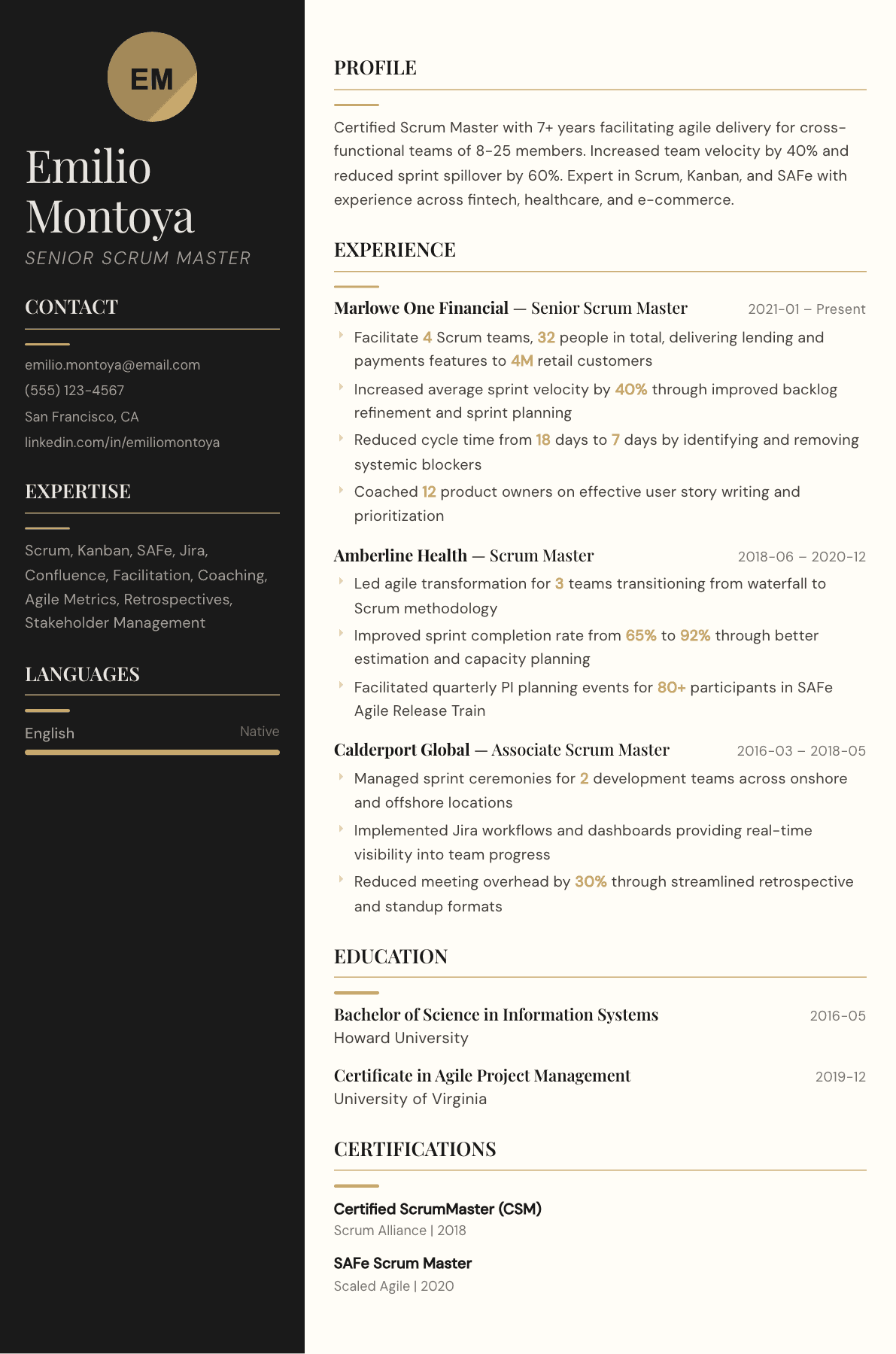
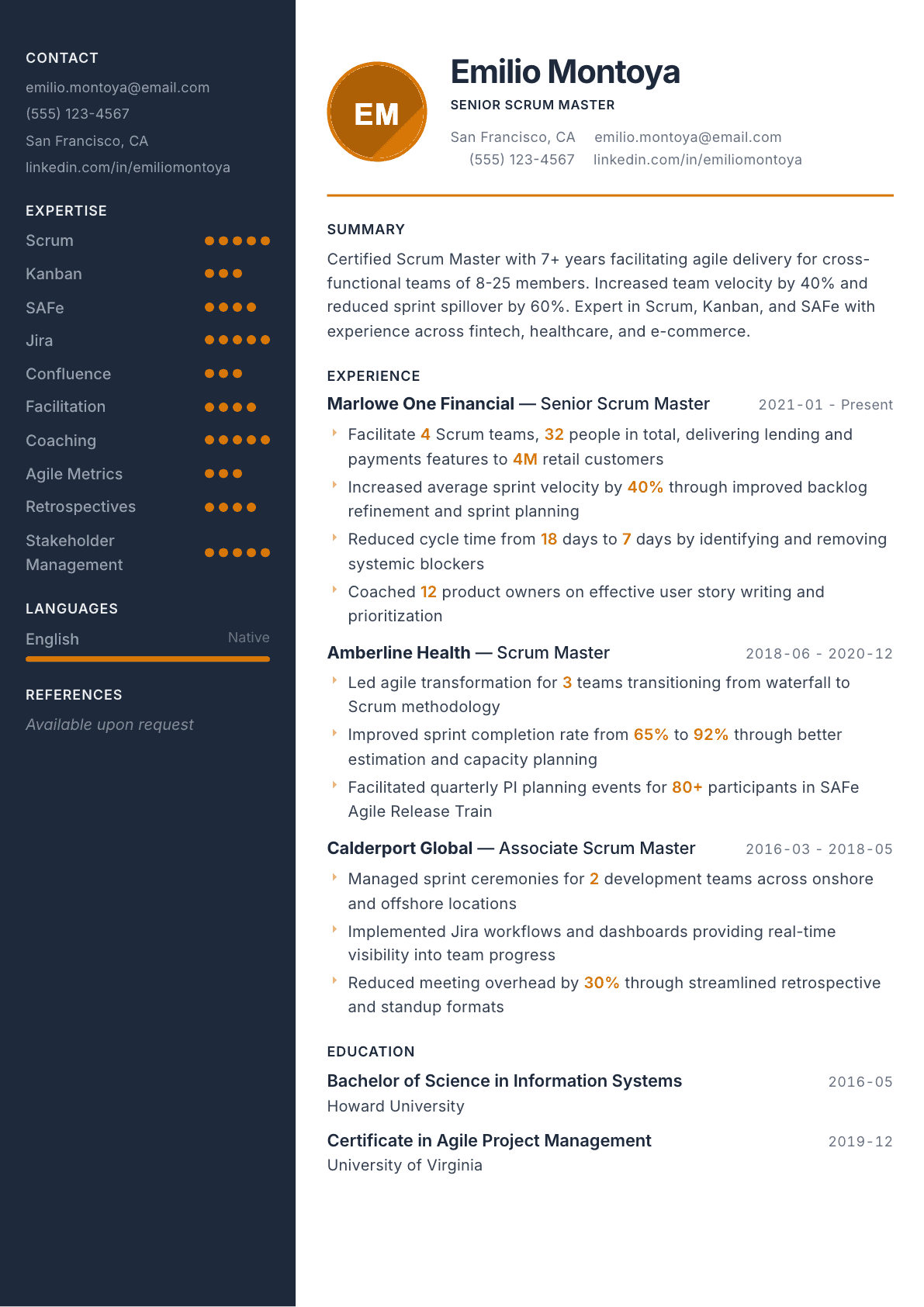
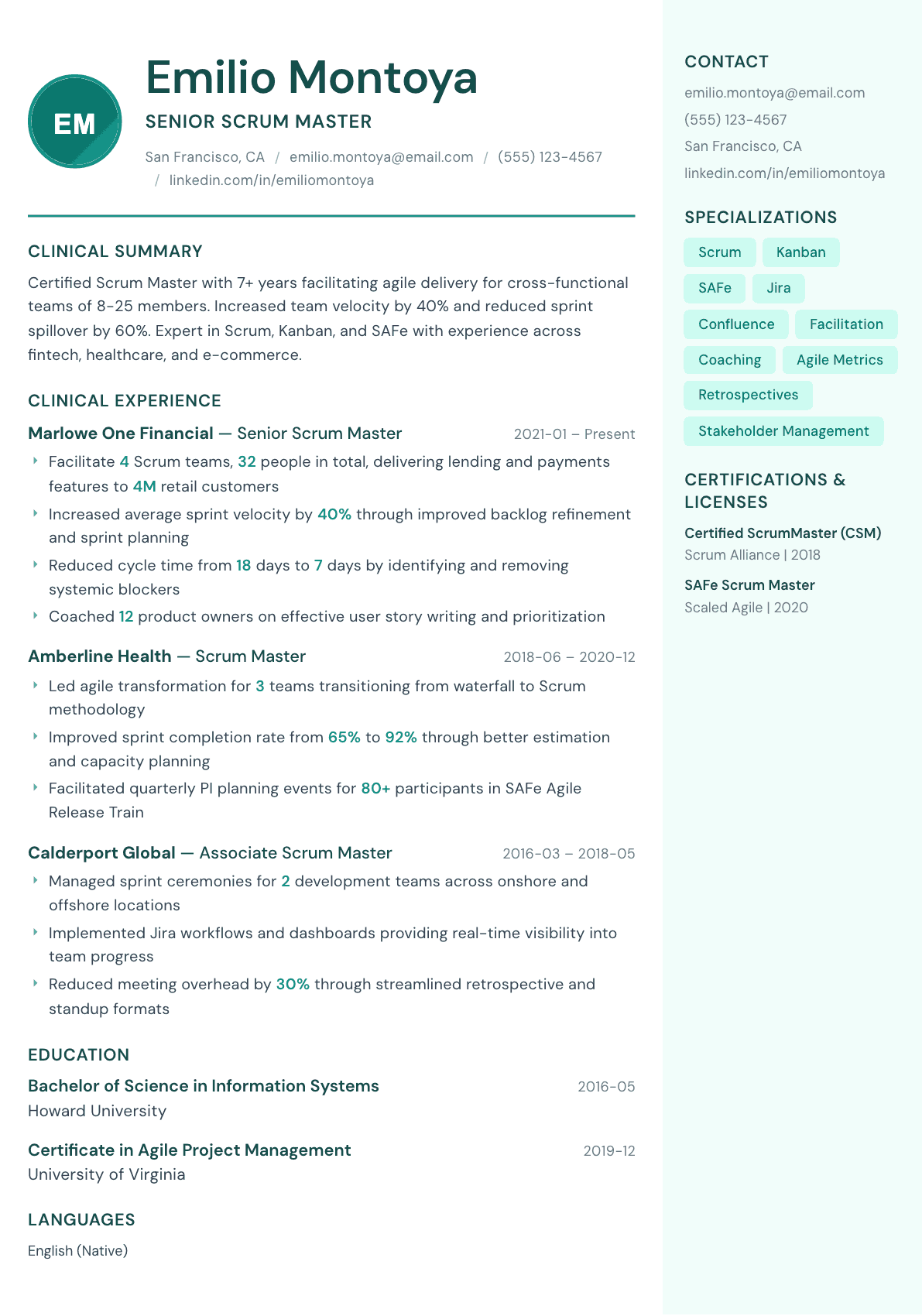
The same scrum master content laid out in three CVBooster templates, so you can see what the finished document looks like before you write a word.
Example Scrum Master summary
Scrum master, CSM and SAFe certified, 7 years across fintech and healthcare running teams of 8 to 25. Raised sprint completion from 65% to 92% at one client and cut cycle time from 18 days to 7 at another by removing the blockers nobody owned, and facilitates PI planning for release trains of 80 people.
Skills to list on a Scrum Master resume
- Scrum
- Kanban
- SAFe
- Jira
- Confluence
- Facilitation
- Coaching
- Agile Metrics
- Retrospectives
- Sprint Planning
- Stakeholder Management
- Servant Leadership
- Conflict Resolution
- Continuous Improvement
What actually gets this resume read
- Lead with Scrum/Agile certifications.
- Quantify velocity improvements and cycle time reductions.
- Show team size and number of teams managed.
- Highlight coaching and mentoring experience.
- Include SAFe experience for enterprise roles.
How to write a scrum master resume
A scrum master resume has a problem no other role has: the job is mostly invisible. The team wrote the code, the product owner set the priorities, and your contribution was removing the impediment that would have cost them a week, or ending the argument that would have stalled the sprint. Candidates deal with this by claiming team achievements as their own, which experienced hiring managers spot immediately, or by describing ceremonies, which tells the reader nothing except that Scrum was followed.
The way out is to write about change. What the team did badly when you arrived, what you did about it, and what measurably improved. Sprint completion, cycle time, defect escape rate, unplanned work and the number of blocked items are all things a scrum master genuinely influences, and they are all defensible in an interview because you can explain the intervention behind each one.
This guide covers where certifications belong, how to describe teams so a reader can size your experience, how to write about coaching and conflict without vague language, and how to handle the awkward truth that many scrum master postings are really delivery manager roles in disguise.
Format: certifications up top, teams described precisely
Reverse-chronological, one page under seven years. Put your agile certifications in a line under the summary, because recruiters filter for the acronyms and hiring managers use them as a baseline. Include the issuer, since Scrum Alliance, Scrum.org and Scaled Agile represent different communities and readers notice which one you came from.
Under each role, describe the teams before the bullets: how many teams, how many people, whether they were co-located or distributed across time zones, the product domain, and the framework in use. Facilitating one co-located team of six is a different job from supporting three distributed teams across three time zones on a regulated product.
- Header: name, credentials such as CSM or PSM after the name, city, phone, email.
- Order: summary, certifications, experience with team profiles, skills, education.
- State the framework honestly: Scrum, Kanban, a hybrid, or a scaled model such as SAFe or LeSS.
- Name the domain, because regulated environments and hardware-linked delivery change the role substantially.
Summary: teams, framework, and the delivery problem you fixed
Name the number of teams and people, the framework, the domain, and the delivery problem you are known for solving. Common ones are unpredictable sprint outcomes, a backlog nobody trusts, dependencies between teams that were discovered too late, or a team that had ceremonies but no working agreement.
Avoid the word servant leader in the summary. Every applicant uses it and it carries no information. Show the behavior in a bullet instead, such as the escalation you took to a director so the team did not have to.
Experience: interventions, not ceremonies
Do not list the events. Every reader knows a scrum master runs planning, daily scrums, review and retrospective, and reciting them costs you a third of the page. Write instead about the specific interventions you made and what changed as a result.
Good material comes in four categories. Flow: work in progress limits, splitting stories that were too large, reducing handoffs, making blocked items visible. Predictability: estimation practice, capacity planning around holidays and on-call, protecting the sprint from mid-sprint injections. Quality: definition of done that includes testing, addressing defect escapes in the retrospective rather than in a separate meeting. And organizational impediments: the dependency, the approval delay, or the missing environment that only leadership could remove.
Write the coaching work with evidence. Which practice you introduced, who resisted it, how you handled that, and what the team decided to keep. A scrum master who can describe a failed experiment the team ran and what they learned reads as an actual practitioner rather than a process enforcer.
Metrics: which agile numbers are defensible
Velocity is the most quoted and the weakest, because it is team-relative and easily inflated by changing estimation. Use it only alongside something harder. Stronger numbers are sprint completion rate, cycle time from start to done, lead time from request to release, defect escape rate, percentage of unplanned work, and how long items sit blocked.
Always attach the intervention. A cycle time that fell from eighteen days to seven means something when you explain that it followed story splitting and a work in progress limit. Without the cause, a hiring manager reads it as a number you inherited from a team that was improving anyway.
- Sprint completion or forecast accuracy over a stated number of sprints.
- Cycle time and lead time, with the practice change that moved them.
- Unplanned work as a share of the sprint, and how you protected the team from injections.
- Blocked item age and how impediments were escalated and closed.
Scaling, tooling, and the delivery manager question
If you have worked at scale, describe the mechanism rather than the acronym. Program increment planning, a scrum of scrums, dependency boards, release trains and communities of practice. Say how many teams were in the group and what your role in the ceremony was, because SAFe experience appears in a large share of enterprise postings.
Many postings titled scrum master expect delivery management: status reporting, budget awareness, vendor coordination and stakeholder management. If you have done that work, include it in its own bullets rather than hiding it, because it widens your options considerably. Keep it separate from the coaching bullets so a purist agile team can still read you as a coach.
On tooling, be concrete about how you configured Jira or an equivalent rather than that you used it. Board and workflow design, custom fields that made flow visible, filters and dashboards leadership actually read, and reports you built to support a retrospective.
Scrum Master resume summary examples
New scrum master
Certified ScrumMaster who moved into the role from business analysis, facilitating one team of seven on a customer portal. Introduced a definition of done covering test automation and raised sprint completion from 60% to 85% over eight sprints through story splitting and capacity planning.
Four years in
Scrum master with four years supporting two distributed product teams of 18 people across three time zones. Cut cycle time from 18 days to 7 with work in progress limits and smaller stories, and reduced unplanned work in the sprint from a third to under a tenth by fixing intake.
Agile coach and scrum master
Agile practitioner with nine years, currently supporting four teams and facilitating program increment planning for a release train of 90 people. Coaches product owners on backlog quality, runs a scrum master community of practice, and led the move from quarterly to fortnightly releases.
Work experience bullets: before and after
Before: Facilitated daily standups, sprint planning, reviews and retrospectives.
After: Replaced a status-report daily scrum with a board-driven walk from the right, which surfaced blocked items on day one instead of day four and cut average blocked age from six days to one.
It describes what you changed about the event and the effect, rather than confirming the event took place.
Before: Increased team velocity by improving processes.
After: Introduced story splitting and a work in progress limit of three per developer, taking sprint completion from 61% to 92% across ten sprints without changing estimation practice.
Naming the practice and keeping estimation constant answers the objection that velocity was simply reinflated.
Before: Removed impediments for the development team.
After: Tracked recurring impediments and found that environment provisioning caused a third of blocked days, then negotiated a dedicated test environment with the platform team, ending the dependency in six weeks.
A measured impediment pattern with an organizational fix shows the part of the role that requires influence.
Before: Coached the team on agile practices.
After: Ran a retrospective experiment on pairing for complex stories, kept it after the team reported fewer rework cycles, and dropped a second experiment on estimation poker when it added time without improving forecasts.
Including an experiment that was abandoned reads as honest practice rather than a coaching slogan.
Before: Worked with product owners on the backlog.
After: Coached three product owners on writing thin vertical slices with acceptance criteria, which cut mid-sprint clarification requests from around 12 per sprint to 3 and removed most of the carryover.
The coaching target and the specific behavior change make an otherwise soft claim measurable.
Hard skills
- Scrum framework and events
- Kanban and flow metrics
- SAFe and program increment planning
- Backlog refinement facilitation
- Story splitting and acceptance criteria
- Capacity and release planning
- Jira board and workflow configuration
- Confluence documentation
- Cycle time and cumulative flow analysis
- Dependency and risk management
- Retrospective facilitation techniques
- Definition of done and working agreements
Soft skills
- Facilitation of difficult conversations
- Conflict resolution within a team
- Coaching without directing
- Influencing leadership without authority
- Protecting focus under stakeholder pressure
- Listening for what a team is not saying
Certifications worth listing
- Certified ScrumMaster (CSM) (Scrum Alliance)
- Advanced Certified ScrumMaster (A-CSM) (Scrum Alliance)
- Professional Scrum Master I (PSM I) (Scrum.org)
- Professional Scrum Master II (PSM II) (Scrum.org)
- SAFe Scrum Master (Scaled Agile)
- PMI Agile Certified Practitioner (PMI-ACP) (Project Management Institute)
- Kanban Management Professional (Kanban University)
Mistakes that cost scrum master candidates the interview
- Listing the Scrum events as achievements, which uses a third of the page to tell the reader nothing.
- Claiming the product outcomes the team delivered as personal results, which collapses under one interview question.
- Leading with velocity improvement, the easiest agile number to inflate and the one experienced managers trust least.
- Using servant leader, passionate and change agent instead of describing a single thing you actually did.
- Omitting team size, distribution and domain, so the reader cannot size the difficulty of what you handled.
- Hiding delivery management responsibilities, which are what a large share of scrum master postings really want.
Scrum Master resume questions
Which scrum master certification is best?
Certified ScrumMaster from Scrum Alliance and Professional Scrum Master from Scrum.org are both widely recognized, and enterprise postings often ask for SAFe. Hold one core credential and add the scaled one if you work in a large organization. More certifications do not compensate for thin experience with real teams.
How do I quantify scrum master work without taking credit for the team?
Measure the process, not the product. Sprint completion, cycle time, blocked item age, unplanned work and defect escape rate all describe how the team worked, and you can attribute the change to a specific intervention you made. That framing gives you numbers while staying honest about who built the software.
Should a scrum master resume include technical skills?
Include enough to show you can follow the team's work: the domain, the delivery pipeline, the testing approach and any background you have in engineering or analysis. You are not being hired to write code, but a scrum master who cannot understand a technical dependency cannot help remove one.
How do I move from project manager to scrum master?
Rewrite your experience around team enablement rather than plan execution: how you removed impediments, coached on estimation and made flow visible. Then be explicit about what you stopped doing, such as assigning tasks and reporting individual utilization, because that is the exact concern an agile hiring manager has about project managers.
Is it a problem that my role was really a delivery manager?
Only if you hide it. Describe both halves plainly: the coaching and facilitation work in one set of bullets, the reporting, budget and vendor coordination in another. Many organizations want both, and being clear about which you did lets each type of employer decide accurately rather than discovering it in week two.
Related resume examples
- Project Manager Resume example
- Product Manager Resume example
- IT Project Manager Resume example
- Product Owner Resume example
- Engineering Manager Resume example
- Technical Program Manager Resume example