CTO Resume Examples: what a hiring manager reads first
Build a CTO Resume That Reads Like Technical Leadership
By Mustafa Tarabya, founder of CVBooster · Published · Updated
A CTO resume guide with an executive sample, engineering scale numbers, the architecture and hiring signals investors probe, plus keywords and structure advice.
Sample resumes for a cto
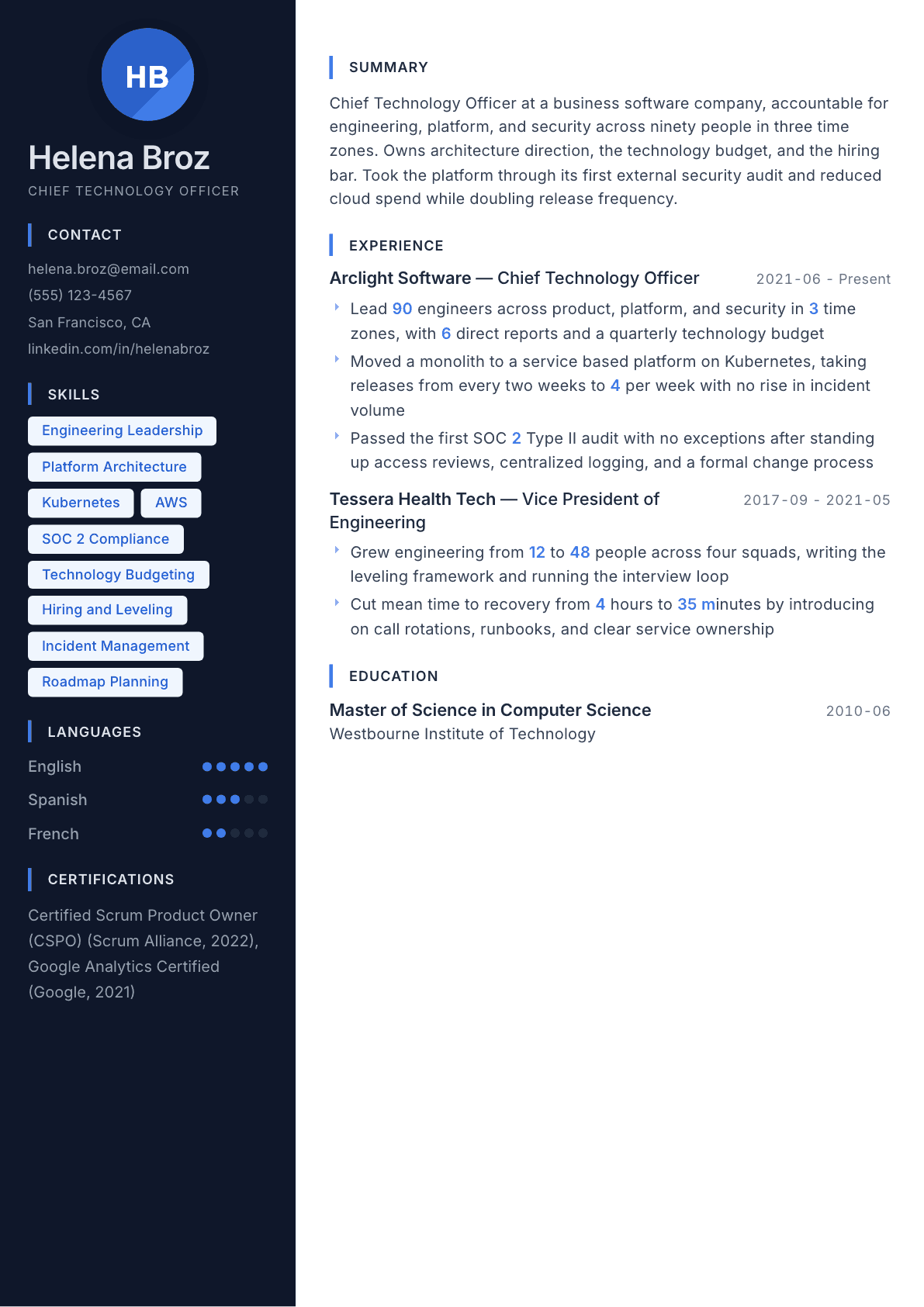
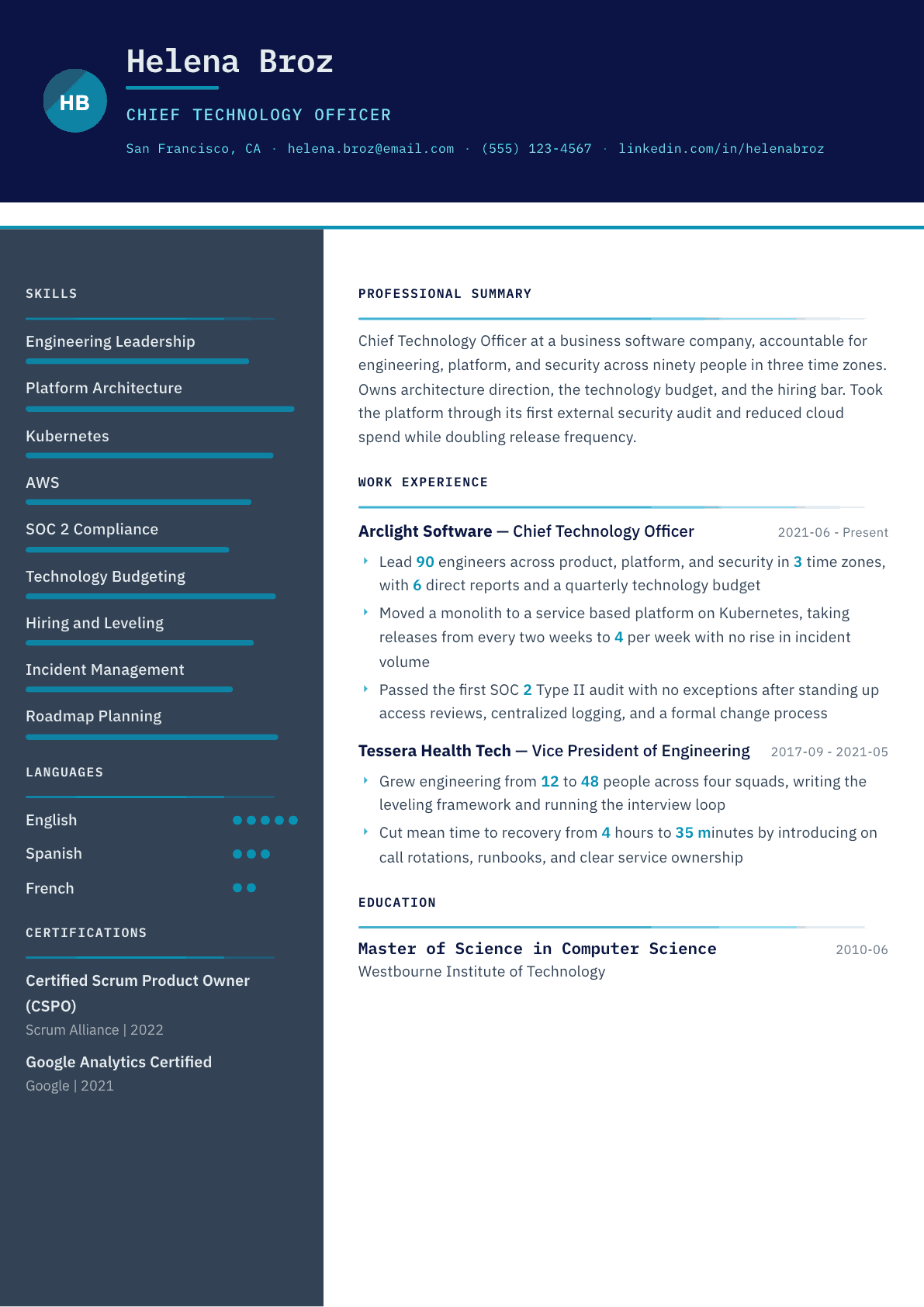
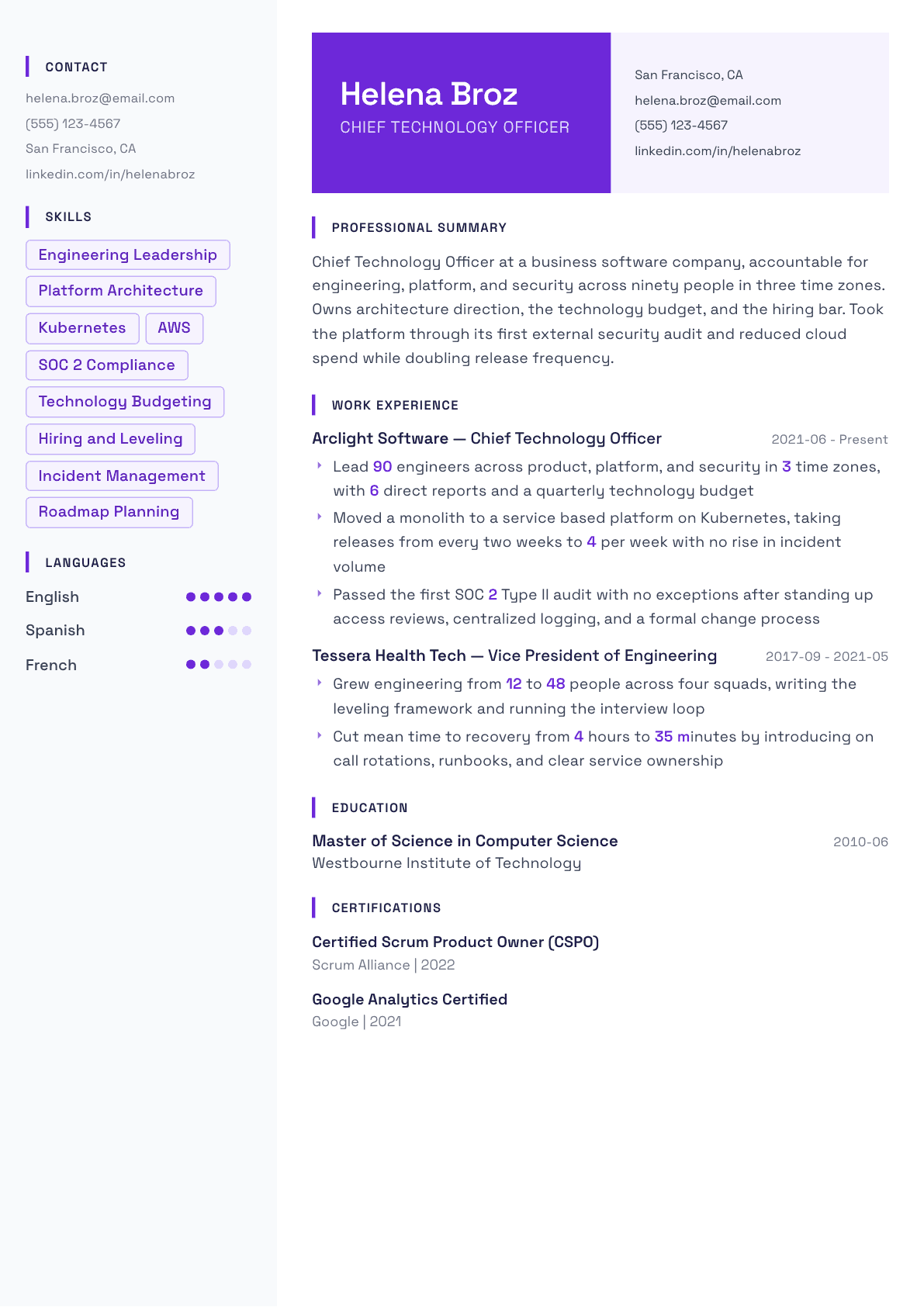
The same cto content laid out in three CVBooster templates, so you can see what the finished document looks like before you write a word.
Example CTO summary
Chief Technology Officer with sixteen years in software, the last five leading engineering, platform, and security for a business product company. Runs an organization of ninety across three time zones, owns the technology budget, and set the leveling framework that made hiring consistent. Took the platform to a clean SOC 2 Type II audit and raised release frequency without pushing up incident volume.
Skills to list on a CTO resume
- Engineering Leadership
- Platform Architecture
- Cloud Strategy
- Kubernetes
- AWS
- Technology Roadmap
- Engineering Hiring
- Budget Ownership
- SOC 2 Compliance
- Incident Management
- Site Reliability
- Contract Negotiation
- Data Architecture
- Security Governance
- Board Communication
- Developer Productivity
What actually gets this resume read
- Lead with team size, budget scope, and the products you are accountable for, because that is how a board sizes a technology leader.
- Present architecture decisions with the constraint you were solving, not as a list of technologies you happen to have touched.
- Include hiring and leveling work, since building an engineering organization is most of the job after the first year.
- Name compliance milestones such as SOC 2 or ISO 27001 audits together with the part you personally played in reaching them.
- Quantify reliability and delivery through release frequency, change failure rate, and recovery time, which read stronger than feature lists.
- Keep one short technical line so screeners see the stack, then spend the rest of the page on leadership scope and decisions.
How to write a cto resume
A CTO resume is read by a chief executive, a board member, or an investor doing technical diligence, and all three are testing the same thing: can this person be trusted with the thing they cannot personally evaluate? None of them will assess your code. They will assess whether the engineering organization you ran delivered predictably, stayed secure, cost what you said it would, and kept the people you needed.
The role also means different things at different company sizes. A CTO at a company of twenty is the person writing the hardest service. A CTO at a company of four hundred is running an organization, a budget, and an architecture strategy through directors. Applying with the wrong version of the story is the single most common reason a strong candidate gets passed over, so the resume has to make the stage explicit.
This guide covers the layout an executive reader expects, three summaries at different company stages, before and after bullets that hold up under diligence, the credentials worth listing, and the questions engineering leaders ask when they step into the seat for the first time.
Format: two pages, leadership scope before technology
Two pages, single column, plain typography. Open with a profile block that gives the organization size, the number of direct reports, the budget scope, and the products you are accountable for. That paragraph is what tells a chief executive whether you have operated at the stage her company is at.
Keep the technology stack to one compact line low on page one. It matters, because a screener will look for it, but a CTO resume that spends half a page on frameworks reads like a staff engineer applying for a title rather than a leader applying for a mandate.
- Header: name, city, phone, email, and a professional profile link.
- Order: profile, selected achievements, experience, technical stack, education, advisory roles.
- Name the company stage in each role: seed, growth, private equity owned, or listed.
Profile: organization, budget, and what you were hired to fix
Say what you were brought in to do. Scaling an engineering team through rapid hiring, rebuilding reliability after a bad year, preparing a platform for diligence, and consolidating three acquired stacks are entirely different mandates, and each attracts a different hiring company.
Then quantify the organization: engineers, direct reports, locations, and whether security, data, and platform sit under you. Ambiguity here costs you interviews, because a reader with no numbers will assume the smaller answer every time.
Architecture: the decision and the constraint behind it
Architecture bullets should read as trade offs, not tours. Moving a monolith onto a service based platform is only interesting when the reader knows why: release contention across teams, a scaling ceiling, a compliance boundary, or a cost curve that no longer worked. State the constraint, the choice, and what changed afterward.
Include the decisions where you deliberately did nothing. Choosing to keep a monolith for another two years because the team was too small to operate services well is a strong signal of judgment, and experienced readers notice its absence far more often than they notice its presence.
Delivery, reliability, and security: the numbers that get checked
Executive readers and diligence teams look for a small set of measures. Release frequency, change failure rate, mean time to recovery, and incident volume describe how the organization runs. Cloud cost per unit of usage describes whether it is affordable. Audit outcomes describe whether it is defensible.
Give compliance work your personal role rather than the company milestone. Standing up access reviews, centralized logging, and a formal change process before an audit is your work. Passing the audit is the company result, and the two sentences belong together.
- Delivery: release cadence, lead time, change failure rate.
- Reliability: incident volume, recovery time, on call structure and service ownership.
- Security: audit outcomes, penetration test remediation, and the controls you introduced.
People: hiring, leveling, and the layer you built
After the first year, most of this job is organizational. Show the hiring you led with numbers and the structure you created: a leveling framework, an interview loop, a promotion process, and the directors or managers you developed. Attrition is worth including when you improved it, because it is the cheapest proof that people wanted to stay.
Name the peers you worked with, particularly the product leader and the finance leader. A chief executive is hiring for a working relationship as much as a skill set, and evidence that you have run a functioning executive partnership before is genuinely persuasive.
CTO resume summary examples
First CTO seat at an early stage company
Founding engineer moving into the technology leadership seat at a seed stage company. Built the first product with two engineers, then hired and led a team of 11 across web and data. Owns architecture, the cloud budget, and the hiring bar while still reviewing code weekly.
Growth stage organization
Chief Technology Officer leading 90 engineers across product, platform, and security in three time zones, with 6 direct reports and a quarterly technology budget. Took the platform through its first external security audit and moved releases from every two weeks to four per week.
Post acquisition and board facing
Chief Technology Officer with sixteen years in software, currently consolidating three acquired platforms into one product line for a private equity owned group. Owns a technology budget, reports to the board on delivery and cyber risk, and has taken two companies through technical diligence.
Work experience bullets: before and after
Before: Led the migration from a monolith to microservices.
After: Moved a monolith onto a service based platform on Kubernetes to remove release contention between four teams, taking deploys from every two weeks to 4 per week with no rise in incident volume.
The constraint and the unchanged incident rate prove the migration solved a real problem without creating a new one.
Before: Responsible for security and compliance.
After: Stood up quarterly access reviews, centralized logging, and a formal change process, then took the platform through its first SOC 2 Type II audit with no exceptions.
Separating the controls you built from the audit result makes the claim specific and checkable.
Before: Grew the engineering team significantly.
After: Grew engineering from 12 to 48 across four squads in under three years, writing the leveling framework and the interview loop that kept the hiring bar consistent through the ramp.
The mechanism behind the growth matters more than the headcount, because anyone can hire quickly and badly.
Before: Improved system reliability and uptime.
After: Cut mean time to recovery from 4 hours to 35 minutes by introducing on call rotations, service ownership, and runbooks written by the teams that operate each service.
A before and after with the three practices behind it explains how the number moved and why it stayed there.
Before: Managed the technology budget and reduced cloud costs.
After: Cut cloud spend by 28% while usage grew, through right sizing, reserved capacity, and moving three batch workloads off the always on cluster, then made unit cost a standing item in the engineering review.
Naming the levers and the ongoing governance shows the saving was structural rather than a one time cleanup.
Hard skills
- Engineering organization design
- Platform and service architecture
- Cloud strategy and cost management
- Kubernetes and container platforms
- Technology roadmap and planning
- Security governance and audit readiness
- Incident management and reliability
- Data architecture and governance
- Budget ownership and forecasting
- Vendor and contract negotiation
- Technical due diligence
- Developer productivity measurement
Soft skills
- Board and investor communication
- Executive partnership with product and finance
- Hiring and leveling judgment
- Coaching managers and directors
- Prioritization under commercial pressure
- Clear written technical explanation
Certifications worth listing
- AWS Certified Solutions Architect Professional (Amazon Web Services)
- Certified Information Systems Security Professional (CISSP) (ISC2)
- Certified Kubernetes Administrator (CKA) (Cloud Native Computing Foundation)
Mistakes that cost cto candidates the interview
- Applying with a staff engineer resume that lists frameworks and pull requests instead of organization, budget, and outcomes.
- Leaving out company stage, so a reader cannot tell whether you led eight people or eight hundred.
- Claiming reliability improvements with no before and after, which diligence teams will ask about in the first call.
- Ignoring hiring, leveling, and manager development, which is most of the job once the team passes about thirty people.
- Writing security as a responsibility rather than as specific controls you introduced and audits you carried.
- Filling two pages with delivered features when the reader is trying to judge how you make decisions under constraint.
CTO resume questions
Should a CTO resume still list programming languages?
Yes, in one short line. It reassures a technical interviewer that you can hold a design conversation, and it helps a screener match you to the stack. Keep it brief so the page stays focused on leadership scope.
How do I move from VP of Engineering to CTO?
Show the parts of the job that sit outside delivery. Architecture strategy, budget ownership, vendor negotiation, security governance, and board communication are what separate the two roles, so pull any of those you have already done into the top half of page one.
What if my company never reached the scale in the job description?
Apply anyway and be precise about your numbers rather than inflating them. Many hiring companies value a leader who scaled from ten to fifty over one who inherited a mature organization, provided the resume makes the trajectory and the decisions visible.
How much detail should I give about failed projects?
One example, told briefly. Naming a platform bet you stopped, what it cost, and what you changed in how decisions were made afterward reads as maturity. Investors ask about this in diligence, so having a prepared answer on the page works in your favor.
Do I need certifications as a CTO?
They carry little weight at this level and can look defensive if they crowd out leadership content. A security or cloud credential is worth one line when it is directly relevant to the mandate, such as a company preparing for a first compliance audit.
Related resume examples
- Engineering Manager Resume example
- IT Director Resume example
- Chief Digital Officer Resume example
- Software Engineer Resume example
- CISO Resume example
- Cloud Security Engineer Resume example