Professional Athlete Resume Examples: what gets the call
Turn a Professional Athlete Career Into a Hiring Resume
By Mustafa Tarabya, founder of CVBooster · Published · Updated
Professional athlete resume examples that translate competition, training and sponsorship experience into language hiring managers outside sport read.
Sample resumes for a professional athlete
The same professional athlete content laid out in three CVBooster templates, so you can see what the finished document looks like before you write a word.
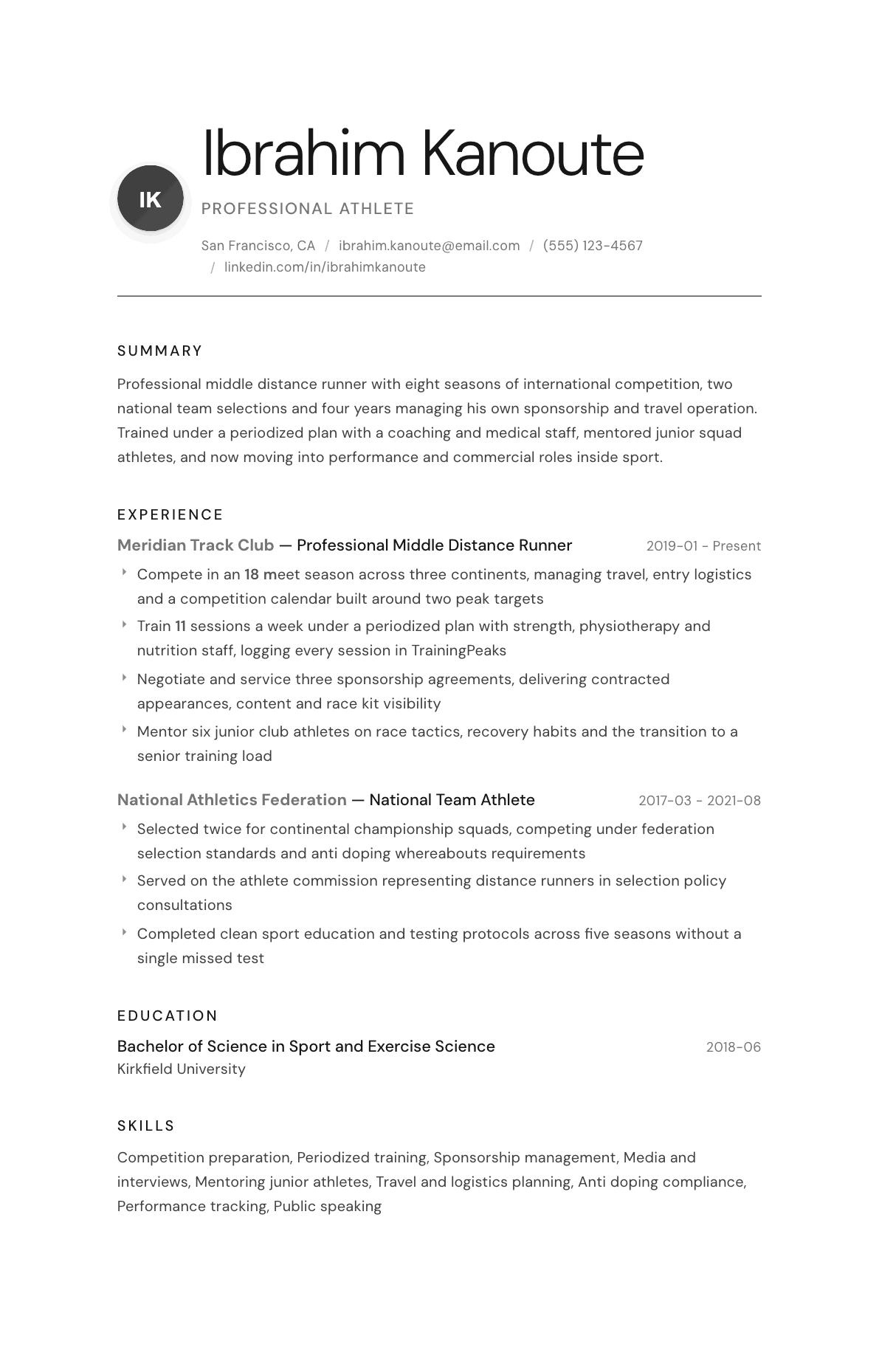
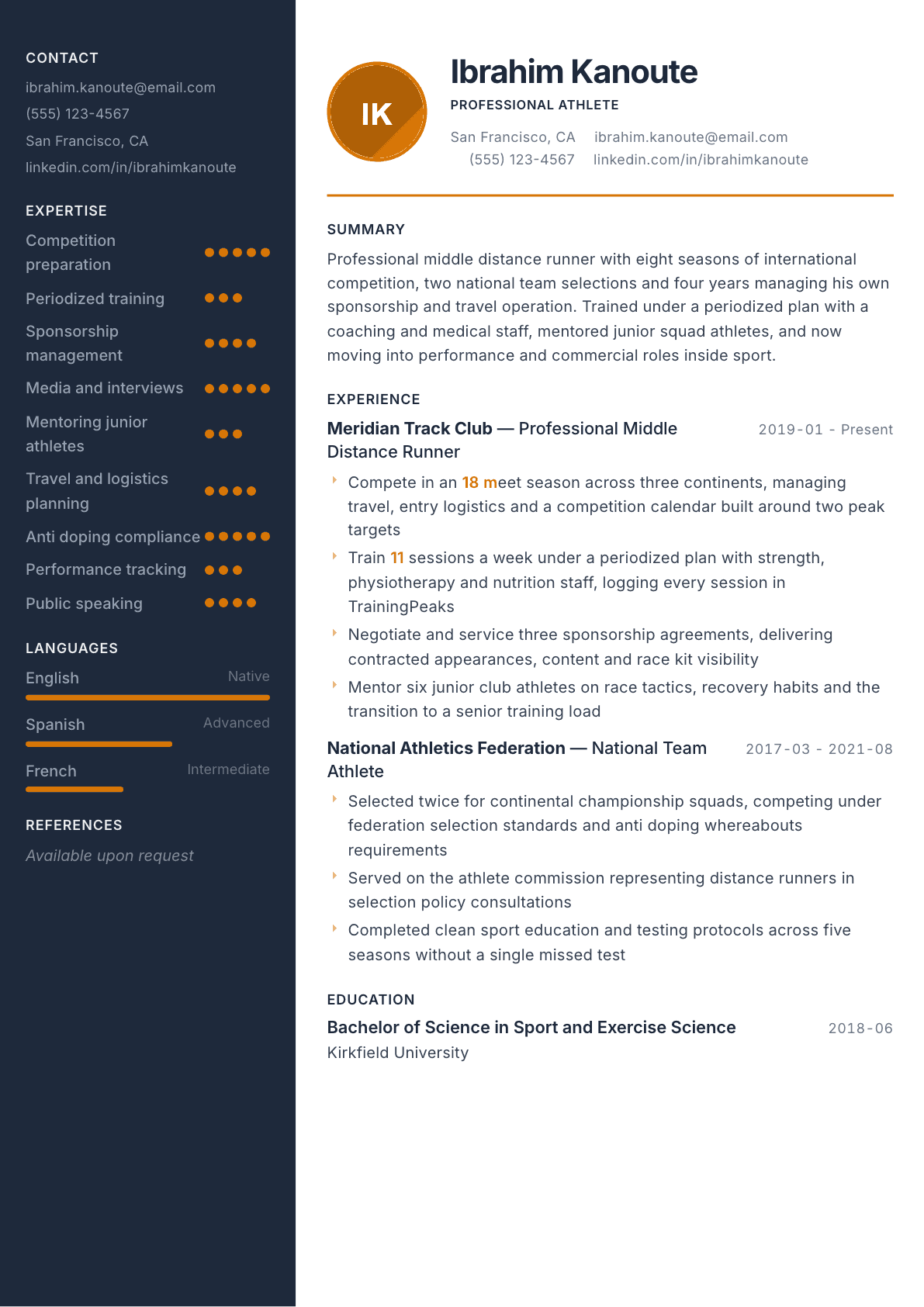
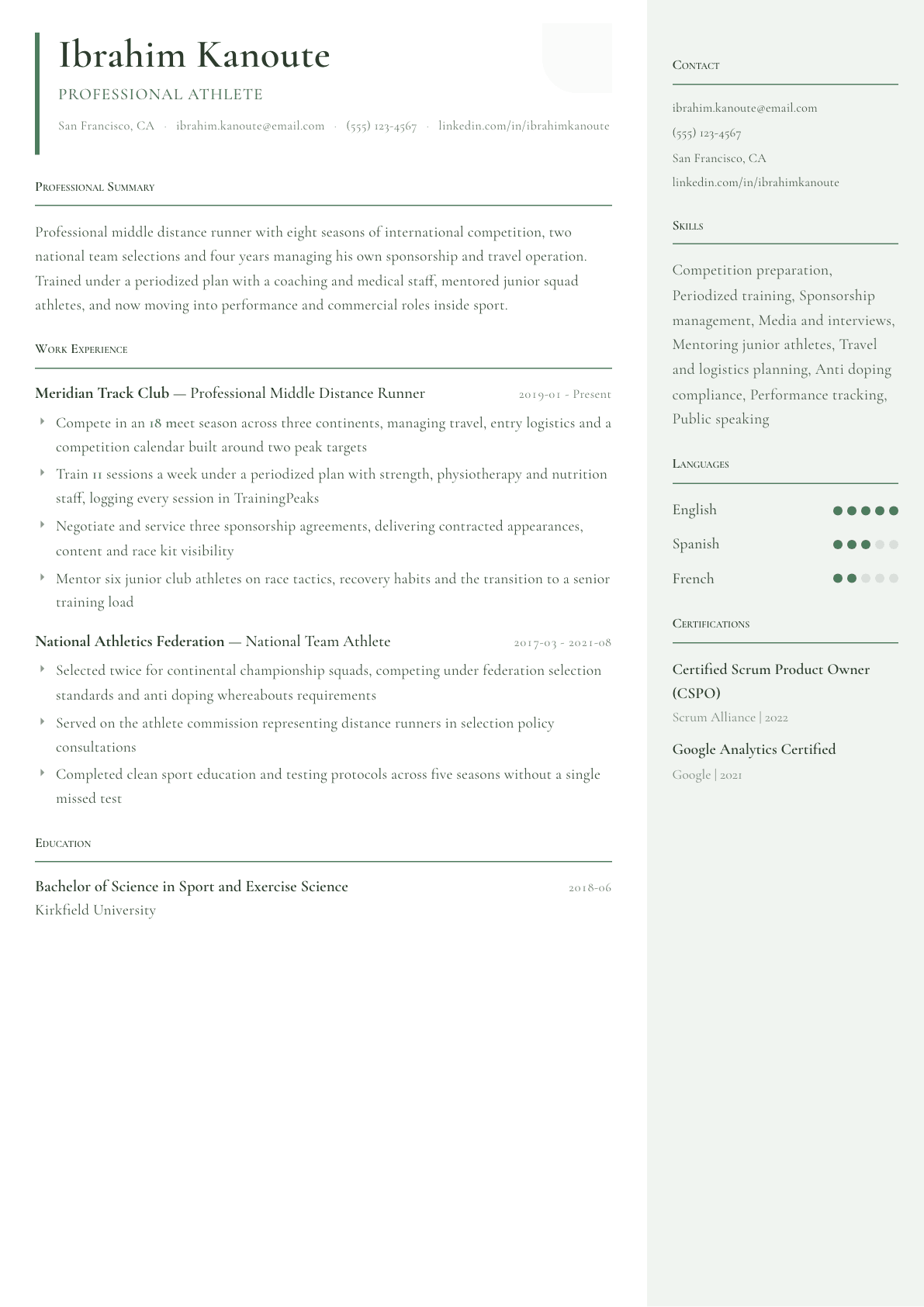
Example Professional Athlete summary
Professional middle distance runner with eight competitive seasons, two national team selections and full ownership of an eighteen meet international calendar. Trained eleven sessions a week with coaching and medical staff, serviced three sponsorship agreements, mentored junior club athletes, and met federation testing and selection requirements throughout.
Skills to list on a Professional Athlete resume
- Competition preparation and peaking
- Periodized training programs
- Performance data tracking
- Sponsorship and endorsement servicing
- Media interviews and appearances
- Athlete mentoring and captaincy
- International travel logistics
- Anti doping and compliance procedures
- Injury rehabilitation collaboration
- Nutrition and recovery planning
- Community and school outreach
- Goal setting under review
What actually gets this resume read
- Treat your competitive career as employment with dates, a club or federation, and responsibilities, not as a hobby section.
- Translate training discipline into work language: schedule ownership, self management, coachability and performance under review.
- List sponsorship, appearance and media obligations, because those are commercial responsibilities a hiring manager recognizes.
- Name the achievement level precisely, such as national championship finalist or continental squad selection, without inflating it.
- Add the leadership you carried, from captaincy and athlete commissions to mentoring younger squad members.
- If you are moving outside sport, put a short target statement at the top so the reader knows what you are applying for.
How to write a professional athlete resume
There are two reasons a professional athlete writes a resume, and they need different pages. One is to stay inside sport, applying to a club, federation, agency, brand or coaching staff where the competitive record is the qualification. The other is to leave for an industry where nobody in the room has heard of your event and the hiring manager quietly wonders what you have been doing for eight years.
The second case is where most applications fail, and the failure is almost always the same. The athlete treats the career as a gap, apologizes for it in a personal statement, and lists competition results as if they were hobbies. A hiring manager reading that sees an absence. The same career written as employment, with a club or federation as the employer, dates, responsibilities and countable obligations, reads as a demanding self managed job, which is what it was.
This guide shows how to write the record either way. It gives sample summaries for an early career athlete, an established professional and one transitioning out, rewrites the bullets athletes usually submit, and answers the questions that come up when the application is going to someone outside sport.
Format: decide the audience before the first line
Write a target line at the top when you are applying outside sport. One sentence naming the role you want and the two capabilities you bring to it. Without that, a reader spends the whole page guessing why an athlete sent it, and guessing readers say no.
Then reverse chronological, one page early, two once you have a long record plus education and outside work. Treat competition as employment: club, federation or team as the employer, your discipline as the position, real start and end dates. Never park the career under interests.
- Header: name, city, phone, email, discipline, and a link to a verifiable results profile or federation page.
- Section order inside sport: summary, competitive record, honors, training and coaching context, education.
- Section order outside sport: target line, summary, professional athletics as employment, other work, education, skills.
- Keep results in a compact block rather than scattered through bullets, so a non specialist reader is not asked to interpret them.
Summary: level, span, and what you managed besides training
Three facts and one direction. What you competed in and at what level, how many seasons, and what you ran alongside the competing: your own travel and entries, sponsorship obligations, media, a training group. Then where you are going next.
Precision protects you here. National team selection, continental championship qualification, first division roster, second division promotion campaign. State the level exactly as your federation would state it, because inflation is easy to check and expensive to be caught at.
Experience: the career as work, with the responsibilities named
Competing is the smallest part of the week. The bullets should show the rest of it: a periodized training plan you executed with coaching, strength and medical staff, sessions logged and reviewed, travel and entry logistics across a season, and a competition calendar built around one or two peak targets. That is planning, self management and performance under review, described in the terms it actually happened in.
Commercial responsibility is the strongest transfer signal most athletes have and the one they leave out. Sponsorship agreements you negotiated or serviced, contracted appearances, content days, kit visibility obligations, media interviews and school or community outreach are contract deliverables. Write them as deliverables.
Leadership belongs on the page too. Captaincy, athlete commission or player association service, mentoring junior squad members, leading a warmup group or representing teammates in selection policy consultations. Add compliance where it applies: anti doping education, testing pool obligations and whereabouts requirements are a demonstrated record of following an exacting external process without slipping.
- Give the season shape: how many competitions, over what geography, built around which peak targets.
- Describe the training load in sessions per week and the staff you worked with, not just hours.
- List sponsorship and appearance obligations as contracted deliverables you met.
- Name leadership roles, from captaincy to athlete commission service and mentoring.
- Include the compliance record, such as testing pool participation with no missed tests.
- Add any education, coaching qualification or work you completed while competing.
Translation: turning a training week into hiring language
Do the translation on the page rather than hoping the reader does it. A training block is a plan with milestones and reviews. A competition is a performance delivered on a fixed date under observation. A coaching relationship is receiving direct critical feedback weekly and adjusting behavior from it. A season of travel is logistics, budgeting and self scheduling across time zones.
Say those things in the bullet with the sport detail attached, so the reader sees both the evidence and its meaning. Avoid the opposite error of writing only in business abstractions, because a page of transferable skills with no sport in it reads as if the athlete is embarrassed by the career.
Keywords, honors and the record block
Keep a short honors block: selections, championship finals, national records, medals and rankings, each with the competition name and year. Five to eight entries chosen for range and recency beats a full career history nobody will finish reading.
For applications inside sport, mirror the posting vocabulary: performance, competition preparation, athlete development, sponsorship, media, community engagement, coaching support. For applications outside it, use the vocabulary of the target job and let the sport supply the evidence underneath each term.
Professional Athlete resume summary examples
Early career professional
Second year professional cyclist on a continental team, racing a thirty day competition calendar across two countries and training under a periodized plan with a coach and physiotherapist. Completed a sport science degree while racing, and serves as the team contact for junior development riders.
Established professional
Professional middle distance runner with eight competitive seasons, two national team selections and full ownership of an eighteen meet international calendar. Trains eleven sessions a week with coaching and medical staff, services three sponsorship agreements, and mentors six junior club athletes on tactics and recovery.
Transitioning out
Former national team athlete with a decade of international competition, two athlete commission terms and four years managing personal sponsorship and travel operations. Completed a coaching qualification and a commercial internship during the final seasons, now targeting a partnerships role inside a sports organization.
Work experience bullets: before and after
Before: Competed as a professional runner for several years.
After: Competed across an eighteen meet international season on three continents, managing entries, travel and a calendar built around two peak championship targets each year.
Turning the career into a season with logistics and planning shows work a hiring manager can evaluate.
Before: Trained daily to stay in top condition.
After: Executed eleven training sessions a week under a periodized plan with strength, physiotherapy and nutrition staff, logging every session in TrainingPeaks for weekly review with the coach.
A named plan, a staff structure and a review cycle reframe training as disciplined, measured execution.
Before: Had sponsors during my career.
After: Negotiated and serviced three sponsorship agreements, delivering contracted appearances, content days and race kit visibility on schedule across four seasons.
Framing sponsors as contract deliverables you met is commercial experience most athletes fail to claim.
Before: Helped younger athletes on the team.
After: Mentored six junior club athletes through their first senior season, covering race tactics, recovery habits and the jump in training load, with four progressing to national selection.
A count plus an outcome turns informal helpfulness into evidence of developing other people.
Before: Followed anti doping rules.
After: Maintained testing pool whereabouts filings and clean sport education requirements across five seasons with no missed tests or filing failures.
A perfect compliance record under an unforgiving external process is exactly the reliability an employer wants proof of.
Hard skills
- Competition preparation and peaking
- Periodized training execution
- Performance data and training log analysis
- Sponsorship servicing and contract deliverables
- Media interviews and public appearances
- International travel and entry logistics
- Anti doping compliance procedures
- Injury rehabilitation collaboration
- Nutrition and recovery planning
- Athlete mentoring and captaincy
- Community and school outreach delivery
- Video and technique review
Soft skills
- Performing on a fixed date under observation
- Taking direct critical feedback weekly
- Recovering from public failure
- Self scheduling without supervision
- Long horizon goal discipline
- Team cohesion in a competitive environment
Mistakes that cost professional athlete candidates the interview
- Listing the competitive career under interests, which invites a hiring manager to read a decade of work as a gap.
- Apologizing for the career in an opening statement instead of stating the role you now want and why you fit it.
- Reporting results in specialist notation a reader outside the sport cannot interpret without a glossary.
- Inflating the competitive level, which any federation results page can disprove in under a minute.
- Leaving sponsorship, media and appearance obligations off, when those are the clearest commercial experience on the page.
- Writing only in business abstractions with no sport detail, which reads as embarrassment rather than translation.
Professional Athlete resume questions
Should a professional athlete list competition as employment?
Yes. Use the club, team or federation as the employer, your discipline as the position, and real dates. Then write responsibilities and obligations underneath. Anything filed under interests will be read as unpaid activity rather than a career.
How do I explain a career break to an employer outside sport?
There is no break to explain if the years are written as employment. State the role, the season structure, the training and commercial obligations, and any education or work you completed alongside. The page then shows continuous demanding work.
Which results belong on the resume?
Five to eight, chosen for level and recency: selections, championship finals, national records, medals and best rankings, each with the competition name. A complete career history is unreadable and dilutes the ones that matter.
What roles inside sport hire retiring athletes most readily?
Coaching and athlete development, performance support, partnership and sponsorship servicing, community and grassroots programs, and athlete relations at federations or players associations. Each values the network and credibility that competing built.
Do I need a degree to move into a business role after competing?
Not always, but it shortens the conversation. Many athletes complete study or short professional courses during the final competitive seasons. Listing anything completed while training also proves you can carry two demanding commitments at once.
Related resume examples
- Sports Coach Resume example
- Athletic Trainer Resume example
- Student Athlete Resume example
- Sports Agent Resume example
- Personal Trainer Resume example
- Head Coach Resume example