Game Designer Resume Examples: free ATS score and gap list
Craft a Game Designer Resume That Shows Real Systems Work
By Mustafa Tarabya, founder of CVBooster · Published · Updated
A game designer resume guide with a sample credits list, portfolio advice, engine and tools keywords, and tips from the people who screen design applicants.
Sample resumes for a game designer
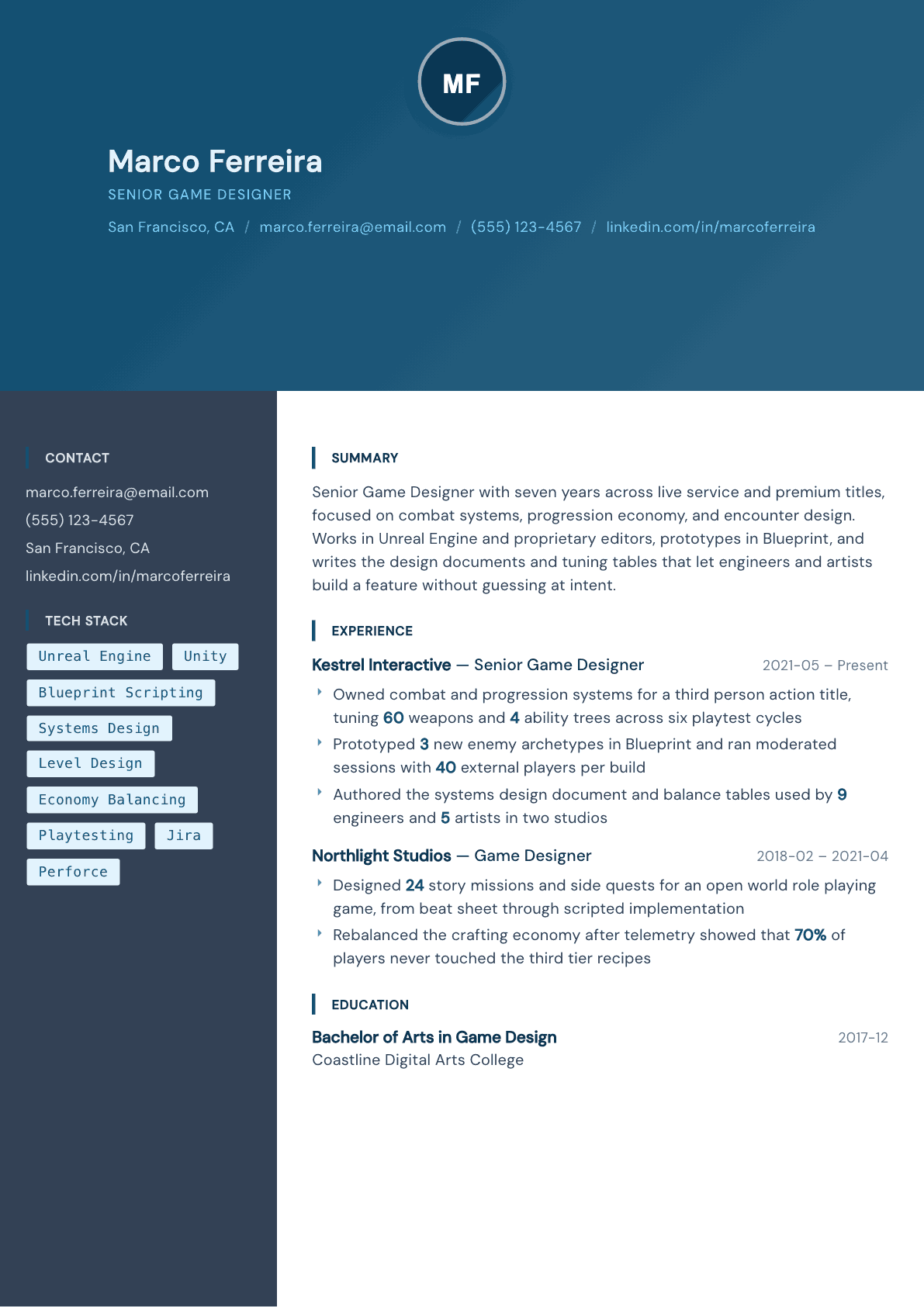
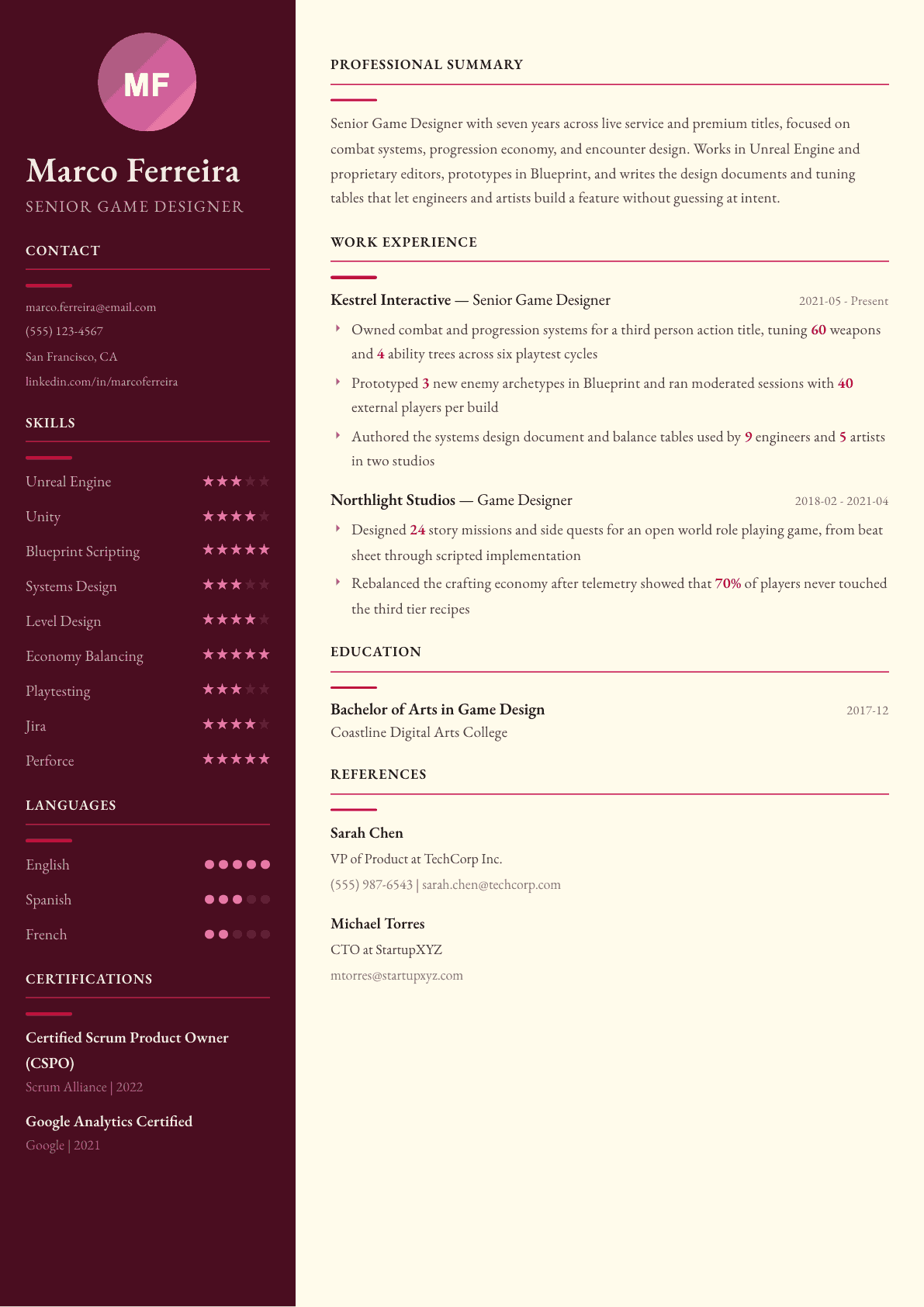
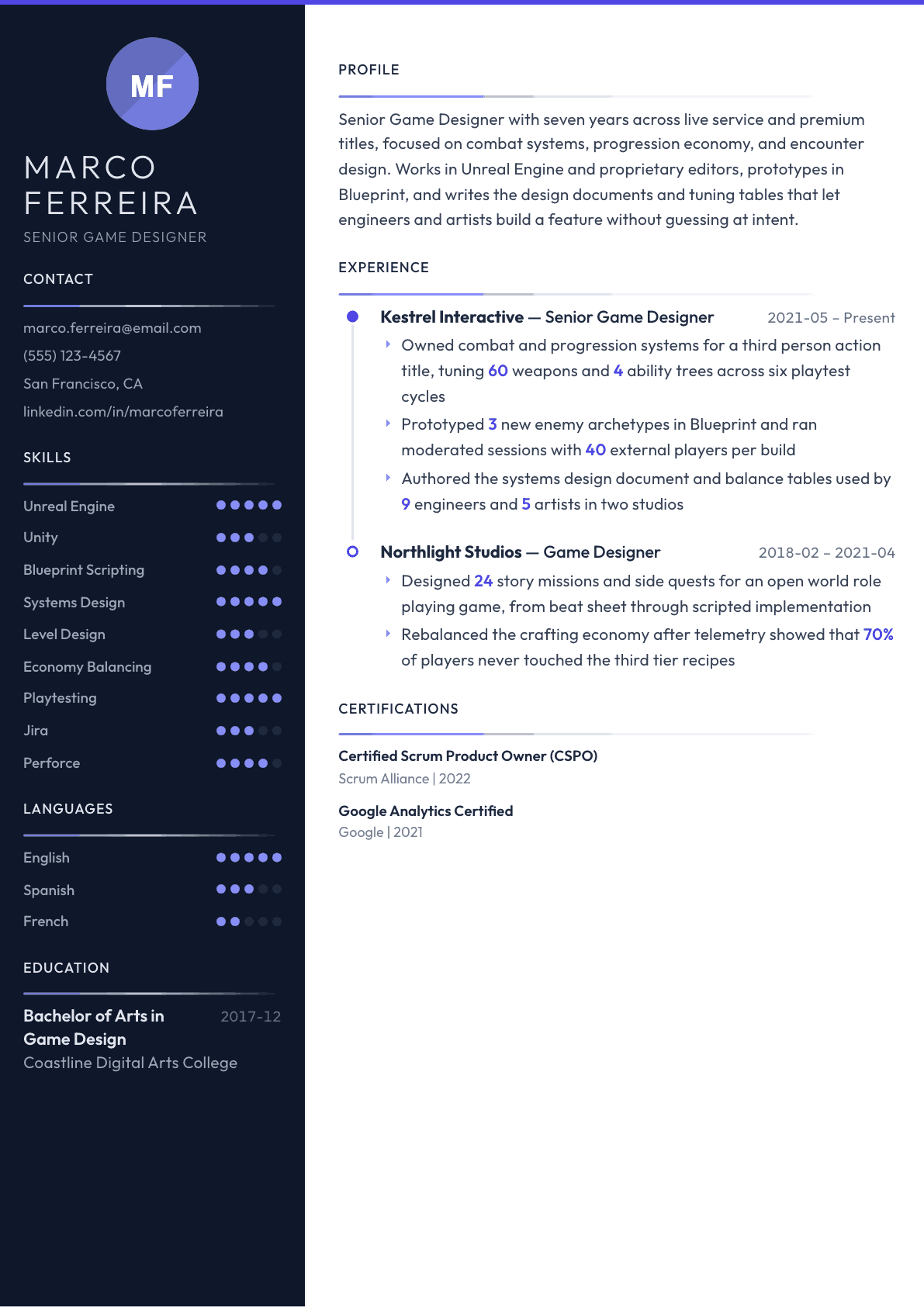
The same game designer content laid out in three CVBooster templates, so you can see what the finished document looks like before you write a word.
Example Game Designer summary
Game Designer with seven years across live service and premium action titles, specializing in combat systems and progression economies. Owned weapon and ability tuning through six playtest cycles, prototyped enemy behavior in Unreal Blueprint, and wrote the systems documentation two studios built from. Comfortable reading telemetry, running moderated tests, and defending a design decision with evidence in a review.
Skills to list on a Game Designer resume
- Systems Design
- Level Design
- Encounter Design
- Economy Balancing
- Unreal Engine
- Unity
- Blueprint Scripting
- Design Documentation
- Rapid Prototyping
- Playtesting
- Telemetry Analysis
- Narrative Design
- Combat Design
- Jira
- Perforce
- Player Experience Design
What actually gets this resume read
- List every title with platform, genre, team size, and your discipline, because a credit without scope tells a design lead nothing.
- Separate systems design, level design, and narrative work, since studios open a requisition for one of them and screen accordingly.
- Put the portfolio link in the header and make each piece state exactly what you personally designed on that project.
- Name the engines and editors you worked in, proprietary tools included, and say whether you scripted your own prototypes.
- Show how telemetry or playtest feedback changed a system you owned, not simply that you attended the playtest sessions.
- Include unreleased and canceled projects with an honest status line, because studios understand that many builds never reach players.
How to write a game designer resume
A game designer resume is read fast and skeptically. The design lead scanning it has a stack of applicants who all list the same engines and all describe themselves as passionate about games. What she is hunting for is proof that you have owned a system through iteration: tuned it, tested it, watched it fail with real players, and fixed it without breaking the three features attached to it.
The discipline matters more than the title. Systems design, level design, encounter design, narrative design, and technical design are separate hiring tracks with separate portfolios, and a resume that blurs them reads as junior even when the experience is not. Studios open a requisition for one lane, and the screener sorts into that lane within seconds.
This guide covers how to lay out credits, what belongs in a portfolio versus the resume, three example summaries from student work to lead level, before and after bullets from real production, and the questions designers ask when a project they worked on was never released.
Format: one page, portfolio link in the header
Keep it to one page until you have five or more released titles under your name. The portfolio carries the evidence, so the resume exists to get someone to open it. Put the link in the header where it cannot be missed, and make sure the site loads on a phone, because leads triage applicants between meetings.
Avoid heavy art direction on the document itself. A designer resume dressed as a game key art frustrates a reader looking for credits, and studio applicant systems parse decorated layouts badly. Save the visual craft for the portfolio, where it is being assessed on purpose.
- Header: name, city, email, portfolio link, and a public repository link if you script your own prototypes.
- Order: summary, credits, design experience, tools, education, and a short line on unreleased work.
- State your discipline in the first line so the screener sorts you into the right pile immediately.
Credits: platform, genre, team size, and what you owned
A credit list without scope is decoration. Give each title the platform, the genre, the team size, and the specific systems or content you personally owned. Combat tuning on a sixty person action title and quest design on a twelve person independent role playing game are different jobs, and a lead cannot tell which one you did from a title alone.
When a title had a long tail, say what phase you joined in. Pre production, vertical slice, production, and live operations demand different skills, and a designer who has run a live game through seasonal content updates is being screened for something quite different from a designer who left at launch.
Experience: systems you tuned and how you knew they worked
Write bullets around ownership and iteration. Naming the number of weapons, abilities, enemy archetypes, missions, or economy tiers you tuned gives the reader a sense of surface area. Naming the number of playtest cycles gives them a sense of rigor. Together they say that you have done the unglamorous part of design.
Show the feedback loop. Moderated playtests, remote sessions, telemetry dashboards, and analytics queries are all evidence that you change designs because of what players actually did rather than what the team assumed. A bullet that ends with a rebalance driven by a specific observed behavior is worth three bullets describing features.
Include your documentation and your prototypes. Design leads care whether engineers and artists could build from your documents without a week of clarification meetings, and whether you can put a rough version in the engine yourself instead of waiting on someone else to test an idea.
Tools: engines, editors, and the scripting you actually do
List engines separately from data and documentation tools. Unreal Engine with Blueprint, Unity with C#, and proprietary editors all belong in the first group. Spreadsheets for balance tables, Jira or a similar tracker, Perforce or Git, and whatever wiki the studio used belong in the second.
Be honest about scripting depth. A designer who can build a working prototype in Blueprint saves a team weeks, and a designer who overstates that skill is discovered in the first sprint. If your scripting is limited to data driven configuration, say that instead, because plenty of teams want exactly that profile.
Unreleased and canceled projects
Most designers carry work that never reached players. Keep it, and mark the status plainly as unreleased, canceled in production, or covered by a non disclosure agreement. Studios understand attrition in this industry, and hiding two years of experience creates a gap that looks worse than the truth. Describe the systems and the scale without naming anything you are not permitted to name.
Game Designer resume summary examples
Graduate or first studio role
Game design graduate with two completed student projects and a six month internship on a mobile puzzle title. Designed 30 levels with a documented difficulty curve, built prototypes in Unity, and ran weekly playtests with 15 external testers. Looking for a junior level design position.
Four years in production
Game Designer with four years across two released titles, focused on quest and encounter design for open world role playing games. Designed 24 missions from beat sheet to scripted implementation, rebalanced the crafting economy after telemetry review, and works daily in Unreal Engine and Perforce.
Lead on a live title
Senior Game Designer leading combat and progression on a live service action title with 9 engineers and 5 artists building from the systems documentation. Owns weapon and ability tuning across six playtest cycles per season, and mentors two junior designers through documentation and review.
Work experience bullets: before and after
Before: Worked on combat design for an action game.
After: Owned combat and progression systems for a third person action title, tuning 60 weapons and 4 ability trees across six playtest cycles before launch.
Counts and iteration cycles turn a discipline label into a measurable scope of ownership.
Before: Created levels for the game.
After: Designed 24 story missions and side quests from beat sheet through blockout and scripted implementation, holding each to a 12 minute target session length.
Naming the pipeline stages and the design constraint proves you worked the whole level, not just a layout.
Before: Used player feedback to improve the game.
After: Rebalanced the crafting economy after telemetry showed 70% of players never used third tier recipes, moving key materials earlier and lifting recipe usage in the following build.
A specific observed behavior and the design response show a real feedback loop instead of a claim about listening.
Before: Wrote design documents for the team.
After: Authored the systems design document and balance tables that 9 engineers and 5 artists across two studios built from, cutting clarification requests to a single weekly review.
The audience size and the reduction in back and forth show that the documentation actually worked.
Before: Made prototypes for new features.
After: Prototyped 3 enemy archetypes in Unreal Blueprint and ran moderated sessions with 40 external players per build, cutting two of the three before they reached the engineering backlog.
Killing your own prototypes early is the exact judgment a design lead is screening for.
Hard skills
- Systems design and balancing
- Level and encounter design
- Game economy design
- Unreal Engine and Blueprint
- Unity and C# scripting
- Design documentation
- Rapid prototyping
- Playtest facilitation
- Telemetry and analytics review
- Narrative and quest design
- Perforce and version control
- Jira and production tracking
Soft skills
- Giving and taking design critique
- Cross discipline communication
- Iteration under a deadline
- Mentoring junior designers
- Player empathy
- Defending a decision with evidence
Mistakes that cost game designer candidates the interview
- Listing titles without platform, genre, team size, or your discipline, which leaves a lead unable to judge the credit.
- Designing the resume like a game poster, which slows a screener down and confuses studio applicant tracking systems.
- Claiming shared team achievements as personal ownership, since references at studios are small world and get checked.
- Hiding canceled projects, which creates an unexplained gap that reads worse than an honest unreleased status line.
- Overstating engine scripting ability, which is exposed within the first two weeks of a production sprint.
- Writing about passion for games instead of the systems you tuned, which every applicant in the stack has already claimed.
Game Designer resume questions
Do I need released titles to get a game design job?
No, but you need finished work someone can play. A complete small game, a well documented mod, or a polished level built in a public engine gives a lead something to evaluate, which an unfinished ambitious project never does.
What should a game design portfolio contain?
Three to five pieces, each with a short write up covering the design goal, what you personally built, how you tested it, and what you changed afterward. Playable builds or video walkthroughs beat static documents, and the write up matters as much as the artifact.
How do I list a project that is under a non disclosure agreement?
Give the genre, platform, team size, and your discipline without naming the title or the studio client. Describe the systems in generic terms. Every studio hires people carrying confidential work and no lead will penalize a clearly marked entry.
Should a game designer resume include coding skills?
List scripting at the depth you truly have it, separating engine visual scripting from written code. Being able to prototype without engineering support is a genuine advantage, and being precise about the boundary protects you during a technical interview.
How do I move from quality assurance into game design?
Use the access you already have. Volunteer for balance feedback, write structured design proposals for issues you find, and build a portfolio piece outside work. Internal moves from testing into design are common when there is documented design thinking to point at.
Related resume examples
- Game Developer Resume example
- Game Artist Resume example
- UX Designer Resume example
- Product Designer Resume example
- Web Designer Resume example
- UX Engineer Resume example