Event Marketing Manager Resume Examples: free ATS score
Build an Event Marketing Manager Resume That Proves Pipeline
By Mustafa Tarabya, founder of CVBooster · Published · Updated
An event marketing manager resume built on attendance, budget and pipeline sourced, with a sample resume, keyword list and a detailed writing guide.
Sample resumes for a event marketing manager
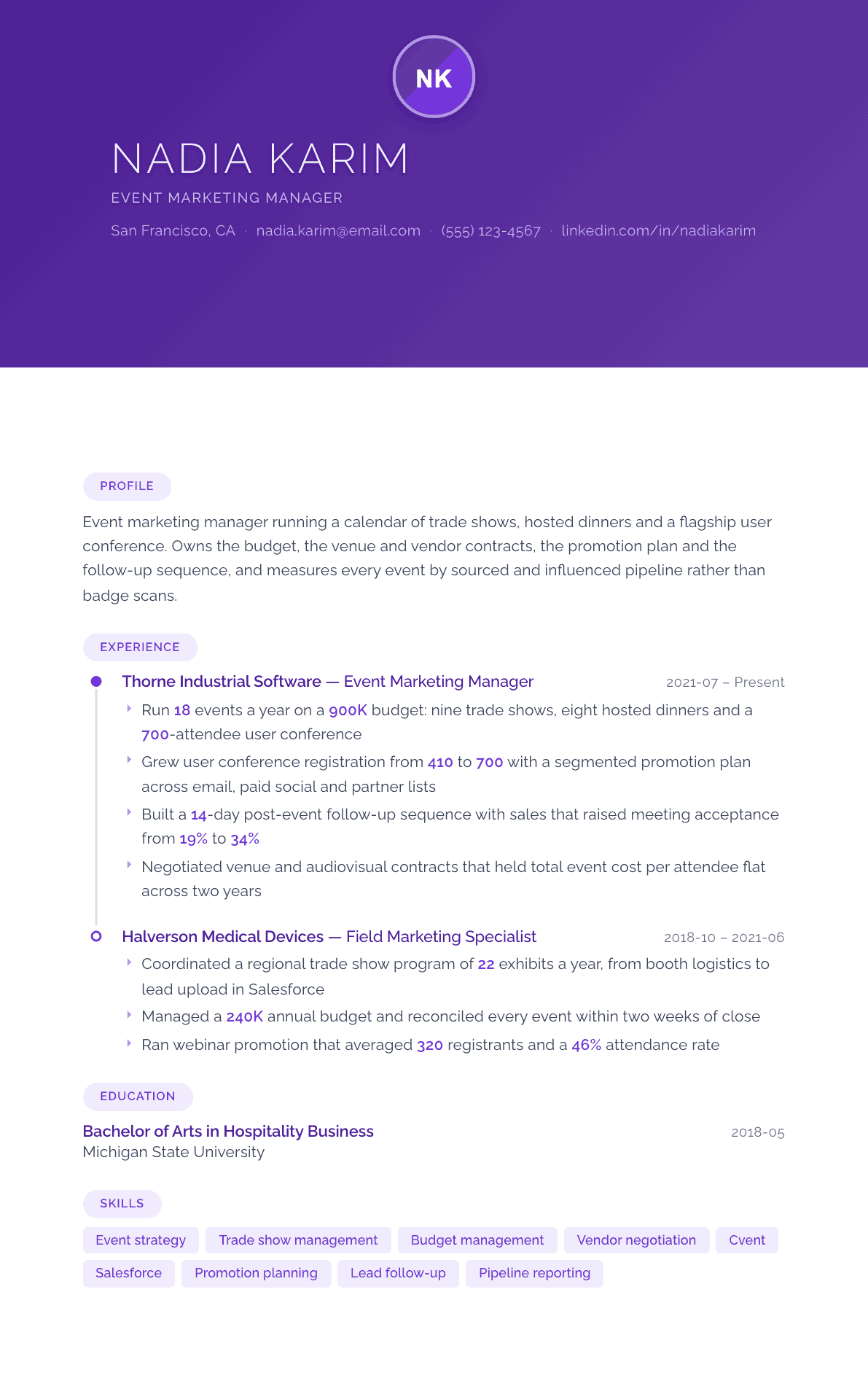
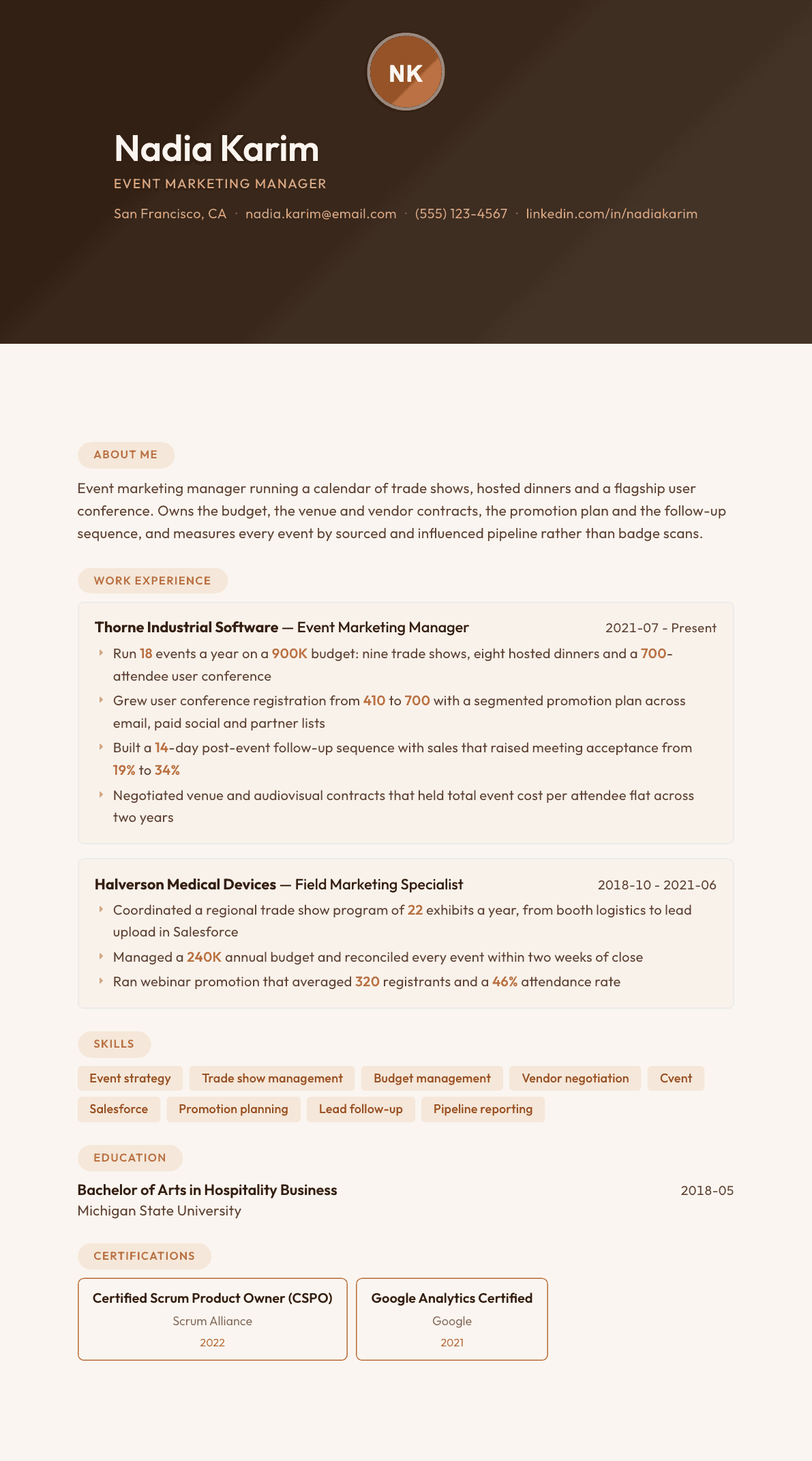
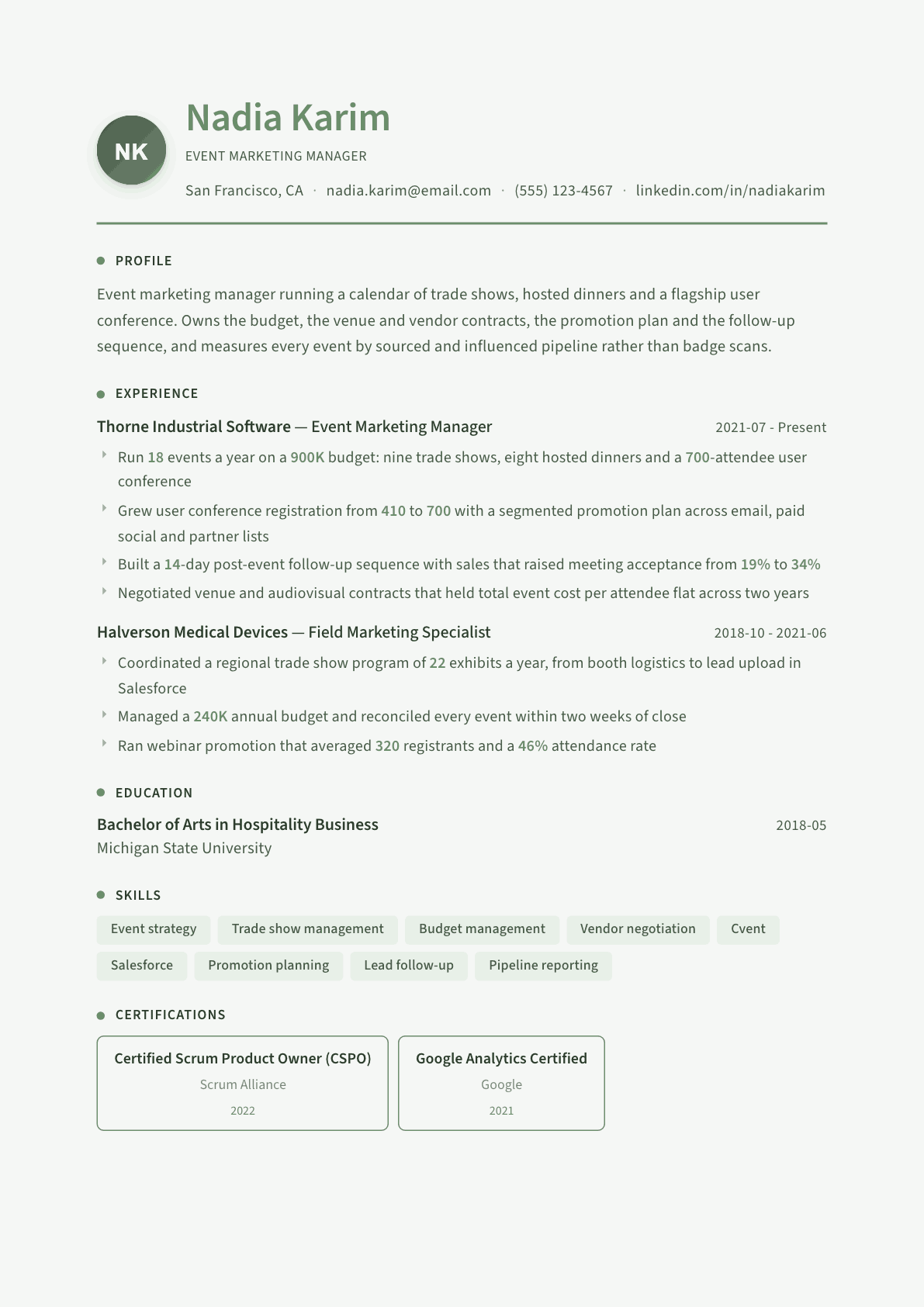
The same event marketing manager content laid out in three CVBooster templates, so you can see what the finished document looks like before you write a word.
Example Event Marketing Manager summary
Event marketing manager with seven years running trade show programs, hosted dinners and an owned user conference. Currently delivers 18 events a year on a 900K budget, and grew flagship conference registration from 410 to 700 attendees. Built the post-event follow-up program with sales that took meeting acceptance from 19% to 34%, and negotiates venue and audiovisual contracts that keep cost per attendee flat.
Skills to list on a Event Marketing Manager resume
- Event strategy
- Trade show management
- Conference production
- Budget management
- Vendor negotiation
- Cvent
- Splash
- Salesforce
- Marketo
- Promotion planning
- Sponsorship management
- Lead capture and follow-up
- Pipeline attribution
- Onsite logistics
What actually gets this resume read
- Report events by pipeline sourced and influenced, since attendance alone no longer justifies an event budget.
- State the budget you owned and the number of events you ran a year, because that pair defines the scope of the role.
- Separate the formats you have delivered: trade shows, hosted dinners, webinars, roadshows and owned conferences.
- Name your event technology stack, from registration platforms to the CRM where leads are uploaded and scored.
- Show the follow-up program you built with sales, as that is where events actually turn into meetings.
- Include vendor and contract negotiation, since venue, audiovisual and catering terms are a real part of the job.
How to write a event marketing manager resume
Event marketing sits between two disciplines and the resume has to satisfy both. A marketing director wants to see pipeline: how much sourced and influenced revenue came out of the calendar you ran. An operations-minded reader wants to see that you can run a build, hold a budget, sign a venue contract and get a booth open on time in a city you have never visited.
Most event marketing resumes only do the second half. They read as logistics records: booths coordinated, badges printed, vendors managed. That work is genuinely hard and completely necessary, and on its own it gets you screened as a coordinator rather than a manager. The line that changes the reading is a pipeline number attached to an event program.
This guide covers how to structure the page, how to report event results without overclaiming, the formats worth separating, three summaries by level, before and after bullets, and the questions event marketers ask when they move between company sizes.
Format: portfolio scope in the header, one page under six years
Put your program scope directly under your name: the number of events a year, the annual budget, and the largest event by attendance. "18 events a year, 900K budget, 700-attendee owned conference" tells a hiring manager your level in one line, and it is the line most candidates leave out.
Reverse chronological after that. Keep a compact single column, because event resumes tend to accumulate long lists and a two-column layout makes them harder to read, not easier.
- Header: name, title, city, contact details, and your willingness to travel with an approximate share of the year.
- Section order: summary, program scope, experience, event technology, skills, certifications, education.
- Add a short list of flagship events you have delivered if the names would be recognized in your industry.
Report pipeline, and be precise about sourced versus influenced
The metric that matters is what happened after the event. Sourced pipeline means opportunities created from contacts first captured at your event. Influenced pipeline means open opportunities where an attendee touched the event during the cycle. They are very different numbers and conflating them is the quickest way to lose credibility with a demand generation leader.
Where you cannot access pipeline data, report the next best measurable outcome and name it honestly: qualified meetings booked, demo requests, meeting acceptance rate from post-event follow-up, or attendee to opportunity conversion. Say which system the number came from, whether Salesforce campaign influence, a HubSpot report or a manual reconciliation with sales.
Cost per attendee and cost per meeting are the two efficiency figures event leaders track, and almost nobody puts them on a resume. Holding cost per attendee flat while an event grows is a strong, checkable claim.
Separate the formats, because they are different jobs
A trade show exhibit, a hosted executive dinner for twelve, a regional roadshow, a webinar series and an owned user conference demand different skills. Exhibits are logistics and lead capture at volume. Dinners are guest list curation and sales alignment. An owned conference is production, content programming, sponsorship and registration marketing all at once.
List what you have delivered by format with a volume for each, then describe the hardest one in detail. Owned conference experience is the strongest single credential in this discipline, so if you have it, give it several bullets covering registration growth, content programming, sponsorship revenue and onsite production.
- Trade shows: booth size, exhibit budget, staffing model and lead volume per show.
- Hosted dinners and roundtables: guest count, target seniority, and the sales follow-up model.
- Owned conferences: attendance, session count, sponsorship secured and registration channel mix.
- Webinars: registration numbers, attendance rate and the promotion channels used.
Show the promotion plan and the follow-up program
Registration does not happen by itself, and this is where event marketers prove they are marketers. Describe the promotion plan: segmented email, paid social, partner and sponsor lists, sales outreach sequences, a speaker amplification kit and the registration page itself. Give the conversion from invitation to registration if you have it.
Follow-up is where events either produce pipeline or evaporate. Describe the sequence you built with sales: how fast leads were uploaded and scored, who owned the outreach, what the cadence was, and the meeting acceptance rate it produced. A follow-up program with a measured acceptance rate is one of the strongest bullets available in this role.
Contracts, budget and the technology stack
Negotiation is a real part of the job. Venue contracts, room blocks, attrition and cancellation clauses, audiovisual quotes, catering minimums and sponsorship agreements all carry money and risk. Say what you negotiated and what it protected, especially any clause that saved the business when plans changed.
Then name the stack. Registration and event platforms such as Cvent, Splash, Bizzabo or Hopin. The customer relationship management and automation systems where leads land, such as Salesforce, Marketo or HubSpot. Badge scanning and lead capture apps. Project tracking in Asana or Smartsheet. Postings search on these names, and so do recruiters.
Event Marketing Manager resume summary examples
Field marketing specialist
Field marketing specialist coordinating a regional trade show program of 22 exhibits a year on a 240K budget. Handles booth logistics, staffing, badge scanning and lead upload into Salesforce, reconciles every event within two weeks of close, and runs webinar promotion averaging 320 registrants.
Owning the event calendar
Event marketing manager running 18 events a year on a 900K budget: nine trade shows, eight hosted dinners and a 700-attendee user conference. Grew conference registration from 410 to 700 with a segmented promotion plan, and built the post-event follow-up that lifted meeting acceptance from 19% to 34%.
Head of events
Events lead with eleven years in business software, managing a team of four and a global calendar across three regions. Rebuilt the event portfolio around sourced pipeline targets, retired six low-return shows, and took the flagship conference to sponsorship revenue covering a third of its cost.
Work experience bullets: before and after
Before: Managed the company trade show and event calendar.
After: Ran an 18-event annual calendar on a 900K budget: nine trade shows, eight hosted executive dinners and a 700-attendee owned user conference.
Event count, budget and format breakdown let a hiring manager place the role against their own program in seconds.
Before: Increased attendance at the annual user conference.
After: Grew user conference registration from 410 to 700 through a segmented promotion plan across email, paid social, partner lists and sales outreach.
Absolute before and after numbers plus the channel mix show marketing work rather than a lucky year.
Before: Worked with sales on following up event leads.
After: Built a 14-day post-event follow-up sequence with sales, with leads scored and assigned within 24 hours, raising meeting acceptance from 19% to 34%.
The cadence, the handoff speed and a measured acceptance rate connect the event to pipeline credibly.
Before: Negotiated with venues and suppliers to control costs.
After: Negotiated venue, audiovisual and catering contracts including attrition and cancellation clauses, holding total cost per attendee flat across two conference cycles.
Naming the clauses and the efficiency metric shows commercial control rather than general cost awareness.
Before: Responsible for event reporting and results.
After: Reported sourced and influenced pipeline separately from Salesforce campaign records, and retired two shows that produced no sourced opportunities in two consecutive years.
The distinction between sourced and influenced, plus a decision to cut, marks a manager rather than a coordinator.
Hard skills
- Event strategy and portfolio planning
- Trade show and exhibit management
- Owned conference production
- Budget management and reconciliation
- Venue and vendor contract negotiation
- Cvent, Splash and Bizzabo
- Salesforce campaign reporting
- Marketo and HubSpot campaign setup
- Registration and promotion planning
- Sponsorship sales and fulfillment
- Lead capture and badge scanning
- Onsite production and run of show
Soft skills
- Calm decision making onsite
- Sales alignment and negotiation
- Executive stakeholder handling
- Attention to detail under deadline
- Vendor relationship management
- Clear briefing of event staff
Certifications worth listing
- Certified Meeting Professional (CMP) (Events Industry Council)
- Digital Event Strategist (DES) (Professional Convention Management Association)
- Cvent Event Management Certification (Cvent)
- Salesforce Certified Administrator (Salesforce)
Mistakes that cost event marketing manager candidates the interview
- Writing the resume as a logistics record, which gets a manager screened as a coordinator.
- Conflating sourced and influenced pipeline, which a demand generation leader will catch in the first interview.
- Leaving out the budget and the number of events a year, the two figures that define the role.
- Ignoring the promotion plan, so registration growth looks accidental rather than earned.
- Skipping the follow-up program, which is the only reason events produce meetings at all.
- Never mentioning contract terms, when attrition and cancellation clauses are a real part of the risk you carry.
- Listing every event by name instead of grouping by format with a volume and describing the hardest one properly.
Event Marketing Manager resume questions
How do I report event results if I cannot see pipeline data?
Report the deepest metric you can verify, such as qualified meetings booked or meeting acceptance rate from follow-up, and name the source. Saying that pipeline reporting sat with sales operations is honest and reads far better than a number you cannot defend.
What is the difference between event marketing and field marketing?
Field marketing owns a region and uses events as one tactic among several, including local campaigns and sales support. Event marketing owns the event portfolio across regions. Many job titles blur them, so read the responsibilities rather than the title.
Is the Certified Meeting Professional credential worth pursuing?
It carries weight for roles heavy in production and logistics, especially owned conferences and hospitality-side employers. For pipeline-focused business software roles, demonstrated attribution and sales alignment matter more, so weigh the credential against where you want to work.
How do I show onsite skill on a resume?
Describe scope and independence rather than adjectives: the build days you managed, the staff you briefed, the run of show you owned, and one incident you resolved such as a venue restriction or a failed audiovisual setup that could have delayed opening.
Should I include events that were canceled or moved online?
Yes, if you led the change. Converting a physical event to a virtual or hybrid format under time pressure demonstrates judgment and platform skill. Give the attendance you retained and what you renegotiated with the venue.