Demand Generation Manager Resume Examples: free score
Write a Demand Generation Manager Resume That Shows Pipeline
By Mustafa Tarabya, founder of CVBooster · Published · Updated
Demand generation manager resume example with pipeline and MQL bullets, the martech stack to list, ATS keywords, and a full writing guide.
Sample resumes for a demand generation manager
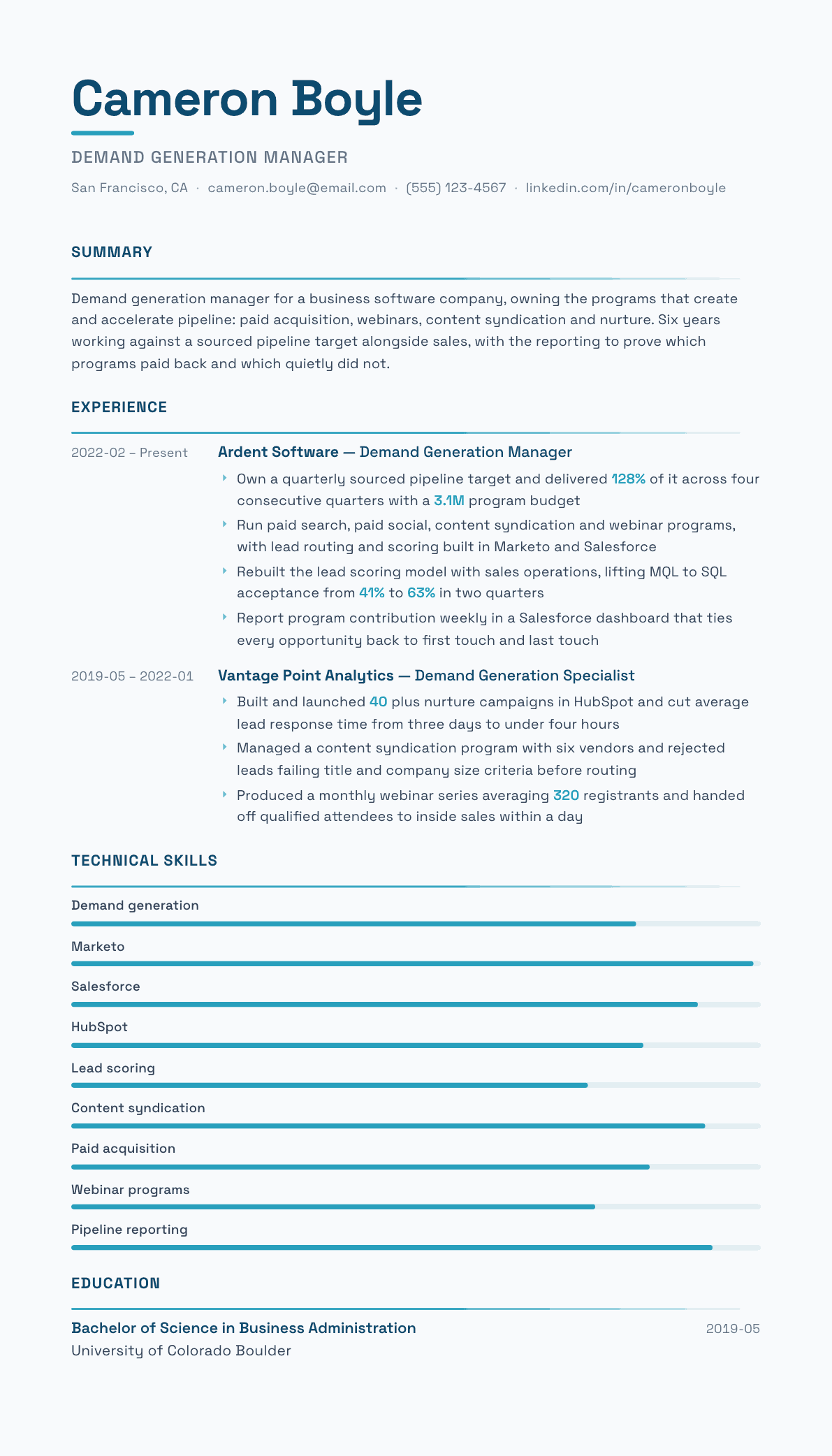
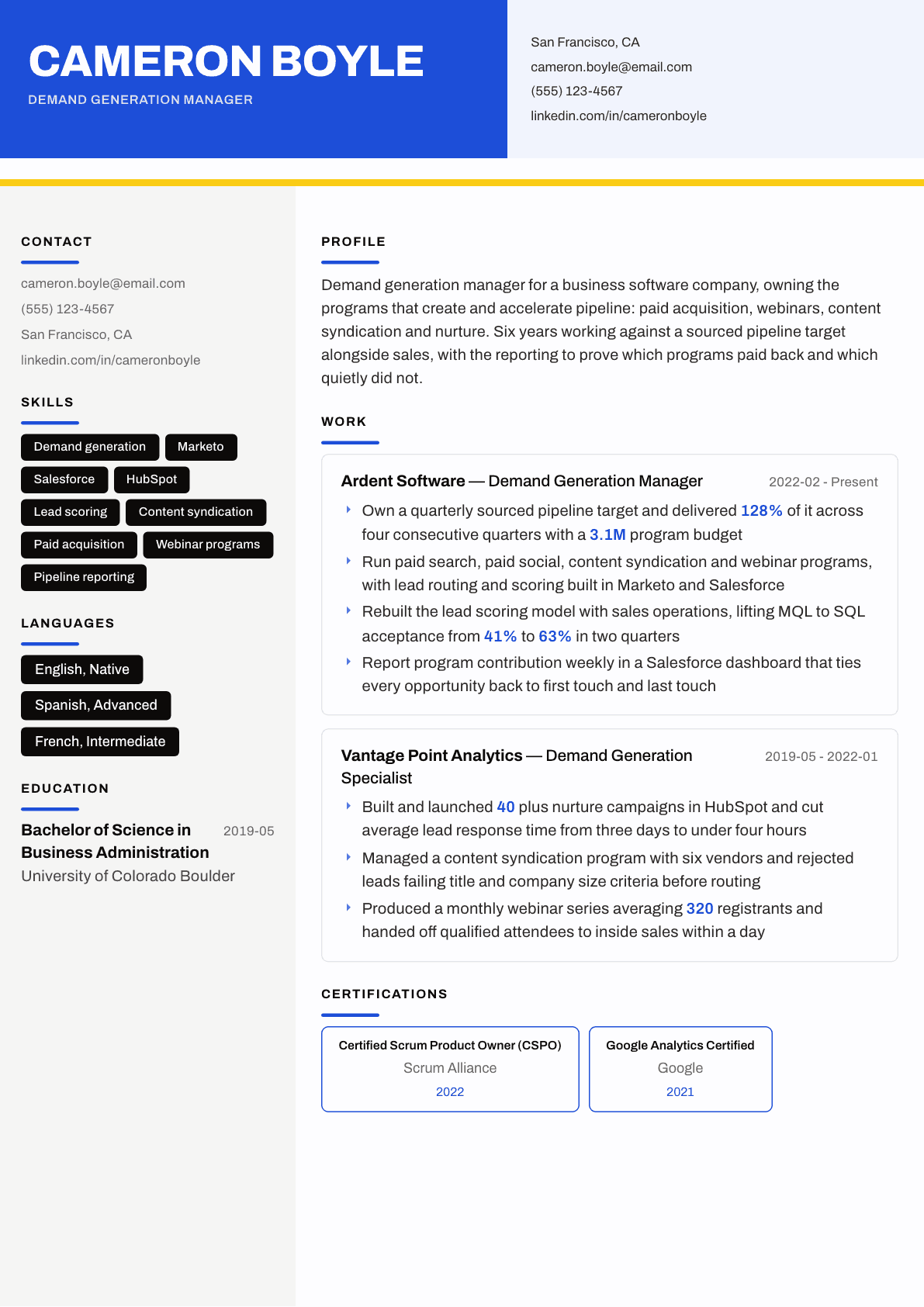
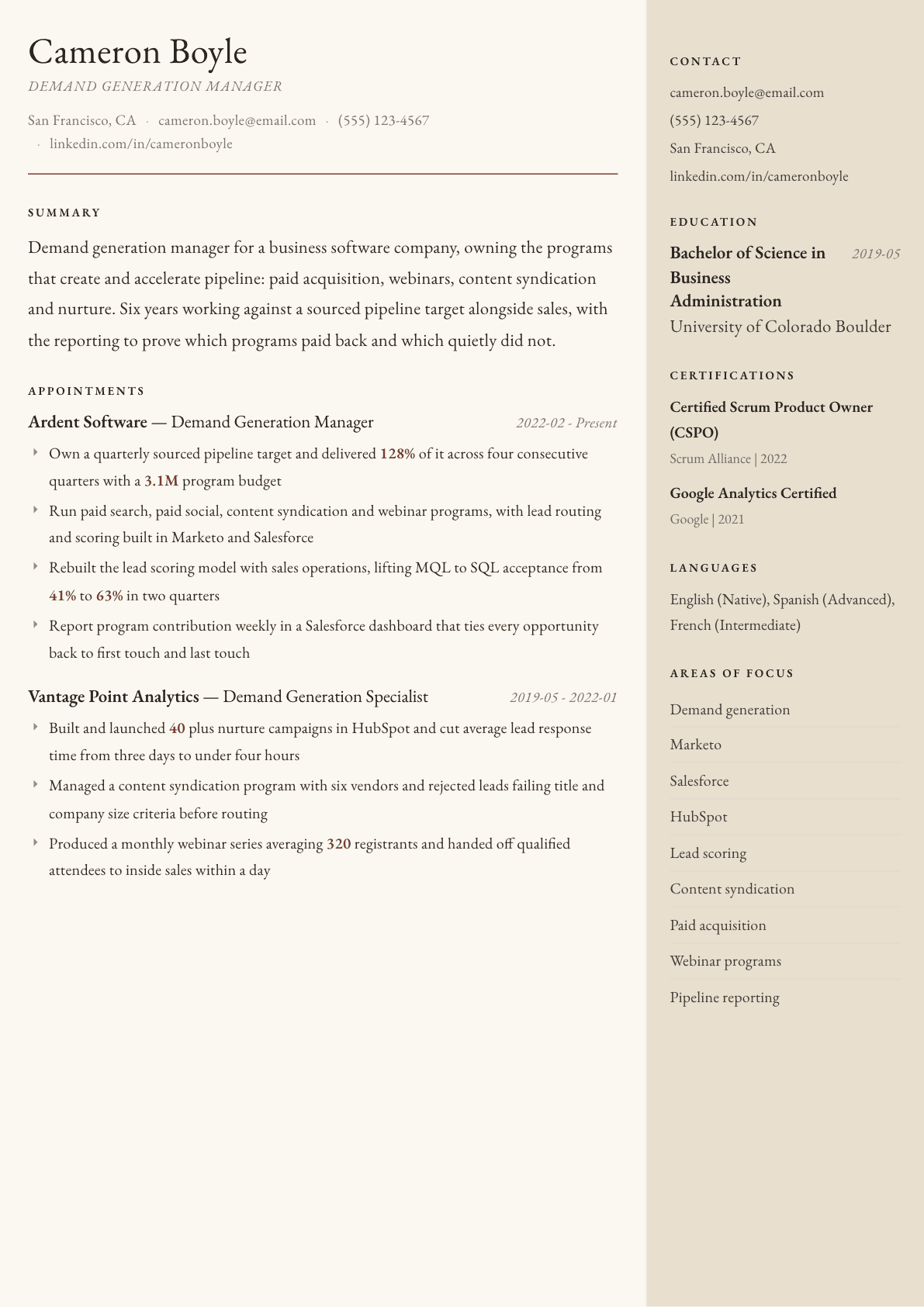
The same demand generation manager content laid out in three CVBooster templates, so you can see what the finished document looks like before you write a word.
Example Demand Generation Manager summary
Demand generation manager with six years owning a sourced pipeline target for business software, most recently delivering well above quota across four straight quarters on a three million program budget. Runs paid acquisition, content syndication, webinars and nurture in Marketo and Salesforce, and rebuilt a lead scoring model that raised the rate at which sales accepted qualified leads. Reports contribution every week, by program.
Skills to list on a Demand Generation Manager resume
- Demand generation
- Pipeline generation
- Marketo
- HubSpot
- Salesforce
- Lead scoring
- Lead routing
- Content syndication
- Paid search
- Paid social
- Webinar programs
- Nurture campaigns
- Attribution reporting
- Account based marketing
- Budget management
- Sales alignment
What actually gets this resume read
- Lead with sourced pipeline and attainment against target, because that is the only number a demand gen hiring panel checks first.
- Name your marketing automation platform and your customer relationship system together, since the pair defines your workflow.
- Show the lead handoff: scoring model, routing rules, response time, and the acceptance rate sales gave you back.
- Break your program budget out by channel so the reader sees where you place bets and how large those bets are.
- Describe a program you killed and why, because judgment about what to stop separates managers from coordinators.
- State whether you sell to small business, mid market or enterprise, since program mix changes completely between them.
How to write a demand generation manager resume
A demand generation manager is measured against a pipeline number, so the resume is read like a track record against quota. The vice president of marketing screening it wants three facts inside the first fifteen lines: the pipeline or revenue target you carried, how consistently you hit it, and the size of the program budget you spent doing so. Campaign lists without those three facts read as activity, not accountability.
The second reader is usually marketing operations, and that person is checking your stack. Marketing automation platform, customer relationship system, the lead scoring model, the routing rules, the attribution setup. Demand generation is a plumbing job as much as a creative one, and a candidate who cannot name her own plumbing raises doubts immediately.
This guide covers how to structure the resume around pipeline accountability, how to write program bullets that survive scrutiny from sales, what the stack section should contain, and the questions demand generation candidates ask when they are trying to move up a level.
Format: target, attainment and budget in the first block
Reverse chronological, one page until roughly ten years in. Put a scope line under each employer stating the pipeline or sourced revenue target you carried, the program budget, the segment you sold into, and the sales team you worked with. That line is the entire hiring case compressed into one sentence.
Follow it with bullets grouped by program area rather than by quarter. Paid acquisition, content syndication, events and webinars, nurture and lifecycle, and the operational layer. Grouping this way lets a reader confirm you have run the specific channel they need filled.
- Scope line: target carried, attainment, program budget, segment, sales team size.
- Group bullets by program area so channel gaps are easy to match.
- Put the stack block above education, since operations screens on it.
- Say business to business explicitly if that is your background.
Summary: pipeline first, stack second, judgment third
Open with the number. Sourced pipeline target, attainment against it, and the budget behind it. Then the automation and customer relationship platforms, then one sentence about judgment: a program you rebuilt, a channel you exited, a model you fixed with sales operations.
Name the segment you sell into. Programs that work for small business self serve motions rarely survive contact with an enterprise buying committee, and hiring managers know it. Being explicit costs you the wrong interviews and wins you the right ones.
Experience: programs, handoff quality, and what you stopped
Program bullets need a budget, a mechanism and a result that ties to pipeline. A webinar series bullet that reports registrant counts stops halfway. The same bullet that reports registrants, the qualification rule applied, how fast attendees reached inside sales and the opportunities created reads like someone who has sat in a revenue meeting.
Handoff quality is the most underused evidence in this field. Lead scoring model, routing rules, response time, and above all the acceptance rate sales gave back. A demand generation manager who can show acceptance rate rising has proof of a working relationship with sales, which is the hardest part of the job and the least often documented.
Include one program you killed. Naming a channel you exited, with the payback logic behind the decision, signals a manager who allocates rather than a coordinator who executes. Very few candidates write this down, and it lands every time with a leader who has budget pressure.
- Attach a budget figure to each program area you owned.
- Report qualified lead volume with the acceptance rate sales returned.
- Give a response time or routing improvement in hours or days.
- Name one program you ended and the reasoning that ended it.
The stack: automation, CRM, attribution and data
List the marketing automation platform and the customer relationship system as a pair, because how they are wired together is your actual working environment. Marketo with Salesforce, HubSpot end to end, and Pardot with Salesforce all imply different daily work.
Then add the layers around them: the attribution or reporting model you used, the intent or account data providers, the enrichment tool, the webinar platform, and any account based marketing platform. Say what you built yourself versus what operations built for you, because an honest split reads better in an interview than a padded list.
Keywords that clear the filter
Demand generation postings repeat a narrow vocabulary: demand generation, pipeline, sourced pipeline, marketing qualified lead, sales accepted lead, lead scoring, lead routing, nurture, content syndication, account based marketing, attribution, Marketo, HubSpot, Salesforce, paid search, paid social. Place each where it carries a fact rather than clustering them in a skills block, since the sales leader who reads next is checking for evidence.
Demand Generation Manager resume summary examples
Demand generation specialist
Demand generation specialist who has built and launched more than forty nurture campaigns in HubSpot and cut average lead response time from three days to under four hours. Runs a monthly webinar series averaging 320 registrants and manages content syndication vendors against title and company size criteria.
Six years in
Demand generation manager carrying a quarterly sourced pipeline target for business software, delivering 128% of it across four consecutive quarters on a 3.1M program budget. Runs paid acquisition, syndication, webinars and nurture in Marketo and Salesforce, and rebuilt the lead scoring model with sales operations.
Director of demand generation
Director of demand generation leading a five-person team and a 12M program budget across enterprise and mid market segments. Owns the pipeline forecast presented in the weekly revenue meeting, runs an account based program with sales leadership, and consolidated four reporting sources into one agreed funnel model.
Work experience bullets: before and after
Before: Managed demand generation campaigns to drive leads.
After: Carried a quarterly sourced pipeline target and delivered 128% of it across four consecutive quarters on a 3.1M annual program budget.
Target, attainment and budget convert a generic ownership claim into a quota record a leader can trust.
Before: Improved lead quality working with the sales team.
After: Rebuilt the lead scoring model with sales operations using firmographic and engagement thresholds, lifting qualified lead acceptance from 41% to 63% in two quarters.
The mechanism and the acceptance rate movement prove the sales relationship worked rather than merely existed.
Before: Ran webinars and nurture campaigns.
After: Produced a monthly webinar series averaging 320 registrants, applied a title and company size qualification rule, and routed accepted attendees to inside sales within one business day.
Adding the qualification rule and the handoff speed shows the program was built for pipeline, not attendance.
Before: Reported on marketing performance to leadership.
After: Built a Salesforce dashboard tying every opportunity to first and last touch program, and presented program contribution weekly in the revenue meeting.
Naming the model and the forum shows your reporting was used for decisions rather than filed.
Before: Optimized the marketing budget across channels.
After: Ended a display retargeting program after two quarters of payback beyond twelve months and moved the budget into content syndication, which produced opportunities at half the cost.
A stop decision with the payback reasoning behind it demonstrates allocation judgment rather than execution.
Hard skills
- Demand generation strategy
- Pipeline forecasting
- Marketo
- HubSpot
- Salesforce
- Lead scoring and routing
- Content syndication
- Paid search and paid social
- Webinar programs
- Nurture and lifecycle campaigns
- Attribution reporting
- Account based marketing
- Program budget management
- Landing page and form optimization
Soft skills
- Sales partnership
- Budget discipline
- Forecast honesty
- Cross-functional negotiation
- Prioritization under a target
- Executive communication
Certifications worth listing
- Marketo Certified Expert (Adobe)
- Salesforce Certified Marketing Cloud Email Specialist (Salesforce)
- HubSpot Marketing Software Certification (HubSpot Academy)
- Google Ads Search Certification (Google)
Mistakes that cost demand generation manager candidates the interview
- Listing campaigns without ever naming the pipeline target they were meant to feed.
- Reporting lead volume alone, which sales leaders discount unless acceptance rate appears beside it.
- Omitting the program budget, so the reader cannot tell whether you allocated thousands or millions.
- Naming an automation platform without the customer relationship system it was wired into.
- Claiming attribution work without describing the model or who agreed to it.
- Presenting every program as a success, which reads as unwillingness to admit a channel underperformed.
Demand Generation Manager resume questions
What number should a demand generation manager lead with?
Sourced pipeline against target, expressed as attainment. Revenue influenced is weaker because it is easy to inflate, and lead counts are weaker still. If your company never set you a formal target, state the pipeline your programs produced and the budget you spent producing it.
How do I write this resume if marketing operations owned the automation platform?
Be precise about the division of labor. Say which campaigns you built yourself, which requests you specified for operations, and what you can administer independently. Hiring managers respect an accurate account far more than a stack list you cannot defend in a technical conversation.
Does account based marketing experience matter for demand generation roles?
Increasingly yes for enterprise segments. Name the platform, the target account list size, how the list was chosen with sales, and what the program produced. Without those details the phrase reads as a buzzword rather than a program you actually operated.
How do I handle a quarter where I missed the pipeline target?
Do not hide it, but do not itemize every quarter either. Report attainment across a period, and be ready to explain a miss in the interview with the cause and the correction. Candidates who can dissect a shortfall usually interview better than candidates who claim they never had one.
Should a demand generation resume include creative or content work?
Only where it changed a result. A landing page rewrite that lifted form completion or an offer redesign that improved qualification belongs on the page. General content production belongs on a content marketing resume, and including it dilutes the pipeline story hiring managers are scanning for.